
Lea Wait's Blog, page 82
August 24, 2022
You Can’t Hurry Love . . or Anything Else Good
OK, short and sweet today, as it is my birthday.  All greetings gratefully accepted, and in the immortal words of Eubie Blake: “If I’d known how long I was going to live, I would have taken better care of myself.”
First: the news. There will be an in-person launch event for The Last Altruist at Longfellow Books in Portland on September 21 at 6:30 PM. 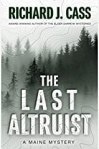 Longfellow Books has been a long time supporter of the Elder Darrow books and I hope you’ll find a way to give them some of your book business. We are blessed in this city to have so many options. If you’re unable to attend the launch, you can pre-order signed and/or inscribed copies from Kelly’s Books to Go. Enough with the commercials. Let’s talk about speed.
No, not that kind. Pace.
I recently started into the fourth draft of a new novel, knowing I still had a great deal of work to do in terms of character depth and smoothing out the plot.
Knowing what a slow writer I am, I wondered if I couldn’t speed up my process a little by doubling the number of pages I worked with in my daily session and thereby halve the time I spent on this draft. As you might predict, I tried this for three days and discovered I was so intent on getting the pages “done” that I wasn’t paying anywhere near enough attention to the quality of what I was doing. So I relapsed.
Those of you who know my good wife will recognize her as a highly energetic type who thrives on getting things done. (When Anne and I had marital counseling before the event, the minister accused me of “plowing a slow straight furrow.” It was New Hampshire.)
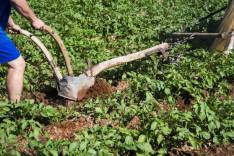
One of the enduring push-pulls in our marriage has been between my slow straight furrow and her reflexive drive for action. We must have figured something out, because we’ve made the partnership last this long, but I was thinking on my long (slow) walk this morning about all the things that cannot be improved by speed.
Portland is a harbor for fine chefs and fine meals. With the pandemic waning somewhat, we’ve gotten out more than we had been. Any meal we’ve had in one of our fine restaurants has not been something to gulp and chew.
Reading is another of my deepest pleasures and though sometimes I find myself impatient with a writer and try to get ahead, my best reading experiences are when I slow myself down enough to savor the good words and taste the ideas fully.
You will have your own list of activities that profit from a slow hand: breadmaking, gardening, cooking, flyfishing. Shelling peas, hulling strawberries. I know Diana Ross knows “You Can’t Hurry Love.”
What hurts us sometimes is the feeling that the pressure is always on, that it is better to get something done quickly (and possibly half-assed) than to render it slowly and carefully. It’s not out of the question to posit, though, that the path to joy is through slowness. As always, however, your mileage (and speedometer) may vary.


August 22, 2022
My First: Nothing Racy. But It is Crafty.
Here’s my first. (Thanks Brenda.)
I’m delighted to welcome Sandra Neily back to Maine Crime Writers today for her thoughts on the craft of writing. A native of East Boothbay, Sandy’s novel Deadly Trespass has won a National Mystery Writers of America award and was a national finalist in the Women’s Fiction Writers Association’s “Rising Star” contest.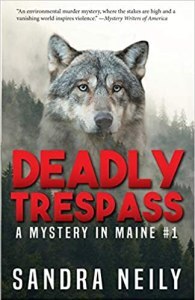
The Maine outdoors is Sandy’s element, and her deep commitment to conservation of the woods and its creatures shines through in her work. If you enjoy crime fiction where the immensity of the natural world is a character, you’ll like Deadly Trespass. Sandy’s lively prose and the intriguing plot will keep you turning pages late into the night.
She now divides her time between Westport Island and Greenville, or as she puts it, between the Sheepscot River and “Antler Camp” on Moosehead Lake.
Today her topic is the craft of writing. Take it away, Sandy
CRAFT & CRAFT-Y
I burst into tears when I first held my fingers over the keys to write fiction. I paced around, knowing I needed help. Lots of help. I stemmed the tears by turning the names of five friends into a mantra, sure that if they were in my living room, they would be cheering me on. Then I taped paper up on my camp wall, and scrawled “CRAFT. BE CRAFT-Y” at the top.
This ever-growing advice list, collected from webinars, seminars, workshops, friends, author mentors, articles, books, and the writing cosmos, is my compass and bible. It goes everywhere I go. (Looking pretty ragged now: squashed bugs, grease smears, and something that looks like squash, but I don’t really want to know.)
I like the word crafty because it’s an adjective we can put in front of our names telling us we are sly, creative, skilled, calculating, and potentially proficient. And that we are people who assemble something out of raw materials. Like artists who work in clay, metal, or paint, we shape something raw into a novel way of seeing the same old world. We are builders of stories. Assemblers of unique worlds. Creators of unforgettable characters. Sly typists who bury clues, calculating how we can hang readers out there until we skillfully reveal the unexpected.
So in no particular order, here are some craft and craft-y items from my wall with the kind of internal commentary they trigger for me.
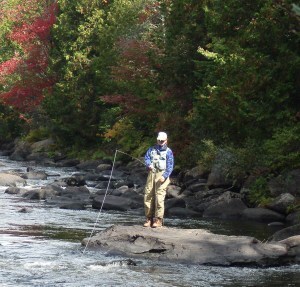
Sandy, fly fishing.
Authentic Self: Go deep and use it. I memorized this from the craft master, Donald Maass, author of Writing 21st Century Fiction, a must-have: “To write 21st century fiction, you must start by becoming highly personal . . . You must become your most authentic self.”
After a few boring drafts I saw that Maass meant, go deep. Very deep. Undress. Use your own life and its truths to pump real life and emotion into the story. So I offered up the frustration of having to wrench a wedding ring off an aging arthritic finger, the deep sadness from touching the soft nose of a dead moose, and the anger of losing wild places to greed.
What’s at Stake? Failure Must Have Huge Consequences: A “high concept” novel is one where, if the protagonist fails, there are significant consequences that ripple out to touch more people or impact the larger world.
Huge is relative but still huge. It might be the demise of the family clambake business and loss of their livelihood, as in Barbara Ross’s Clambake mysteries. My protagonist saves a pack of wolves, hoping they’ve saved a forest. The threat of failure must always loom, threatening pain and loss.
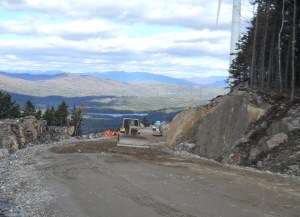
Out among the wind turbines
Want & Desire Drive Character & Characters: Each scene, everyone must want something, even just a class of water. To track each character’s various thirsts, large and small, I make a “gap” chart for what each wants and if I will give it to her or to him.
Create 5 Things Readers Expect; Disappoint Them on 2 or 3: Of course, the resolution should not disappoint, but expected story elements, once frustrated, contribute to the surprise of turning a corner (or page) and meeting the unexpected. This advice is from the amazing Elizabeth George. When I shared it at Crime Bake, even famous authors bent to take notes.
Imagine the Worst. Make It Happen: Go there. When Kate Flora forces us to watch someone cooked alive through the terror of her protagonist, Thea Kozak in Death Warmed Over, she has certainly imagined the worst for her readers.
“Don’t do it! Don’t do it!!” Goes with imagine-the-worst, but create at least one scene where readers want to scream this at your protagonist.
Sex That’s Not Sex: Sex is rarely about sex. Hallie Ephron had us listing reasons for sex: anger, fear, revenge, lust, reward, curiosity, farewells, boredom, gratitude. Pretty endless. She told us to match up two characters who had different reasons and write the scene. Boom! I think Elizabeth Strout’s Olive Kitteridge does this so very well.
Backstory: Most is not interesting. Here’s the whole Stephen King quote from On Writing: “The most important things to remember about back story are (a) everyone has a history and (b) most of it isn’t very interesting. Stick to the parts that are.”
4 Cups of Tea: Compress time with action that always moves plot or characterization forward. Cut slow stuff. Four cups of tea later, Helmand was dead on the floor. After a week of burnt toast, Anna stuffed clothes into a paper bag and hitched to Idaho.
Research: Maine author Paul Doiron reminds us to avoid too much book stuff. Go there if you can. I spent time with some dead moose and some live wolves. When researching Deadly Turn, my upcoming mystery, I hung out at wind power sites. The book’s narrator Patton is hired to collect dead birds. Who says it all has to be fun research?
Edward Abbey! Get up! Get out! Fill up! Yes, whole quote’s on my wall and fridge. From The Monkey Wrench Gang: “…: do not burn yourselves out. Be as I am – a reluctant enthusiast….a part-time crusader, a half-hearted fanatic. Save the other half of yourselves and your lives for pleasure and adventure. It is not enough to fight for the land; it is even more important to enjoy it. While you can. While it’s still here. So get out there and hunt and fish and mess around with your friends, ramble out yonder and explore the forests, climb the mountains, bag the peaks, run the rivers, breathe deep of that yet sweet and lucid air, sit quietly for a while and contemplate the precious stillness, the lovely, mysterious, and awesome space.”
Now You: There’s more on my wall, but it’s time for the writer and reader community to weigh in. Thank you!
Sandra Neily
Sandy’s debut novel, “Deadly Trespass, A Mystery in Maine” won a national Mystery Writers of America award, was a finalist in the Women’s Fiction Writers Association “Rising Star” contest, and was a finalist for a Maine Literary Award. The second Mystery in Maine, “Deadly Turn,” was published in 2021. Her third “Deadly Assault” is due out in 2023. Find her novels at all Shermans Books (Maine) and on Amazon. Find more info on Sandy’s website.
August 19, 2022
Weekend Update: August 20-21, 2022
 Next week at Maine Crime Writers there will be posts by Sandra Neily (Monday), Maureen Milliken (Tuesday), Dick Cass (Thursday), and Matt Cost (Friday).
In the news department, here’s what’s happening with some of us who blog regularly at Maine Crime Writers:
An invitation to readers of this blog: Do you have news relating to Maine, Crime, or Writing? We’d love to hear from you. Just comment below to share.
And a reminder: If your library, school, or organization is looking for a speaker, we are often available to talk about the writing process, research, where we get our ideas, and other mysteries of the business, along with the very popular “Making a Mystery” with audience participation, and “Casting Call: How We Staff Our Mysteries.” We also do programs on Zoom. Contact Kate Flora
Maine Writers Share Some Favorite Maine Summer Activities
From time to time, we like to get together in a group post. Sometimes it is writing tips or writing books, sometimes it is Maine food or how we celebrate holidays or the books we’re giving or want to get for Christmas. Today, we’re sharing some of our favorite Maine summer activities.
Kate Flora: I wish I had some photos from last week, when I took a wonderful trip down memory lane to my childhood on a Maine lake. The farm was perched on a hilltop in Union, with a long hill running down to the pond. One summer afternoons, that’s where we could be found, usually along with friends and neighbors who also liked to end their days with a swim. Last week, my friend Karin Rector (we’ve been friends for almost 70 years!) was renting a camp on Crawford Lake, so the two of us took inner tubes (the real kind that went inside vehicle tires) and paddled out into the lake, where we bobbed in the waves and talked for at least an hour. The water was perfect. The sky was blue with whipped cream mounds of clouds, and while we floated and reminisced, a family of loons swam past.
Maggie Robinson: Years ago, a friend and I took our kids blackberry picking down a long dirt road in the woods. In those days, I made jam and jelly and syrup, canned, froze, and generally tried to be as back-to-the-land-ish as a suburban New York girl could be who found herself in Lee, Maine with four little kids.
I mentioned that the bushes were pretty beaten down and broken, and Suzanne replied, “Oh, that’s just from the bears.” Needless to say, I speed-picked and have not really been back in those woods since.
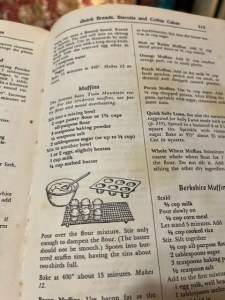
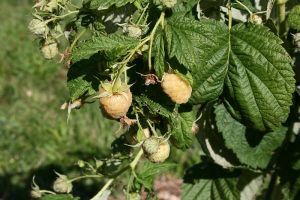
Now I don’t have to–I have blackberries in my backyard, along with three blueberry bushes. I still have to speed-pick to get ahead of the chipmunks and birds, but there’s nothing like fresh Maine berries in fresh muffins. Here’s the much-spattered basic muffin recipe from my ancient Fannie Farmer Cookbook. You can add whatever berry you like!
John Clark: Berries, berries, berries. Summer is rife with them, given adequate rain Exploring logging roads can offer wild strawberries, raspberries and later on, blueberries. Occasional handfuls of boxberries and even wild cranberries add to the ‘eat-as-you-go joy of finding new territory. My other guilty pleasure is finding images in puffy summer clouds. Beth and I saw a fire breathing serpent on our way back from picking blueberries this morning.
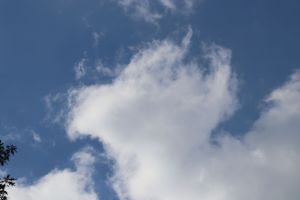
Featherhead dragon

Looking up at Heaven perhaps?
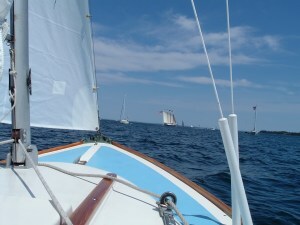
Susan Vaughan: When I was a teen in West Virginia, my favorite summer activity was swimming with my friends at the nearby lake. Many years later, I married a guy who grew up sailing. So when we moved to Maine, his priority was buying a sailboat. So for several years, we sailed our 19-foot sloop named Iris on Penobscot Bay. He taught me the basics of crewing for him. I’m still no sailor, but loved being out there, especially watching the Schooner Races.
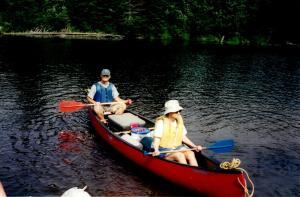
In 2001 we did a canoe and camping trip with a guide on the West Branch of the Penobscot River. If you read my 8/11/22 blog post, you’ve read more about that. I enjoyed the canoeing and seeing the wilderness around us, including a moose. I did not enjoy sleeping in a tent.
More years later, we own a camp on Crawford Pond. I love to see the loons that populate the lake, especially when they have chicks. This summer, there are two chicks. We have no sailboat, but tool around the lake in a motorboat named Scribbler (a nickname for a writer). Early in the mornings, we paddle to various spots in a canoe my husband built. Our dock is crowded with various other watercraft enjoyed by our friends and us. Like Kate, I love floating around on my inner tube, especially in this summer’s baking heat. Needless to say, I still enjoy summertime on and near the water.
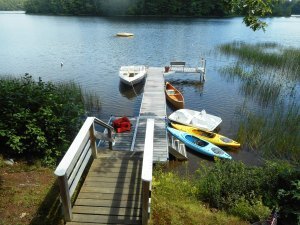
Matt Cost: Summer in Maine for me is about golf, outdoor music, beaches, and driving with the top of my Jeep. The availability of so much music is amazing to me. I recently did a book signing in Damariscotta. Afterward, I had a beer with my father and listened to music at Schooner Landing, drove back toward my home and stopped at the Bath Waterfront Park for some Bluegrass music, and contemplated going on down to LL Bean for their outdoor concert series.
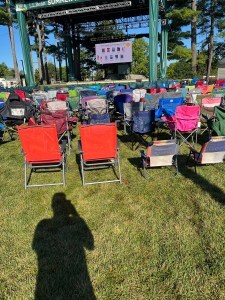
The LL Bean summer concert series (only four miles from my house) brings in some world class bands for free. You are allowed to drop chairs starting at 6:00 AM, so if desired, you can get front row seating for these concerts. On the fourth of July I did just that and enjoyed Pink Martini with China Forbes, an orchestra that travels the world playing a mix of jazz and pop. It was followed by a light show that replaced the old fireworks and was just amazing.

Another favorite summer venue is on the Brunswick Mall. Wednesday nights they bring in amazing local talent such as the Delta Knights, Pat Colwell and the Soul Sensations, and Bonnie Edwards and the Practical Cats.
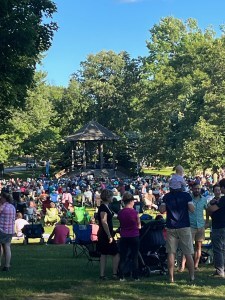
This is just a smattering of the offerings. Art walks, craft fairs, summer festivals, and so many more places are offering up, usually free, often fantastic, music all summer long.
August 18, 2022
The Writing is Off the Wall
 I have discovered the “closed caption” command now that I am losing my hearing and probably my mind. This is especially necessary for the British mystery shows I love to watch on my computer but cannot understand. You know, the whole two nations separated by a common language thing. However, I suspect most of the translating from sound to text is done by other computers, because some of what I’m reading on the screen is hilariously wrong.
Recently I watched Ten Percent, not a mystery but a fast-paced, glossy show about entertainment agents in London. It features lots of great guest stars and twisty plots, but on one episode there was discussion of going to Hampstead Heath, a famous park on the outskirts of the city. Unfortunately, the closed caption read “Hamster Teeth.” Sure, why not?
It got me thinking about misheard words or phrases or lyrics that make sense, but are oh so wrong. There’s even a word for this, mondegreen, coined by Sylvia Wright, who as a little girl misunderstood this poem.
Ye Highlands and ye Lowlands,
Oh, where hae ye been?
They hae slain the Earl o’ Moray,
And Lady Mondegreen.
There was no Lady Mondegreen, dead or alive. The actual words are “and laid him on the green.”
Song lyrics are habitually imagined to be something other than they are. Two fun examples:
Hold me closer, Tony Danza (tiny dancer)
Give me the Beach Boys and free my soul (Give me the beat, boys, and free my soul)
A close relative of the mondegreen is the Malaprop (from the play The Rivals) or Dogberry (from Much Ado About Nothing). Named for the verbally discombobulated characters in these plays, they are incorrect words substituted for words that sound similar. Dance a flamingo for dance a flamenco, ravaged for ravished, lathed for laved (the latter two a common mistake in some romances I’ve read, which have to be seriously uncomfortable and bloody).
When I was a little girl, I heard the term guerilla warfare and pictured a bunch of gorillas in the Cuban jungle that had somehow been trained to fight by Fidel Castro. I was confused but impressed. A sign in the deli around the corner from my house said “No beer sold to minors,” and I wondered where the mines (Gold? Silver? Coal?) were on suburban Long Island and why the poor thirsty miners were being discriminated against. Both my auditory comprehension and spelling were faulty at that tender age.
I find I have to read directions—I cannot listen to or watch someone and understand what I’m supposed to do. But if I have that written list of steps in front of me, there’s a chance I can complete the task without too many screws left over. It’s rather late in life to discover my learning style, but better late than never. And that is why closed captions are my new best friends, even if they make me laugh on occasion.
Do you have a favorite word mix-up? Please share!

For more about Maggie and her many words, please visit www.maggierobinson.net
August 16, 2022
Whimsical Maine Through a Writer’s Lens
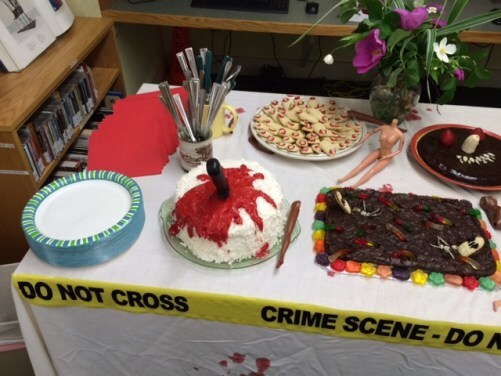
Kate Flora: In the world of talented photographers, I wouldn’t even try to compete. Their brilliance is everywhere, including on my walls. But as regular readers of this blog know, one piece of advice I routinely offer to aspiring writers is to observe. To be tuned in to the world that surrounds us–listening to the sounds, watching the people, smelling the scents, feeling the surfaces. Because we don’t always remember what we’ve collected through our senses, our cameras or our phones can help us remember. Snap that reflection. Subtly collect those crazy shoes or that amusing store window. The weirdly rough bark on that tree.
You can also use this technique to try and see the world through your character’s eyes. How do your fictional creations see the world differently from the way you see it? What does their background bring to the table?
A few years back, I realized that something that pleased me and lifted my spirits was whimsy, and I began to collect that in my photographs as well. I’m not often enough attuned–I think few of us are despite our best intentions–but I am trying. In today’s post, I share some of the odd, amusing, surprising, and “whatever you want to call it” photos from my perambulations.
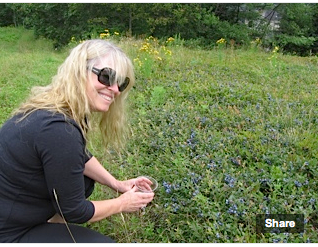
In my blueberry field, where I should be in August
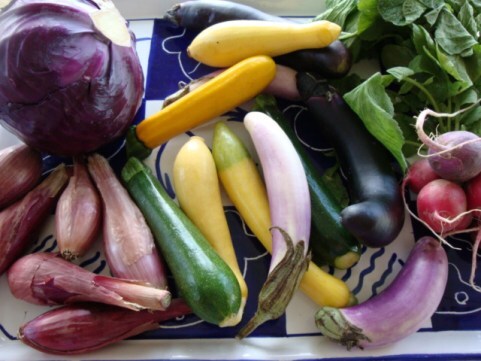
After the farmer’s market

Pothole in Camden, Maine shaped like the state of Maine. Is there a message here?
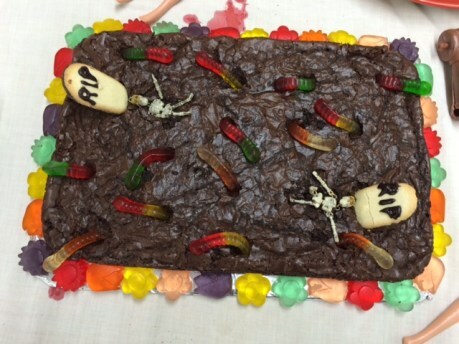
Death and Desserts at the Liberty Library
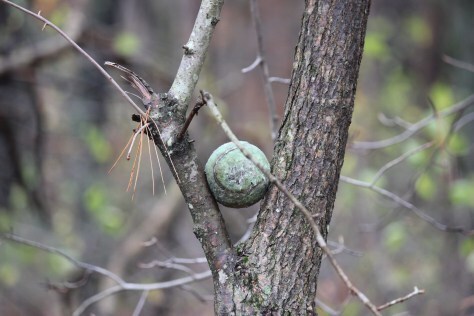
An odd thing to find deep in the forest?
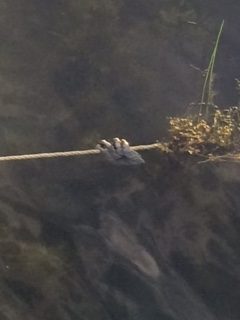
Stray lobsterman’s glove tangled on a rope
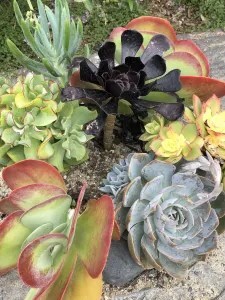
Succulents at Coastal Maine Botanical Garden
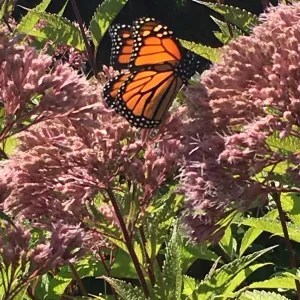
And of course, I could fill dozens of pages with our summer sunsets.

Sunset over Mackerel Cove
August 14, 2022
Judging a Translation by its Cover
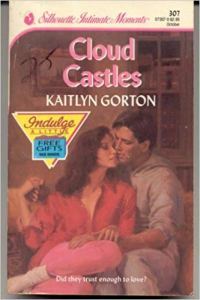
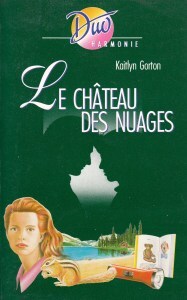
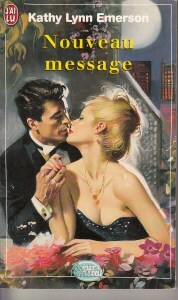
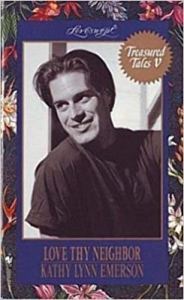
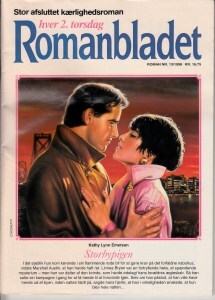
Kaitlyn Dunnett/Kathy Lynn Emerson here, today wondering whether most writers who have their books translated into other languages ever know how much was changed during the translation process. To judge by the covers on foreign editions of my novels, the answer is quite a lot! This is obviously a post based on the visual, so I’ll be showing the original, U. S. covers first and then the foreign language editions.
Here is my first experience with a translation. The cover didn’t surprise me, but something else did. In this French edition of Cloud Castles, my hero’s surname was changed from Moreau to Moore. Go figure.
Then there was the French editions of Sight Unseen, a book that takes place entirely in rural Maine. Note the obvious cityscape in the background.

The Danish edition of Love Thy Neighbor had the same problem and the German version of that book apparently thinks it involved a shipboard romance.
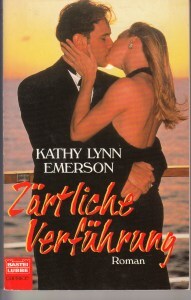
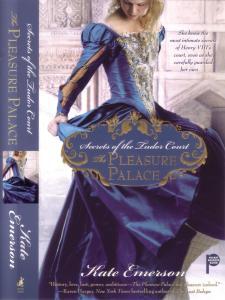
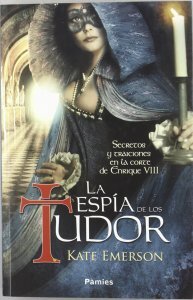
The novels I wrote as Kate Emerson had the most . . . interesting interpretations when it came to the covers of foreign editions. I blame TV series about the Tudors. This is the Czechoslovakian version of Between Two Queens.


And the Spanish edition of The Pleasure Palace.
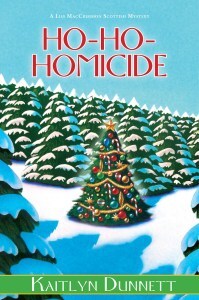
Of my books written as Kaitlyn Dunnett, only one had a foreign edition. I kind of like the German version of Ho-Ho-Homicide.

What do you think? Would you ever guess some of these covers are for the same book?
Kathy Lynn Emerson/Kaitlyn Dunnett has had sixty-four books traditionally published and has self published others, including several children’s books. She won the Agatha Award and was an Anthony and Macavity finalist for best mystery nonfiction of 2008 for How to Write Killer Historical Mysteries and was an Agatha Award finalist in 2015 in the best mystery short story category. She was the Malice Domestic Guest of Honor in 2014. Her most recent publications are The Valentine Veilleux Mysteries (a collection of three short stories and a novella, written as Kaitlyn) and I Kill People for a Living: A Collection of Essays by a Writer of Cozy Mysteries (written as Kathy). She maintains websites at www.KaitlynDunnett.com and www.KathyLynnEmerson.com.
August 12, 2022
Weekend Update: August 13-14, 2022
Next week at Maine Crime Writers there will be posts by Kaitlyn Dunnett/Kathy Lynn Emerson (Monday), Kate Flora (Tuesday), Maggie Robinson (Thursday), and a group post (Friday).
In the news department, here’s what’s happening with some of us who blog regularly at Maine Crime Writers:
An invitation to readers of this blog: Do you have news relating to Maine, Crime, or Writing? We’d love to hear from you. Just comment below to share.
And a reminder: If your library, school, or organization is looking for a speaker, we are often available to talk about the writing process, research, where we get our ideas, and other mysteries of the business, along with the very popular “Making a Mystery” with audience participation, and “Casting Call: How We Staff Our Mysteries.” We also do programs on Zoom. Contact Kate Flora
August 11, 2022
Lessons I Have Learned About Literary Agents

Vaughn C. Hardacker
Vaughn C. Hardacker here: Most of us have been subjected to the frustration of searching for a literary agent. My experience with agents has not been a pleasant one. I, too, have experienced the struggle to obtain representation and have learned some valuable lessons (unfortunately, most of them were hard). To illustrate how the publishing industry, with specific attention to the role of the agent, works, we must first look at how the process was versus how it is now,
Back in the day (before my entrance into the writing world in 1990), publishing houses had a hierarchy through which an author had to navigate. When a publishing house received a manuscript, it first went to the first reader. This person read the submission and either rejected or accepted it. If the work was accepted, it was sent to the next person in the hierarchy (for the purpose of this blog post, I’ll call this individual either a second reader or an assistant {or associate} editor).
Again, the work was subjected to the accept/reject decision, and if accepted, the manuscript was passed up the line, etc. A successful manuscript would eventually make it to an editor who would compete with other editors for a spot on the publishing calendar.
What was the agent’s role in this? They were initially the writer’s postal clerk, albeit one with contacts among the first readers. They sent the manuscript to the publishing house. Their true work was when the manuscript was accepted for publication, and a contract was proposed. Obviously, the larger the advance, the larger the agent’s commission.
Let’s jump ahead to the 1990s. This was a period in which every industry was looking to downsize. The leading experts in business management were preaching that successful companies removed layers of management and placed the decision-making process closer to the customer. This meant publishing removed several layers in the manuscript review/acceptance process. These functions were passed along to the agent.
Now, a few words about what I believe is the agent’s job. The agent’s first and most important task is to represent the writer. They work for the writer. Unfortunately, my experience is that many agents believe that it’s the other way around. Secondly, the agent should review the contract offer before sending it to the writer. In my case, every point of debate in my contract was discovered by me, not my agent. The worst sin an agent can commit is always taking the publisher’s side rather than the writer’s. I learned this from experience. There weren’t many instances where I was at odds with my publisher. However, whenever I had an issue, my agent made excuses for them.
How does the agent get compensated? They take a commission (I paid 15%). Remember their first task? The agent works for the writer. If that is the case, why does the publishing house send all advances and royalties to the agent, who then takes their piece of the pie and sends the rest to their boss (remember that person called the writer)?
How does an agent select who to represent? An agent is a commission salesperson–same as a used car salesperson. They look at any query or manuscript with one question on their mind: How easy will this be for me to sell? If they believe it will be easy, you will get an acceptance letter (or email). On the other hand, if they believe that (no matter how good the book is) selling the manuscript will require work… you will get a canned response (maybe) stating that the book sounds interesting, but they don’t feel they’re the right person to represent it. They usually soften the blow by adding that they would be willing to look at future submissions.
The most valuable lesson I learned in the writer/agent process is this: an agent’s number one priority must be representing the writer. The agent I had (I will not reveal the name to protect the guilty) was a master multi-tasker. She was adding clients at an explosive rate, teaching writing boot camps, attending writer conferences, and (this was the proverbial straw that broke the camel’s back) writing her own novels. Another of her clients told me that the agent went as far as to write a book with a similar plot to one of the clients. I believe that an agent writing novels in the same genre as his/her client is a definite conflict of interest. Who’s work gets discussed first in a meeting between agent and publisher? Despite all that, the true reason I severed our professional relationship was a phone conversation when she told me: “Don’t call me next month. I have a couple of writer conferences scheduled, a BootCamp scheduled, and will take vacation the month after.” After that conversation, I asked myself: “Who the hell is working for who?” I called the publisher and asked my editor if the termination of my agreement with the agent would affect my relationship with them. His reply: “No. In fact, we don’t require any one submitting to us to have an agent.”
The head of the agency told me in an email: “_____ was surprised and hurt when she got your notice.” Really? Why did she not call or contact me to discuss the situation when I sent her a letter terminating our relationship? To me, that doesn’t exhibit surprise and hurt. I felt hurt. The agent and I had been close friends for over ten years. (That’s another lesson: NEVER do business with a friend or relative. My experience is that you will be relegated to a low priority, whether they do it intentionally or not. They believe you will accept a lower level of service because of your past history. The old “he’ll understand because we’re friends (or relatives)” syndrome.
Fast forward to last week. I contacted the agency and spoke with the owner. I said I had not received a royalty report in almost three years. She asked for the date of my last report (royalty reports… like royalty payments… are not sent to the author, but the agent), and I provided the information. She contacted me two days later, informing me that she had received the reports from the publisher, which were attached. You may understand my concern when I was advised by the agency that I was owed $678.75 in back royalties! I wanted to tell the agency that I wanted the agent’s 15% commission back as interest due. However, I haven’t. It’s worth being rid of the agent to forego it.
Even after all this, I am still not an anti-agent writer. Many major publishing houses will not look at a manuscript that did not come from an agent, and I still query each of my novels. Several writers I know have agents who are actively involved in their careers. One goes so far as to arrange book signing tours for her client. When I asked my agent for help in the marketing part of the business, I was told, “Social Media…” An agent can be a valuable asset to a writer, or they can be a predator.
I also have another caution. Don’t get excited if an agent at a conference asks you to send them a sample. It’s lip service. I have yet to meet a writer who has gotten representation from one of those face-to-face deals (There may be some who have, but I’ve never met one.). I know of a conference when one of the agents was a friend of one of the conference committee members, and she had no experience as an agent. In fact, to the best of my knowledge, she has never queried or communicated with a publisher. The writers scheduled to speak with her were charged the same fee for the sitdown as those who met with bonafide agents. I have learned to do a lot of research before I query an agent. In the case I just stated, a simple internet search would have shown that the woman was not an agent, never had been, and never will be.
August 10, 2022
Trivia as a Research Sport
I posted this a few years ago, but I’m so busy with a new and dramatically different project (news coming this fall!), I thought it might be okay to share again.
My name is Susan and I’m a trivia junkie. I love learning something new. A new word, an unusual little fact, a new process, no matter how obscure or weird. I’ve always enjoyed

Wordle grid
crossword puzzles, partly because of the new things I learn as I do them. Scrabble is fun, too, but more a search of the brain for words I already know. And recently, along with many of my Facebook Friends, Wordle daily has me in its grip. Only once has the answer given me a new word. Of course, it meant I didn’t solve that puzzle.
Here’s an example of the trivia I have picked up from who knows where. My neighbor was worried about his father whose doctor had just told him something seemed to be going on with the older man’s heart. My neighbor couldn’t figure out the term the cardiologist used, couldn’t figure out how to spell it to look it up. But once he said the word, I knew the spelling from crossword puzzles: i-s-c-h-e-m-i-a. Ischemia means coronary heart disease, or narrowing of the arteries. My neighbor was thankful because now he could learn more on Web MD. See what I mean about trivia?
As a trivia junkie, I love acquiring new information as I research my books. Writing historical novels would demand incredible amounts of research because of all the historical information involved, even the clothes, vocabulary, and activities of daily life. But you might be surprised how much research goes into contemporary novels as well. I found with my first book, Dangerous Attraction, I was looking for information constantly as I wrote the book. But that was before so much could be found on the internet. I had to phone the Boston office of the Drug Enforcement Administration to obtain answers to my questions.
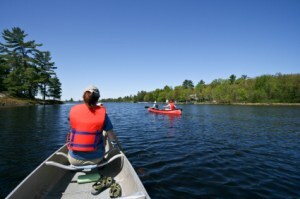
For another release, Primal Obsession, I did a lot of direct research, personal research, with a canoe and camping trip. My husband and I had planned the trip anyway, which would award us hours toward recertifying our teaching certificates. This was a six-day trip on the West Branch of the Penobscot River with a guide and three other campers, also educators. I used the skills and experiences of the week to help me write authentic background and to plot the book. My fellow campers even suggested some plot points. Later I had other research to do, either online, in books, or by calling people.
I read a blog post elsewhere by another author who listed what she learned in the process of researching and writing a book. I thought it would be fun to do the same. Here are some things I learned while writing Primal Obsession.
1. In the state of Maine, the Maine Criminal Investigation Division handles murder cases. Only the cities of Bangor and Portland have homicide detectives. All other jurisdictions defer to the Major Crimes Units in different areas of the state.
2. Police often use cell phones instead of police radios because they can keep the calls more private. No one can listen in with their scanners at home.
3. There’s never been a serial killer in the state of Maine. (Mine’s the first!)
4. A serial killer’s signature makes his crime stand out with his personal compulsion, which remains static and represents what he is. A signature is different from a modus operandi, which can change. I learned this from Mindhunter, by John Douglas, one of the founders of the FBI Investigative Support Unit.
5. The Cessna Caravan pontoon airplane can carry the pilot and eight passengers.
6. Maine Guides were first licenses in 1897. Guiding at first was primarily for hunters and fishermen but today Maine Guides are licensed for recreational guiding as well. That first year 1316 guides were licensed. The first licensed guide was a woman, Cornelia “Fly Rod” Crosby.
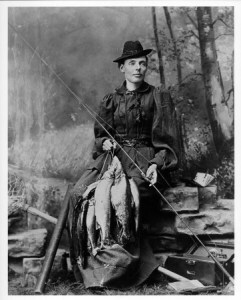
Fly Rod Crosby
7. When navigating rapids in a canoe, watch for “funnels,” rocks with water streaming before them. Head down the V’s between the funnels/rocks. Use a Radical Paddle–pull the paddle in toward the canoe to make a quick turn–then power paddle through the V. The rear paddler sets the direction by switching sides and by pulling back in a J move.
8. When using a simple compass, place the red N arrow in the red section pointing north, or put “Fred in the shed,” as our guide said.10. When heading for a target spot in the woods, plot your course in short distances. Aim for a rock or tree ahead, then recheck the compass and choose a new target.
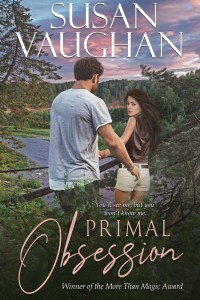
In Primal Obsession, Former pro athlete Sam Kincaid needs success guiding canoe expeditions in the Maine wilderness, not attraction to a sexy reporter researching a serial killer. Annie Wylde fights the pull of his charisma, considering him an arrogant jock. When the trip turns deadly, they realize the killer has followed her into the woods. If they survive the ordeal, can they find a way to each other?
I have a signed copy of Primal Obsession to give away to one commenter. I’ve tried to do this before but couldn’t contact the commenter, so if you comment and are also interested in receiving the book, email me at susan@susanvaughan.com with your USPS address. If you live in the continental US, I’ll mail it to you; if not, I can gift you the Kindle version of the book.
Lea Wait's Blog

- Lea Wait's profile
- 509 followers


![[image error]](https://mainecrimewriters.com/wp-content/uploads/2022/08/8D8A08B5-60F3-42DA-8931-51C9B8211DBC.heic)