
Lea Wait's Blog, page 61
June 23, 2023
Weekend Update: June 24-25, 2023
 Next week at Maine Crime Writers there will be posts by Kait Carson (Monday) and Maureen Milliken (Thursday), and a group post on Friday.
In the news department, here’s what’s happening with some of us who blog regularly at Maine Crime Writers:
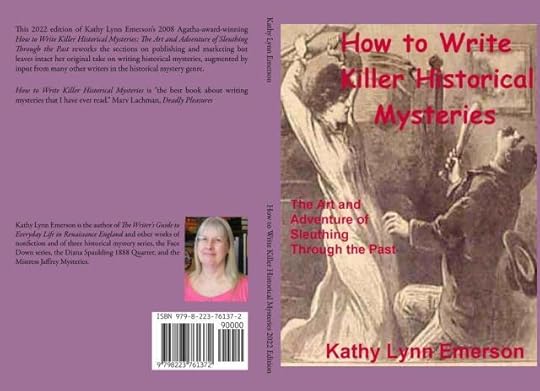
From Kathy Lynn Emerson: Remember those non-fiction books I was contemplating self-publishing in print-on-demand trade paperback editions? I couldn’t resist seeing if it was possible and the result is that you can now pre-order paperback copies of my Agatha-award winning How to Write Killer Historical Mysteries, 2022 edition. The release date is June 30. Links to Amazon and Barnes & Noble are below but any bookseller or library should be able to order a copy through their usual channels.
Kate Flora: Excited to have a story in this collection:
 Beach Reads Day has arrived!
Matt Cost, John Clark, Kate Flora and Maureen Milliken are at the Maine Crime Writers Beach Reads Day at the Belgrade Village Green Craft fair, 9 a.m.-2 p.m. Sunday, June 25, in Belgrade Lakes. The event is in support of the Friends of Belgrade Public Library. Come on over and say hi, check out our books, and enjoy a great craft fair and a beautiful part of Maine! The Village Green is at the intersection of Main Street (Route 27) and West Road in Belgrade, about 15 miles north of Augusta. Just head north and you can’t miss it!
An invitation to readers of this blog: Do you have news relating to Maine, Crime, or Writing? We’d love to hear from you. Just comment below to share.
And a reminder: If your library, school, or organization is looking for a speaker, we are often available to talk about the writing process, research, where we get our ideas, and other mysteries of the business, along with the very popular “Making a Mystery” with audience participation, and “Casting Call: How We Staff Our Mysteries.” We also do programs on Zoom. Contact Kate Flora


Taking the Summer Off…or will the best laid plans go awry?
Kate Flora: After my agent declared that she didn’t like my new book and found my character “not very likeable” I sulked in the corner for a bit and then decided that I would take the summer off. Evidently my habit of referring to my writing as “homework” was telling. I need to put some space between my current self and the self I need to be to write more likeable characters.
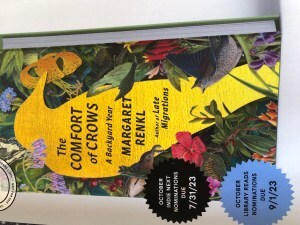
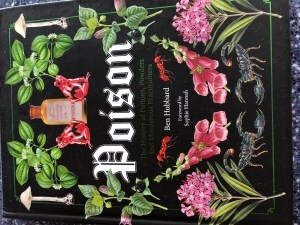 That is the plan, anyway. But plans, like rules, often seem to be made to be broken. At least that is the message that I am getting from the universe. I’m a week into my resolution, with a stack of wonderful books on my lamp table waiting for my attention. There’s the new 700-page novel, The Covenant of Water, by Abraham Verghese, whose book Cutting For Stone is an all-time favorite. There’s The Comfort of Crows by Margaret Renkl, a gift from a recent guest. A beautiful book about poisons by Ben Hubbard that I got for Mother’s Day.
Yes, it looks like I have my summer’s break full of great things to read. Plus it is summer in Maine, which means guests. It means lovely dinners and drinks with my neighbors. It means spending a lot of time in my garden fighting back the weeds and the pests. It means harvesting my blueberries and making lots of jam.
 So what, you are wondering, might make these idyllic plans go awry? It’s that darned writer in me. I need to find out why my character—a character I like a lot—isn’t striking my agent as likeable. And then, because evidently the write’s nature abhors a vacuum, I sat down at the keyboard to play the other day and dug up a series of linked stories from long ago. I wasn’t sure where I’d left them but in the process of rereading and trying to figure that out, I got hooked on the last story, actually more of a novella, and find I have to finish it and figure out what happens. I may have to write more stories to explore where the character goes from here.
It should be fine. I’m always curious to see where writing takes me. Where my imagination wants to go. One New Year’s Day several years ago, I had two different books warring in my head that both wanted to be written. I decided I would sit down at my desk, poise my fingers over the keyboard, type “Chapter One” and see what happened. What happened was a Joe Burgess book. I have a feeling this summer will be a bit like that. I have no deadlines. I have nothing I have to write, so it will be fun to see whether the linked stories become a book, or whether something else comes along and elbows them aside.
There are writers who are planners, I know. My late friend Lea Wait always had a five year plan and was very disciplined about her work. I am not like Lea. I’m more willing to go with the adventure of the thing. Lately, though, I haven’t been feeling any sense of fun. But I hope that by September 1st many more books will be read, and I will be back at my keyboard feeling the passion and adventure of writing instead of calling it “my homework.”
Stay tuned…
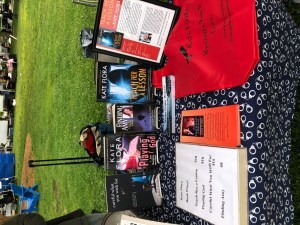
Trying to sell books on a cold and rainy day. Is that an adventure?
June 22, 2023
Is it a Mystery, a Thriller, or Suspense? By Matt Cost
I recently was a moderator for a panel at Crime Wave for the Romantic Suspense panel consisting of writing wonders Carla Neggars, Paul Doiron, Susan Vaughan, and Susan Stoker. This gave me pause to ponder the separation of categorization of genres that I write within. Is it a mystery, a thriller, or a suspense?
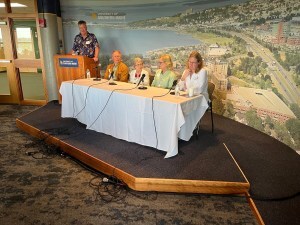
I was a at the ThrillerFest conference back before the time that will not be mentioned attending a panel that first began these questions percolating in my mind. At this panel, the question came up as what the difference between a mystery and a thriller was. Pretty simple stuff. But everybody had a different opinion and it became downright cantankerous up there on the stage.
A simple dictionary search of the word mystery is any affair, thing, or person that presents features or qualities so obscure as to arouse curiosity or speculation. The word thriller is described as an exciting, suspenseful play or story, especially a mystery story. Hm. And suspense is a state or condition of mental uncertainty or excitement, as in awaiting a decision or outcome, usually accompanied by a degree of apprehension or anxiety.
Untangling this box of loose translations seems to be a thrilling, suspenseful, mystery. So, it is not enough to unpack the jumble, but necessary to reduce these words to their core essence. Simplification leads me to a thriller being a cliffhanger, suspense being a state of anticipation, and a mystery being a puzzle or secret.
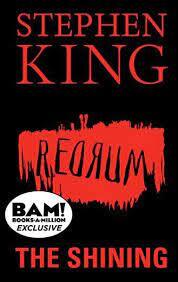
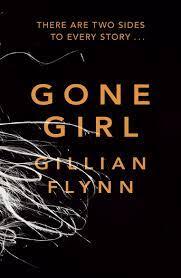
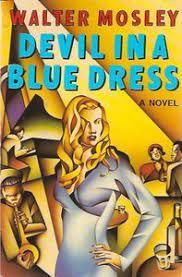
Two of my favorite mysteries of all time would be The Big Sleep by Raymond Chandler and Devil in a Blue Dress by Walter Mosely. My top two thrillers would have to include Silence of the Lambs by Thomas Harris and The Spy Who Came in from the Cold by John le Carré. Suspense would then be Gone Girl by Gillian Flynn and The Shining by Stephen King.



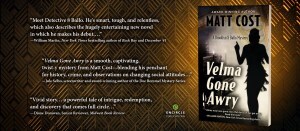
Of course, doing a simple internet search, I can find all of these titles on top lists for mystery, thriller, and suspense. The category placement of my most recent novel, Velma Gone Awry, then, would in the mystery, thriller, suspense section. Of course, at Sherman’s Maine Coast Bookshops, it is in the Maine Authors section.
Not to mention the breakdown into subcategories of cozy, noir, traditional, crime, hardboiled, PI, capers, medical, legal, historical, techno, psychological, domestic, spy, political, supernatural, narrative, cliffhanger, dramatic, romantic, and comedic. Whoa. It is enough to make one tired just thinking about it. Perhaps, as in a recent blog I suggested that perhaps it is enough to just write, it is also enough to just read and not worry about the labels attached.


But if push came to shove, my personal definition would thus be refined to is a mystery is something happens and must be solved, a thriller is something being raced against to prevent from happening, and suspense is something waiting to happen. All three can contain romance, but in suspense, that romance has an angst preventing it from happening until later in the book. And, of course, all these genres intertwine on a regular basis.
What thinks you?
Write on.
About the Author
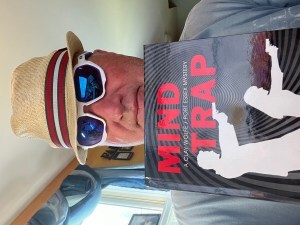
Matt Cost was a history major at Trinity College. He owned a mystery bookstore, a video store, and a gym, before serving a ten-year sentence as a junior high school teacher. In 2014 he was released and began writing. And that’s what he does. He writes histories and mysteries.
Cost has published four books in the Mainely Mystery series, with the fifth, Mainely Wicked, due out in August of 2023. He has also published four books in the Clay Wolfe Trap series, with the fifth, Pirate Trap, due out in December of 2023.
For historical novels, Cost has published At Every Hazard and its sequel, Love in a Time of Hate, as well as I am Cuba. In April of 2023, Cost combined his love of histories and mysteries into a historical PI mystery set in 1923 Brooklyn, Velma Gone Awry.
Cost now lives in Brunswick, Maine, with his wife, Harper. There are four grown children: Brittany, Pearson, Miranda, and Ryan. A chocolate Lab and a basset hound round out the mix. He now spends his days at the computer, writing.
June 19, 2023
‘Creative’ use of tense by writers makes me … tense
I’m often accused, even by people who purport to love me, that I’m way too picky about writing when I read. Not everyone was an English major! No one cares!
Yeah? Well I care. And, dear reader, you do, too. You just don’t know it. Things that take you out of the book, even confuse the meaning, are going on all around you and just because you’re oblivous doesn’t mean it’s not affecting your experience. You have no idea how much better that book would be if that one thing wasn’t going on. Or those zillion things.
I have many peeves. Don’t even get me started on point of view change in the middle of a scene. Or middle of a paragraph.
But that’s a rant for another day. Today’s topic? PRESENT TENSE.
[Disclaimer: This is not an attack on any specific writer. I’ve been set off by several podcasts I’ve listened to in the past week in which tortured use of present tense drove me over the edge. But it reminded me how much I hate it in books. Not that I needed reminding.]
The best tense to use in long-form fiction or nonfiction is past tense. Boom.
Let me explain.
It’s virtually impossible to consistently write in present tense when you’re telling a story, particularly a long one.
When you write in present tense, there are still times when you need to use past tense. Most people who try to write an entire book (or podcast) in present tense don’t get that part right. The missteps are distracting and confusing. In some cases, it changes the meaning of a sentence. I’m not kidding. I’ve seen it happen.
Present-tensers also slip up and use past tense instead of present, since it’s hard to maintain that unnatural tense use for a long time. Those slipups also makes things confusing and inconsistent.
I’d give examples, but it’s been a long day. Now that I’ve pointed it out, you’ll know what I mean when you see it.
If you love writing in present tense, I know I’ve upset you. As I said, it’s been a long day. I don’t have the energy to tip-toe around this topic. I know that my brassy pronouncements make people uncomfortable. The fact I make them sometimes offends people. That doesn’t mean I’m wrong. [Someone I supervised once complained to my boss that I made “brassy pronouncements.” Has that ever been considered a valid complaint against a male supervisor? A blog post for another day. Anyway, I thought it was ridiculous. So now I own it. Brassy as charged. Anyone who doesn’t like it can kiss my brass.]
Back to you, though, present tense-lover. Why are you making so much extra work for yourself? Isn’t writing a book hard enough as it is?
While we’re at it, I want to go on the record on what I call past future perfect tense. It’s uneccesary and annoying. [If there’s a better name for this bizarre usage, I apologize. It’s been a long time since the nuns battered this stuff into me with their smacking rulers and evil glares. I may not know all the terms, but like a nun zeroing in on a student who’s making brassy pronouncements in class, I know what I can’t abide.]
When I was a sports editor, the sportwriters loved past future perfect tense. I hated it. I edited that s*&t right out of their stories. [BTW, it wasn’t any of them who complained about my brassy pronouncements, though I’m sure they didn’t like them.]
Here’s what I’m talking about:
“Bobby Jones would hit five home runs in Friday’s double-header.”
What’s wrong with writing “Bobby Jones hit five home runs in Friday’s double-header”?
NOTHING.
My theory is that the sports writers wanted to write like the guys on TV talked. Trying to sound like someone on TV is not an effective model for good writing.
You can disagree with me on all of this. Go ahead. Just keep in mind that if readers are pulled out of your story because they have to try to untangle your storytelling, your writing is doing the opposite of what you want it to do.
And yes, I know this blog post is in present tense. It’s also in second person (a blog post for another day). That’s because it’s short and it’s a blog post. It’s a whole different animal than a long article or book. I also used past tense. I’m doing it now. No wait, I’m not. But I did when I wrote that sentence before I didn’t. I am again! No, I’m not. But I was.
That’s it on that topic.
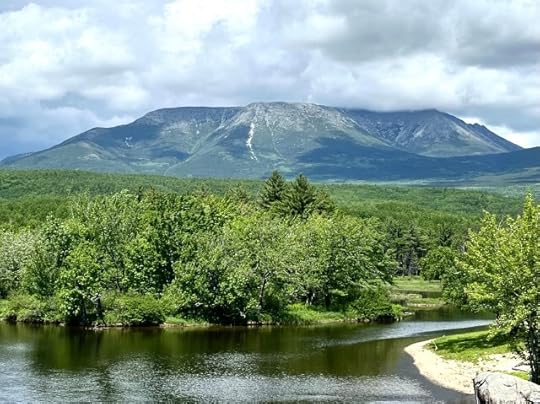
Below is a photo I took last week of Katahdin from Abol Bridge. It’s got nothing to do with this post, but it makes me happy. Welcome summer!
For The Love Of Books
Charlene D’Avanzo: I’ve treasured books for as long as I can remember. As a kid I literally devoured the “Cherry Ames Student Nurse” series and remember my mother complaining that the books were too costly to be read in a day.
The series was set in World War Two when Cherry Ames solved problems and captured criminals “demonstrating that women can succeed in the public, working world”. Apparently I was a young feminist before I knew what the word meant!
 No question, books are revered – poke around online and you’ll find lots of terrific literary quotes. A few of my favorites:
“The more that you read, the more things you will know. The more that you learn, the more places you’ll go.” – Dr. Seuss, I Can Read With My Eyes Shut!
“Books are a uniquely portable magic” – Stephen King, On Writing: A Memoir of the Craft.
“Until I feared I would lose it, I never loved to read. One does not love breathing.”
– Harper Lee To Kill a Mockingbird
“Reading is an active, imaginative act; it takes work.”―Khaled Hosseini
Another critical point: “If You Have Something To Say Write A Book”. But the 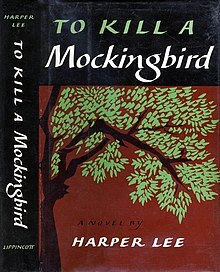 reverse is also true – “Don’t Write Book Until You Have Something To Say”.
So why did I – a scientist who wrote technical marine research articles – decide to write fiction? As I explain in the rationale for book one in my Oceanographer Mara Tusconi series: “I was motivated to write Cold Blood, Hot Seaby stories of researchers maliciously targeted by climate change deniers”.
That’s what I wanted to get across – dedicated climate scientists I knew had been ridiculed by politicians who knew zero about our warming planet and the serious realities of climate change. I was livid, people needed to understand what was going on, and the “uniquely portable magic” of popular fiction was the best vehicle.

June 16, 2023
Weekend Update: June 17-18, 2023
Next week at Maine Crime Writers there will be posts by Charlene D’Avanzo (Monday) Maureen Milliken (Tuesday), Matt Cost (Thursday), and a special guest (Friday).
In the news department, here’s what’s happening with some of us who blog regularly at Maine Crime Writers:
Matt Cost, John Clark, Kate Flora and Maureen Milliken are at the Maine Crime Writers Beach Reads Day at the Belgrade Village Green Craft fair, 9 a.m.-2 p.m. Sunday, June 25, at the Belgrade Lakes Village Green. The event is in support of the Friends of Belgrade Public Library. Come on over and say hi, check out our books, and enjoy a great craft fair and beautiful part of Maine!
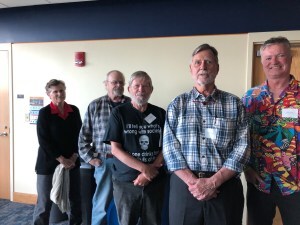
Matt Cost had a wonderful time giving a book presentation at the South Freeport Congregational Church last weekend, as well as doing a reading, moderating a panel, and being a panelist at Maine Crime Wave last weekend. That’s me trying to pretend I am on the final panel of the day.

Next weekend, on June 24th, I will be doing a book signing at Sherman’s Maine Coast Book Shop in Damariscotta from 1-3 p.m. On Sunday, June 25th, I will be at the Belgrade Craft Fair selling and signing books with fellow Maine Crime Writers Maureen Milliken, Kate Flora, and John Clark.


Matt Cost moderating at the Maine Crime Wave

Jule Selbo moderating a panel

An invitation to readers of this blog: Do you have news relating to Maine, Crime, or Writing? We’d love to hear from you. Just comment below to share.
And a reminder: If your library, school, or organization is looking for a speaker, we are often available to talk about the writing process, research, where we get our ideas, and other mysteries of the business, along with the very popular “Making a Mystery” with audience participation, and “Casting Call: How We Staff Our Mysteries.” We also do programs on Zoom. Contact Kate Flora
June 15, 2023
Memory and Memorial
By the time you read this, Memorial Day will have come and gone. I try to pay it the appropriate attention. Like many Maine families (and others), I know scores, both alive and dead, who served: my father and grandfather, my uncles, even two of my nephews. My mother-in-law was a Marine, about which we do not joke.
I associate Memorial Day most memorably with the sweet bready smell of blooming lilacs, but also with veterans handing out red plastic poppies,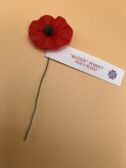 student marching bands, and old faded men in old faded uniforms marching into the long moments of silence.
Only a week later, I returned from my 50th college reunion at that well-known liberal arts school in central Maine, and I will skip the obligatory joke about how old all those other people looked. I will say that, by show of hands, there were many more joint replacements than tattoos. Not that there were no tattoos.
The highlight of the weekend for me, faintly macabre as it sounds, was the memorial service one of my classmates arranged for the forty-six members of our class who have died. Better than ten per cent of the freshman class, and if that number didn’t give people pause, nothing else would.
The remembrance consisted of a reader speaking the name of each person who was gone, then a friend or acquaintance of that person picking a red rose from a pail and placing it into a bouquet  that would collectively represent everyone we had lost. We would carry the bouquet with us to dinners and events for the rest of the weekend.
In 1969, when we all were first on campus, like any group of young people, we divided ourselves into groups: the jocks, the freaks, the science nerds, the brains, the party people, the frat boys and the sorority girls. It was a strange and divisive time, deep into the Vietnam War, 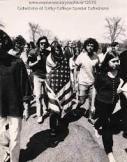 steeped in conflicts over civil rights and gender politics. At the same time, we loved our beer, dancing badly to the Rolling Stones, and all the other escapades that make the privilege of college life so dear in the moment.
What struck me deeply in the memorial was that nearly all of our dead classmates had someone to add a rose for them, and that many—most—of the connections crossed those strange and arbitrary lines we had drawn when we were younger and more foolish. It became clear that, if nothing else, the passage of time teaches you to suspend your judgments, weaken your prejudices, open up your assumptions to new information. It was moving to see how many of those old disconnections had faded.
Which would be lovely if all of us lived long enough to do that for each other. But just in the group of my classmates, some died while they were students, others in only their twenties and thirties. I was reminded that we don’t always have the time we think we have to act better than we have. Which is all the more reason to loosen our self-imposed boundaries, to cross over the divisions we have fashioned for ourselves, to open up our selves to the possibility we might be wrong about something. Or someone. What would be fine, I think, is if you could bring someone a rose, or a poppy, before someone needs to bring one for you.
POST CONFERENCE
Plusses and Minuses — Jule Selbo
If you’ve been keeping up with the blog in the last few days, you know that last weekend was the annual Crime Wave Conference, held in Portland, Maine at the Glickman Library at University of Southern Maine. 
 Friday night there were nibbles and a cash bar and then the main event: Carla Neggers was interviewed by Julia Spencer-Fleming and received the CrimeMaster Award. Then ten writers participated in “Two Minutes in the Slam” – that’s when writers read – for two minutes – from one of their books or books-in-progress.
Saturday started with breakfast nibbles, a day of panels about various aspects of writing crime/mysteries and an interview: Kate Flora talked with crime novelist Kathy Lynn Emerson who received the Lea Wait Award. There was a great lunch, a lot of networking and chatting and more panels, culminating in a fest of a panel (and other attendees) sharing personal writing experiences.
There were a lot of take-aways for me – plusses and minuses. Plusses:
From the moment I stepped off the elevator, I was in the midst of buzzing fellow writers and lovers of crime/mysteries who were excited to talk about, analyze, joke and empathize about the writing process.

2.Barbara Kelley, bookseller, was there, right in front of the elevator, with a long table of titles available for sale – cozies, procedurals, sci-fi crime mysteries, long-lived series with beloved investigators, stand-alone thrillers and espionage crime/mysteries and more. She’s so knowledgeable, has probably read them all.
3. Gibson Fay-LeBlanc, head of Maine Writers and Publishers, and Phoebe Little, Programming and Promotions Associate, roamed the lobby and room, making sure people were introduced to each other, eating from the food table, and that the organization of the event stayed on schedule.
4.Meeting crime novelist Carla Neggers – no-nonsense prolific New York Times Best Selling writer and listening to her takes on writing, the publishing world, the ups and downs of the writing life and the compulsion she has to put stories to paper (onto computer pages). She’s amazingly approachable and fun and a reminder of why writers usually “like” each other.
5. Robert Kelley, acting as MC of the “Two Minutes in the Slammer”, making it clear he loves this genre and appreciates a well-done whodunit it. I got to talk to him a bit about his recent experience at the Writers Hotel, an intensive week-long writing retreat in Boothbay Harbor that is dedicated to giving participants (writers) the tools they need to start/finish/get published.
6. Meeting Margot Kelley, editor and professor and lover of creative writing.
7. Seeing “old friends and fellow writers” that I have met at previous Crime Wave Conferences. Getting to know them just a bit better.
8. Hanging with Nicole Asselin, who drove up from Boston to be a panelist on the “Why a Series?” panel. She writes a crime/mystery series centered around the offices of minor baseball team.
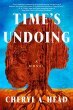
9. A panel of writers talking about on how real-life events (past and contemporary) inform their writing. How their research leads them into unexpected territory – like how historical events often mirror today’s events. Example: How writer Cheryl Head’s dig into her family’s saga and white supremacy and violence in two separate decades revealed new information on her familial past and informed her writing of her newest novel Time’s Undoing.
 Another example: How journalist Kathryn Miles’ research into a murder of two young woman on the Appalachian Trail morphed into an exploration of their love story- as well as a revelation of Kathryn’s own personal tale.
Other examples: Jim Ziskin’s use of his series protagonist Ellie Stone as a conduit to explore mysteries/histories and real-life events in various places in the world – places where Jim has adopted/loved/lived/worked in. And how Carolyn Marie Wilkins uses her personal psychic skills and knowledge and her family’s history, as well as her musical chops, to inform her stories.
 The panel (led by Jessica Ellicott) was fascinating – highlighted how all writers’ personal experiences, ideas, druthers, opinions, leanings and well-seated observations can inform their fiction.
 10. I got to moderate a panel of well-read and well-reviewed writers who work in various sub-genres of the crime/mystery genre. Espionage thriller, YA, traditional and crime/mystery that also incorporates horror, sci-fi and disaster. What was great about reading the panelists’ works was that it helped me “know” more about the Dee Rommel Mystery Series that I write.
Okay – the plusses keep mounting up – and the day was only half over. Panels on “Romantic Suspense”, “Why a Series” and “What I Hate About Writing” filled the afternoon. For those of you who didn’t get to make the conference – be sure to make it next year!
Oh – I promised plusses and minuses.
Minuses:
NONE.June 12, 2023
So, this happened . . .
Kathy Lynn Emerson/Kaitlyn Dunnett here. There are many times in a writer’s life when something unexpected happens. On average, these are good experiences. One of the best of my career happened last Saturday at the Maine Crime Wave.
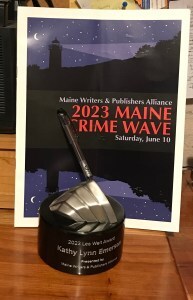
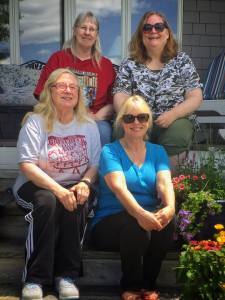
This award, given for “excellence and achievements” as a Maine writer by the Maine Writers and Publishers Alliance, was named in memory of my dear friend and fellow Maine Crime Writers blogger, Lea Wait. We lost Lea too early, but it is a lovely tribute to her that the award was created this year and will continue to be presented to Maine writers. To tell you the truth, in a perfect world Lea herself would have been the first recipient. Below is one of my favorite photos of her, together with Kate Flora, Barb Ross and me, on the one and only retreat the four of us managed to organize. We had a blast, and Barb’s husband, Bill Carito, took this photo on the last day.
On Saturday, Kate interviewed me. That was a lot of fun and seemed to go over well. Here’s a photo my husband took of the Q&A.

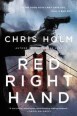
There were other panels throughout the day and had been events the evening before as well. The finale was a “mega panel” centered around what we hate (and love) about writing. As you can see below, it was a motley crew that participated in this one. Left to right here are Cheryl A. Head, Jessica Ellicott, Julia Spencer-Fleming, me, Brenda Buchanan, Carla Neggers (who was Maine Crime Master for the event),Barb Ross, Carolyn Marie Wilkins, Chris Holm, and Matt Cost.
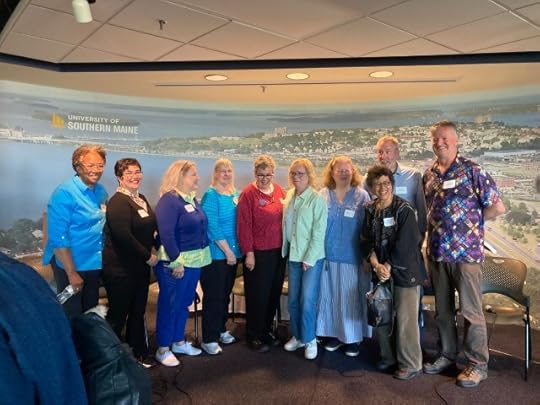
The community of writers here in Maine is alive and well and this is our once-a-year opportunity, since many of us live in remote areas of the state, to get together in person. Writers from other states are always welcome, too, along with avid mystery readers. This “retired” writer had a wonderful time connecting with old friends and making a few new ones, too.

Kathy Lynn Emerson/Kaitlyn Dunnett has had sixty-four books traditionally published and has self published others, including several children’s books. She won the Agatha Award and was an Anthony and Macavity finalist for best mystery nonfiction of 2008 for How to Write Killer Historical Mysteries and was an Agatha Award finalist in 2015 in the best mystery short story category. She was the Malice Domestic Guest of Honor in 2014. Her most recent publications are The Valentine Veilleux Mysteries (a collection of three short stories and a novella, written as Kaitlyn) and I Kill People for a Living: A Collection of Essays by a Writer of Cozy Mysteries (written as Kathy). She maintains websites at www.KaitlynDunnett.com and www.KathyLynnEmerson.com.
Another Great Maine Crime Wave!
Kate Flora: For those of you who missed the Crime Wave on Friday night and yesterday,

MCW regulars Vaughn Hardacker, Sandy Neely, Kate Flora, Dick Cass, Brenda Buchanan, and Dick Cass
you really missed a great event. As we are all aware, the writing life is usually a very solitary one. That’s one reason why, when the crime writing community comes together, it is such a congenial event.
One aspect of this community I discovered as a brand new writer was the lack of hierarchy in our community. Whether you’re a newbie working on a first book or a multi-published writer working on a twelfth, the experience of getting that germ of an idea and struggling to develop it into a story is the same. You are in a group who understand those insistent voices in your head begging for you to find the time to let them out. You are in a room full of people who see an empty car by the side of the road with the doors open and begin to speculate where the occupants have gone.
From Julia Spencer-Fleming’s brilliant Friday night interview with the accomplished guest

MCW alum Barb Ross and Nicole Asselin, who describes herself as a “geriatric milennial”
of honor, Carla Neggers, to a series of twelve brief readings from writers all across the genre, the event was off to a great start. Those readings highlighted a comment made in a panel early on Saturday—you can teach a lot about writing but a write has to arrive with a strong individual voice.
Many times I’ve heard it said that even if you take away only one piece of advice from a conference, it would be worth it. On Saturday, it was hard not to come away with an exploding head as there was so much wisdom and so many great pieces of advice about writing.
Here are some of those pieces from my own notes:
When you characters are talking, the reader is a third person in the conversation.
How do you balance using time as a propulsive device versus having the leisure to develop your characters?

Matt Cost moderates a panel
What are the elements of other genres that also weave into your story?
When we talk about suspense, we need to recognize that there are many different kinds, including character friction and romantic friction.
It’s important to be aware of the norms or tropes of the genre you’re writing in, and be fluent in them, before you start breaking the rules.
Want to know what that genre looks like? Read the finalists for the Agatha, the Anthony, and the Edgar for the past several years.
Or if you’re uncertain how to structure your novel, practice by making up a novel using the structure of one of your favorites.
Your character should change over the course of the book and over the arc of a series, and

Jule Selbo moderating a panel
you, the author, should know where your character needs to be at the end. But also be open to the possibility of your character surprising you.
Are you a writer who has trouble with some aspect of writing—description, or dialogue, or action scene? Try typing out or writing out by hand some scenes that work.
It was wonderful to see writers who return every year and learn where they are in their writing. Maybe next year, you will be there, too.

Sandy, John, Dick, Vaughn, and Matt. Such fun to see each other in the real world.
Lea Wait's Blog
- Lea Wait's profile
- 509 followers

