
Lea Wait's Blog, page 325
March 28, 2014
Weekend Update: March 29-30, 2014
 Next week at Maine Crime Writers we’ll be featuring posts from Al Lamanda (Monday) Barb Ross (Tuesday), Dorothy Cannell (Wednesday), John Clark (Thursday), and Kate Flora (Friday).
In the news department, here’s what’s happening with some of us who blog regularly at Maine Crime Writers:
Lea Wait: You’re invited! To the launch of my newest historical, UNCERTAIN GLORY! I’m thrilled that my wonderful publisher, Islandport Press, is hosting a launch party for Uncertain Glory on Sunday,  April 6, from 4 until 5:30 at Le Garage Restaurant on Water Street in Wiscasset, Maine. There’ll be refreshments, I’ll speak (a little) and there’ll be a cash bar. And, of course, there’ll be copies of Uncertain Glory! Hope to see many of you there!
And, if you can’t make the launch, I’ll also be signing copies of UNCERTAIN GLORY at the Children’s Book Cellar in Waterville, Saturday, April 5, from 10 until 12.
And for those of you who’ve been waiting … SHADOWS OF A MAINE CHRISTMAS (which won’t be published until September) is now available for pre-order on Amazon. Strange to think of a Christmas mystery when we still have snow on the ground from last Christmas .. but that’s the way it is. Happy spring everyone!
Kate Flora: Here’s a picture of Lea, Al Lamanda, and Jim Hayman from their panel at the Kennebunkport Library this week. They look like they’re very engaged in their discussion.

An invitation to readers of this blog: Do you have news relating to Maine, Crime, or Writing? We’d love to hear from you. Just comment below to share.
And a reminder: If your library, school, or organization is looking for a speaker, we are often available to talk about the writing process, research, where we get our ideas, and other mysteries of the business. Contact Kate Flora: kateflora@gmail.com


Thirsty
(Now living away from Maine, today’s guest, writer Noelle Carle misses what we take for granted–our ocean, lakes, and streams)
 My youngest sister lived for several years in Colorado. While there, she wrote longingly of the bodies of water that she missed, rendering to them an almost human status. She spoke of the blue waters of our lake welcoming her, holding her, buoying her, embracing her. While I agreed with her on the necessity of water for our existence, I really didn’t understand what she meant about the dryness of her soul that resulted from living so far from the sight, sound or influence of water.
Now I know. Although I never saw the ocean until I was quite old, I lived within easy distance of some lake, stream or river. New England is abundantly blessed with water, a liquid portion of the country, so as an adult I have almost always been near enough the ocean to at least see it or drive to it.
I remember our first experience actually living where I could see ocean every day, in Nova Scotia. It was then that it became a necessary component to my “soul health”, although I didn’t recognize that fact. From our front window was a vista of such changing and magnificent splendor that I rarely grew tired of gazing at it. I wasn’t a native, but I grew to enjoy the deep, almost cobalt blue of the Atlantic on a sun drenched morning; the churning green when the wind strove against it; the stormy gray of a late winter afternoon. I sensed a powerful presence and sweet peace just by being near it, or even looking at it from afar.
A move overseas to New Zealand in the 1990’s impressed on me the sheer magnitude of the Pacific and acquainted me with a variety of different waters. The Pacific proved a sensual, warm and sometimes pushy companion, while the Tasman was boisterous, even frightening in its colder and darker aggression. Lake Taupo was a silent deep inscrutable place that seemed alluring yet aloof. These waters affected the daily weather patterns and general atmosphere of the area with a drenching, sometimes overwhelming presence.
For the last five years I lived close enough to a particular lake in Maine, the lake of my sister’s longing, to understand the connection between that body of water and her soul. Whenever I felt disturbed, needy or anxious, I found tranquility there by the lake. The kiss of the waves, the expanse of calm blue on a still morning, the smell of the water as I indulged in a canoe ride across the cove, the twilight call of the loons as the sun was setting, the solitude of a frozen winter there – these all lodged in my heart as rich and lustrous components of every day.
Now I have moved to the Midwest, a needful move but difficult. In seven months I’ve seen less than seven days of rain. The landscape of Oklahoma is as foreign as if I’d gone to Mars, and as just dry. Winter has enhanced that sensation with the grass a dull brown, the trees bare of leaves and the soil a rusty red color. The air lacks moisture so that even my husband, who has never had a problem, has dry skin. Getting up from our micro fiber couch charges us enough that we might be able to power a small city. Did I already say that it’s dry?
We were heading south to visit family in Texas and I saw on the map that we were approaching the Canadian River. That sounded promising. Visions of a sparkling blue jolt of color through the forever brown filled me with anticipation. Perhaps a cacophony of white water tumbling over boulders awaited as we crossed the bridge. I think I actually slumped when I saw the pittance of meandering red-brown water that was barely more than a slick of mud. Maybe the ones who named it the Canadian River were ever hopeful.
I’ve read enough about the Dust Bowl to be profoundly thankful that conditions are much improved. Technically there is drought here, but not so severe as in years past. There is a mighty aquifer, the Ogallala, that stretches from South Dakota down through Texas. It supplies my drinking water, and that of almost everyone who lives in this High Plains area. I believe it’s there, however, I can’t see it unless I watch it come out of my tap. Somehow sitting by a bathtub of water will never compare with the powerful sense of calm and inspiration that comes from a sojourn beside my lake.
I fully understand now that thirst that seems to pervade the soul; the sense of longing for a glimpse of sparkling whitecaps, the sound of chuckling waves or the particular heady scent of a New England lake surrounded by pine, cedar and spruce trees. In our town here in Oklahoma there is a small man-made pond of cramped proportions and murky water. If I squint in the sunlight, it almost looks like…well, definitely not an ocean, but nearly a lake. I’m so dry…it will to do for now.
Noelle Carle grew up in northern Maine, the setting for this book. She is the fourth child and third daughter in a large family. She married at eighteen and lived with her husband, a pastor, throughout New England, Canada, New Zealand, and now in the Midwest. They have enjoyed the beauty and variety of exotic places, but Maine has always been a touchstone for them. Writing about the woods, water and fields helped assuage Noelle’s homesickness and inform her sense of place. Her husband is her favorite preacher, and while she has occasionally done public speaking, she prefers writing. It gives her much more time to think of exactly the right word. They have three children and four and a half grandchildren.
March 26, 2014
Getting Away With Murder
James Hayman: It wasn’t really McCabe’s kind of place. Or Maggie’s either. A dreary little hangout on the edge of town somewhere in rural Georgia where a few hardcore drinkers started downing shots at about eight in the morning and kept on downing them well into the day. There was a brief surge of lunchtime traffic between twelve and one. Most of the lunchtime crowd didn’t order more than a beer or two before heading back to work. After that things quieted down till four or five o’clock in the afternoon when a bunch of the regulars who had real jobs at the local auto parts plant would drift in as soon as their shifts were over. They’d start drinking and keep on drinking right up until the time they knew they had to head home to face angry spouses, ignored children or, among the lonelier, dogs, cats, goldfish or parakeets who had gone over the brink.
Most of the shift workers drank beer. Usually Bud or PBR because it was cheap. Sometimes Terrapin or SweetWater because it was local and some of the better off among them cared about supporting local. Some of the drinkers, many of them leftovers from the morning and afternoon crowds, went for the harder stuff. Bourbon. J.W. Dant or Jim Beam being the favorites. Or rye. George Dickel the one most asked for. Occasionally somebody unknown would wander in and ask for something more expensive. A vodka or gin martini or if it was a woman a cosmo or the latest fruit cocktail dreamed up by the barkeep.
For a long time things had stayed pretty peaceful. There were, of course, disagreements among customers. Sometimes one jerk would make a slightly clumsy and usually drunken pass at another jerk’s wife or girlfriend. Or some other jerk would make a stupid remark that would piss yet another jerk off . Maybe the disagreement grew out of somebody spilling somebody else’s beer and refusing to apologize or pay for it. Maybe it grew out of nothing.
Frequently these disagreements led first to nasty remarks and then to fisticuffs. But things didn’t usually get too far out of hand because everybody knew the barkeep kept a 34 inch, solid ash Louisville Slugger under the bar and wasn’t afraid to use it to keep unruly or overly aggressive customers under control and convince them that it was time to go home before any real damage was done either to themselves or to others.
Then, weirdly, after the Newtown, Connecticut massacre, everything changed. And not in the way one would have expected. Among other weird outcomes, the State of Georgia passed a “carry anywhere” law that allowed people to openly carry guns into bars, hospitals, schools or pretty much anywhere else they wanted. More or less at the same time twenty-three out of the fifty states approved “stand your ground” laws like the one that led to the death of teenager Trayvon Martin in Florida.
What that meant for the dreary little hangout on the edge of town was that many, maybe most, of the customers were packing heat. Which in turn meant anytime one of the drunks got pissed off, the barkeep’s Louisville Slugger didn’t cut much ice.
All the drunk had to do was pull his gun before the other drunk could pull his and bang-bang, just like that, somebody was dead. And because the one who was still alive could say he thought he was being threatened by the one who was dead, no crime had been committed. In other words legalized murder. And cops like Mike McCabe or Maggie Savage couldn’t do a damned thing about it.
In places like Georgia, I suspect the body count has only begun to rise. But never fear, legalized murder in America is just getting started as a growth industry. Where it will stop no one can predict. For those of you interested in such things, here’s a list of the states that have passed both open carry and “Stand your ground” laws. Read it and weep.
Alabama
Alaska
Arizona
Florida
Georgia
Indiana
Kansas
Kentucky
Louisiana
Michigan
Mississippi
Montana
Nevada
New Hampshire
North Carolina
Oklahoma
Pennsylvania
South Carolina
South Dakota
Tennessee
Texas
Utah
West Virginia
March 25, 2014
Bringing People (Back) to Life
Lea Wait, here, very close to celebrating the publication (April 4) of my latest historical for young people ages 8 and up, Uncertain Glory. As people have heard about the book (the latest in the books I’ve written set in 19th century Wiscasset: Stopping to Home, Seaward Born, Wintering Well and Finest Kind) the question I’ve gotten most often is: how do you write about real people?
Before Uncertain Glory, although I’ve always had both fictional and real people in my books for children, my main characters and their families were fictional. It was the minor characters who’d really lived and worked in Wiscasset in the years I set my stories.
My books focus on children, women, and ordinary men … I once told a class that George Washington would never ride through one of my books. I wanted to focus on the everyday life of Americans in different eras.
I first broke that self-imposed rule In one of my Shadows mysteries (Shadows of a Down East Summer,) in which Winslow Homer is a major character. I loved the challenge of focusing on HIS every day life … his daily schedule; what he ate; who he was surrounded by; where he lived. My fictional characters in that book borrowed the identities of two young Maine women who posed for Homer in the summer of 1890. (I apologized to the actual women in my acknowledgements.) And now, in Uncertain Glory, the major character is also a real person. Not as well-known as Winslow Homer, certainly, but a major figure in the world of 19th century Maine newspaper publishing.
Joseph Wood came from the small town of Wiscasset, where he published his first newspaper, a weekly called the Wiscasset Herald, for almost a year when he was a teenager. Later, after apprenticing a few years in Portland, he returned to Wiscasset and published the Seaside Oracle from 1869-1876. After that he published newspapers in Bath, Skowhegan, and Bar Harbor. He remained involved with Maine newspapers until he died in 1923. The idea of a teenaged boy who published a town newspaper intrigued me. I wanted to share his story.
But I needed more. Joe Wood actually published his newspaper in 1859. I set my first draft of Uncertain Glory then, in the dead of winter, when ice and snow were daily challenges. I added in Nell, a 12-year-old girl who was a traveling spiritualist. Her character is fictional, but based on the lives of several well-known spiritualists of that period.
But I needed more. I knew the story was too thin. I put the manuscript aside for several years, but it was always in the back of my mind. Then, checking dates for another project, I realized that 1859 was close to 1861. (Sometimes I’m really focused …!) How much more exciting would it be if Joe not only had personal issues, but also was trying to cover the beginning of the Civil War? I hesitated a little – but then remembered what one of my editors had once told me when I was similarly stuck on a point of history versus fiction. She reminded me I was writing historical fiction.
I went ahead and did all the research I could on what was happening in Maine in April of 1861, and was thrilled to discover a group of letters that described what happened in Wiscasset at that time.
I added another character: Owen, a nine-year-old African-American boy who helped Joe at the newspaper, and I modified the role of Joe’s (real) friend Charlie Farrar. Finally, I was ready to write my story.
So — Joe and Charlie are actual people. So are many of the minor characters in Uncertain Glory. Nell and Owen are fictional, but based on people who lived in 1861. And Joe really published his paper in 1859. I cover all of that in my historical notes to Uncertain Glory.
The only thing I changed was the year. I didn’t change the personalities of the characters, or what they did, or what was happening in the nation or the state.
Uncertain Glory. And, yes: it is historical fiction.
And I invite everyone to join me and my editor for refreshments at a launch party for Uncertain Glory on Sunday afternoon, April 6, from 4 until 5:30 p.m. at Le Garage, a restaurant on Water Street in Wiscasset. I’ll be talking a little about my research process — but, I hope, not long enough to bore anyone! Just enough for you to know what it was like in a small town in Maine, far from Fort Sumter, but changed forever by what happened there 153 years ago.
Dedications, Dinner, and the Debut of DEAL KILLER

Yesterday my first two copies of the newest Darby Farr Mystery arrived via Fed Ex.
Vicki Doudera here. It’s always such an exciting moment to hold a new book in your hands, rifle through the pages, and feel that sense of accomplishment that comes at the culmination of a long project. It’s a moment worth savoring, for sure.
Deal Killer is the fifth in the series, and sometimes I have to pinch myself in wonder. (I would never actually pinch myself but you know what I mean.) Yesterday, when I opened the box and flipped through the book, I was struck by the good job publisher Midnight Ink does with my books, as well as the truth underlying my simple, one-line dedication:
To Ed, who makes it all possible.
Yes, it’s a sweet tribute to my husband of 28 years, a nice way to say thanks for putting up with me, but it’s also the truth. And if I’d forgotten that it was indeed a fact – that I would have been unable to write five murder mysteries without Ed’s assistance – a little experience on Sunday helped me remember just how important he’s been to my success.
Here’s what happened.

I woke up Sunday morning and suggested we have roast chicken for dinner. No reason – it just popped into my head. Since I’ve been on a Snowy Owl Quest of late (more about that at another time) I was headed out into the never-ending Maine cold, so I stopped at the supermarket in Rockland and bought not only the chicken but some salad fixings, Brussels sprouts from Mexico, and a spaghetti squash. (I don’t normally do the grocery shopping so bear with me.) When I walked in the door later and told Ed what I’d purchased, he said, “Sounds like you’re making dinner.”
“Well – okay,” I acquiesced. I then quickly called my mother and invited her to join us.
After checking with the internet experts on the best way to roast the chicken, I popped it in a 425 degree oven along with a few vegetables, including the sprouts. I pricked the squash all over with a knife and put in the oven as well, although in a separate pan. I then ran upstairs to my new office (another post for a future date) and picked up where I’d left off prior to my outing. (I’m revising the short holiday novel that I wrote during National Novel Writing Month, and wanted to get it to an editor Monday morning who is considering it for publication.)

After a while I got a whiff of extreme roasting (some might say burning) and hustled down the stairs.
The charred remains of the vegetables were seared permanently to the roasting pan, and both the pan (and certainly the veggies) looked to be a total loss. The squash was a little charred but seemed as if it would be okay inside, where it mattered. The chicken, however, was nice and brown, but according to the Internet experts still needed another 30 minutes of cooking. Up I went, back to my office, and buried myself once more in edits.
Time passed and I again remembered the chicken, so I yelled down to Ed to remove the bird from the oven. “Oh, it’s out,” he said and something in his tone sounded ominous.
Back down I went to see what was going on, and there was the chicken, out of the oven, with a thermometer stuck straight into it, like the American flag on the moon. Ed said something about it being so many degrees hotter than it was supposed to be(hinting in a not-so-subtle-way that it was overcooked,) but I just yanked out the thermometer, made my salad, and hoped for the best.
“It’s not crock-pot cooking,” Ed commented a moment or so later, meaning, I suppose, that most kinds of cooking require someone actually present to cook. Not someone upstairs focused on adding more
tension to the last fifty pages of a manuscript.
But I have a happy ending for you, because my dinner turned out delicious. The squash was perfect, the chicken somehow still moist, and the salad nice and fresh. But the whole thing made me realize two things: first, that I really love crock-pots (or, to use the new hip term, slow cookers,) and second, that I am lucky to have Ed.
Because – like many of my fellow female writers – my husband makes me a delicious dinner almost every night, freeing me to use that time to write without worry that I’m burning down the house.
I can hear some of you skeptics now, wondering if it makes that much of a difference.
As someone who likes very much to eat, I can say without hesitation, YES. Not only am I not having to do the actual physical labor, but I don’t have to do all of that preparation and planning that goes into a good meal. And when I had three children underfoot? Believe me, it made a HUGE difference that he took on the role of dinner chef. I KNOW that I could not have written these books without that very tangible gift of time and brain-power, not to mention, nourishment.
Still – once in a while I do like to cook, if only to remind myself that I can. But after Sunday’s near disaster? I’m sticking with my favorite multi-tasker, the kind of appliance that makes a Gemini girl smile. Here’s a recipe that I made a few months ago and really liked. You can pop it in the crockpot and read your new copy of Deal Killer at the same time!
Philippine Chicken Adobo with Smashed Sweet Potatoes – from Skinny Slow Cooker
2 to 2 1/2 pounds chicken pieces (use thighs or drumsticks, skin removed) * 2 cups sliced
yellow onions * 4 cloves minced garlic * 3 bay leaves * 1 1/2 lbs sweet potatoes, peeled and quartered * 1 cup unsweetened light coconut milk * 2 Tbs. soy sauce * 2 tsp. rice vinegar * 1/4 tsp cayenne pepper * 2 Tbs cold water * 1 Tbs cornstarch * chives & black pepper for garnish (OPTIONAL : I added 2 chipotle peppers in adobo sauce, along with some of the sauce, because we like spicy food.)
1. Coat a large skillet with cooking spray and heat over medium high heat. Cook chicken, half at a time, in hot skillet until brown. Set aside.
2. In a 4 quart slow cooker combine onions, garlic and bay leaves (as well as chopped peppers and adobo sauce if desired.) Add sweet potatoes. Top with chicken. In a medium bowl, combine coconut milk, soy sauce, vinegar, and cayenne pepper. Pour over chicken.
3. Cover and cook on low-heat setting for 6 hours or on high-heat setting for 3 hours or until chicken and sweet potato pieces are tender. Meanwhile, go work on your book!
4. To serve, remove chicken with a slotted spoon, cover and keep warm. Transfer sweet potatoes to a medium bowl, mash slightly with a potato masher. Cover and keep warm.
5. To make sauce, remove and discard bay leaves from onion mixture. In a medium saucepan, stir together the cold water and cornstarch until smooth. Stir in onion mixture. Cook and stir over medium heat until slightly thickened and bubbly. Cook and stir for 2 minutes more. Serve chicken with mashed sweet potatoes and sauce. Garnish with chives and black pepper if desired. Makes six servings – each with only 284 calories.
March 23, 2014
INTERPRETING HISTORY
Susan Vaughan here, rejuvenated and refreshed after a step back in time at Old Sturbridge Village in Massachusetts. When the hubby and I returned, I was surprised to find that many people didn’t know about this living museum of early New England life. So in case you don’t know OSV, here’s a little of what we experienced.
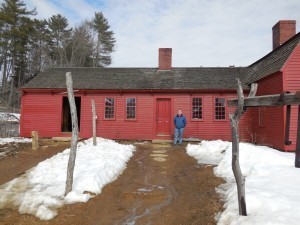
Buildings collected from all New England states create a rural community and small village of 1790-1840. Think a smaller, earlier version of Williamsburg, but somehow it seems to me more authentic. Costumed historians share what life was like in those times and demonstrate trades and crafts. We saw—and petted—the first lamb of the season, unusually early because, as the farmer said, “a ram jumped the fence.”

We also saw cattle, oxen, twin calves (I petted one), and chickens, all of breeds typical in those times but rare now.
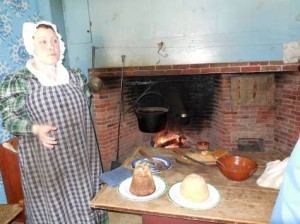
In the Small House, the historian showed us how an early Massachusetts wife made sugar from maple sap. Unlike in northern New England, in Massachusetts, they didn’t make syrup but purified the sap into an almost white sugar for sweetening. The woman was also frying doughnuts in a kettle hanging in the large fireplace. Not today’s ring shapes, but more like what we call donut holes, these are “nuts” made of flour dough (yes, thus the name!), deep fried in lard then rolled in sugar. No crowds early in March, so we were lucky to sample more than one of these tasty treats.
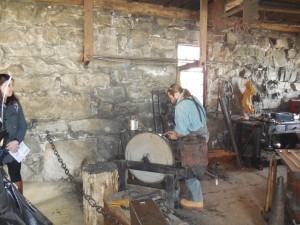
In the blacksmith shop, the smithy demonstrated how he gauged the temperature of the fire without a thermometer. He was forging a knife and first had to sharpen a tool.
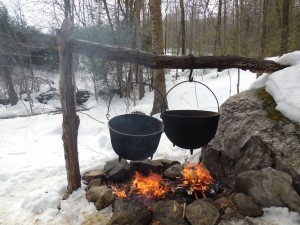
Sap wasn’t running yet, but the interpreter showed us how they gathered the sap and cooked it over open fires.
In warmer weather, OSV offers wagon and stagecoach rides, but with snow on the ground, people were enjoying a sleight ride around the green. In the background, you can see a small yellow house, and behind it the bank, the only brick building.

Two houses of worship dominated one end of the green. The Society of Friends, or Quakers, were a minority in New England but influential in ending slavery. The blue building was a Friends Meeting House. The worshippers in the Center Meeting House, the white, spired church, would have been Congregationalists, descendants of the Puritans.

 .
.
We thoroughly enjoyed our day and a half without modern technology. I was impressed with the interpreters’ depth of knowledge and how they were so immersed in their activity or subject, they seemed to have stepped out of 1800. The experience still has me pondering how difficult life was back then and how hard people worked from dawn to dusk. You can find more about the shops, houses, and businesses of Old Sturbridge Village at www.osv.org.
*** My newest release is Primal Obsession. You can find an excerpt and buy links at www.susanvaughan.com.
March 21, 2014
Weekend Update: March 22-23, 2014
 Next week at Maine Crime Writers we’ll be featuring posts from Susan Vaughan (Monday) Vicki Doudera (Tuesday), Lea Wait (Wednesday), and Jim Hayman (Thursday), and on Friday there will be a group post on Maine products.
In the news department, here’s what’s happening with some of us who blog regularly at Maine Crime Writers:
Kaitlyn Dunnett: This isn’t writing news, but it relates to Gerry’s post two days ago. We had fourteen inches of new snow dumped on us here in the western Maine mountains for the first day of spring. Here’s what our wood supply looks like at the moment.

And here are some of those turkeys Gerry mentioned, taking a stroll across our back yard before the latest snowfall.

Spring in central Maine. Ain’t it grand?
Lea Wait: It is! And more snow scheduled for tomorrow … one appearance note: Gerry Boyle and Jim Hayman and I will be speaking at the library in York, Maine, on Tuesday night, March 25, at 7 p.m. This is a panel that was postponed from February because of (guess what?!) — snow! I seem to be spending more on time on scheduling appearances than writing/editing right now, so stay tuned for other events in April, May … and beyond!
Barbara Ross: As of this writing (9:23 pm on Friday) Clammed Up is $1.99 on Kindle. So if you have avoided my previous entreaties, act now! P.S. As an added incentive and to link to the above, story takes place in June. It is warm and the flowers are blooming.
An invitation to readers of this blog: Do you have news relating to Maine, Crime, or Writing? We’d love to hear from you. Just comment below to share.
And a reminder: If your library, school, or organization is looking for a speaker, we are often available to talk about the writing process, research, where we get our ideas, and other mysteries of the business. Contact Kate Flora: kateflora@gmail.com
March 20, 2014
A Cure for the Middle-of-the-Book Blahs
So there I was, approaching the midpoint of the ninth Liss MacCrimmon mystery (no title yet), when I hit another of those obstacles that crop up every single time I write a novel. Yes, that’s right. I ran headlong into the middle-of-the-book blahs, where the plot is chugging along okay and the characters have all taken on distinct personalities and I know who the villain is and how the book is going to end but . . . and that’s a BIG but! . . . I was having a really hard time dragging myself to the computer every morning to crank out the next scene.
 Partly, that was because I didn’t have anything particularly exciting in mind for the day’s pages. Mostly, it was because I’d been working on this opus just about every day for weeks. I wasn’t tired of it. Not exactly. Nor bored. Exactly. But I wasn’t as revved up as I was at the beginning when everything was fresh.
NOTE: Refer back to my post on “the hardest part” if you’ve forgotten what I wrote about the early days of crafting a new novel. http://mainecrimewriters.com/kaitlyns-posts/the-hardest-part
So, how did I get out of the doldrums? First let me say that although I usually do manage it, there was one time recently when I didn’t. I started a stand-alone novel a couple of years ago with the idea that my agent could sell it on a proposal. That meant I needed to write a synopsis and the first one hundred pages or so. I came up with the requisite chunk of text, but by page one hundred (manuscript pages), when books these days tend to run less than three hundred, I was officially in the middle of the book. That’s when I realized that I didn’t know where I wanted the story to go. And that I’d pretty much lost interest in trying to make changes in what was already there to make it easier to sell. I knew I’d do something with the material someday, since I’m never one to let ideas go to waste, but at that point (October 2012) I set the manuscript aside and more or less forgot about it.
 I don’t have that option here. I’m under contract to deliver the manuscript of Liss #9 on the first of September and it’s supposed to be at least 75,000 words in length. There was another difference, too. I was pretty happy with most of what I’d written. It’s building toward the denouement I have in mind. But, were I to keep writing from my miscellaneous notes, I’d be typing THE END on my rough draft when it was still less than 50,000 words in length.
Oops.
Obviously, I needed to do more than just up the word count. Padding is always a bad idea. Most traditional mystery novels weave together the mystery plot (the sleuth discovering who dunnit) with one, and sometimes two, subplots. Usually a subplot involves an aspect of the sleuth’s private life. It could be a romantic dilemma, conflict with another character, or a secondary mystery that needs solving. Whatever it is, it needs to add depth to the novel and aid in character development. As a happy side effect, it increases the word count. Ideally, the plot and subplot are inseparable.
I began writing Liss #9 without a subplot in mind. There are other things going on besides the sleuthing, but nothing that intertwines with the main plot throughout the novel. That meant my biggest problem was easy to identify, but not so easy to cure.
The extreme solution (surgery) would be to toss out everything I’d written and start over from scratch. I wasn’t about to do that. There was too much about the WIP that I did like. What would have been most convenient, a “Eureka!” moment while washing the dishes or taking a shower (for some reason, immersion in water seems to promote creativity), did not materialize. Darn! So much for physical therapy. I was going to have to fall back on a tried and true course of treatment, one that has worked in similar situations in the past.
 When I was writing as both Kaitlyn Dunnett and Kate Emerson (non-mystery historical novels) I’d work on one type of book for awhile and then, when I needed a break or ran out of steam, I’d switch to the other. My subconscious would noodle whatever problems I was having with Book One while I was working on Book Two. When I hit a wall with Book Two, I’d go back to Book One armed with fresh ideas and renewed enthusiasm. Since there are no more Kate Emerson books on the horizon and since, writing as Kathy Lynn Emerson, I finished Murder in the Queen’s Wardrobe before I began work on Liss #9, I had no “other” project in the works and, until Murder in the Queen’s Wardrobe sells, I don’t want to do more toward a second book in that series than scribble down ideas.
Thank goodness the “cure” for my middle-of-the-book woes is somewhat flexible. After a couple of days of moping around the house without opening Liss#9text.doc, I belatedly remembered the hundred pages of that unfinished stand-alone. No, I was not suddenly inspired to finish writing that novel, but within those hundred pages there were several scenes where the protagonist encounters crime. It had already occurred to me that one or more of those incidents could be turned into a short story. My hope was that writing a short historical mystery would give me the same kind of break from writing a contemporary humorous mystery that working on a non-mystery historical had.
 I can’t guarantee this cure with work for everyone, or even that it will work every time for me, but in this case it definitely helped. By the time I’d polished two short stores about Old Mother Malyn, a mid-sixteenth century herb woman, healer, and finder of lost things, and her granddaughter Joan (the “Watson” character), I’d come up with an idea for a subplot for Liss #9. How well it will work remains to be seen, as does whether either of these short stories will find a publisher, but I’m pleased to report that I’m now back at work on Liss #9. My stalled enthusiasm for the project has been jump started.
Stay tuned in a month or so for a post about the next hurdle, the end of the book, where I’ll no doubt be struggling to come up with a thrilling climax while also finding just the right words to bring the story to a close.
******************
P.S. This afternoon I stopped by one of my favorite blog sites and lo and behold Dana Cameron is talking about this same subject. Here’s the link: http://femmesfatales.typepad.com/
Maine Winter Noir
Hey all. Gerry Boyle here. I’m a little tired today so bear with the typos, should there be any. I was up in the middle of the night, as has become my habit of late. I wake up, try to go back to sleep, toss and turn, but finally give up.
It’s no use. I just have to check.
The outside temperature.
It’s been cold in my neck of the Maine woods for the last, well, it seems like forever. How cold, you say? So cold the feral tom cats under our barn have given up fighting and are huddled together for warmth. So cold that the turkeys are coming in from the fields to scrounge under the birdfeeder. So cold that last night sometime between 8 p.m. and 4 a.m., one of our cars, an SUV, slid down to the road on the ice-covered driveway. What got it started? A gust of northwest wind? One of those cats jumping on the hood?
Last night it was 10 degrees, balmy. We’ve gotten so that anything around zero is normal, and for a while there double digits below zero barely raised a shiver. I feel like an Alaskan, or I would except that parts of Alaska have been warmer than Maine. A couple of days ago it hit the high 20s and I was driving around with the sunroof open. If the revision of my next book is late I’ve got a good excuse: I was putting wood in the stove. And putting wood in the stove. And putting wood in the stove.
Which brings me to the point (about time he stopped his whining, you say). On April 19 I’ll join some of my colleagues on this blog as we take part in Maine Crime Wave, a crime-writing conference in Portland. We’ll talk shop, tell stories, try to help each other with the finer points of this particular and peculiar craft. It should be fun. And warm.
In the run-up to this event, we’ve been interviewed by the Maine press, and one of the questions we’ve been asked is, “Why is Maine so conducive to mystery writing?” I spoke to Maureen Milliken, a newspaper editor and columnist (and crime writer) and I talked, I think, about how crime in Maine isn’t lost in general mayhem, as in other places. In Maine we have time and inclination to consider motive and consequences, character and circumstances.
But after I hung up, and I was looking out the window at the frozen tundra, the gun-metal gray ice, the snow piled outside the north window four feet high, I had another idea. You know how they say that during heat waves people go nuts in a criminal sort of way? Well, what happens during a Siberian-style Maine cold snap? I’ll tell you what happens. You get very quiet. You have very dark thoughts. You begin to think of the ways that people annoy you, especially the ones who jet off to the Caribbean and come back all cheery and tanned.
And maybe, just maybe, the cold and the dark get to be too much. And somebody pushes you just a little too far. And you do something you’ll regret for a very long time. From the warmth of your prison cell.
And that will become fodder for the kinds of people who invent stories about people like you. They do this to pass the time during the long Maine winter, when they wake up to the sound of the furnace running, the house creaking, mice doing laps in the walls.
And check the temperature. And it is cold.
Still.
March 19, 2014
Fascinating Fillers
 Earl Smith / March, 2014: I really like those filler pieces that magazine editors use along the edges of their pages. I often learn a thing or two. Sometimes, they give me pause. For example, I was recently startled to discover that Olympic officials distributed 100,000 condoms to the 7,650 athletes at the Winter Games in Sochi, and, not far away, another blurb explained that nearly 30% of Americans didn’t read a single book in all of 2013.
So, you might ask, exactly what do these random bits of information have in common? It’s a fair question, and the answer could well be ‘not much,’ except for one thing. Both of them proffer discouraging news to writers who like to sell their books.
Take the Olympic story, and do the numbers. This grand latex handout amounted to 35 condoms for each and every athlete to ration out over the two-week duration of the winter games. That seems to me to be a most ambitious project, even for athletes. Olympic indeed! But, here’s my point: These numbers also suggest there was precious little spare time in Sochi for reading books. (Never mind the dent that was left in the general population of future readers.)
As for Americans, writ large, the Huffington Post reports that in 2013, 41% didn’t read any fiction, 42% didn’t read non-fiction, and 28% didn’t read any books at all. These numbers have more than tripled since 1978. That means, I suppose, that whenever we stand in a three-person line for a cup of coffee latte, we can be quite certain that one of us hasn’t picked up a book in a very long time. What will we talk about? The weather? Of course.
So, exactly what are these people doing if they aren’t reading books? (I’m not talking about the Olympians, here. We already know what they’re doing.) I’m talking about the rest of us, and I have a pretty good idea about that, as well. The Information Age is leading to the Information-less Age. Too many of us are absorbed with electronic gadgets that talk, twitter, text and email. Clearly, we are improving the dexterity of our thumbs to the exclusion of our minds. OMG
The solution is simple, albeit somewhat elusive. As with any effort to swing the public mind, we must begin with the children. Read them books, buy them books, and talk with them about books. And, while we’re at it, make their bedrooms and eating spaces electronic-free zones – no TV, no computer, no phone. If this seems a bit daunting and harsh, it’s only because we aren’t doing it ourselves.
As for the rampant use of condoms, I just don’t know. The topic is well beyond my expertise. LOL
Earl Smith is the author of the The Dam Committee, a comic crime caper set in Belfry, Maine. A second book, More Dam Trouble, https://www.facebook.com/moredamtrouble will be released by North Country Press on April 7. http://www.northcountrypress.com/
Lea Wait's Blog

- Lea Wait's profile
- 508 followers

