Joanne Leedom-Ackerman's Blog, page 9
May 22, 2020
PEN Journey 29: Mexico City and the Road Ahead—Part II, Substance
PEN International celebrates its Centenary in 2021. I’ve been active in PEN for more than 30 years in various positions and now as an International Vice President Emeritus. With memories stirring and file drawers of documents and correspondence bulging, I am a bit of a walking archive and have been asked by PEN International to write down memories. I hope this personal PEN journey will be of interest.
The 2003 International PEN Congress in Mexico City celebrated the First Congress of the Americas. Hosted by Mexican PEN, it was also supported by Canadian PEN, Quebecois PEN, American PEN, and the Latin American PEN Foundation. Organized around the theme of “Cultural Diversity and Freedom of Expression,” the 69th Congress welcomed delegates from 72 PEN Centers from every continent except Antarctica.
As well as reporting on the welcoming of new centers, Part 1 of PEN Journey 29 recounted an historic Charter amendment, major rules and regulation changes and a strategic plan—the nuts and bolts and essential frame for any organization, especially one as complex as International PEN as it sought to modernize its governance and structure. In Part II the focus turns to the substance of PEN’s work and of the 2003 Congress.
The final gathering under the presidency of Mexican poet and novelist Homero Aridjis, PEN’s 69th World Congress hosted more than 250 participants, speakers and guests, including Nobel laureate and PEN International Vice President Nadine Gordimer and also listed on the literary programs Nobel laureate and former PEN International President Mario Vargas Llosa and many writers from the Americas—Michael Ondaatje, John Ralston Saul, Francine Prose, Andrés Henestrosa and writers from at least 12 indigenous regions and languages in Mexico—Huichol, Maya, Mazahua, Mazatec, Mixtec, Náhuatl, Tenec, Tojolab’al, Tzotzil, Wuirárica, Yoleme, Zapoteca.

PEN International 69th Congress. L to R: Deborah Jones (PEN USA West), Jens Lohman (Danish PEN), Isobel Harry (Canadian PEN), Terry Carlbom (PEN International Secretary), General José Francisco Gallardo (former PEN main case) and his family; Nadine Gordimer (PEN International Vice President) and General Gallardo; General Gallardo, translator, and Jens Lohman (photos courtesy of Sara Whyatt)
Homero Aridjis noted: “The Congress programs explore the literature of the Americas, of Canada, the United States and Latin America, shining a particular light on the indigenous literatures which are so essential to understanding the cultural map of our continent from Chile to Canada.”
“At this Congress indigenous, native literature became a part of International PEN through presentations,” Carles Torner, Vice Chair of the Translation and Linguistic Rights Committee told the Assembly though he noted the Indian languages were still not represented in the Assembly. “But for many years to come the Mexican Congress will be remembered as the Congress at which indigenous literature entered PEN.”
Mexican PEN President María Elena Ruiz Cruz reflected that the Congress theme “Cultural Diversity and Freedom of Expression” gave PEN the opportunity to work on two essential aspects of its core mission—respect for human rights of those whose medium is the word and respect for sovereignty and cultural diversity, which is essential in the face of increasing anti-democratic tendencies.
One of PEN’s main cases Mexican Brigadier-General José Francisco Gallardo Rodríguez addressed the Assembly, thanking PEN for all its efforts on his behalf. Released from prison just the year before, he said that without the work of PEN’s Writers in Prison Committee, it would have been very difficult to obtain his release. He asked his wife to address the Assembly.
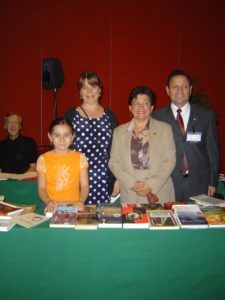
Book display at PEN 69th Congress. Lucy Popescu (English PEN), Señora Gallardo, General Gallardo and their daughter (In background Eugene Schoulgin (WIPC Chair) (photo courtesy of Sara Whyatt)
Señora Gallardo said her husband had spent eight years and three months behind bars. To this Congress they had brought the many books that had been sent to him by PEN members when he was in prison, books in many languages. They were displaying them at the book festival in the conference hall. These books had helped him endure imprisonment. “The windows were opened; there were no walls for him; he did not feel he was in prison,” she said because of these books. They would visit him and instead of finding someone who was inhibited and shy, he was the opposite and would encourage them to keep fighting. With PEN’s support they had been able to obtain his freedom. They received 35,000 letters, some of which delegates could see in the boxes they had also brought with them. It was the strength of that ink that had enabled her husband to be with PEN on this occasion, she said.
General Gallardo told the delegates that on November 9, 1993 he had published an article on reforming the army in a military magazine. From that moment he had been persecuted by the military high command who had tried to take away his right to free speech, a right—as he had told them—that was enshrined in the Mexican constitution. For this he had been imprisoned for eight years and three months. The high command had harassed his family, attempting kidnapping and shooting, but he was convinced that they had survived because they had stayed firm. His stand on freedom of speech had started a debate on one of the prohibited subjects in Mexico—the army. He had also acted in defense of freedom in teaching and in research as a university student; his article was the result of research he had undertaken on the need to greatly reform the Mexican army. It had created considerable conflict in Mexico and had demonstrated that to do away with the culture of impunity in Mexico and to transform the Mexican state, first the army must be reformed—it must be returned to its barracks so that democracy and justice could be achieved in Mexico.
International Vice President Nadine Gordimer expressed her great concern, which she knew was shared by everyone, she said, at what had been happening for the past ten years to mainly young and poor women, and some students and workers. She wanted to propose the recording of the Congress’s condemnation regarding the murders of women in Ciudad Juarez. She did not know whether there had been any inquiry into the torture and abductions of these young women in towns on the Mexican-American border or a great deal about their circumstances, but they seemed to be young and poor and defenseless and because PEN was concerned for human dignity as well as having very strong feelings about violence and victimization, she felt it would be appropriate for PEN to ask for an enquiry into the whole matter. A letter of concern and protest was drafted and signed by delegates and PEN’s leadership to Mexico’s President Vicente Fox, who was listed on the as attending the Congress’ Opening Ceremony.
At the Congress PEN’s Writers in Prison Committee delivered two reports—one on Freedom of Expression and Impunity Campaign and the other on Anti-Terrorism, Writers and Freedom of Expression. Isobel Harry of Canadian PEN reported that the Freedom of Expression and Impunity Campaign launched with assistance of Canadian PEN, American PEN and WiPC headquarters last year at the San Miguel de Allende WiPC Conference and had produced a study of over 400 cases of murders of writers since 1992. It also produced a handbook on how to campaign against killings with impunity. PEN had highlighted cases of killings with impunity for the UN Commission on Human Rights where a submission had been made. PEN called upon the United Nations, the Inter-American Commission on Human Rights of the Organization of American States and national governments to bring to justice those who employed murder as a tool of censorship. The Impunity report, published in English and Spanish and the handbook was available to all centers, and an Impunity Watch was being set up to alert PEN members to react to killings as soon as they were reported.
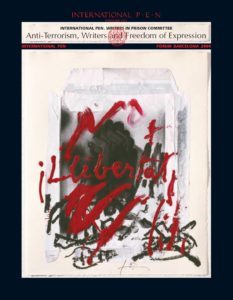
Anti-Terrorism, Writers and Freedom of Expression report issued by PEN International at 2003 Congress
Joan Smith of English PEN reported on the Anti-Terrorism, Writers and Freedom of Expression report which grew out of PEN’s London meeting in November 2001 shortly after the 9/11 attacks on the United States. In this report just published in English, French and Spanish 35 countries had been identified where “anti-terror” actions curtailed free speech and challenged legitimate protest in France, Britain, Russia, Israel/Palestine among others. The situation had also led to alliances between the U.S. and countries with poor human rights records such as Uzbekistan. The “war on terror” can empower those who use violence, she said, legitimizing them as much as suppressing. The report was distributed at the meeting and would be given to PEN Centers’ local news media and also to Foreign Offices.
Eugene Schoulgin, Chair of the Writers in Prison Committee, noted in his 2003 Report to the Congress, “We have deep concerns that the called fight against international terrorism has in far too many countries and situations become a tool in the hands of those in whose interest it is to silence intellectual criticism and persecute writers and journalists who raise their voices in protest. The legislation in defense of the right to free expression is weakened and more short time sentences and many more cases of harassment are reported to us.”
The Assembly passed Writers in Prison Committee resolutions condemning attacks on writers and limitations on freedom of expression and impunity in the Americas, Algeria, Belarus, China, Cuba, Ethiopia, Iran, Italy, Myanmar (Burma), Russia, Syria, Tunisia, Turkey, Uzbekistan, Vietnam, USA, and Zimbabwe. These resolutions were added to by resolutions from the Translation and Linguistic Rights Committee on Minorities in Russia and on linguistic rights of Kurds in Turkey, Iran and Syria. Resolutions from the Peace Committee focused on Israel & Palestine and Chechnya.

Jiří Gruša, new PEN International President
At the 2003 Congress Homero Aridjis stepped down after six years as President. Only one candidate was presented for the office: Jiří Gruša, Czech/German writer and a close colleague of PEN Member playwright Václav Havel, who had once been a PEN main case when he was imprisoned and later had served as President of his country. Václav Havel had finished his term of office earlier that year and had been approached to stand as President of International PEN. Instead he recommended his close friend Jiří Gruša, nominated by Austrian PEN.
Wolfgang Greisenegger of Austrian PEN told the Assembly that Jiří Gruša was not only a poet, essayist and novelist and fluent in Czech and German, he was also a journalist of conviction “who would always fight for the right cause, in the best PEN tradition.” As a dissident and a close friend of Václav Havel, he had paid dearly for his convictions, both by being forbidden to publish his work and by imprisonment and loss of his citizenship. However, his struggle on behalf of freedom of expression had led him to continue even under the worst conditions of a communist regime as a publisher and reader, first in Czechoslovakia and then in exile in Germany. His voice could not be silenced, and he moved not one inch toward totalitarianism. Under the new republic he was appointed Czech Ambassador in Germany by Havel, and he later served his country in the same capacity in Austria. But even as a diplomat and civil servant, he never ceased to be a free intellectual, daring to speak out when necessary. “Freedom fighter, dissident and experienced diplomat makes him ideal to be PEN’s next International President.”
Cecilia Balcazar of Colombian PEN seconded the nomination. Others noted Jiří Gruša had also been a signatory of the famous Charter 77 which had preceded the overthrow of the communist regime in Czechoslovakia.
After discussion on the need for having a wider choice of candidates in the next election, Jiří Gruša addressed the Assembly. He stressed that he had lived more than half his life under regimes that had suppressed freedom. He came from a small nation that had been forced to fight for its language and its statehood, and he knew firsthand that a state and a language did not automatically guarantee freedom.
In his official statement, he said, “International PEN, the only organization above and beyond all national and cultural borders, draws its strength from the amicable and responsible cooperation of its authors. It unites the diversity of languages and thus is given a more diversified mission. In addition to the defense of the freedom of the word comes a battle for the multiplicity of linguistic innovation for the ability to create a metaphor of our being. These are the hallmarks of every literature and they form the basis of our international standing. The men and women gathered in International PEN pursue writing as an art, and are ready to assume all the needed risks. H.G. Well’s slogan—no politics under any circumstances—remains valid, even if it has become more politicized. Today it also means leaving room for the free expression of metaphoric quality—irrespective of governments.” Jiří Gruša was elected the next President of International PEN.
In the limited free periods at the Congress delegates also explored the city. Homero had pointed out that Mexico City was the historic, political and economic center of the Mexican civilization with ubiquitous archaeological ruins in the city. He noted that Mexico had received via Spain, the contributions of the European and Arab cultures, including the Spanish language, the Judeo-Christian religion, the university, the printing press and a pluralistic concept of living. In the past Mexico had been the cultural bridge between the Old and New Worlds, and in the present thanks to its geographic place and the lives of its people, it was the border and the meeting place between North and South America. It was both a recipient of and a catalyst for cultural diversity that encompassed past, present and future, he observed. “I sincerely believe that without cultural diversity, the only force capable of counterbalancing unrestrained and denationalized globalization, we will not be able to understand the world of the 21st century.”
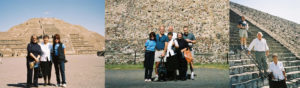
Exploring ruins in Mexico City during PEN International’s 69th Congress. L to R: Joanne Leedom-Ackerman (PEN International Vice President), Fawzia Assaad (Swiss Romand Center), Deborah Jones (PEN USA West); Deborah Jones, Jay Corcoran (PEN America), Fawzia Assaad, Eric Lax (PEN USA West), Joanne Leedom-Ackerman, Michael Roberts (PEN America); Mike Roberts, Eric Lax, Fawzia Assaad
Next Installment: PEN Journey 30: Barcelona—A Surprise
The post PEN Journey 29: Mexico City and the Road Ahead—Part II, Substance appeared first on Joanne Leedom-Ackerman.


May 21, 2020
PEN Journey 29: Mexico City and the Road Ahead—Part I, Form
PEN International celebrates its Centenary in 2021. I’ve been active in PEN for more than 30 years in various positions and now as an International Vice President Emeritus. With memories stirring and file drawers of documents and correspondence bulging, I am a bit of a walking archive and have been asked by PEN International to write down memories. I hope this personal PEN journey will be of interest.
A PEN International World Congress is a hybrid—a mini-UN General Assembly with delegates sitting at tables behind their center’s (and often country’s) name plates discussing world affairs that relate to writers; an academic conference with panelists addressing abstract philosophical themes; a literary festival with writers reading their poetry and stories and sharing books, and finally a civic engagement with resolutions passed on global issues which are then delivered, sometimes by a march or candlelight vigil to a country’s embassy that is oppressing writers.
Heads of state and UN officials frequently visit and/or speak at PEN Congresses depending on the openness of the host country; esteemed writers, including Nobel laureates, and former PEN main cases are often guests. The Congress’ size varies depending on the resources available, but the financial commitment is out of reach for many PEN Centers.
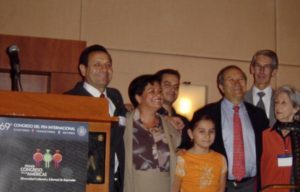
PEN International 69th Congress 2003. L to R: PEN main case General José Francisco Gallardo and family; Homero Aridjis, PEN International President; Terry Carlbom, PEN International Secretary; Nadine Gordimer, PEN International Vice President. (photo courtesy of Sara Whyatt)
The 2003 International PEN Congress in Mexico City was celebrated as the First Congress of the Americas. Hosted by Mexican PEN, it was also supported by Canadian PEN, Quebecois PEN, American PEN, and the Latin American PEN Foundation. It was the final Congress under the presidency of Mexican poet and novelist Homero Aridjis. Organized around the theme of “Cultural Diversity and Freedom of Expression,” the 69th Congress welcomed delegates from 72 PEN Centers from every continent except Antarctica. At the Assembly six new centers were admitted—Afghanistan, Morocco, Paraguay, Spain, Trieste, and Zambia; three dormant centers—Chilean, Kenyan and German-speaking Writers Abroad—were reinstated as active.
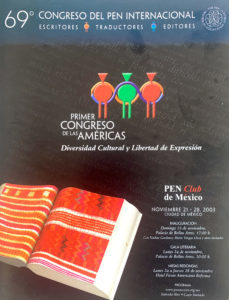
PEN International First Congress of the Americas 2003 in Mexico City. Theme: Cultural Diversity and Freedom of Expression
The admission of new centers was especially celebratory because of the number and the variety, leading with Afghanistan. Two delegates—a man and a woman—had traveled from Kabul in spite of the conflict in the country. Eugene Schoulgin, chair of the Writers in Prison Committee and member of Norwegian PEN, had visited Afghanistan twice that year along with Norwegian PEN member Elisabeth Eide. Eugene told the Assembly how impressed they were by the courage and vitality of the Afghan writers. “For them, after so many years of war, it was extremely important to open a window to the world through which they could look outwards and through which others could be introduced to their rich literature and culture and become friends in this tormented part of the world.”
Twenty Afghan writers had rented space in Kabul for a writers house, signed the PEN Charter and sent it to London with their membership application. (Less than a decade later there were 1000 members of Afghan PEN.) The Afghan delegate Partaw Naderi told the Assembly in order to reflect the major languages and communities in Afghanistan, the center planned to have a Pashtun language section, a Persian language section, and a section for Uzbek, Turkmen and other local people. In the last three decades writers had become refugees, mainly in Pakistan and Iran and some in the West, he said. Now one of the cultural centers in Kabul was ready to publish work by some of them though “freedom of expression was very, very limited” with frequent attacks and killings of writers and journalists. He had made the long trip to attend PEN’s Congress in order “to be among kind people,” and he profoundly wished for democracy and freedom of speech in Afghanistan.
Alexander Tkachenko of Russian PEN and a PEN International Board member observed that the Soviet Union had brought great trouble for 20 years to the Afghan people, their culture and literature, and he apologized for this and gave support to the new PEN center.
In response, Safia Siddiqi, the second Afghan delegate, said writers were not enemies; it was the governments. “Pens did not kill people, pens constructed things and helped people to join together in friendship,” she said, urging “their brother from Russia,” not to feel that writers were ever the enemy of each other. Thanking all who had made this trip possible, she noted it was also important that women participate and overcome restrictions and cross boundaries to come to places like Mexico.
Every new PEN center has its own story and mandate. I expand here on only one more at the Mexican Congress because that center’s raison d’etre also represented a change that was about to be voted on regarding PEN’s Charter.
The Trieste Center’s organizing principle was not nationality—it was located in Northern Italy—nor a single language—the writers spoke and wrote in Italian and many other languages—but culture as an organizing principle. The majority of PEN Centers were formed around geographic and national locations such as the new Morocco, Paraguay and Zambian centers. Countries can have as many as five centers if the nation is large like Russia, China and the U.S. or if there are multiple languages originating within its borders such as Spain which now had three centers—Catalan, Galician and Spanish centers or like Switzerland which had four centers—Swiss Romand, Swiss German, Swiss Italian-Reto-Romanish, and Esperanto. A few centers were formed in exile when the host country was not free enough for a PEN Center like Vietnamese Writers Abroad or Cuban Writers in Exile centers.
The Trieste Center was unusual. Endorsing the new center, Giorgio Silfer of Esperanto PEN observed that PEN centers did not represent nations; they represented literature, and literature did not need a nation to give it identity—as was the case with Yiddish, Roma and Esperanto. Literature established its own territory, and when a language was dead, its literature was simply and only an expression of connection with memory, he said. Trieste was a unique place, a cosmopolitan city: its writers in Italian were the expression of a culture that was not exactly Italian culture, but which incorporated expressions from other linguistic traditions.
Tone Persak of Slovene PEN added that Trieste had been “the town in the open space, on the open wind.” There had been extraordinary writers in different languages there: Italian, Slovene, English, Spanish, Croatian, Serbian, Yiddish, German, Friulian and so on. James Joyce, Rainer Maria Rilke, Italo Svevo, Juan Octavio Prenz. It had been a town of many conflicts but also the town of the cohabitation of different cultures.
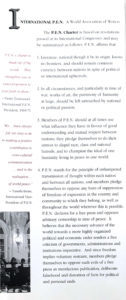
PEN International’s Charter before amendments in earlier brochure
Serbian delegate Vida Ognjenović and Croatian delegate and PEN International Board member Sibila Petlevski highlighted the multilingualism in Trieste and observed that the current situation after many, many Balkan wars had created an environment in Trieste where a PEN Center whose members came from different nations could cooperate with the Italian Center and all the other Centers in the region and give rise to new ideas. The Trieste Center was accepted.
The following day an amendment to PEN’s Charter was approved, the first change to this central document since the Charter’s text was agreed at the 1948 Copenhagen Congress. Literature’s origin beyond nationality informed the amendment which had been presented at the 2002 Macedonian Congress and vetted over the past year. The revision was a simple deletion of words. The Charter’s first item would now read: “Literature [deleted “national though it be in origin”] knows no frontiers and must remain common currency among people in spite of political or international upheavals.”
At the Mexico Congress another amendment was proposed and discussed for the fourth item in the Charter and would have a year for further consultation. The vote would come at the 2004 Congress. Both amendments involved a fine-tuning of words, reflected in the many pages of minutes, and an attention and passion for language and the translation of language which only a gathering of writers would have patience for.
These amendments and the changes proposed for the Regulations that evolved in the strategic planning process were shepherded by the International Secretary Terry Carlbom and especially by the Administrative Director Jane Spender whose patience and humor and intelligence kept everyone on track. The laborious task of taking more than 130 delegates through 30 Articles, often with subsets, fell to PEN International Board Member Eric Lax whose Sisyphean patience and care led the Assembly item by item. Ultimately all the recommended changes to the governance and structure of International PEN were approved.
The highlights involved the role and authority of the International PEN Foundation which focused on gathering resources for PEN and whose trustees had a voice on the Board but were also governed by the Board; the roles and authority of the International Secretary, the President and Board. The International President was to be a “distinguished writer of international literary reputation,” and the International Secretary was to have “actively participated in the affairs of International PEN” and was given a vote on the Board. These relationships were a moving target and would remain so over the years to come. In 2003 the President was given the discretion to lead and chair the Board and the Assembly but not the obligation so the role would depend on who occupied the office. A more formal Search Committee was established to seek out candidates for the positions of President, International Secretary and Board and to be elected by the Assembly on nomination by the Board. Chairs of both standing and special committees could attend regular board meetings but had no vote.
Deputy Chair of the Board Judith Rodriguez (Melbourne PEN) reported to the Assembly that the first Aim of the Strategic Plan, “Building the community of writers” included the item “expand PEN’s presence around the world and, in doing so, develop its humanitarian and cultural mission.” PEN was now pursuing a policy of cooperation with other organizations, initiated by the International Secretary’s signing of a cooperation agreement between International PEN and the European-Pacific Congress Alliance. The full Strategic Planning document would continue through a consultative process with the centers and be on the agenda for approval at the 2004 Congress in Tromso, Norway.
Parsing through, revising, getting approval of strategic plans and regulations for an organization as complex and diverse as PEN was a tedious but necessary task and reminded me of the book title “The Anarchists’ Convention.” Though rules and regulations and strategic plans would change in the years ahead, the Mexico Congress document was a base from which PEN grew and shape-shifted. Those who sat in the large Fiesta Americana ballroom can perhaps still hear Eric’s patient voice: “And now turn to Article 23…Comments…There being no further discussion, Article 23 is approved. Now turn to Article 24…”
Next installment: PEN Journey 29: Mexico City and the Road Ahead—Part II, Substance
The post PEN Journey 29: Mexico City and the Road Ahead—Part I, Form appeared first on Joanne Leedom-Ackerman.
May 11, 2020
PEN Journey 28: Bellagio: Looking Forward—PEN for the 21st Century
PEN International celebrates its Centenary in 2021. I’ve been active in PEN for more than 30 years in various positions and now as an International Vice President Emeritus. With memories stirring and file drawers of documents and correspondence bulging, I am a bit of a walking archive and have been asked by PEN International to write down memories. I hope this personal PEN journey will be of interest.
In discovering Lake Como in Northern Italy on a walking tour in 1790 poet William Wordsworth called it “a treasure, which the Earth keeps to itself.” Poet Percy Bysshe Shelley declared it “exceeds anything I ever beheld in beauty with the exception of the arbutus islands of Killarney.” He extolled the chestnut, laurel, bay, myrtle, fig and olive trees that “over-hang the caverns and shadow the deep glens which are filled with the flashing light of the waterfalls.” These descriptions from the English romantic poets are matched no doubt by Italian and other poets encountering Lake Como, one of Italy’s largest and one of Europe’s deepest lakes.
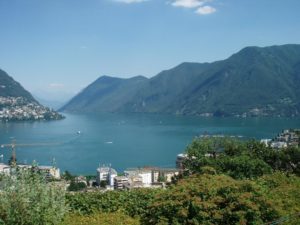
Lake Como—“a treasure which the Earth keeps to itself” and the site of PEN International’s strategic planning conference, July, 2003
Lake Como is one of my favorite places so meeting for an International PEN strategic planning conference above the shimmering Y-shaped lake set among the Alpine foothills was an ideal working vacation the summer of 2003. I participated as a PEN vice president and a trustee of the International PEN Foundation and former Writers in Prison Committee chair, along with International PEN’s President Homero Aridjis, International Secretary Terry Carlbom, Treasurer Britta Junge Pedersen, current and past board members, other trustees of the International PEN Foundation, several vice presidents and the standing committee chairs.
Twenty-six of us from 14 countries gathered to discuss the changed global context for PEN, which had grown from 95 to 134 centers in the last 14 years, and to consider the demands on this organization dedicated to the role of writers in promoting intellectual co-operation, tolerance and pluralism in the world.
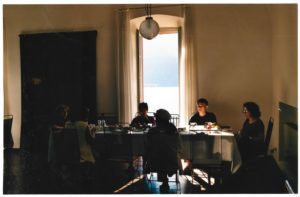
Working session of PEN International’s planning conference, 2003 (photo courtesy Carles Torner)
There had been significant growth in the activities and programs carried out by PEN centers and by the international office. In 1991 a Women Writers Committee had been founded. In 1992 an associated charity, the International PEN Foundation was created, and now British charitable law had changed so a charitable corporation would replace it. In 1998 following the revision of the Regulations, a nine-member Board came into existence, and in 1999 the Writers in Exile Network was formed. All of this had occurred in a rapidly changing globe, placing strain on PEN’s membership and structures.
With the help of American PEN, International PEN had received funding for the large strategic planning initiative from the Andrew W. Mellon Foundation and a grant for the four-day residency at the Rockefeller Foundation’s Bellagio Study and Conference Center. Edmund (Mike) Keeley, former American PEN president, and , American PEN’s executive director, had been instrumental in getting the grants, and Mike Roberts, a lawyer, served as pro bono counsel for International PEN in the process. George Gawlinski, director of Planning Together Associates who had worked with PEN before, facilitated the discussions.
The Rockefeller Foundation’s Villa Serbelloni spread out above the village of Bellagio, which climbed the hills with cobbled streets and terraced gardens and sat on a promontory at the intersection of the fingers of the lake. Water was visible on all sides.
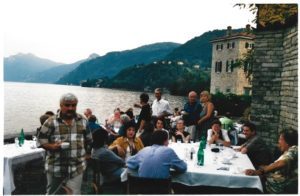
Delegates taking a break at PEN International’s strategic planning conference at the Rockefeller Foundation’s Study and Conference center in Bellagio, Italy, 2003 (photo courtesy Carles Torner)
All of us knew each other, had worked together over many years and knew PEN International. A smaller group had already met twice in London for preliminary planning. The goal of the Bellagio meeting was to re-examine major areas of PEN’s life, including governing structures, scope of its programs, the role and structure of the Secretariat and plans for fundraising. The hope of the conference was that we would reach an interim consensus that could then be circulated to the PEN centers for comment so that a final plan could be approved at the fall 2003 World Congress in Mexico City.
We debated and discussed programs and structures in workshops and at meals and in winding walks over the hills. It was difficult at times to parse through strategic aims, governance, center development, capacity building and financial models while looking out on the expanse of blue sky and water with poetry and history fleeting in and out of thought, but we managed to take on each issue, share ideas and finally agree on a document and recommendations.
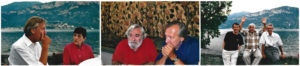
PEN members at strategic planning conference on Lake Como, 2003. L to R: Eugene Schoulgin (WiPC Chair/Norwegian PEN), Judith Rodriguez (PEN Board/Melbourne PEN), Moris Farhi (Vice President/former WiPC chair/English PEN), Eugene Schoulgin, Hori Takeaki (PEN Board/Japan PEN), Alexander (Sascha) Tkachenko (Russian PEN), Terry Carlbom (International Secretary/Swedish PEN) (photos courtesy Carles Torner)
One immediate discussion in the wings and at informal meetings during the conference was who would be the next President of International PEN. Homero Aridjis’ second term concluded at the Mexico Congress. The PEN centers and Search Committee had yet to nominate a candidate. Central to the formal and informal discussions was the role of the President and the International Secretary—both volunteer positions. Was it not time for International PEN to hire a professional paid executive director to manage the organization? If PEN decided to embrace that course, was there still a need for both a President and an International Secretary? These roles had changed over the years, in part depending on who occupied them. During the 17-year tenure of the immediate past International Secretary, the position had essentially been an executive position with a budget for travel but not a salary. PEN, however, had recently imposed limits of two 3-year terms for both the offices of the President and International Secretary. In 2003 the International Secretary did not have a vote on the Board, but that would change.
The 2003 deliberations, before an executive director was added, concluded that there was still a need for both positions, especially if PEN chose as its President a world renowned writer who was not able to attend to the running of PEN but one who served as a voice for PEN with governments and at events.
At the Bellagio conference there were several unofficial conversations about who might be the next president. In my files I found a list of 33 writers discussed. None was the name finally nominated and elected that fall in Mexico City, but the ultimate candidate was a close colleague of one of those eminent PEN members on the list, and that center endorsed the candidacy.
PEN Journey 29 will focus on the Mexico Congress, introduce the new president and outline the results of the long range strategic plan agreed by International PEN’s Assembly of Delegates as the organization embraced the 21st century.
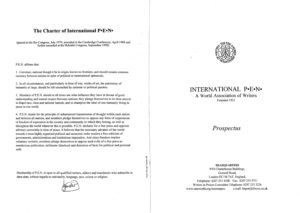
PEN brochure draft with note for potential change in Charter to include “gender.” This change came in later years.
Next Installment: PEN Journey 29: Mexico City and the Road Ahead
The post PEN Journey 28: Bellagio: Looking Forward—PEN for the 21st Century appeared first on Joanne Leedom-Ackerman.
May 4, 2020
PEN Journey 27: San Miguel de Allende and Other Destinations—PEN’s Work Between Congresses
PEN International celebrates its Centenary in 2021. I’ve been active in PEN for more than 30 years in various positions and now as an International Vice President Emeritus. With memories stirring and file drawers of documents and correspondence bulging, I am a bit of a walking archive and have been asked by PEN International to write down memories. I hope this personal PEN journey will be of interest.
Over the years I’ve used various metaphors to describe PEN International—a giant wheel with 140+ spokes that reach out into the corners of the globe. A vast orchestra with the string, woodwind, brass and percussion sections scattered across the map, directed by local conductors and the Secretariat in London.
PEN’s core is an idea, codified in its Charter, acted upon by writers around the world organized into PEN centers. These writers and centers gather intensity as they work together.
PEN International logo in 2002
Writers in a country or region or language are empowered to work as a center of PEN by the whole body of centers—the Assembly of Delegates—which vote on a center’s membership at PEN’s annual Congresses. During the months in between, PEN centers act both individually and collectively—celebrating and presenting literature in the many cultures and languages, mobilizing on issues of freedom of expression, acting to preserve and celebrate languages and translation, in particular minority languages, discussing and debating issues of peace, addressing the situation of women writers, and assisting and protecting writers who find themselves in exile. All of this activity between the annual Congresses occurs in the PEN centers and in the work of PEN International’s standing committees and at regional conferences which convene during the year.
I take a moment here to set out this template because in the PEN Journeys I’ve been focusing in large part on PEN’s annual Congresses. Yet the heart and soul of the organization resides in its centers and the individual members, most of whom never attend a PEN International Congress.
Some centers host the meetings of PEN’s standing committees. Slovene PEN has long hosted the annual Peace Committee meeting in Bled, Slovenia (PEN Journey 14). Until recently Macedonian and Catalan PEN have alternated hosting the Translation and Linguistic Rights Committee’s annual meetings either in Ohrid or Barcelona. The Women’s Committee set a new paradigm when it formed in 1991 by rotating its chair to different regions of the world and hosting its meetings there though recently because of costs, the Women’s Committee has held its meetings along with other committees, usually with the Peace Committee in Bled. As I’ve written in earlier posts (Journey 17 and 23) the Writers in Prison Committee began holding a biennial meeting in 1996, hosted by different PEN Centers. In recent years to share costs, the Writers in Prison Committee (WIPC) has teamed up with ICORN (International Cities of Refuge Network) to hold its biennial meeting in different countries. The recent 2018 WIPC meeting was held aboard a docked cruise ship in the Rotterdam Harbor.
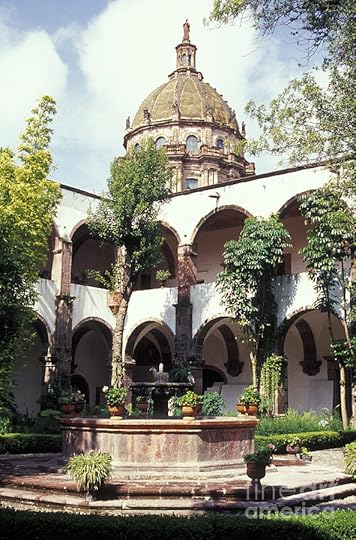
Bellas Artes Center, San Miguel de Allende, site of PEN WIPC conference, November 2002
In November 2002 the fourth WIPC meeting gathered in San Miguel de Allende, hosted by the PEN Center there in the charming old colonial town 170 miles from Mexico City where the 2003 PEN Congress would convene the following year. Forty-three PEN members from 25 centers from six continents gathered at the Bellas Artes center for a three-day conference followed by a meeting of the PEN Americas Regional Conference with the Latin American PEN Centers.
At the Bellas Artes center, originally the cloister of a convent, and in the Teatro del Artes PEN members met in workshops to review sources and methods as related to the threats of terrorism and to freedom of expression, to review campaign techniques, PEN’s work at the United Nations, missions, regional networks, exile and asylum issues, borderline cases and finally strategies for the future. PEN’s WIPC set out to research a report in consultation with other organizations on the effect of anti-terrorism measures worldwide on freedom of expression, a report that would be presented at the 2003 PEN Congress.
In San Miguel PEN’s WIPC launched a report and a campaign “Freedom of Expression and Impunity Campaign” with an epigraph from Helen Mack, sister of anthropologist Myrna Mack, who was murdered in 1990 on orders carried out by the Guatemalan military.
Through my experience as co-plaintiff in the on-going trial to resolve the murder of my sister, Myrna Mack, I have seen impunity up close, along every step of this tortuous path in search of justice. I have felt it when essential information has been denied that would determine individual criminal responsibility; when judges and witnesses have been threatened; when the lawyers for the accused military officials use the same constitutional guarantees of due process in order to obstruct judicial procedures; and when my family, my lawyers, my colleagues and I have been threatened or been victims of campaigns to discredit us. In every action that is oriented toward generating impunity, one can clearly see the hand of agents of the State who use the same judicial and security institutions to pervert, once again, the goal of reparation through judicial means as well as the right to the truth and to justice.
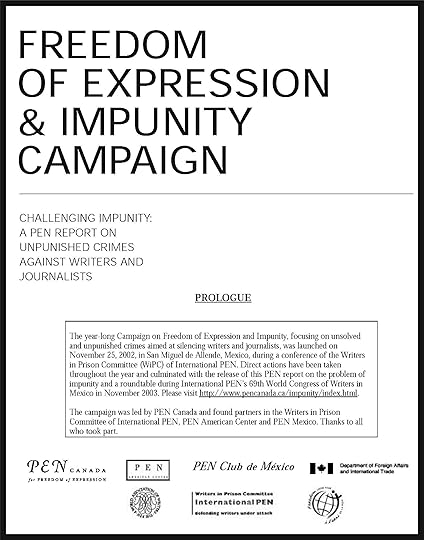
PEN International Impunity Report, launched at 2002 WIPC Conference, San Miguel de Allende
The Impunity report focused on Colombia, Iran, Mexico, Philippines, and Russia but PEN’s ongoing campaign targeted the issue wherever it occurred in the world.
Addressing the 2002 WIPC Conference and the Latin American Network was Brigadier General José Gallardo Rodriguez. At the Macedonian Congress earlier in the year PEN International President Homero Aridjis had reported on his release. “Last February, I was invited to testify on behalf of PEN on General José Francisco Gallardo’s case, as one of three witnesses scheduled to appear before the Inter-American Court on Human Rights at a hearing in Costa Rica,” Homero said. “A few days before the hearing at which the Mexican Government was ordered to appear, he [Gallardo] was unexpectedly pardoned and released from jail, nine years after his arrest and imprisonment following the publication in the magazine Forum of an excerpt of his masters’ thesis about the need for a military ombudsman in Mexico. General Gallardo’s release was an important victory for freedom of speech and a significant advance of justice in Mexico. PEN Centers worldwide who defended Gallardo’s cause for eight years now celebrate the liberation of a Mexican Dreyfus.”
General Gallardo thanked International PEN for its invaluable support for having campaigned on his behalf, and he assured that he would continue to press for the creation of a military ombudsman.
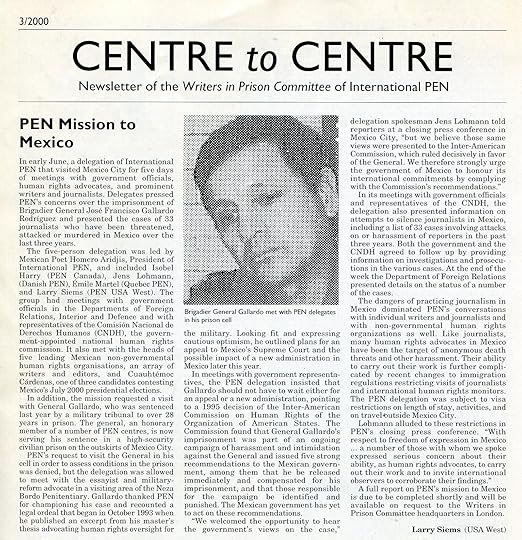
PEN WIPC newsletter 2000 on case of General José Gallardo Rodriguez
The Special Rapporteur on Freedom of Expression for the Organization of American States also participated on a panel on Corruption and the Writer, focusing on the problem of impunity, its link to corruption, its effect on free speech and the role of the writer in combating these problems.
Noting the increasing workload of the WIPC and the fact that the staff and budget had not grown at the same rate, several members suggested a Steering Committee of five individuals/centers be formed to assist the WIPC headquarters and work directly with committee chair Eugene Schoulgin and the WiPC staff led by Sara Whyatt. This group would formulate a strategy for the next three years, help define priorities and address the resources needed to achieve the goals. The proposal was accepted, and Isobel Harry (Canadian PEN), Archana Singh Karki (Nepal PEN), Jens Lohmann (Danish PEN), Lucy Popescu (English PEN) and Larry Siems (American PEN) formed the Planning Group. Their goal was to produce with the staff a plan that would be vetted by all WiPC members and approved at the Mexico Congress.
At the same time PEN International as a whole was undergoing a major strategic planning process. As the century turned, PEN International was in the midst of restructuring itself both to develop a more democratic governance system and also to address its rapid growth and funding challenges. In this process American PEN was an important actor, along with the Scandinavian and Japanese centers. American PEN, located in New York, was the largest of PEN’s centers and contributed more dues than any other center, but it had not hosted an International Congress since 1986 and did not host any of the international conferences or committee meetings. It had launched a World Voices Festival after 9/11 to bring international writers to the U.S. but this was an American PEN, not an International PEN, activity. However, with the assistance of two former American PEN presidents—Edmund (Mike) Keeley and Michael Scammell and American PEN Executive Director Michael Roberts and former PEN USA West President and International PEN Board member Eric Lax, the American contingent stepped up to raise funds from American foundations, including the Mellon Foundation and the Rockefeller Foundation to assist International PEN in a major strategic planning initiative. This consisted of several preliminary conferences in London and a final gathering at the Rockefeller estate in Bellagio, Italy.
The Americans, particularly , PEN America’s Executive Director, understood that American PEN was only as strong as the whole body of PEN which at the moment had a very small hub or Secretariat for a very large wheel of 140 spokes. The core needed strengthening both structurally and financially. International Secretary Terry Carlbom, International PEN President Homero Aridjis, Deputy Vice Chair of the Board Carles Torner and the whole Board of PEN International, along with members of the board of the PEN International Foundation, Standing Committee Chairs, and several Vice Presidents agreed and committed to the strategic planning process.
During the last decades PEN had depended on funds from its centers and from UNESCO and from SIDA, the Swedish Development Association and a few other funders, but the world was changing and with it the sources of funding. U.N. organizations like UNESCO were under siege. Government funding for European and East European cultural organizations was evaporating; the same was true for other PEN centers. The challenge for PEN was structural and financial. No one knew what the 21st century would bring, but most everyone understood it would not be the same.
Next Installment: Bellagio: Looking Forward —PEN for the 21st Century
The post PEN Journey 27: San Miguel de Allende and Other Destinations—PEN’s Work Between Congresses appeared first on Joanne Leedom-Ackerman.
April 24, 2020
PEN Journey 26: Macedonia—Old and New Millennium
PEN International celebrates its Centenary in 2021. I’ve been active in PEN for more than 30 years in various positions and now as an International Vice President Emeritus. With memories stirring and file drawers of documents and correspondence bulging, I am a bit of a walking archive and have been asked by PEN International to write down memories. I hope this personal PEN journey will be of interest.
I remember diving from a rowboat into Lake Ohrid and swimming in pristine water. I love to swim but never did so at PEN Congresses. However, the 68th Congress was held on one of Europe’s oldest—3 million years old—and deepest lakes which floated in the mountainous region between North Macedonia and eastern Albania. The water was the cleanest I had ever seen or felt. I swam without looking back until finally, I heard a voice from the boat shouting, “Come back! You’re almost in Albania!”
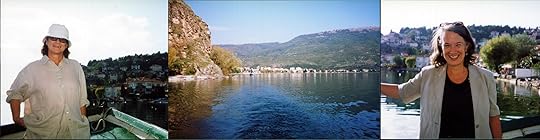
Moments before Isobel Harry (l) (Canadian PEN) and Joanne Leedom-Ackerman (r) (American PEN) dive into Lake Ohrid for a swim between meetings at the 68th PEN Congress in Ohrid, Macedonia in 2002
Albania, or rather the Albanian Liberation Army, a paramilitary organization, had recently been in conflict in Macedonia and was the reason PEN’s Congress here had been postponed the year before. (PEN Journey 25)
Swimming with me was my friend Isobel Harry, Executive Director of Canadian PEN, and in the boat sat Cecilia Balcazar from Colombian PEN and another PEN member. They watched over us in this break from the PEN meetings. My memories of the 2002 PEN Macedonia Congress include intense meetings of the Assembly in the Congress Hall of the old Soviet-style Metropol Hotel and neighboring Bellevue Hotel conference center and relaxed gatherings afterwards at lakeside cafes in the town of Ohrid, an UNESCO World Heritage site.
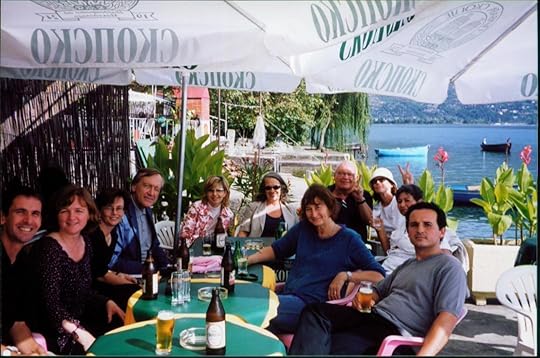
PEN colleagues at a lakeside cafe during the PEN Congress in Ohrid, Macedonia. (L to R) Dixie Willis and Sara Whyatt (WiPC staff), Susie Nicklin (English PEN), Eugene Schoulgin (Norweigan PEN & WiPC Chair), PEN member, Joanne Leedom-Ackerman (Vice President & American PEN), Niels Barfoed (Danish PEN), Isobel Harry (Canadian PEN), Fawzia Assaad (Swiss Romand PEN), Victoria Glendinning (English PEN), Carles Torner (PEN Board & Catalan PEN)
In the evenings we gathered for literary events with UNESCO-like titles—The Future of Language/Language of the Future and Borders of Freedom/Freedom of Borders. These were also the themes of the Congress. There was music and poetry in languages I didn’t understand, recited in cavernous, shadowy chambers, including in the ancient Cathedral Church of St. Sophia, a structure from medieval times, rebuilt in the 10th century. Its frescoes still adorned the walls from Byzantine times in the 11th,12th and 13th centuries and had been restored after the church was converted to a mosque during the Ottoman Empire.
While current politics and conflicts occupied the daytime work of PEN, history suffused the gathering. Civilization in Ohrid dated to 353 BC when the town had been known as “the city of light.”
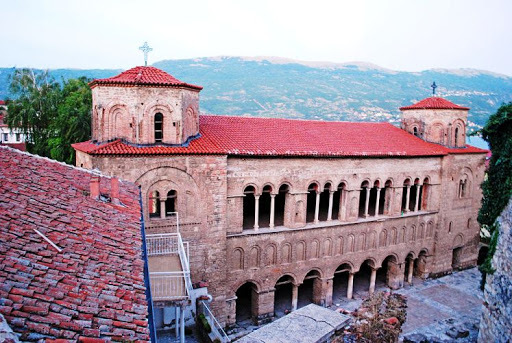
Cathedral Church of St. Sophia in Ohrid
“The old millennium, especially in ‘old’ Europe, should, I believe, be left behind with all its anachronistic boundaries—geographical, historical, racial, ethnic, state, linguistic, religious and cultural—and give way to the unfolding of the new millennium, to its open-mindedness and tolerance,” Dimitar Baševski, President of Macedonian PEN, wrote in his introduction to the Congress. “For generations we in Macedonia have lived with a creed according to which culture and not warfare or power is perceived as the field for competitiveness among nations. The aims of the World Congress of International P.E.N. in 2002 perfectly correspond with the spirit of this creed.”
Over 300 people from 69 PEN Centers gathered in the hills of this North Macedonian city for the 68th World Congress. The Congress’ work included the activities and reports of PEN’s committees—Writers in Prison, Peace, Translation and Linguistic Rights, Women’s, Exile Network—and the PEN Foundation, PEN International Magazine, and PEN Emergency Fund. There was a proposed revision to PEN’s Charter removing the concept of literature as being national in origin; there was the introduction of new centers, the dissolution of inactive centers and the elections for the Board, Vice Presidents, and Search Committee. There was a report from the International Secretary on the renewal of PEN’s “formal consultative relations” with UNESCO for a further six years, a step that acknowledged PEN as the only voluntary organization and the only literary organization in this category and one of only 12 organizations with a “Framework Agreement.” PEN had also been reclassified as a Category II organization with ECOSOC (United Nations Economic and Social Council) which included organizations with “special competence in specific areas” such as Amnesty and Human Rights Watch, a category that reflected PEN’s status and contribution as the only world writers organization within the UN system. At PEN’s Assembly of Delegates attention was called to a dozen PEN conferences—last year’s and the year ahead—and finally the Assembly passed Resolutions from the Writers in Prison Committee and Peace Committee on the situations in Russia and Chechnya, Russia itself, the Middle East, Belorussia, China, Colombia, Cuba, Iran, Turkey, Zimbabwe, Uighur Writers, and Tatarstan.
The aftermath of the 9/11 attacks on the United States the year before remained a focus that was altering the security landscape for nations around the world and for writers. PEN President Homero Aridjis observed, “Today our world is teetering on the brink of war.” He added, “In search of security, there have been encroachments on privacy and intrusive measures threatening freedom of expression and the right to dissent and criticize, but the global reach of information seems to have accelerated, proof of which is the current effort by the Chinese government to block its citizens’ access to the search-engine Google.”
“How can PEN and writers bring about positive changes?” he asked. “For a start, we could promote freedom of expression in Afghanistan. Not that long ago we were signing Internet petitions protesting against the treatment of women by the inhumane Taliban regime and begging the Taliban not to dynamite the colossal Buddhas of Bamiyan. Now I ask you to help me identify and approach Afghani writers who would be willing to found a PEN Center in Afghanistan and to try and find ways of giving this fledgling Center the means to thrive.”
[With the help of Norwegian PEN and others, an Afghan PEN Center was in fact founded with men and women writers from all ethnic groups and was voted into PEN at the 69th Congress the following year in Mexico. Writers in Prison Committee Chair Eugene Schoulgin played an instrumental role in working with and facilitating support for the Afghan writers.]
At the Macedonia Congress Eugene reported, “In my speech in London last November I mentioned the threats to the freedom of expression I feared that would follow the events of 9/11 in the US. What has happened last year has unfortunately proved these fears were well founded. Today over 40 countries have imposed new legislation on their populations which clearly weaken their human rights. New have been established in Canada, USA, UK, France, EU as a whole, Jordan, India and New Zealand. Terrorism laws expanded on Cuba and on Italy and in Colombia, Egypt, Zimbabwe, Israel, Russia, Uzbekistan, China and in the Philippines, and terror laws have been used as an excuse to crack down on the opposition and on minorities inside their regions. This in combination with the threats of a new war on Iraq makes the present situation extremely worrying, and will most certainly give us in the WiPC reason to be even more vigilant in the year to come.”
Visiting the WiPC Committee at the Congress were two former PEN main cases—Eşber Yağmurdereli, Turkish poet/dramatist and lawyer, who was blind and spent 14 years in prison and whom a number of us had met in Istanbul at a Freedom of Expression Initiative a few years before, and Flora Brovina, a Kosovair/Albanian poet and doctor who had been abducted by Serbian troops and imprisoned in Belgrade during the NATO bombing. Flora’s son had contacted PEN which sent out an urgent appeal about her abduction. I had met her husband and family when I visited Pristina, Kosovo the year before with the International Crisis Group while she was still in prison. This was the first time I met Flora, who had become an internationally celebrated case and was a member the country’s Assembly. Russian journalist Anna Politkovskya also attended the Macedonian Congress. My last meeting with Anna was sharing thick coffee at a tiny airport café in Skopje on our way home from the Congress.
Elections at the Congress included two new Vice Presidents Lucina Kathmann (San Miguel Allende PEN) and Boris Novak (Slovene PEN) and new Board members Takeaki Hori (Japan PEN), Cecilia Balcazar (Colombian PEN), Sibila Petlevski (Croatian PEN) and Elisabeth Nordgren (Finnish PEN).
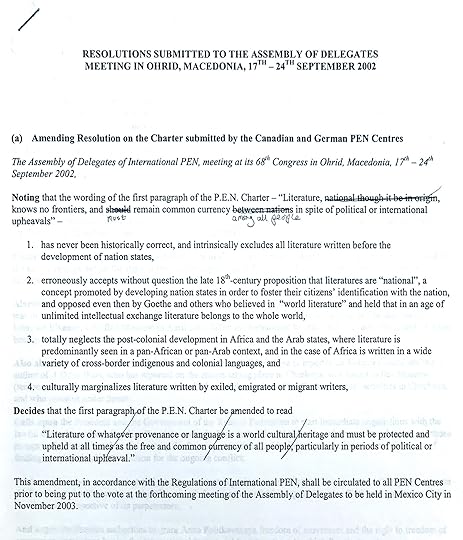
Resolution for change in wording of PEN’s Charter; amended wording, noted and approved, proposed by English PEN president Victoria Glendinning. Final proposal and approval to take place at Mexico Congress in 2003.
In addition to its traditional work, International PEN was proceeding with modernizing its governance and structure, led by International Secretary Terry Carlbom and the Board of PEN. Deputy Vice Chair of the Board Carles Torner reported that this included the restructuring of PEN and the PEN Foundation as British charitable tax law was changing; also new roles for the Vice Presidents were being considered; a modest change in the Charter was proposed for this Assembly to be confirmed at the next year’s Congress in Mexico, and the Treasurer was proposing a new international dues structure with a graded system, raising dues for centers from wealthier economies and reducing dues for others, based on the World Bank system of four categories. The change in the dues structure was unanimously approved.
“We are at the end of the first mandate of the first Board elected three years ago during the Warsaw Congress under the new Regulations.” Carles reported. “…we now have a real capacity for collective decision-making between Congresses…we are noticing that the transformation we dreamed of six years ago, when the new structuring of International PEN started, has taken place. There are more people involved in the work of International PEN, and each person represents a specific sensitivity within our international community…and we are better prepared to achieve our task now and in the future.”
The modernization and reform of governance also applied to PEN’s more than 130 centers with agreement that new centers from unrepresented parts of the world needed to be developed and centers that no longer functioned or worked in harmony with PEN’s Charter should be disbanded though there was often reluctance among PEN members to close a center.
At the Macedonia Congress, a particular PEN-like debate arose over the Langue d’Oc Center which no longer functioned. Langue d’Oc, or the Language of the Troubadours, was still spoken in a region in the South of France, in part of Italy and in one valley in Spain. The center’s president, whose name was the same as a great literary character, had worked on PEN’s Universal Declaration of Linguistic Rights with PEN’s Committee on Translation and Linguistic Rights half a dozen years before, and one member was still eager to keep the center going as a cause of minority languages. But the elderly outgoing President was not able to help, according to Jane Spender, PEN’s Administrative Director, who communicated or tried to communicate, with these centers. The center no longer functioned, had no office or contacts who replied, she reported. Before the center was declared closed, however, former International Secretary Alexander Blokh proposed that it be declared dormant and during the ensuing year French PEN writers who knew some of the members would “try to wake them up.” The Portuguese PEN delegate also offered to help as did the Esperanto, Slovene and Galician delegates. A similar lifeline was given to the inactive Welsh center by English PEN who agreed to perform the same role.
At PEN’s Congress the following year in Mexico, the interventions confirmed that after a year of dormancy neither center had rallied and so the Assembly voted to close the centers. In both cases new writers then came forward, and a few years later a new and active Welsh Center and Langue d’Oc Center formed and were elected back into PEN’s Assembly.
At the Macedonia Congress three brand new centers—Kyrghyz, Sierra Leone, and Tibet—joined the PEN family. It was in this fashion that PEN International pruned, renewed and broadened its base in civil society among nations and cultures and languages.
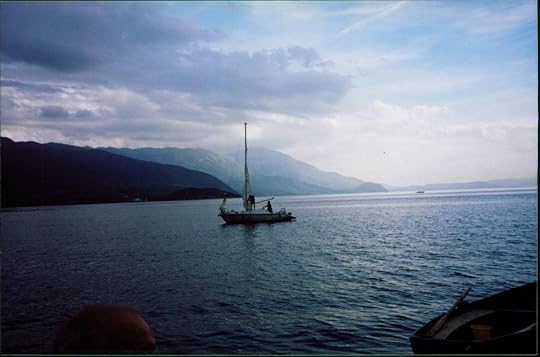
Lake Ohrid in the hills of North Macedonia between Macedonia and eastern Albania
Next Installment: PEN Journey 27: San Miguel Allende and Other Destinations–PEN’s Work Between Congresses
The post PEN Journey 26: Macedonia—Old and New Millennium appeared first on Joanne Leedom-Ackerman.
April 17, 2020
PEN Journey 25: War and More War: Retreat to London
PEN International celebrates its Centenary in 2021. I’ve been active in PEN for more than 30 years in various positions and now as an International Vice President Emeritus. With memories stirring and file drawers of documents and correspondence bulging, I am a bit of a walking archive and have been asked by PEN International to write down memories. I hope this personal PEN journey will be of interest.
“Whenever and wherever writers band together, whenever and wherever the members of PEN gather, regionally or nationally, there seems to be an emergency on our agenda…” So German novelist Günter Grass opened the 67th PEN Congress in Moscow in 2000. Grass was referring to the crisis in Chechnya at the time, but his observation held true the following year as PEN hastily arranged a replacement Assembly of Delegates in London, November 2001.
Two months earlier the United States had been attacked on September 11. A month later a U.S.-led NATO coalition invaded Afghanistan. But the conflict which upended PEN’s plans stirred in the Balkans with an impending civil war in Macedonia.
PEN’s 2001 Congress was originally to have taken place in the Philippines, but funding fell through. (Philippine PEN finally hosted a Congress in 2019.) Macedonian PEN agreed to move its 2002 Congress ahead a year and host PEN in the ancient city of Ohrid, but the Albanian National Liberation Army attacked Macedonian security forces in February 2001. As fighting escalated, PEN was again faced with the dilemma of whether to hold a Congress in a country in conflict.
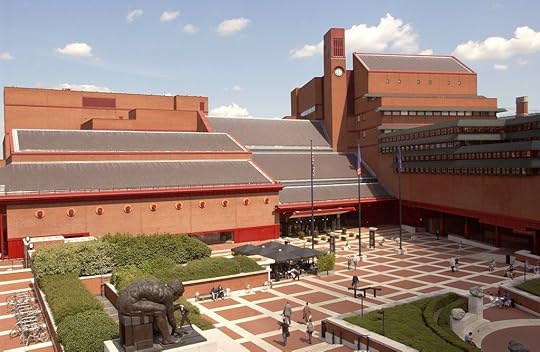
English PEN hosted an opening reception at the British Library for PEN International’s replacement Assembly of Delegates, November 2001
Finally, in August given the political situation in Macedonia, which was close to civil war, PEN’s Executive Committee “against the advice of the International Secretary” but “united in trying to overcome the situation,” decided to cancel the Macedonian Congress. Instead PEN planned a three-day replacement Assembly of Delegates in London where the business of PEN and its committees would take place but without all the literary and social events that usually accompanied a Congress. Delegates who arrived early could attend English PEN’s Day of the Imprisoned Writer service at St. Brides on Fleet Street, and English PEN hosted an opening reception and literary evening at the British Library; another reception at Lancaster House was hastily arranged, hosted by the Parliamentary Undersecretary of State for Foreign and Commonwealth Affairs. Ten years earlier a similar replacement Assembly had taken place in Paris when the Congress had been canceled in Delphi because of finances and the start of the Balkan War. (PEN Journey 7)
In September, “alarmed by the escalating volatility of the situation,” International Secretary Terry Carlbom sent a letter to PEN’s Vice Presidents announcing the change and asking for support. That letter was dated September 11, 2001.
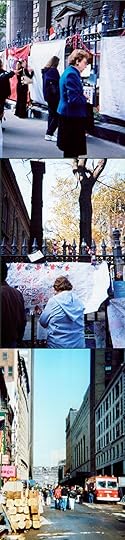
November 2001 near Ground Zero in New York City after the 9/11 attacks. People remembering those lost and workers still clearing wreckage.
On September 11, I was in New York City. I had just flown in the night before from an International Crisis Group board meeting in Brussels to attend meetings at Human Rights Watch. That morning I was dressing and watching the news when, like millions of Americans, I saw the first plane fly into the World Trade Center. I assumed it was a terrible accident when suddenly live on tv I saw the second plane crash into the South Tower….
Phone lines quickly jammed. I couldn’t imagine my meetings would take place, but when I couldn’t get through, I left the hotel and began walking down Fifth Avenue towards the Empire State Building where Human Rights Watch had its offices. But as I headed downtown, the streets filled with people rushing uptown. New York City was closing, with no traffic allowed in or out. I found myself locked down in Manhattan. Most Americans can tell you where they were that day and what happened next.
Two months later I flew back to Europe for the PEN Assembly of Delegates, held in Russell Square in Bloomsbury at a cost-efficient hotel, rather stark if I recall, but functional and accommodating to the over 160 people who made their way from 65 PEN Centers around the world, delegates from every continent.
It was PEN’s 80th Anniversary. The initial meeting of PEN in 1921 with its first president John Galsworthy, PEN founder Catherine Amy Dawson Scott and others had been held in Bedford Square, not far from where we were meeting. PEN clubs had rapidly sprung up in Europe—in France, Sweden and elsewhere—and in the United States. By the Assembly in 2001 PEN had more than12,000 members in 131 centers in over 100 countries.
PEN was born in the upheavals of world history, observed International PEN President Homero Aridjis at the opening of the 2001 Assembly. “What should be the role of writers and PEN in the aftermath of 9/11?” he asked and answered that PEN should continue to ensure the role of writers and be alert to those who would try to sacrifice personal freedom and the rights of minority populations. It was important that democratic practices survive and that PEN remain vigorous in the defense of freedom.
In a resolution passed by the Assembly of Delegates, PEN recognized “the urgent threat to freedom represented by the terrorist attacks of September 11. It also recognized the aims of terrorism are incompatible with democratic values, including freedom of expression.” But the resolution also addressed the concern that “the emergency measures adopted by governments to combat ‘terrorism’ should not further endanger those values and the essential human rights that derive from them.” In the resolution passed, PEN “expressed its concern that legislation and executive orders currently being planned or already passed by the governments of the United Kingdom, the United States, Canada, Denmark, Japan and other countries may place unacceptable restrictions on these rights. PEN voices its concern that such measures may curtail existing rights of writers and journalists, as protected by Article 19 of the Universal Declaration of Human Rights and other international human rights instruments. The Assembly of Delegates of International PEN urges that the atrocities of September 11 should not be exploited by governments to assume extraordinary and unjustifiable power to curtail free expression.”
The Resolution on post-September 11 events was the first of more than a dozen resolutions passed by the Assembly, resolutions which included protests, actions and appeals regarding freedom of expression and human rights in Bangladesh, China, Cuba, Eritrea, Iran, Israel and Palestine, Mexico, Russia, Syria, Turkey, Uzbekistan, Vietnam, Zimbabwe, and relating to the Kurds.
The Russian delegate thanked PEN for holding the previous Congress in Moscow. “You saw with your eyes what was in Moscow. I want to thank you that you didn’t leave us in this difficult time,” he said. Russian journalist Anna Politkovskaya, who had been covering the war in Chechnya, then addressed the Assembly. She explained that she went to Chechnya in 1999 as a reporter for the only free and independent newspaper still publishing “to witness the crimes and evil by the Russian Army.” Because of recent threats against her by the government, she was advised by her editor to leave Russia, and she now lived in Vienna. “I’m going to remind you of unpleasant things the world has forgotten,” she said. “There is a war in Chechnya. The world doesn’t want to fight against this war. Nobody is counting how many civilians have been killed in the war. Journalists who cover the Chechen war have different figures from 18,000-100,000 people. There is no economy, only a black economy. Now there are practically no journalists who cover it…To me it’s clear it’s an anti-terrorist operation that failed to accomplish its goal, but against this background Putin has become a very important person after September 11…I want to remind you that all new wars are sequels to previous wars.”
After Anna addressed the Assembly, the delegates returned to the ongoing business of reports and resolutions, and Anna met with Writers in Prison Committee members and the WiPC Program Director Sara Whyatt.
Additional resolutions were also passed which approved the adoption of “the Membership Platform Document as a Working Paper of International PEN and as a guideline document governing the creation, organization and work of all PEN Centers.” The document developed in consultation with the centers and the Executive Committee and International Secretary, along with changes in Regulations and Rules of Procedure were part of the ongoing modernization of the organization. At the Assembly, the Executive Committee of PEN was officially renamed the Board of International PEN with an understanding that the translation of the term “Board” still had to be agreed upon by the French and Spanish speaking centers.
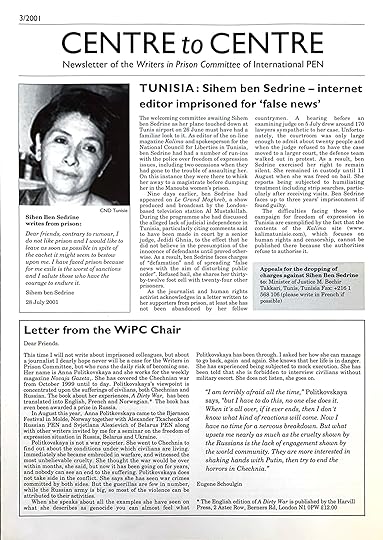
PEN’s Writers in Prison Committee newsletter summer/fall, 2001. The two stories—of Tunisia’s Sihem ben Sedrine and of Russia’s Anna Politkovskaya—would play out on a world stage a few years later.
In a globe where security paradigms had been turned upside down and armies were standing up, PEN’s 2001 Assembly, which had no remit in the area of security except to write about it, focused on the situation of writers around the world. This included the large number of prominent writers who had been freed over the past year after intensive PEN involvement as well as the rise in the number of writers who had been detained.
PEN worked in civil society. At the 2001 Assembly PEN encouraged regional cooperation between centers through networks. Earlier that year a trip through Africa by the International Secretary and African Board member Vincent Magombe had promoted further activity and growth of PEN centers in Africa.
The Assembly also attended to rules and regulations and the development of a strategic plan in the belief that a robust organization could better deliver the programs of International PEN and serve the world’s writers.
Elections gave Terry Carlbom a second term as International Secretary; Britta Junge Pedersen was elected Treasurer; Andrei Bitov and Moris Farhi were elected Vice Presidents, and with thanks to the three retiring Executive Committee members, especially Deputy Vice Chair Marian Botsford Fraser, three new members were elected to PEN’s International Board: Eric Lax (PEN USA West), Judith Roriguez (Melbourne PEN) and Alexander Tkachenko (Russian PEN.) Four new Centers were also voted into PEN: Algerian Center, Independent Chinese Writers Center, Nigerian Center and Ugandan Center.
PEN’s role at that time was perhaps best summed up earlier that year in an address by former International PEN President Arthur Miller at an American PEN event. He said, “That PEN is still around after three quarters of a century when it has no army, no navy or air force, no political rewards or threats of punishment, is possibly a triumph of illusion over reality, the illusion that hope is rational in this world.”
Next Installment: PEN Journey 26: Next Year in Macedonia
The post PEN Journey 25: War and More War: Retreat to London appeared first on Joanne Leedom-Ackerman.
April 14, 2020
PEN Journey 24: Moscow—Face Off/Face Down: Blinis and Bombs—Welcome to the 21st Century
PEN International celebrates its Centenary in 2021. I’ve been active in PEN for more than 30 years in various positions and now as an International Vice President Emeritus. With memories stirring and file drawers of documents and correspondence bulging, I am a bit of a walking archive and have been asked by PEN International to write down memories. I hope this personal PEN journey will be of interest.
“Contrary to our tradition, this year’s PEN Congress is being held in a country in which a massive, genocidal military and paramilitary operation is under way. Besides mass murder, the crimes perpetrated against the civil population of Chechnya include deportation, rape, torture, destruction and theft of personal property as well as the systematic looting and destruction of the material bases of Chechnyan culture and civilization. At the same time, freedom of information has been severely curtailed, and the official propaganda plays on xenophobic and even racist ethnic stereotypes…” So began a Declaration from the 67th World Congress of International PEN voted by the Assembly of Delegates in May, 2000.
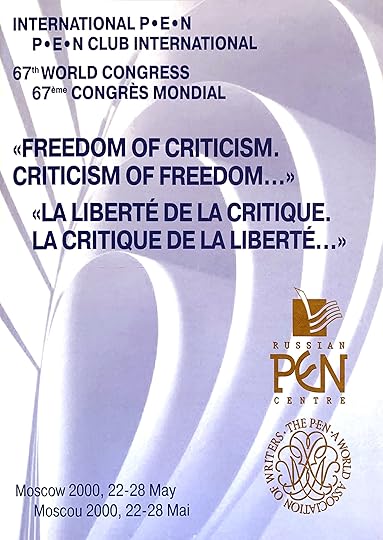
Program for PEN International 67th World Congress, Moscow
The decision to hold the International PEN Congress in Moscow was a controversial one, resulting in some members refusing to attend because of Russia’s prosecution of the war in Chechnya and the concern that holding a Congress in Moscow would give the government an appearance of approval. However, PEN’s Secretariat with the new Executive Committee concluded that the long-planned millennial Congress also presented the opportunity for International PEN to show solidarity with Russian PEN which had been outspoken both on the war and on behalf of Russian journalists and writers under pressure.
“The writers of Russia, united under the auspices of the Russian Centre of the International PEN Club, are concerned about the escalation of the war in Chechnya which is becoming a threat to not only peaceful residents of Grozny-city but also to the national security of Russia. The ultimatum announced to women, children and old people of the Chechen capital makes them hostages of both terrorists and federal forces. It is hard to believe that in this situation the Russian authorities are going to use the same methods as terrorists. We are very aware how hard it is to cut the tight Chechen knot, but in any case innocent people do not have to become victims of the decisions taken…” Russian PEN sent this appeal earlier to the acting President of the Russian Federation, Vladimir Putin.
Russian PEN members, including President Andrei Bitov, had signed the appeal. Russian PEN’s General Secretary Alexander (Sascha) Tkachenko noted at the Congress that it was essential to call on all those involved—Russian and Chechen—to cease their brutalities. Sascha himself had regularly stood up to the Russian government. He championed the cases of imprisoned writers Alexandr Nikitin and Grigory Pasko, both of whom had recently been freed after trials. Pasko, who was a journalist and former Russian Naval officer, had been arrested and accused of espionage for his publication of environmental problems in the Sea of Japan. Nikitin, a Naval officer, had been charged with stealing state secrets by contributing to a report that revealed the sinking of Russian nuclear submarines and the dangers these decaying submarines posed to the environment.
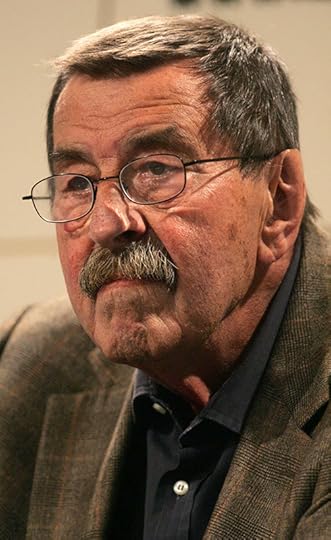
German novelist Günter Grass talk opened PEN’s 67th Congress
The freedom and the openings which many embraced after the break-up of the Soviet Union in the early 1990’s were beginning to close down and restrictions tighten. At the Moscow Congress Pasko expressed his gratitude for everything PEN had done to obtain his freedom. He urged the Assembly to focus on environmental problems. But he warned that the structure of the current Russian government had grown out of the KGB, and he feared nothing good would come for free speech or the environment.
In the opening address of the Congress German novelist Günter Grass, who won the Nobel Prize for Literature the previous year, recounted the many times in the past century that writers had called attention to the abuses and genocides which governments had tried to hide. “At least literature does achieve this—it does not turn a blind eye; it does not forget; it does break the silence,” Grass concluded.
The Congress theme “Freedom of Criticism. Criticism of Freedom…”seemed a particularly UNESCO title, with a focus on how freedom is exercised, noting that freedom unrestrained by morality can lead to a license for corruption, brigandage, state terrorism, censorship and the wanton murder of those who dare to speak out. “That freedom is a double-edged sword is a fact long appreciated in free societies. It is what prompted Voltaire to place a limitation upon it, when it interfered with the freedom of another,” one Congress description noted.
Thus framed, the panels and the work of PEN’s committees proceeded. Many wondered how able PEN members would be to criticize openly as we met both formally and in cafes sharing conversation and meals of blinis and caviar. There was no incident nor interference that I recall at the Moscow Congress nor at the subsequent programs in St. Petersburg, but we were all aware that repercussions could follow after we left. Over time Putin’s government did close down the space for NGO’s with Russian PEN as one of the early targets. (Future blog post.)
The Moscow Congress itself proved an opportunity to celebrate Russian literature and other literature as well as to conduct the work of PEN’s committees which met in halls named after Tolstoy, Pushkin, and Chekov. Many writers from over 70 PEN centers were visiting Moscow for the first time since the Soviet Union broke apart. Since my first trip in 1991 shortly after the coup attempt (PEN Journey 8), the city had changed. Western hotels, restaurants and stores had moved in; certain citizens had amassed wealth; others had lost jobs and security. It was a city of contrasts with children on the street begging, but begging by playing violins. A wealthy new group crowded the lobbies of western hotels and department stores.
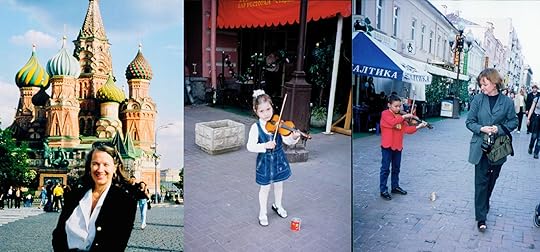
On the streets at PEN Congress in Moscow May, 2000: L: Joanne Leedom-Ackerman, PEN Vice President; R: Sara Whyatt, PEN Writers in Prison Committee Program Director
In a message to the Congress Andrei Bitov wrote:
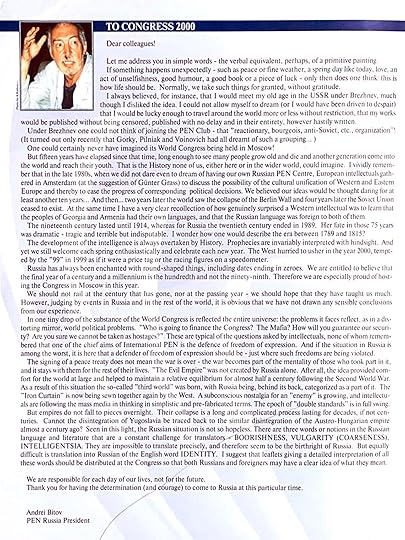
Full text of Russian PEN President Andrei Bitov’s message to PEN delegates
I always believed…that I would meet my old age in the USSR under Brezhnev, much though I disliked the idea. I could not allow myself to dream (or I would have been driven to despair) that I would be lucky enough to travel around the world more or less without restriction, that my works would be published without being censored, published with no delay and in their entirety, however hastily written.
Under Brezhnev one could not think of joining the PEN Club—that “reactionary bourgeois, anti-Soviet, etc., organization”! (It turned out only recently that Gorky, Pilniak and Voinovich had all dreamt of such a grouping…)
One could certainly never have imagined its World Congress being held in Moscow!
But fifteen years have elapsed since that time, long enough to see many people grow old and die and another generation come into the world and reach their youth. That is the History none of us, either here or in the wider world, could imagine…
We should not rail at the century that has gone, nor at the passing year—we should hope that they have t aught us much. However, judging by events in Russia and in the rest of the world, it is obvious that we have not drawn any sensible conclusions from our experience…
In one tiny drop of the substance of the World Congress is reflected the entire universe, the problems it faces reflect, as in a distorting mirror, world political problems…
We are responsible for each day of our lives, not for the future.
Thank you for having the determination (and courage) to come to Russia at this particular time.
PEN’s business at the Assembly of Delegates included the International Secretary Terry Carlbom’s report on PEN’s relationship with UNESCO as the only global organization representing literature associated with UNESCO and a preliminary notice about a multi-year strategic plan under development. Business also included the election of the International President. Homero Aridjis was standing for a second term, and former International Secretary Alexander Blokh of Russian origin had returned to this PEN Congress for the first time since he’d stepped down as International Secretary in 1998, (PEN Journey 20) and he was also running for President. I was asked to chair the Assembly for the election, including during a stir that arose when Alex wasn’t present to speak for his candidature. He’d left the meeting early for an appointment, mistakenly thinking he would speak in the afternoon. However, there was no afternoon session, and controversy arose over whether the election should be postponed so he could speak. I ruled that he would be the first item on the morning agenda and then the election would proceed as scheduled. Homero Aridjis won a second term; Alexander Blokh continued to serve PEN for many years as a Vice President and President of French PEN.
Also at the Congress Martha Cerda (Guadalajara Center) succeeded Lucina Kathmann as Chair of the Women Writers’ Committee; Veno Taufer (Slovene PEN) succeeded Boris Novak, who’d opposed holding the Congress in Moscow and had stepped down as chair of the Writers for Peace Committee, and Eugene Schoulgin (Swedish PEN) was confirmed as the new Writers in Prison Committee Chair.
In his farewell comments as WiPC chair Moris Farhi quoted Günter Grass’s address that literature always breaks the silence. Moris added that by breaking the silence, by telling the truth and exposing wrong-doing, literature also defied fear and embraced courage. The members of International PEN had witnessed this defiance of fear and the manifestation of courage time and again. Moris noted among those with courage were Grigory Pasko, Alexander Tkachenko and our colleague Boris Novak.
The Moscow Congress saw the return of delegates from Chinese PEN after a decade-long absence post Tiananmen Square. Two resolutions on China were presented, one calling for the release of dissident writers imprisoned in China and another protesting the long prison terms for writers in Tibet. The Chinese delegate objected to both resolutions, arguing first that Tibet shouldn’t be singled out as though it were not part of China. He also said that the Chinese people and Chinese writers cared for human rights after centuries of feudal society, but the West emphasized individual rights and values while the Chinese valued collective human rights and obligations to the family and society. The Chinese believed that human rights in a given country were related to the social system, the level of economic development and historical and cultural traditions of that country, and they encompassed the right to development and subsistence. A country of more than 1.2 billion people had to find food and clothing. It was impossible for one pattern to solve all existing problems. The Cold War had ended, but its influence remained with those who believed their values, their concept of human rights, their position were the only correct ones in the world. Dialogue was the only way to resolve the differences of view, a dialogue based on equality and mutual respect.
Hands shot up seeking to respond. At least 25 delegates at the Assembly spoke, welcoming the return of the Chinese delegates to the PEN Congress, but most taking exception to the argument of the relativity of human rights in PEN’s work. The first to speak was Eric Lax of PEN Center USA West who said he appreciated the speaker’s comments but wanted to add that the PEN Charter, to which all members subscribed, was very clear that freedom to write was a basic tenant of the organization and that information should pass unimpeded without restriction. Some questioned the way the resolution was written. Alexander Tkachenko of Russian PEN said he felt PEN should be understanding of people living under a regime about which the rest of PEN knew little. It was up to the Assembly to decide whether to support the resolution; they needn’t accept the Chinese delegate’s opinion, but they should respect it. He didn’t want the Chinese to be missing from PEN for another ten years. PEN should be tolerant of those for whom it was extremely dangerous to discuss such questions. The Assembly applauded. A small amendment was made to the resolutions, both of which passed with large majorities, though not unanimously.
The following year the Independent Chinese PEN Center (ICPC) came into being, a center of independent writers and democracy activists inside and outside of China. One of the founding members and the second president of ICPC (2003-2007) was writer Liu Xiaobo, on whose behalf PEN worked twice when he was imprisoned after Tiananmen Square and again when he was arrested in 2009. Liu Xiaobo was the first Chinese citizen to win the Nobel Prize for Peace in 2010, but he was incarcerated in a Chinese jail, and he died in custody in 2017.
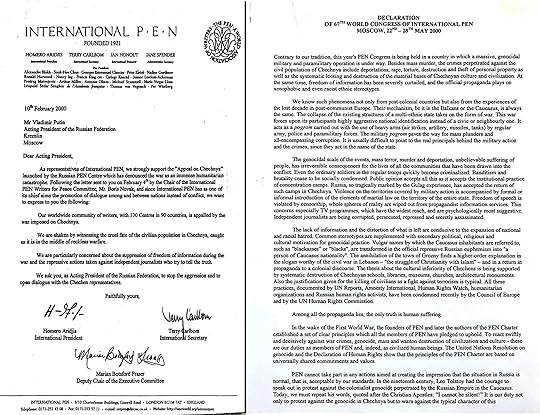
Next installment: PEN Journey 25: War and more War: Retreat to London
The post PEN Journey 24: Moscow—Face Off/Face Down: Blinis and Bombs—Welcome to the 21st Century appeared first on Joanne Leedom-Ackerman.
April 8, 2020
PEN Journey 24: Moscow—Face Off/Face Down: Blinis and Bombs—Welcome to the 21st Century
PEN International celebrates its Centenary in 2021. I’ve been active in PEN for more than 30 years in various positions and now as an International Vice President Emeritus. With memories stirring and file drawers of documents and correspondence bulging, I am a bit of a walking archive and have been asked by PEN International to write down memories. I hope this personal PEN journey will be of interest.
“Contrary to our tradition, this year’s PEN Congress is being held in a country in which a massive, genocidal military and paramilitary operation is under way. Besides mass murder, the crimes perpetrated against the civil population of Chechnya include deportation, rape, torture, destruction and theft of personal property as well as the systematic looting and destruction of the material bases of Chechnyan culture and civilization. At the same time, freedom of information has been severely curtailed, and the official propaganda plays on xenophobic and even racist ethnic stereotypes…” So began a Declaration from the 67th World Congress of International PEN voted by the Assembly of Delegates in May, 2000.
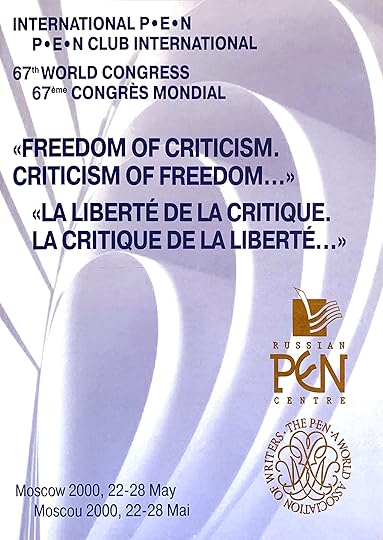
Program for PEN International 67th World Congress, Moscow
The decision to hold the International PEN Congress in Moscow was a controversial one, resulting in some members refusing to attend because of Russia’s prosecution of the war in Chechnya and the concern that holding a Congress in Moscow would give the government an appearance of approval. However, PEN’s Secretariat with the new Executive Committee concluded that the long-planned millennial Congress also presented the opportunity for International PEN to show solidarity with Russian PEN which had been outspoken both on the war and on behalf of Russian journalists and writers under pressure.
“The writers of Russia, united under the auspices of the Russian Centre of the International PEN Club, are concerned about the escalation of the war in Chechnya which is becoming a threat to not only peaceful residents of Grozny-city but also to the national security of Russia. The ultimatum announced to women, children and old people of the Chechen capital makes them hostages of both terrorists and federal forces. It is hard to believe that in this situation the Russian authorities are going to use the same methods as terrorists. We are very aware how hard it is to cut the tight Chechen knot, but in any case innocent people do not have to become victims of the decisions taken…” Russian PEN sent this appeal earlier to the acting President of the Russian Federation, Vladimir Putin.
Russian PEN members, including President Andrei Bitov, had signed the appeal. Russian PEN’s General Secretary Alexander (Sascha) Tkachenko noted at the Congress that it was essential to call on all those involved—Russian and Chechen—to cease their brutalities. Sascha himself had regularly stood up to the Russian government. He championed the cases of imprisoned writers Alexandr Nikitin and Grigory Pasko, both of whom had recently been freed after trials. Pasko, who was a journalist and former Russian Naval officer, had been arrested and accused of espionage for his publication of environmental problems in the Sea of Japan. Nikitin, a Naval officer, had been charged with stealing state secrets by contributing to a report that revealed the sinking of Russian nuclear submarines and the dangers these decaying submarines posed to the environment.
German novelist Günter Grass talk opened PEN’s 67th Congress
The freedom and the openings which many embraced after the break-up of the Soviet Union in the early 1990’s were beginning to close down and restrictions tighten. At the Moscow Congress Pasko expressed his gratitude for everything PEN had done to obtain his freedom. He urged the Assembly to focus on environmental problems. But he warned that the structure of the current Russian government had grown out of the KGB, and he feared nothing good would come for free speech or the environment.
In the opening address of the Congress German novelist Günter Grass, who won the Nobel Prize for Literature the previous year, recounted the many times in the past century that writers had called attention to the abuses and genocides which governments had tried to hide. “At least literature does achieve this—it does not turn a blind eye; it does not forget; it does break the silence,” Grass concluded.
The Congress theme “Freedom of Criticism. Criticism of Freedom…”seemed a particularly UNESCO title, with a focus on how freedom is exercised, noting that freedom unrestrained by morality can lead to a license for corruption, brigandage, state terrorism, censorship and the wanton murder of those who dare to speak out. “That freedom is a double-edged sword is a fact long appreciated in free societies. It is what prompted Voltaire to place a limitation upon it, when it interfered with the freedom of another,” one Congress description noted.
Thus framed, the panels and the work of PEN’s committees proceeded. Many wondered how able PEN members would be to criticize openly as we met both formally and in cafes sharing conversation and meals of blinis and caviar. There was no incident nor interference that I recall at the Moscow Congress nor at the subsequent programs in St. Petersburg, but we were all aware that repercussions could follow after we left. Over time Putin’s government did close down the space for NGO’s with Russian PEN as one of the early targets. (Future blog post.)
The Moscow Congress itself proved an opportunity to celebrate Russian literature and other literature as well as to conduct the work of PEN’s committees which met in halls named after Tolstoy, Pushkin, and Chekov. Many writers from over 70 PEN centers were visiting Moscow for the first time since the Soviet Union broke apart. Since my first trip in 1991 shortly after the coup attempt (PEN Journey 8), the city had changed. Western hotels, restaurants and stores had moved in; certain citizens had amassed wealth; others had lost jobs and security. It was a city of contrasts with children on the street begging, but begging by playing violins. A wealthy new group crowded the lobbies of western hotels and department stores.
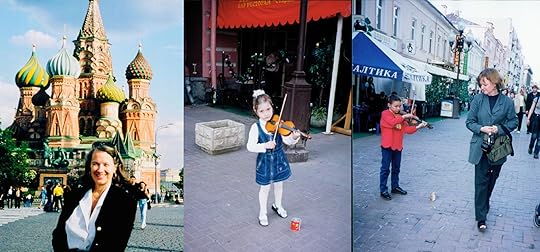
On the streets at PEN Congress in Moscow May, 2000: L: Joanne Leedom-Ackerman, PEN Vice President; R: Sara Whyatt, PEN Writers in Prison Committee Program Director
In a message to the Congress Andrei Bitov wrote:
Full text of Russian PEN President Andrei Bitov’s message to PEN delegates
I always believed…that I would meet my old age in the USSR under Brezhnev, much though I disliked the idea. I could not allow myself to dream (or I would have been driven to despair) that I would be lucky enough to travel around the world more or less without restriction, that my works would be published without being censored, published with no delay and in their entirety, however hastily written.
Under Brezhnev one could not think of joining the PEN Club—that “reactionary bourgeois, anti-Soviet, etc., organization”! (It turned out only recently that Gorky, Pilniak and Voinovich had all dreamt of such a grouping…)
One could certainly never have imagined its World Congress being held in Moscow!
But fifteen years have elapsed since that time, long enough to see many people grow old and die and another generation come into the world and reach their youth. That is the History none of us, either here or in the wider world, could imagine…
We should not rail at the century that has gone, nor at the passing year—we should hope that they have t aught us much. However, judging by events in Russia and in the rest of the world, it is obvious that we have not drawn any sensible conclusions from our experience…
In one tiny drop of the substance of the World Congress is reflected the entire universe, the problems it faces reflect, as in a distorting mirror, world political problems…
We are responsible for each day of our lives, not for the future.
Thank you for having the determination (and courage) to come to Russia at this particular time.
PEN’s business at the Assembly of Delegates included the International Secretary Terry Carlbom’s report on PEN’s relationship with UNESCO as the only global organization representing literature associated with UNESCO and a preliminary notice about a multi-year strategic plan under development. Business also included the election of the International President. Homero Aridjis was standing for a second term, and former International Secretary Alexander Blokh of Russian origin had returned to this PEN Congress for the first time since he’d stepped down as International Secretary in 1998, (PEN Journey 20) and he was also running for President. I was asked to chair the Assembly for the election, including during a stir that arose when Alex wasn’t present to speak for his candidature. He’d left the meeting early for an appointment, mistakenly thinking he would speak in the afternoon. However, there was no afternoon session, and controversy arose over whether the election should be postponed so he could speak. I ruled that he would be the first item on the morning agenda and then the election would proceed as scheduled. Homero Aridjis won a second term; Alexander Blokh continued to serve PEN for many years as a Vice President and President of French PEN.
Also at the Congress Martha Cerda (Guadalajara Center) succeeded Lucina Kathmann as Chair of the Women Writers’ Committee; Veno Taufer (Slovene PEN) succeeded Boris Novak, who’d opposed holding the Congress in Moscow and had stepped down as chair of the Writers for Peace Committee, and Eugene Schoulgin (Swedish PEN) was confirmed as the new Writers in Prison Committee Chair.
In his farewell comments as WiPC chair Moris Farhi quoted Günter Grass’s address that literature always breaks the silence. Moris added that by breaking the silence, by telling the truth and exposing wrong-doing, literature also defied fear and embraced courage. The members of International PEN had witnessed this defiance of fear and the manifestation of courage time and again. Moris noted among those with courage were Grigory Pasko, Alexander Tkachenko and our colleague Boris Novak.
The Moscow Congress saw the return of delegates from Chinese PEN after a decade-long absence post Tiananmen Square. Two resolutions on China were presented, one calling for the release of dissident writers imprisoned in China and another protesting the long prison terms for writers in Tibet. The Chinese delegate objected to both resolutions, arguing first that Tibet shouldn’t be singled out as though it were not part of China. He also said that the Chinese people and Chinese writers cared for human rights after centuries of feudal society, but the West emphasized individual rights and values while the Chinese valued collective human rights and obligations to the family and society. The Chinese believed that human rights in a given country were related to the social system, the level of economic development and historical and cultural traditions of that country, and they encompassed the right to development and subsistence. A country of more than 1.2 billion people had to find food and clothing. It was impossible for one pattern to solve all existing problems. The Cold War had ended, but its influence remained with those who believed their values, their concept of human rights, their position were the only correct ones in the world. Dialogue was the only way to resolve the differences of view, a dialogue based on equality and mutual respect.
Hands shot up seeking to respond. At least 25 delegates at the Assembly spoke, welcoming the return of the Chinese delegates to the PEN Congress, but most taking exception to the argument of the relativity of human rights in PEN’s work. The first to speak was Eric Lax of PEN Center USA West who said he appreciated the speaker’s comments but wanted to add that the PEN Charter, to which all members subscribed, was very clear that freedom to write was a basic tenant of the organization and that information should pass unimpeded without restriction. Some questioned the way the resolution was written. Alexander Tkachenko of Russian PEN said he felt PEN should be understanding of people living under a regime about which the rest of PEN knew little. It was up to the Assembly to decide whether to support the resolution; they needn’t accept the Chinese delegate’s opinion, but they should respect it. He didn’t want the Chinese to be missing from PEN for another ten years. PEN should be tolerant of those for whom it was extremely dangerous to discuss such questions. The Assembly applauded. A small amendment was made to the resolutions, both of which passed with large majorities, though not unanimously.
The following year the Independent Chinese PEN Center (ICPC) came into being, a center of independent writers and democracy activists inside and outside of China. One of the founding members and the second president of ICPC (2003-2007) was writer Liu Xiaobo, on whose behalf PEN worked twice when he was imprisoned after Tiananmen Square and again when he was arrested in 2009. Liu Xiaobo was the first Chinese citizen to win the Nobel Prize for Peace in 2010, but he was incarcerated in a Chinese jail, and he died in custody in 2017.
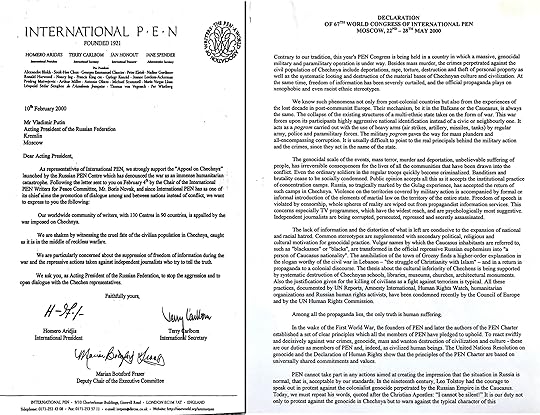
Next installment: PEN Journey 25: War and more War: Retreat to London
The post PEN Journey 24: Moscow—Face Off/Face Down: Blinis and Bombs—Welcome to the 21st Century appeared first on Joanne Leedom-Ackerman.
April 6, 2020
PEN Journey 23: Nepal—WIPC Crossing the Bridge Between People
PEN International celebrates its Centenary in 2021. I’ve been active in PEN for more than 30 years in various positions and now as an International Vice President Emeritus. With memories stirring and file drawers of documents and correspondence bulging, I am a bit of a walking archive and have been asked by PEN International to write down memories. I hope this personal PEN journey will be of interest.
As I write these PEN Journeys, memory differs with each one. I sit and think, pulling up whatever memories I have. Some are visual; some are of activities, some of the twists and turns in PEN itself; many are of friends, a few of incidents; others come from concurrent parts of my life such as moving to London with my family and connecting to work at International PEN headquarters (PEN Journey 5), or scaling the Berlin Wall just after Germany reunited (PEN Journey 4), or visiting Russia shortly after the coup attempt (PEN Journey 8).
I have paper documentation for most of PEN’s events, not because I was an archivist in the making but more of a packrat who was too busy to sort through papers after a congress or conference and so set the files in a drawer. I am not even accounting for all the emails and digital files that began to accumulate in the late 1990’s and 2000’s. In my recounting, I am only now entering that period when the internet and email were burgeoning. For some of the Journeys I have photographs, but my picture-taking was random in retrospect, probably reflecting my role at the time. The more work I had, the fewer pictures. There were no iPhones or Android phones during these earlier years so I had to have a camera at hand. In certain years I have no photographic record of PEN though some may yet turn up in the recesses of my basement. There are, however, always pictures in my head.
For the Writers in Prison Committee’s (WiPC) third biannual meeting in Katmandu, Nepal in the spring of 2000, I have lots of pictures. We were celebrating the 40th anniversary of International PEN’s Writers in Prison Committee. As ex-chair, I helped with the conference, but the burden of the meeting wasn’t mine so I was also out with camera in hand. In my head I still carry the landscape of Nepal—the hills outside Katmandu with the haze over mountains in the distance, the woman in a red sari walking up the hill carrying bundles of sticks, the gentle landscape and the harsh conditions.
Landscape in hills and fields outside Katmandu, Nepal at Writers in Prison Committee Conference, April 2000
I arrived a few days early to visit schools and women’s education projects relating to other work I did, some as a board member of Save the Children. By the time I joined the PEN Conference, I had already fallen in a soft love with the country and its people, the old—sometimes centuries old—and the new culture: Katmandu with its rickshaws and bustling streets and vibrant colors and the hills outside where farmers still farmed with oxen plowing the fields and children high in the hills crowded into village schools and women learning to read in makeshift community libraries. And there was the nation’s complicated governing system with a privileged royal family which only a year later would be massacred by one of its own and in the hills a Maoist insurgency developing which threatened the government and population for years to come. Nepal was as dramatic a place as the landscape it occupied.
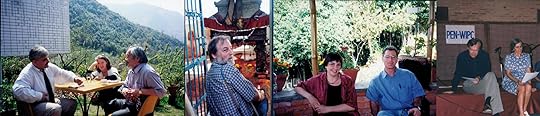
At work and rest at WiPC Conference. L to R: Alexander (Sascha) Tkachenko (Russian PEN), Joanne Leedom-Ackerman (American PEN/PEN Int’l), Mitsakazu Shiboah (Japan PEN), Jens Lohman (Danish PEN), Cathy McCann (Asia researcher PEN Int’l), Larry Siems (American PEN), Eugene Schoulgin (Norweigan PEN), Lucina Kathman (San Miguel Allende PEN)
At PEN’s WiPC conference, 43 writers gathered from 25 countries representing every continent except Africa where the costs had limited attendance. Before the meeting WiPC chair Moris Farhi and I and the WiPC staff met to identify areas of work that needed review and possible restructuring. From a survey of the centers we developed discussion points which were circulated before the meeting. Since the fall of the communist states, PEN had seen a growth in membership, an increase in freedom of expression work by the centers, and an expanded use of email and the internet. The innovation in communications was having an impact on the way PEN did its work and challenged old methodologies such as letter-writing campaigns.
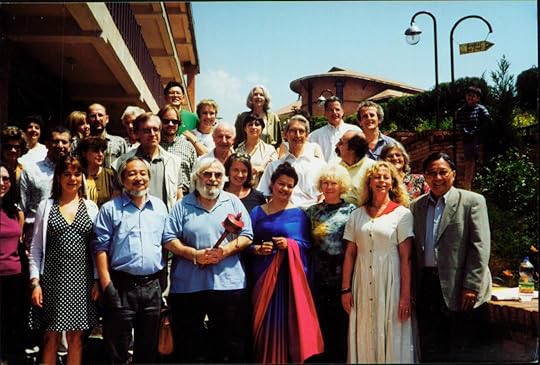
Delegates at PEN Writers in Prison Committee Conference, Nepal, 2000. In center WiPC Chair Moris Farhi holding local prayer wheel.
The agenda developed included workshops on the use of the internet, on PEN’s WiPC case list and newsletter, on PEN’s commitment to journalists in peril as compared to writers who had no other organization to protect them. We considered crisis situations and the changing nature of repression, including nongovernment and non-custodial forms of repression, WiPC relations with international organizations, the role of PEN’s Congress, the role of regional centers and networks, the value of PEN missions to other countries, and always, the discussion on how to fund the work and how to assure those finances included funds to bring delegates from every region to future meetings.
Looking back at the program, it appears exhaustive (or exhausting), though I don’t recall it as tedious or overwhelming. With each workshop, the group developed a summary of the situation and recommendations. For example, a recommendation was to post on PEN’s website, accessible to everyone, the information on the RAN special actions. The RAN (Rapid Action Network) itself was a relatively new tool which was sent out over the internet for immediate action on certain PEN cases. It was also agreed and recommended in another workshop that journalists should continue to be part of PEN’s campaigns and that PEN should collaborate more closely with journalists’ organizations.
Reading through the minutes and recommendations of the four-day meeting, I am impressed by the professionalism of the work of the WiPC staff, small as it was, just Sara Whyatt, Program Director and Cathy McCann, Asia researcher.
At the Nepal conference a new WiPC chair—Eugene Schoulgin from Swedish PEN was elected to take over from Moris Farhi after PEN’s Congress in Moscow the following month.
As well as workshops and discussions, we were entertained by local groups and also entertained ourselves with song and dance in the evening as we had at the first WiPC conference in Helsingør (PEN Journey 17).
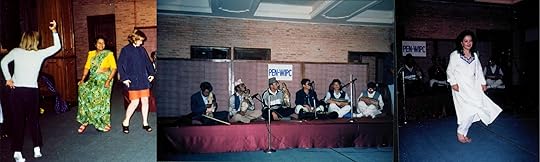
After working days at WiPC Conference, music and dancing, including local Nepal PEN members and Sara Whyatt (WiPC Program Director) in orange skirt on left and on right Archana Singh Karki (Nepal PEN) in white; local musicians in middle.
On the last day UNESCO sponsored a panel The Culture of Peace: Censorship and the Writer which PEN Nepal President Greta Rana introduced, observing that censorship led to violence and that 47 journalists in South Asia were currently imprisoned for addressing free expression issues. Sara Whyatt in her introduction of the printed talks noted that free expression was inextricably entwined with the promotion of peace for without voices to challenge dictatorships and warmongers, peace would be an even rarer commodity than it was.
Because I don’t need copyright permission to reprint my talk, I take the liberty of sharing it below. Other panelists included Ratna Sarumpaet, an Indonesian script writer whose play about the plight of women laborers led to her imprisonment; Kunda Dixit, a Nepali journalist who spoke about the role of the free media in ensuring objectivity in times of pressure from political and corporate interests; Shahid Nadeem, a Pakistani playwright long exiled in England, who told of returning to Pakistan where critical voices were still seen as a threat; WiPC Chair Moris Farhi who noted that xenophobia and religious fanaticism were increasingly dangerous elements; Rajeev Rajbhandari, a Nepali internet expert, who argued it was not the content of the internet that was problematic but the uses of its new technology; Romesh Gumesekere, a Sri Lankan author and poet, who identified illiteracy as an encumbrance to the promotion of free expression; and myself whose talk below began with the poem of the renowned Turkish poet Nâzım Hikmet:
The prisoner Halil
closed his book.
He breathed on his glasses, wiped them clean,
gazed out at the orchards,
and said:
“I don’t know if you are like me,
Suleyman,
But coming down the Bosporus on the ferry, say
making the turn at Kandilli,
and suddenly seeing Istanbul there,
or one of those sparkling nights
of Kalamish Bay
filled with stars and the rustle of water,
or the boundless daylight
in the fields outside Topkapi
or a woman’s sweet face glimpsed on a streetcar,
or even the yellow geranium I grew in a tin can
in the Sivas prison—
I mean, whenever I meet
with natural beauty,
I know once again
human life today
must be changed . . .”
—Nâzım Hikmet, Human Landscapes
In 1938 Turkish poet Nâzım Hikmet (1902–63) was sent to prison, charged with “inciting the army to revolt,” convicted on the sole evidence that military cadets were reading his poems. He was sentenced to 28 years but was released 12 years later in 1950. His “novel” in verse, Human Landscapes from My Country, was written in prison, featuring Halil, a political prisoner, scholar, and poet who was going blind….
Today in Istanbul journalist Nadire Mater is charged with “insulting the army” for her book Mehmet’s Book, a collection of interviews with soldiers who have served in the conflict with the Kurds in the Southeast of Turkey. Nadire Mater and her publisher will be in court in early May to face charges, which could bring them at least six years in prison.
I’d like to read a brief passage from one of the interviews in Mehmet’s Book:
These friends coming from the West didn’t really know any Kurds, because they don’t know any they couldn’t really understand very well. What should be said about this? They are not familiar, and not being familiar, they act according to the government’s opinion…They’ve adapted to what they hear and read. I would explain to these friends that the other side is human, that the politics of the government is wrong.
We all of course adapt to what we hear and read. That is why it is so important that we have the opportunity to consider many points of view. The reality we carry in our heads and in our hearts shapes us as individuals and governs us as nations. Writers are the ones who produce what people read. The writer bears both the responsibility and the liability for his words and the realities they evoke. The writer can be a positive instrument for change as Hikmet saw the need, or as we have seen in the past decade in the Balkans, the writer can inflame animosities. The writer is not always the hero, but at his or her best, the writer can build bridges, reporting on and imagining not only himself, but those who are not him, illumining he humanity that connects us.
Peace between people relies on such bridges. The nature of a bridge is to span the space between points. The pilings of a bridge absorb the tension as one crosses over the space. However, censorship undermines, even destroys the pilings. The censor would allow only a limited view of reality, and by disallowing other views, the censor cuts away at the pilings necessary to build the bridge between him and the so-called enemy.
Censorship takes many forms. Whether it be brutal killings as in Iraq, death threats as in Peru and Colombia, long term prison sentences as in Burma and China or shorter terms as in Cuba or endless court cases as in Turkey where writers say the judicial process itself is punishment, the effect of censorship is to weaken or even tear down the bridge and to freeze up the imagination that envisions this bridge.
Fortunately, however, the imagination is a nimble and wily companion. It is also the natural enemy of the tyrant. While a man or woman can be censored, threatened, even put behind bars, his ability to think and imagine other worlds can defy and even eventually triumph over the most ruthless tyranny. I still remember reading and hearing the testimony of writers in prison in the Western Sahara in the early 1990’s when they were forced to live in subhuman conditions. They spoke about how they used their ration of soap to write poetry on their trousers, used coffee grounds to write on any scrap of paper they could find in the prison yard. They then memorized each other’s verses to stay alive and sane. The prison guards told them they might as well forget the outside world for they would die in prison. But they could imagine another world, and they lived in their imaginations, and those outside prison imagined them and worked on their behalf. Ultimately they were freed.
In the work PEN does for writers we have observed tragedies, but we have also witnessed the resiliency of writers and the power of ideas to find their way.
I have always found instructive the story of the Zimbabwean novelist Solomon M Mutswairo. Writing in the 1950’s Mutswairo knew the implication of his message and the sting of the British censor so he cast his story in the ancient kingdom of his people. The political content went unrecognized by the British, who in an expansive mood in 1956 published his novel Feso as the first novel in the Shona language. The Shona people, however, understood the story of protest against oppression. When the British finally realized what they had published, they came to arrest Mutswairo, who happened to be teaching in the U.S. at the time. He protested from afar. But how can you arrest me when you are the ones who published my book! Feso later became a rallying cry for independence.
Today with the move towards democracy around the world, fewer countries routinely throw writers in prison, but PEN still monitors cases of writers in over 80 countries, including Nepal. In many countries the struggle towards democracy has not yet yielded the full freedom of expression, including a free press, that is essential.
Freedom of expression is an engine and a safety valve in strong working democracies for that is how the population both expresses itself and gains information and different points of view in order to make decisions.
Historically democracies have not gone to war with each other. Since we are considering a “culture of peace” in this panel, we do well to pay attention to the freedom of expression on which strong democracies are built. With imagination one may envision the bridge to peace; the writer may articulate the vision but it is up to us all to walk across that bridge. Let us hope its pilings are secure.
Next installment: PEN Journey 24: Moscow—Face Off /Face Down: Blinis and Bombs—Welcome to the 21st Century
The post PEN Journey 23: Nepal—WIPC Crossing the Bridge Between People appeared first on Joanne Leedom-Ackerman.
March 31, 2020
The Journey of Liu Xiaobo: From Dark Horse to Nobel Laureate
The Journey of Liu Xiaobo: From Dark Horse to Nobel Laureate, published April 1 by Potomac Books (The University of Nebraska Press) tracks the life and ideas of the scholar, poet and activist who has been called the Nelson Mandela of China. It has been my privilege to edit this volume, along with colleagues of Liu’s. Below is my editor’s note to introduce this book which I hope readers will embrace to celebrate Liu Xiaobo’s life and legacy. (Essay reprinted with permission of Potomac Books.)
“Freedom of expression is the foundation of human rights, the source of humanity, and the mother of truth.”—Liu Xiaobo, I Have No Enemies: My Final Statement
Available at Potomac Books, Politics and Prose, Barnes and Noble, Amazon, Powells, and Indiebound
Editor’s Note
Joanne Leedom-Ackerman
A zoo in China placed a big hairy Tibetan mastiff in a cage and tried to pass if off as an African lion. But a boy and his mother heard the animal bark, not roar. As news spread, the zoo’s visitors grew angry. “The zoo is absolutely trying to cheat us. They are trying to disguise dogs as lions!” declared the mother.1
In 2009 the Chinese government put Liu Xiaobo, celebrated poet, essayist, critic, activist, and thinker into a cage, labeled him “enemy of the state,” charged him with “inciting subversion of state power,” and sentenced him to eleven years’ imprisonment. Liu Xiaobo was not an enemy, but he was a “lion” the state feared. He challenged orthodoxy and conventional thinking in literature, which he wrote and taught, and authoritarian politics, which he protested and tried to help reshape. His insistence on individual liberty in more than a thousand essays and eighteen books, his relentless pursuit of ideas, including as a drafter and organizer of Charter 08, which set out a democratic vision for China through nonviolent change, and finally his last statement, “I have no enemies and no hatred,” threatened the Chinese Communist Party and government in a way few other citizens had.
Dr. Liu Xiaobo was the first Chinese citizen to win the Nobel Prize for Peace, in 2010, but he was in prison, was not allowed to attend the ceremony, and died in custody in July 2017.
When news of Liu Xiaobo’s death reached the world and in particular the writers and democracy activists who knew him, writers began to write. Tributes and analyses poured in, many sent to the Independent Chinese PEN Center (ICPC), a gathering of writers inside and outside of Mainland China that Liu helped found and served as president. The Journey of Liu Xiaobo traces Liu’s history and the path of liberalism in China and is perhaps the largest gathering of Chinese democracy activists’ writing in one volume. Because of length restrictions, some tributes are listed only by authors’ names in the appendix.
A Chinese edition was published in 2017 as Collected Writings in Commemoration of Liu Xiaobo by Democratic China and the Institute for China’s Democratic Transition. It is hoped that this revised and expanded English edition, organized according to phases of Liu’s life and development, will find an even wider audience and offer insight into the person—his ideas, his loves, and his legacy. Some have suggested that because of Liu Xiaobo’s death and the economic and political ascendency of the current Chinese regime, Liu’s legacy has been reduced to a void. I would recommend that those who claim such consider the longer arc of history. The same was said of visionaries in Eastern Europe when earlier protests were crushed in Poland, East Germany, and elsewhere; the same was said of early martyrs in South Africa, where repression eventually led to widespread civic resistance and in other countries where civilians have challenged repressive systems. Liu Xiaobo was committed to nonviolent engagement and political change. Though he no longer walks the earth, his ideas and writings endure. History will unfold this story. In the meantime the essays in this volume recount one man’s journey and commitment to the struggle for the individual’s right to freedom.2
Societies move forward and are changed by ideas, by leaders, and ultimately by their citizens. None of these essays show Liu Xiaobo aspiring to personal power. But those in power worried about this man of ideas and this activist who set ideas into motion. He didn’t need to roar like a lion to garner the world’s attention and respect. By his life and his death he holds those in power to account.
Notes
———————————————————————————————————————
Michael Bristow, “China ‘Dog-Lion’: Henan Zoo Mastiff Poses as Africa Cat,” BBC News, August 15, 2013, https://www.bbc.com/news/world-asia-china-23714896..
In these collected essays, a number of writers express concern about the fate of Liu Xiaobo’s beloved wife, poet and artist Liu Xia, who spent years under house arrest. Since the writing of these articles, Liu Xia has been allowed to go to Germany for medical treatment. As of 2019 she resides in Berlin.
The post The Journey of Liu Xiaobo: From Dark Horse to Nobel Laureate appeared first on Joanne Leedom-Ackerman.