David L. Lindsey's Blog, page 3
December 17, 2021
The Importance of Critical Thinking
Today we live in what is commonly called the “digital era” or “the information age”. New ideas fly at us unrelentingly and at greater speed than at any other time in human history. Not surprisingly, these new ideas often come to us in ways that tempt us to fire off a quick response, or reaction. And it’s not uncommon to see tragic examples of people who have been lured into doing just that: acting before thinking. It can ruin careers, and lives, creating a world of regrets. Accordingly, never before has it been more crucial that we process these new ideas with as much clarity as possible. If we’re going to maintain any self-determination about how we shape and live our lives, it’s essential that we have the desire and the skills to think critically about the ideas constantly swarming at us.
Propaganda, lies, distortions, manipulation, coercion, and deception in human messaging have never been more pervasive and insistent. (Again, largely because of the unprecedented speed of communication.) Ideas, propositions, and general information constantly bombard us from politics, commerce, social media, and entertainment. Accepting everything pushed in our faces without questioning its validity is as dangerous to our well-being as recklessly handling a firearm.
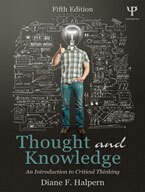 But what is critical thinking? If you do a quick check on the Internet a Wikipedia entry will give you a single-spaced twenty-something page introduction with a lengthy bibliography. The Oxford English Dictionary will give you (for starters): “The objective analysis and evaluation of an issue in order to form a judgment.” But if you’re inquisitive enough about the subject to want to learn more, one of the best places to start is with a book written by Dr. Diane Halpern, an American educator and psychologist. Thought and Knowledge: An Introduction to Critical Thinking is in its 5th edition and has become a standard text on the subject.
While the subject of critical thinking can quickly become an overwhelming topic to explore, Dr. Halpern believes it has two main components: 1) understanding information at a deep, meaningful level, and 2) overcoming fallacies and biases. There are many options about how to start learning to think more critically. Each of us can improve how we do it, and the possible methodologies we employ can vary on a continuum from philosophy to common sense. There’s a path for all of us.
Critical thinking can be taught at any grade level, as long as it’s taught in a way that is developmentally appropriate. It can be learned at any point in life. But it does have some key prerequisites: the awareness that issues we encounter need to be thought through more clearly; the desire to seek the truth and the willingness to suspend biases; open-mindedness; the willingness to suspend judgment; and trust in reason.
Most things of great value in life don’t come to us easily. They require some effort. Often a lot of effort. But the rewards for doing so can be incalculable.

The post The Importance of Critical Thinking appeared first on David Lindsey.


May 15, 2015
Out of the past…
…but never forgotten.

May 14, 2015
Fight Electronic Surveillance of Everyone
A key provision of the Patriot Act is set to expire in a matter of weeks. If Section 215 expires it would mean that the unconstitutional surveillance of everyone’s phone records will end. One federal judge criticized the program as “beyond Orwellian” and “likely unconstitutional.” Even the government-appointed Privacy and Civil Liberties Oversight Board has said this program doesn’t make us any safer, stating that they couldn’t find a single example of a threat to the US where this program made a concrete difference in outcome of a counterterrorism investigation.
But many proponents of Section 215 want to see it renewed.
The Electronic Frontier Foundation is an international non-profit digital rights group based in the United States, and they are trying to raise awareness of this soon-to-expire provision. Here’s their website.
I encourage you to watch the following video, and GET INVOLVED.
April 9, 2015
FIGHT ELECTRONIC SURVEILLANCE OF EVERYONE
A key provision of the Patriot Act is set to expire in a matter of weeks. If Section 215 expires it would mean that the unconstitutional surveillance of everyone’s phone records will end. One federal judge criticized the program as “beyond Orwellian” and “likely unconstitutional.” Even the government-appointed Privacy and Civil Liberties Oversight Board has said this program doesn’t make us any safer, stating that they couldn’t find a single example of a threat to the US where this program made a concrete difference in outcome of a counterterrorism investigation.
But many proponents of Section 215 want to see it renewed.
The Electronic Frontier Foundation is an international non-profit digital rights group based in the United States, and they are trying to raise awareness of this soon-to-expire provision. Here’s their website.
I encourage you to watch the following video, and GET INVOLVED.
Speak out now Dial 215-600-2215 to call Congress or visit fight215.org to speak out.
February 24, 2015
Your Privacy: a right or a piece of merchandise?
This article appeared in Bruce Schneier’s blog. Schneier is a world renown authority on privacy issues. If you’re not familiar with his blog you should be.
AT&T Charging Customers to Not Spy on Them
AT&T is charging a premium for gigabit Internet service without surveillance:
The tracking and ad targeting associated with the gigabit service cannot be avoided using browser privacy settings: as AT&T explained, the program “works independently of your browser’s privacy settings regarding cookies, do-not-track and private browsing.” In other words, AT&T is performing deep packet inspection , a controversial practice through which internet service providers, by virtue of their privileged position, monitor all the internet traffic of their subscribers and collect data on the content of those communications.
What if customers do not want to be spied on by their internet service providers? AT&T allows gigabit service subscribers to opt out — for a $29 fee per month.
I have mixed feelings about this. On one hand, AT&T is forgoing revenue by not spying on its customers, and it’s reasonable to charge them for that lost revenue. On the other hand, this sort of thing means that privacy becomes a luxury good. In general, I prefer to conceptualize privacy as a right to be respected and not a commodity to be bought and sold.
Complexity creates strange bedfellows

The ever-expanding uses of digital technology continue to introduce complexity into our lives, even while trying to make life easier and more just. The issues of protecting personal privacy while at the same time assuring that secrecy isn’t abused by those entrusted with it, continues to trouble us. Privacy and sunlight in official affairs has, in recent years, brought together the far left and far right in this country as few issues have ever done before.
Today’s media has produced yet another example of this. As this article in the Daily Beast demonstrates, yet another good idea appears to be more complicated than we initially thought. This article does a good job of introducing that complexity, giving us plenty of food for thought in the process. What seemed at first blush to be a no-brainer, turns out to be a brain-teaser.
Life is many things, but it’s never simple.
November 12, 2014
How To Create Safe Passwords–It’s Easy!
It’s well known that hackers use brute force computing to quickly crack our passwords and steal our private information. A lot has been written about this, but now I’ve got a handy tool for you to guarantee that your password will be secure.
I first read about this tool in the book Dragnet Nation: A Quest for Privacy, Security, and Freedom in a world of Relentless Surveillance, by Julia Angwin published earlier this year. Angwin was a columnist for The Wall Street Journal for 13 years before joining ProPublica last year as an investigative journalist.
In her book she talks about password entropy which, in terms of passwords, is the strength of a password’s protection against hackers. The higher the entropy the stronger the word and the longer it takes hackers to crack it. She provides a link to a password entropy estimator which lets you type in your password and it calculates the length of time it would take a hacker’s powerful computer to crack the word. The estimator also tells you how the password would be cracked as you type the word.
Try it. You’ll become addicted to creating safer passwords, and you’ll have fun doing it!
November 6, 2014
An Unsavory Job You’ll Never See on “Somebody’s Gotta Do It”
Here’s an article from Wired that will never be covered by Mike Rowe for his CNN show “Somebody’s Gotta Do It”. It’s a job that all of us who use the Internet rely on, and those of us who use social media in particular. It’s a job that most American Internet companies outsource to foreign countries (this Wired article goes into more detail about it) because it’s an unsavory occupation that seriously wears on the minds of those who have to do it. If you read both these articles you won’t look at social media the same way again. Very thought provoking…and sobering.”
October 23, 2014
Would You Rather NOT Know?
Edward Snowden is one of those people who polarize a vast majority of the people. Most people hold strong views about him and what he did. Pro and Con. Today I heard a former CIA operations officer interviewed, and she was asked where she stood on the question of whether Snowden was a patriot or a traitor. She said that she felt it was counterproductive to take sides on that question. Rather, she felt that all citizens should ask themselves another question, and think it over very carefully, taking their answer to their logical conclusion from both points of view: Would you rather not know what Snowden revealed? Would the U.S. be better off if we didn’t know what we now know as a result of Snowden’s revelations?
Here is an interview with Laura Poitras, a film maker who has just released a documentary film about Snowden. The film is called “CitizenFour”, the codename Snowden used when he first contacted her way back in January 2013. It was Poitras who took the story to Glenn Greenwald.
October 21, 2014
A Cautionary Tale…
No society or nation can survive without its police and intelligence organizations to maintain order and security. BUT all societies and nations are in deep trouble if they allow those agencies to function without checks and balances, and the oversight of the civilian populations they were created to protect and secure.
Here’s a link to a cautionary tale…..