James Farner's Blog, page 2
September 22, 2015
Riding to Number Four on Amazon – The Power of Marketing
This week was a very special time because 1914 (The War Years Book 1) was featured on the site Bookbub. If you don’t know what that is, it’s the premier book promotion platform. You can expect more eyes on your book than you can shake a stick at, and it’s why even traditional publishers use it for their authors.
It’s the second time I’ve run an ad with them. The first one was with 1964 (Made in Yorkshire Book 1). If you’ve looked at the book’s page, you’ll see that it managed to hit number five at that time in the whole Kindle store.
This time, I went one better.
That’s right. I hit number four in the whole Kindle store. Okay, I didn’t stay there for long. I’m not a famous author (yet), but I reached almost 30,000 people due to that promotion, and the sales have been immense.
I don’t usually talk about the business side of publishing on here, but over time I’ve realised that I have to consider it more. Ultimately, that’s how I’m going to continue travelling.
Speaking of travelling…
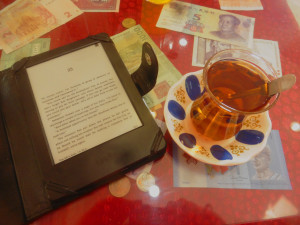 Right now I’m in Istanbul, Turkey. I’m spending at least two weeks here with the option of spending more time if I feel like it. It’s the first time I’ve entered a place that really feels radically different from everywhere else.
Okay, I spent a month in Macedonia and that wasn’t exactly Leeds, but it still retained some similarities with my home city. For a start, it had easily accessible supermarkets.
Anyway, when I travel I do far more than just sit around and do tourist things. In fact, I do very few touristy things at all. At least half of my time I’m writing. It’s why I have no problem leaving things behind because I know I can always return. I don’t have any limit to my time.
My only intention is to return home at Christmas to visit family, before going back on the road again.
It will be a long time before I ever return to the top of Amazon like that, but I will keep writing and I’m sure it will come around again one day. For now, I can enjoy the fruits of my labour and get on with writing my new historical thriller novels.
Oops…did I just leave a spoiler?
Until next time…
James Farner
It’s the second time I’ve run an ad with them. The first one was with 1964 (Made in Yorkshire Book 1). If you’ve looked at the book’s page, you’ll see that it managed to hit number five at that time in the whole Kindle store.
This time, I went one better.
That’s right. I hit number four in the whole Kindle store. Okay, I didn’t stay there for long. I’m not a famous author (yet), but I reached almost 30,000 people due to that promotion, and the sales have been immense.
I don’t usually talk about the business side of publishing on here, but over time I’ve realised that I have to consider it more. Ultimately, that’s how I’m going to continue travelling.
Speaking of travelling…
 Right now I’m in Istanbul, Turkey. I’m spending at least two weeks here with the option of spending more time if I feel like it. It’s the first time I’ve entered a place that really feels radically different from everywhere else.
Okay, I spent a month in Macedonia and that wasn’t exactly Leeds, but it still retained some similarities with my home city. For a start, it had easily accessible supermarkets.
Anyway, when I travel I do far more than just sit around and do tourist things. In fact, I do very few touristy things at all. At least half of my time I’m writing. It’s why I have no problem leaving things behind because I know I can always return. I don’t have any limit to my time.
My only intention is to return home at Christmas to visit family, before going back on the road again.
It will be a long time before I ever return to the top of Amazon like that, but I will keep writing and I’m sure it will come around again one day. For now, I can enjoy the fruits of my labour and get on with writing my new historical thriller novels.
Oops…did I just leave a spoiler?
Until next time…
James Farner


September 13, 2015
What Might Have Happened V – The Death of a Main Character
I said the other week that I would reveal one of the greatest turning points of the series. The early death of a major character was one of the biggest decisions I had to make. It resulted from my desire to make a villain into a bigger villain, whilst also adding a random shock to the series.
In the end, I decided against it for reasons I will outline for you now. As always, there will be spoilers coming immediately in the next section, so if you haven’t finished the series stop reading here.
Who Died?
I can reveal that Peter Warren was the character to die early in the series. He was supposed to die in book 3 1972 at the hands of Rufus Camberwell, or I should say that was the final plan.
Thoughts entered my head about having Robert Hardy himself slay Peter, but in the end this was too easy and I couldn’t figure out how to make it work without changing the entire premise of the book. So in the end I was going to use Rufus to kill Peter through stabbing him.
I wish I could tell you how it was going to happen, but the idea never made it as far as this. I knew he was going to stab him and I knew he would defend Richard from something, but what, where, and why I have no clue.
Why Kill Off Peter?
I can only advance on my previous blog about the real villain. Rufus was designed to be the main antagonist, so I thought this was the best way to make him so. By killing off, arguably, the person who matters most to Richard, he’s committed the worst possible sin against him.
The truth is I turned against this idea when I discovered how much I liked Peter and how essential he became to the series. I’ve always believed he’s the most important person after Richard because he’s the only one who can function as a true foil to Richard’s personality.
Like most big brothers do, Peter can put Richard down when he needs it the most. There’s little Richard can do about it because, again like most big brothers are, he’s bigger, stronger, and older than him.
The Disappearance of Peter
The idea that I was going to kill Peter off originally manifested whilst I was writing 1969. I plan my books even before I’ve finished their prequels. The plots are never fully formed, but I note down events I may want to enter into the plots. I’ll usually finish off the ‘how to get there’ later on.
When I’d decided against removing Peter, I took him out of the book entirely. I could easily use the excuse that he’d simply disappeared to ‘find himself’ and discover his place in the world. I suppose in some ways it made it more meaningful when he did return a year later after four years.
But the truth is I consider this a mistake.
Peter is so essential to the series that I think removing him from a book entirely wasn’t a good move. I’d have loved to use him even in a cameo role. It’s taught me an important lesson for the future, though.
Next week we’re going to discuss the original plans for Richard’s father and why he became little more than a background character after 1964.
Until next time…
James Farner
In the end, I decided against it for reasons I will outline for you now. As always, there will be spoilers coming immediately in the next section, so if you haven’t finished the series stop reading here.
Who Died?
I can reveal that Peter Warren was the character to die early in the series. He was supposed to die in book 3 1972 at the hands of Rufus Camberwell, or I should say that was the final plan.
Thoughts entered my head about having Robert Hardy himself slay Peter, but in the end this was too easy and I couldn’t figure out how to make it work without changing the entire premise of the book. So in the end I was going to use Rufus to kill Peter through stabbing him.
I wish I could tell you how it was going to happen, but the idea never made it as far as this. I knew he was going to stab him and I knew he would defend Richard from something, but what, where, and why I have no clue.
Why Kill Off Peter?
I can only advance on my previous blog about the real villain. Rufus was designed to be the main antagonist, so I thought this was the best way to make him so. By killing off, arguably, the person who matters most to Richard, he’s committed the worst possible sin against him.
The truth is I turned against this idea when I discovered how much I liked Peter and how essential he became to the series. I’ve always believed he’s the most important person after Richard because he’s the only one who can function as a true foil to Richard’s personality.
Like most big brothers do, Peter can put Richard down when he needs it the most. There’s little Richard can do about it because, again like most big brothers are, he’s bigger, stronger, and older than him.
The Disappearance of Peter
The idea that I was going to kill Peter off originally manifested whilst I was writing 1969. I plan my books even before I’ve finished their prequels. The plots are never fully formed, but I note down events I may want to enter into the plots. I’ll usually finish off the ‘how to get there’ later on.
When I’d decided against removing Peter, I took him out of the book entirely. I could easily use the excuse that he’d simply disappeared to ‘find himself’ and discover his place in the world. I suppose in some ways it made it more meaningful when he did return a year later after four years.
But the truth is I consider this a mistake.
Peter is so essential to the series that I think removing him from a book entirely wasn’t a good move. I’d have loved to use him even in a cameo role. It’s taught me an important lesson for the future, though.
Next week we’re going to discuss the original plans for Richard’s father and why he became little more than a background character after 1964.
Until next time…
James Farner
August 28, 2015
What Might Have Happened IV – Richard’s Powerful Friend
Last week I failed to update the blog because I was away on an impromptu trip to Prizren and Pristina in Kosovo. Naturally, I met people in the hostel there and I didn’t have time to write or post a new blog.
I’m back in Skopje, Macedonia, now, so I’ve finally managed to get around to it. This week we’re going to take a look at Richard’s inner circle. In the earlier books he’s portrayed as quite naïve and weak. In many respects, he’s an opportunist and doesn’t have any problems betraying the people he knows, especially in 1969 and 1972.
Whilst this was always the original plan, he wasn’t always a lost little lamb. I once intended him to have an extremely powerful friend to back up his rise to power.
Enter Robert Hardy
Oh, yes, the worst nightmare was once true. I think you the reader always knew that this man was shady from the first time you met him in 1964, but Richard didn’t, or he did but he chose not to acknowledge it.
In the first half of the series Robert helps Richard achieve his goals. Richard repeatedly says he doesn’t want his help, but he gets it anyway. The reverse was true in the original draft. Richard was more than happy to take his help.
There was even a time where Richard thought he had the ambitious officer under his thumb and he could use him to get anything he wanted.
What Happened Then?
We know in 1973 that when Richard attempted to get rid of Robert for good through blackmail he found himself arrested on his wedding day. This led to an eight-year phase where Richard became bitter, angry, and out of control. It wasn’t until the end of his tenure out on the streets he mellowed and became a normal human being again.
In the first draft it happened exactly like this. Richard became too big for his boots and Robert decided it was time to throw him aside for good.
Did it Influence the Future?
To tell you the truth, no it didn’t. The events played out in pretty much the same way.
The major difference you would have seen is the way Richard and Robert spoke to each other. Richard would have spoken from a position of power, almost as an equal. I daresay Richard would have been much more unpleasant to follow if that had been the case.
It’s why I changed it. I know Richard is a character that splits opinion for the things he does. I find him to be more realistic for that reason, but it’s a constant balancing act to ensure he doesn’t swing too far towards becoming a villain.
Next Week (for real this time)
Every character has an ending. Some survive and some just disappear into the sunset. Next week I reveal perhaps the biggest spoiler so far. A major character wasn’t due to make it past book three. Find out who it was next week!
Until next…
James Farner
I’m back in Skopje, Macedonia, now, so I’ve finally managed to get around to it. This week we’re going to take a look at Richard’s inner circle. In the earlier books he’s portrayed as quite naïve and weak. In many respects, he’s an opportunist and doesn’t have any problems betraying the people he knows, especially in 1969 and 1972.
Whilst this was always the original plan, he wasn’t always a lost little lamb. I once intended him to have an extremely powerful friend to back up his rise to power.
Enter Robert Hardy
Oh, yes, the worst nightmare was once true. I think you the reader always knew that this man was shady from the first time you met him in 1964, but Richard didn’t, or he did but he chose not to acknowledge it.
In the first half of the series Robert helps Richard achieve his goals. Richard repeatedly says he doesn’t want his help, but he gets it anyway. The reverse was true in the original draft. Richard was more than happy to take his help.
There was even a time where Richard thought he had the ambitious officer under his thumb and he could use him to get anything he wanted.
What Happened Then?
We know in 1973 that when Richard attempted to get rid of Robert for good through blackmail he found himself arrested on his wedding day. This led to an eight-year phase where Richard became bitter, angry, and out of control. It wasn’t until the end of his tenure out on the streets he mellowed and became a normal human being again.
In the first draft it happened exactly like this. Richard became too big for his boots and Robert decided it was time to throw him aside for good.
Did it Influence the Future?
To tell you the truth, no it didn’t. The events played out in pretty much the same way.
The major difference you would have seen is the way Richard and Robert spoke to each other. Richard would have spoken from a position of power, almost as an equal. I daresay Richard would have been much more unpleasant to follow if that had been the case.
It’s why I changed it. I know Richard is a character that splits opinion for the things he does. I find him to be more realistic for that reason, but it’s a constant balancing act to ensure he doesn’t swing too far towards becoming a villain.
Next Week (for real this time)
Every character has an ending. Some survive and some just disappear into the sunset. Next week I reveal perhaps the biggest spoiler so far. A major character wasn’t due to make it past book three. Find out who it was next week!
Until next…
James Farner
August 10, 2015
What Might Have Happened III – A Different Romance
The third part of our blog series focuses on Richard’s love life. We’ve already discussed a number of things, including what Richard was originally going to do with his life and the real antagonist of the series.
So if you haven’t read last week’s blog, it’s time to click to that page now. As always, if you haven’t read the entire series I recommend you don’t read this blog series because there will be a lot of spoilers involved.
You’ve been warned.
So, let’s go!
How it Happened
If you’ve read 1972, you already know Jessica and Richard met when Richard came to work in Newcastle as a journalist. They met in a club and quickly hit it off. Of course, Robert Hardy had to stick his nose in and the idea of a happy marriage was lost when Richard was carted off to prison.
This was never designed to happen, though. To tell you the truth, there was never meant to be a Jessica character at any point. That was added when I started writing the third book.
It was Anna
Anna was the scorned girl Richard left behind in Ripon. He chose his career and his ambitions over someone who loved him unconditionally. For a time, he loved her the same way, and he became obsessed with her.
That was something I wanted to continue. There was only ever supposed to be one lover for Richard in this part of the story. Jessica was an afterthought.
The problem was how could I possibly send Richard away from Ripon and take Anna with him? I couldn’t, to tell you the truth. It wasn’t possible. Richard had to move out of Yorkshire at this point, and that’s what I did with him.
What Happened with Anna?
Anna does return properly in 1973 when Richard reconciles with her, but she fades away. She does make the odd reappearance, but only as a friend. The insanity from both sides dissipates like the mist on a winter’s morning.
I didn’t intend it to happen this way. She should have had a bigger part in Richard’s story, but when she was out of the main storyline there was never a way to put her back again.
One of my ideas was to have her become Peter’s wife, as opposed to Amber. In the end I didn’t like that idea because they weren’t right for each other in the long-term. Through using Amber I wanted to demonstrate Peter had really moved on. And the same with Amber. Having her marry and become Anna Normandeau enabled her to move on with her life as well.
Next Week
Richard wasn’t always the defenceless, incapable young man I often made him out to be. At one point, he had friends, powerful friends.
Find out what this means next week.
Until next time…
James Farner
So if you haven’t read last week’s blog, it’s time to click to that page now. As always, if you haven’t read the entire series I recommend you don’t read this blog series because there will be a lot of spoilers involved.
You’ve been warned.
So, let’s go!
How it Happened
If you’ve read 1972, you already know Jessica and Richard met when Richard came to work in Newcastle as a journalist. They met in a club and quickly hit it off. Of course, Robert Hardy had to stick his nose in and the idea of a happy marriage was lost when Richard was carted off to prison.
This was never designed to happen, though. To tell you the truth, there was never meant to be a Jessica character at any point. That was added when I started writing the third book.
It was Anna
Anna was the scorned girl Richard left behind in Ripon. He chose his career and his ambitions over someone who loved him unconditionally. For a time, he loved her the same way, and he became obsessed with her.
That was something I wanted to continue. There was only ever supposed to be one lover for Richard in this part of the story. Jessica was an afterthought.
The problem was how could I possibly send Richard away from Ripon and take Anna with him? I couldn’t, to tell you the truth. It wasn’t possible. Richard had to move out of Yorkshire at this point, and that’s what I did with him.
What Happened with Anna?
Anna does return properly in 1973 when Richard reconciles with her, but she fades away. She does make the odd reappearance, but only as a friend. The insanity from both sides dissipates like the mist on a winter’s morning.
I didn’t intend it to happen this way. She should have had a bigger part in Richard’s story, but when she was out of the main storyline there was never a way to put her back again.
One of my ideas was to have her become Peter’s wife, as opposed to Amber. In the end I didn’t like that idea because they weren’t right for each other in the long-term. Through using Amber I wanted to demonstrate Peter had really moved on. And the same with Amber. Having her marry and become Anna Normandeau enabled her to move on with her life as well.
Next Week
Richard wasn’t always the defenceless, incapable young man I often made him out to be. At one point, he had friends, powerful friends.
Find out what this means next week.
Until next time…
James Farner
August 2, 2015
What Might Have Happened II – The Real Antagonist of the Series
A slight delay this time, but this week I will talk about another major change I made to the original Made in Yorkshire series. As always, if you haven’t read the series from start to finish I highly recommend you don’t read any of these blogs.
If you haven’t yet started this series, please go back to the first edition and start from there. But, seriously, spoilers alert.
Got it?
Good. Let’s get started.
The Original Antagonist
You probably know that there are a number of antagonists within the series. First of all, you have the one we first meet in Rufus Camberwell. Rufus is the son of a lord and adopts a haughty attitude that quickly brings him into conflict with the Warren family’s working class background.
There’s also Anna, for a time. She becomes a thorn in Richard’s side emotionally, and later physically, when he abandons her to pursue a dream career as a journalist.
We also have a number of villains who appear in single books, including the prison warder Mr. Carewood and the man from Dunblane, who later goes on to injure Richard so badly he requires a stay in hospital.
Then we have the primary antagonist of Robert Hardy. He pursues Richard for his own purposes from book one through to book seven. His eventual death, albeit an accident, is both a blessing and a curse for Richard, but when it happens it allows him to begin a new life away from his shadow.
But this wasn’t the original plan.
A Minor Character?
Robert was never meant to be the primary antagonist. He was supposed to be a simple corrupt police officer who doesn’t rise up the rankings in the way he did. The real antagonist was Rufus Camberwell.
My original plans for Rufus started in book one and ended in book three. Rufus was going to disappear for book two and come back in book three, determined to destroy Richard. Instead, Rufus simply doesn’t care. In the same way as the rest of his life, he doesn’t pay much attention unless it involves the best brandy or money.
Why did I change it?
It would make it extremely difficult for me to bring Richard down a peg. I would have a situation where I would be forced to destroy Richard through simply having Rufus utilise his money. There was an option where Robert would be the junior party and Rufus the controller, but in ‘1984’ I later turned this on its head.
Next Week
Next week you’re going to find out that the relationship between Jessica and Richard wasn’t always as straightforward as it seemed. Yes, their eyes met across the environment of a hot, sweaty club, but it didn’t always happen like this.
Find out more about a different romance for Richard next week.
Until next time…
James Farner
If you haven’t yet started this series, please go back to the first edition and start from there. But, seriously, spoilers alert.
Got it?
Good. Let’s get started.
The Original Antagonist
You probably know that there are a number of antagonists within the series. First of all, you have the one we first meet in Rufus Camberwell. Rufus is the son of a lord and adopts a haughty attitude that quickly brings him into conflict with the Warren family’s working class background.
There’s also Anna, for a time. She becomes a thorn in Richard’s side emotionally, and later physically, when he abandons her to pursue a dream career as a journalist.
We also have a number of villains who appear in single books, including the prison warder Mr. Carewood and the man from Dunblane, who later goes on to injure Richard so badly he requires a stay in hospital.
Then we have the primary antagonist of Robert Hardy. He pursues Richard for his own purposes from book one through to book seven. His eventual death, albeit an accident, is both a blessing and a curse for Richard, but when it happens it allows him to begin a new life away from his shadow.
But this wasn’t the original plan.
A Minor Character?
Robert was never meant to be the primary antagonist. He was supposed to be a simple corrupt police officer who doesn’t rise up the rankings in the way he did. The real antagonist was Rufus Camberwell.
My original plans for Rufus started in book one and ended in book three. Rufus was going to disappear for book two and come back in book three, determined to destroy Richard. Instead, Rufus simply doesn’t care. In the same way as the rest of his life, he doesn’t pay much attention unless it involves the best brandy or money.
Why did I change it?
It would make it extremely difficult for me to bring Richard down a peg. I would have a situation where I would be forced to destroy Richard through simply having Rufus utilise his money. There was an option where Robert would be the junior party and Rufus the controller, but in ‘1984’ I later turned this on its head.
Next Week
Next week you’re going to find out that the relationship between Jessica and Richard wasn’t always as straightforward as it seemed. Yes, their eyes met across the environment of a hot, sweaty club, but it didn’t always happen like this.
Find out more about a different romance for Richard next week.
Until next time…
James Farner
July 23, 2015
What Might Have Happened I – Richard’s Real Profession
Today I begin a new blog series where I will reveal the original plans for Richard Warren and the Made in Yorkshire series. Like most authors, what I planned to do turned into something entirely different.
I recommend you don’t read any of this series until you’ve read all seven books. I take no responsibility for spoiling anything if you don’t pay attention to this warning.
Got it?
Good!
The Journalist in Richard
Journalism was a profession I chose because I didn’t really have anywhere to go with Richard becoming an author at such a young age. At the end of 1964 he has his first interview and his stories are sometimes referred to, but the reality is it would change the entire series if I did go down that route.
You see there’s not a great deal I can do with someone who happens to be an author. The writing process is not something that can be described. Plus, it’s not exactly interesting for you guys to hear about how he stayed up all night dealing with a hook.
Give Me a Reason
I considered the possibility of having a similar story play out even with him as an author. The difficulty was in giving him a reason for the events that unfold. In 1969 he goes down to London because Andrew Carter says he could learn to be a journalist there. Okay, I could try to say he could go down there to get inspiration for his book.
But the other adventures Richard undergoes also need a reason, and I can’t use the same one each and every time.
What about Robert Hardy?
Robert Hardy wouldn’t need Richard if he was an author. As sad as it is, authors don’t have any real power. They often don’t have any connections, so what use would Richard have to him?
The answer is not much. So the main villain who drives the story forward now has no motivation to deal with Richard at all.
How Quick Did I Make the Change?
Towards the conclusion of 1964 I was ready to make Richard a young author. Five years later he has slacked off like any teenager. I was pretty much set on Richard beginning a real career the moment I started the second book.
I did return to Richard’s writing by the time 1984 swings around. Consider this homage to the original plan. Eventually, Richard did become an author, but it wasn’t without going through the personal hell of being a journalist first.
Next week I reveal the identity of the real villain of the story. Robert Hardy never did start out as the main series antagonist.
Until next time…
James Farner
I recommend you don’t read any of this series until you’ve read all seven books. I take no responsibility for spoiling anything if you don’t pay attention to this warning.
Got it?
Good!
The Journalist in Richard
Journalism was a profession I chose because I didn’t really have anywhere to go with Richard becoming an author at such a young age. At the end of 1964 he has his first interview and his stories are sometimes referred to, but the reality is it would change the entire series if I did go down that route.
You see there’s not a great deal I can do with someone who happens to be an author. The writing process is not something that can be described. Plus, it’s not exactly interesting for you guys to hear about how he stayed up all night dealing with a hook.
Give Me a Reason
I considered the possibility of having a similar story play out even with him as an author. The difficulty was in giving him a reason for the events that unfold. In 1969 he goes down to London because Andrew Carter says he could learn to be a journalist there. Okay, I could try to say he could go down there to get inspiration for his book.
But the other adventures Richard undergoes also need a reason, and I can’t use the same one each and every time.
What about Robert Hardy?
Robert Hardy wouldn’t need Richard if he was an author. As sad as it is, authors don’t have any real power. They often don’t have any connections, so what use would Richard have to him?
The answer is not much. So the main villain who drives the story forward now has no motivation to deal with Richard at all.
How Quick Did I Make the Change?
Towards the conclusion of 1964 I was ready to make Richard a young author. Five years later he has slacked off like any teenager. I was pretty much set on Richard beginning a real career the moment I started the second book.
I did return to Richard’s writing by the time 1984 swings around. Consider this homage to the original plan. Eventually, Richard did become an author, but it wasn’t without going through the personal hell of being a journalist first.
Next week I reveal the identity of the real villain of the story. Robert Hardy never did start out as the main series antagonist.
Until next time…
James Farner
July 13, 2015
A Theme Track to Life in Made in Yorkshire
People have asked me before whether I’ve ever thought about attempting to get Made in Yorkshire made into a TV show or a film.
I can honestly say I have. In fact, I wrote the books that way. In terms of the actual series, it’s not suitable for a film. I can’t imagine trying to fit seven books into ninety minutes or two hours. I’m sure it could be done, but for me it’s trying to do too much with all that material.
A book in a one-hour drama I could imagine that, and that’s how it was all planned and formatted, in many ways.
A Goodreads Giveaway
I was asked to do a giveaway as part of the Never Too Late to Read the Classics group on Goodreads. The way it works is I give out 1964 (Made in Yorkshire Book 1) for a month and one winner gets the second book for free.
As part of the giveaway I did a Q&A that lasted from June to July. I got a lot of questions, but one of the questions I got was whether I’d considered making the series into a TV show or a film. It was the first time I’ve ever been able to talk about this publicly, since most fans speak about the books only, rather than what they could become.
So I said I did. In fact, I do have about ten pages of a script for the first episode ‘1964’. But that’s beside the point.
Music means a lot to me and so naturally I listen to a lot of it, especially when writing. My books have always had theme songs that I think could fit into a TV show, and I’m going to share them with you now.
Theme Songs
Take note I’ve given them titles. Some of you will see what I’m alluding to, but if you’ve yet to complete the series the chances are you’ll wonder what I’m talking about.
Nevertheless, there are no spoilers here:
Main series theme: The Eurythmics – When Tomorrow Comes
Richard’s Theme: Damien Rice – It Takes a Lot to Know a Man
Peter’s Theme: Smile Empty Soul – Finding Myself
Jessica’s Theme: Roxette – It Must Have Been Love
Growing Up: The Adventures – Broken Land
Leaving Home: Elton John – Goodbye Yellow Brick Road
Death in the Family: Ed Sheeran – Afire Love
On Top: Fiction Factory – Feels Like Heaven
Alone in the World: Need a Name – Key to Your Heart
Under the Bridge After the Dream: Michiru Oshima – Brothers (English)
Longing for the Past: Celtic Woman – Fields of Gold
These tracks are the main ones I listened to at various points. I acknowledge it might not be to your tastes, but there’s an array of styles here. A lot of them are quite symbolic, which is why I gave them such specific titles. In most cases, it’s the lyrics that make these songs appeal to me.
Search them out on YouTube yourself and see what you think.
Until next time…
James Farner
I can honestly say I have. In fact, I wrote the books that way. In terms of the actual series, it’s not suitable for a film. I can’t imagine trying to fit seven books into ninety minutes or two hours. I’m sure it could be done, but for me it’s trying to do too much with all that material.
A book in a one-hour drama I could imagine that, and that’s how it was all planned and formatted, in many ways.
A Goodreads Giveaway
I was asked to do a giveaway as part of the Never Too Late to Read the Classics group on Goodreads. The way it works is I give out 1964 (Made in Yorkshire Book 1) for a month and one winner gets the second book for free.
As part of the giveaway I did a Q&A that lasted from June to July. I got a lot of questions, but one of the questions I got was whether I’d considered making the series into a TV show or a film. It was the first time I’ve ever been able to talk about this publicly, since most fans speak about the books only, rather than what they could become.
So I said I did. In fact, I do have about ten pages of a script for the first episode ‘1964’. But that’s beside the point.
Music means a lot to me and so naturally I listen to a lot of it, especially when writing. My books have always had theme songs that I think could fit into a TV show, and I’m going to share them with you now.
Theme Songs
Take note I’ve given them titles. Some of you will see what I’m alluding to, but if you’ve yet to complete the series the chances are you’ll wonder what I’m talking about.
Nevertheless, there are no spoilers here:
Main series theme: The Eurythmics – When Tomorrow Comes
Richard’s Theme: Damien Rice – It Takes a Lot to Know a Man
Peter’s Theme: Smile Empty Soul – Finding Myself
Jessica’s Theme: Roxette – It Must Have Been Love
Growing Up: The Adventures – Broken Land
Leaving Home: Elton John – Goodbye Yellow Brick Road
Death in the Family: Ed Sheeran – Afire Love
On Top: Fiction Factory – Feels Like Heaven
Alone in the World: Need a Name – Key to Your Heart
Under the Bridge After the Dream: Michiru Oshima – Brothers (English)
Longing for the Past: Celtic Woman – Fields of Gold
These tracks are the main ones I listened to at various points. I acknowledge it might not be to your tastes, but there’s an array of styles here. A lot of them are quite symbolic, which is why I gave them such specific titles. In most cases, it’s the lyrics that make these songs appeal to me.
Search them out on YouTube yourself and see what you think.
Until next time…
James Farner
July 5, 2015
A New Appreciation for the Marvel of Wi-Fi
Wi-Fi is something we all tend to take for granted in the west. We switch on the computer and poof the glory of Wi-Fi is upon us. It means we can procrastinate at absolutely any time. I was once one of you, before the dark times, before the time of realising all places aren’t as well-connected as the UK.
Shut up, I’ve never travelled at any time before this!
The Negative of My Genre
One of the big problems with historical fiction is I need the Internet for research. It’s not like fantasy where I can just make it up. I have to investigate how things worked in order to make sure I don’t make mistakes.
Of course, I do get things wrong from time to time. Some of you have kindly pointed that out to me, but the error count would soar if I didn’t have immediate access to the Internet.
The Difference in Free Wi-Fi
What I discovered in Europe is that in the west you’re less likely to find any free Wi-Fi. If you can’t find any, your only option is to sneak into a restaurant and steal some of the receipts left on the tables. These tend to have the password on the bottom. Alternatively, you have to ask a customer for the password.
No, it isn’t an option to actually buy something.
In the east you tend to find it more readily. In Helsinki, Finland, for example, there’s free Wi-Fi everywhere in the city centre. The same applies to Tallinn in Estonia, and to an extent Riga in Latvia.
I’ve lost count of the number of times I’ve had to camp out at a bus station or railway station to get guaranteed Wi-Fi.
So How do I Cope?
Badly. I cope extremely badly.
For me, I get around this through regular couchsurfing. The vast majority of my hosts have a home connection, so that usually isn’t a problem. Only on one occasion did the host not have a stable Internet connection.
Hostels tend to vary in terms of the Internet connection. Sometimes they have a good connection and sometimes not. Last night in Vilnius, Lithuania, I got so annoyed by my hostel’s connection I marched 3km down to the train station. It was about 11pm by the time I had to walk back on a Friday night in the city centre.
In short, I have a new appreciation for the power of Wi-Fi in the UK. As always, you can find out more about my adventures on the Travel Farner website.
Until next time…
James Farner
Shut up, I’ve never travelled at any time before this!
The Negative of My Genre
One of the big problems with historical fiction is I need the Internet for research. It’s not like fantasy where I can just make it up. I have to investigate how things worked in order to make sure I don’t make mistakes.
Of course, I do get things wrong from time to time. Some of you have kindly pointed that out to me, but the error count would soar if I didn’t have immediate access to the Internet.
The Difference in Free Wi-Fi
What I discovered in Europe is that in the west you’re less likely to find any free Wi-Fi. If you can’t find any, your only option is to sneak into a restaurant and steal some of the receipts left on the tables. These tend to have the password on the bottom. Alternatively, you have to ask a customer for the password.
No, it isn’t an option to actually buy something.
In the east you tend to find it more readily. In Helsinki, Finland, for example, there’s free Wi-Fi everywhere in the city centre. The same applies to Tallinn in Estonia, and to an extent Riga in Latvia.
I’ve lost count of the number of times I’ve had to camp out at a bus station or railway station to get guaranteed Wi-Fi.
So How do I Cope?
Badly. I cope extremely badly.
For me, I get around this through regular couchsurfing. The vast majority of my hosts have a home connection, so that usually isn’t a problem. Only on one occasion did the host not have a stable Internet connection.
Hostels tend to vary in terms of the Internet connection. Sometimes they have a good connection and sometimes not. Last night in Vilnius, Lithuania, I got so annoyed by my hostel’s connection I marched 3km down to the train station. It was about 11pm by the time I had to walk back on a Friday night in the city centre.
In short, I have a new appreciation for the power of Wi-Fi in the UK. As always, you can find out more about my adventures on the Travel Farner website.
Until next time…
James Farner
June 24, 2015
Starting a New Series
If you haven’t noticed, I started a brand new Made in Yorkshire series this week. It’s entitled the War Years and takes place from the perspective of an underage soldier signing up for the war. Over the course of five books, you’ll follow the six Keeton brothers as the Great War moulds them in ways both good and bad.
I’m not here to write a whole blog promoting my new book or series. There’ll be plenty of time for that later. It’s a time to reflect because this is the first time I’ve left the bounds of my original series.
A Departure
I will say that I attempt to keep the same style as you’re all used to. The style is the same, but the setting has changed. Now we’re about fifty years before the start of 1964 (Made in Yorkshire Book 1).
The world is different and the entire premise is far more concentrated than before. There were far more challenges this time because I’m not merely skimming over different time periods. Also, the events surrounding the main character Danny Keeton are more pronounced. He can’t escape them. They aren’t going on in the background, as was often the case with Richard Warren.
So I had to research more thoroughly this time. I say that, but I must confess World War I and World War II have always been interests of mine, ever since I was a child. They were the first historical periods I learned about.
The Slight Genre Change
Okay, you’re all used to historical fiction. That’s exactly what you’re going to get this time. The difference is I’m bringing in the war/military flavour.
It wasn’t a difficult decision to do this. Luckily, this is a genre where you have a lot of room to manoeuvre. It’s not like in other genres where one sub-genre switch will entirely change the landscape of your work.
I must say 1914 (The War Years Book 1) is about the people in the war, rather than the war itself. You’re not going to hear much about battle tactics and the technical components of a Lee Enfield rifle. Strictly speaking, it contains a war flavour, without entering that genre in its entirety.
Experimentation
I believe experimentation is a crucial part of the writing process. I want to see what I can do with other parts of history. I started from an extremely modern standpoint with my first series. I want to see what lies elsewhere.
The journey to find one’s area never truly stops. I know what parts of history I like, but I don’t know whether that will translate to my work. Only going through the process can do that.
That’s why I need all of you to tell me about that. I do appreciate the messages you’ve been sending me, and I would love you to keep them coming. They really do help, even if they’re only a couple of lines long.
Until next time…
James Farner
I’m not here to write a whole blog promoting my new book or series. There’ll be plenty of time for that later. It’s a time to reflect because this is the first time I’ve left the bounds of my original series.
A Departure
I will say that I attempt to keep the same style as you’re all used to. The style is the same, but the setting has changed. Now we’re about fifty years before the start of 1964 (Made in Yorkshire Book 1).
The world is different and the entire premise is far more concentrated than before. There were far more challenges this time because I’m not merely skimming over different time periods. Also, the events surrounding the main character Danny Keeton are more pronounced. He can’t escape them. They aren’t going on in the background, as was often the case with Richard Warren.
So I had to research more thoroughly this time. I say that, but I must confess World War I and World War II have always been interests of mine, ever since I was a child. They were the first historical periods I learned about.
The Slight Genre Change
Okay, you’re all used to historical fiction. That’s exactly what you’re going to get this time. The difference is I’m bringing in the war/military flavour.
It wasn’t a difficult decision to do this. Luckily, this is a genre where you have a lot of room to manoeuvre. It’s not like in other genres where one sub-genre switch will entirely change the landscape of your work.
I must say 1914 (The War Years Book 1) is about the people in the war, rather than the war itself. You’re not going to hear much about battle tactics and the technical components of a Lee Enfield rifle. Strictly speaking, it contains a war flavour, without entering that genre in its entirety.
Experimentation
I believe experimentation is a crucial part of the writing process. I want to see what I can do with other parts of history. I started from an extremely modern standpoint with my first series. I want to see what lies elsewhere.
The journey to find one’s area never truly stops. I know what parts of history I like, but I don’t know whether that will translate to my work. Only going through the process can do that.
That’s why I need all of you to tell me about that. I do appreciate the messages you’ve been sending me, and I would love you to keep them coming. They really do help, even if they’re only a couple of lines long.
Until next time…
James Farner
June 17, 2015
Does the Writing Environment Change Anything?
Back home I had a couple of spots where I always used to write. It was consistent and I wrote my Made in Yorkshire books over the course of a couple of years. Now all that’s changed.
As you know, I’m travelling the world, which you can read more about on my other blog.
But one thing that has changed is that I rarely write in the same place/position twice. It’s impossible for me to do that since I’m moving around so quickly. Lately I’ve been thinking about my writing style.
Does my writing environment alter my style?
Definitive Yes or No
In short, I can’t say for sure yet because I’ve yet to send a completed book to my editor. Only she will know whether anything has changed. I’m getting close to half way through my first book written entirely on the road, so I’ll know for sure then.
I think one thing that has changed is my ability to plan. These days I can’t carry around a notebook and paper because quite frankly I’d lose it. I have to write things into my phone now.
You might not think this is so much of a problem, but when you’re making the change for the first time it does present difficulties in adapting.
I find myself making it up as I go along a lot more than I did before.
Distractions and Productivity
One area that has suffered is productivity. I’m sad to say that I have had to scale back my efforts somewhat. It’s simply a matter of balancing seeing what the world has to offer, socialisation, and actual work. So on some days I’m unable to write much at all.
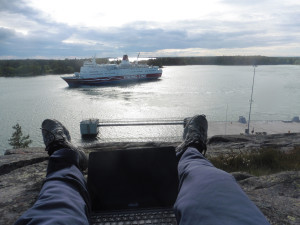
The writing spot on the cliffs
For example, yesterday I edited some of my latest book whilst on a cliff in Mariehamn on the Aland Islands, in Finland. This was tranquil and there was nobody anywhere near me. It was a great place to get some work done.
On the other hand, I’ve also worked in an empty hostel before, and this was another fantastic place to work. But when there are lots of people around the job becomes far more difficult. There are distractions, and I don’t say that in a bad way.
Getting Ahead of Myself
I’m happy that I managed to get well ahead of myself before I started this trip. I feel I would struggle to make my release dates if I hadn’t.
There’s a good chance I will have to scale back my releases in future, but with any luck this won’t be for a long time yet.
How many of you have tried to juggle travelling and writing?
Until next time…
James Farner
As you know, I’m travelling the world, which you can read more about on my other blog.
But one thing that has changed is that I rarely write in the same place/position twice. It’s impossible for me to do that since I’m moving around so quickly. Lately I’ve been thinking about my writing style.
Does my writing environment alter my style?
Definitive Yes or No
In short, I can’t say for sure yet because I’ve yet to send a completed book to my editor. Only she will know whether anything has changed. I’m getting close to half way through my first book written entirely on the road, so I’ll know for sure then.
I think one thing that has changed is my ability to plan. These days I can’t carry around a notebook and paper because quite frankly I’d lose it. I have to write things into my phone now.
You might not think this is so much of a problem, but when you’re making the change for the first time it does present difficulties in adapting.
I find myself making it up as I go along a lot more than I did before.
Distractions and Productivity
One area that has suffered is productivity. I’m sad to say that I have had to scale back my efforts somewhat. It’s simply a matter of balancing seeing what the world has to offer, socialisation, and actual work. So on some days I’m unable to write much at all.

The writing spot on the cliffs
For example, yesterday I edited some of my latest book whilst on a cliff in Mariehamn on the Aland Islands, in Finland. This was tranquil and there was nobody anywhere near me. It was a great place to get some work done.
On the other hand, I’ve also worked in an empty hostel before, and this was another fantastic place to work. But when there are lots of people around the job becomes far more difficult. There are distractions, and I don’t say that in a bad way.
Getting Ahead of Myself
I’m happy that I managed to get well ahead of myself before I started this trip. I feel I would struggle to make my release dates if I hadn’t.
There’s a good chance I will have to scale back my releases in future, but with any luck this won’t be for a long time yet.
How many of you have tried to juggle travelling and writing?
Until next time…
James Farner