Zachariah Wahrer's Blog, page 6
January 18, 2018
Flight of the Mariner (Short Story)
When five torpedo bombers disappear off the coast of Florida during a training flight in 1945, Wally and his flight crew are sent to look for them. They head out over the stormy Atlantic in their Mariner seaplane, searching the dark ocean for survivors. They find the downed planes, and with them, something far more sinister.
eBook available at: AMAZON – SMASHWORDS – GOOGLE


November 9, 2017
God of the Storm (A Memory)
The following is a story of time I spent with my dad. A few years after these events, he killed himself. He was a depressed, recovering alcoholic who took his own life for reasons I sometimes feel I fathom, but can’t agree with.
As time has passed and I’ve reflected on his life, I wish I had gotten more time to know him. Family and friends have told me more, and I’m grateful for it, but it would have been cool to have my own observations. From what I do know, he was not perfect, but was smart, caring, and good. I wish he could see my life now, that I could talk to him about the difficulties of being a husband, a writer, a climber. I’ll never have that chance, but I’m glad he isn’t suffering anymore. As I write this, listening to “Wish You Were Here,” I think about his life and how much someone can mean to you, even after they’ve been gone for so many years, even when they left you forever.


October 10, 2017
The Process: How I Write A Novel (Part 5)
I’ve still been working on the latest Dawn Saga novel, despite all the awesome climbing I did over the summer. After finishing the second draft, I gave the manuscript to my editor. It took a month or so for her to read it and give her feedback. Once she did, I began grinding away on the 3rd draft.
Having someone else read an early version of my work (especially something as large as a novel) is a bit nerve wracking. I spend hundreds of hours writing and revising, and if something major is wrong, it can set the process back significantly. If one of my story arcs is junk, or a new character is boring, it means huge rewrites. In addition, I have standard line edits and additional content to create, even if the major things are spot on.
Every time I go through this step of the process, I hope my editor will say it’s good as is, or maybe just only minor changes required. Another (better, smarter) part of me knows that is foolish and wants feedback on how to make the book better. But not too much feedback. That just means I did a bad job. 
September 12, 2017
Legacy (5.7, 850′) – Tobacco Root Mountains, MT
After our big push on the Upper Doublet, we needed a day or two to rest and recuperate. With our week of alpine climbing nearing its end, we wanted to get one more climb in. Both of us agreed it shouldn’t be anything too crazy, as our minds and bodies were still feeling strained.
We decided on Legacy, a mellow 6 pitch climb up Leggat Spire in the Tobacco Root Mountains near Sheridan, MT. With only one pitch of 5.7 and the rest low 5th class, it would be a nice change of pace from the scary EZ Route. The approach and descent were supposed to be short as well, adding to the allure.
Saturday morning we got a leisurely start and made the two hour drive out to Sheridan and up the long and bumpy road to the Branham Lakes. The approach was mellow, although it is bushwhacking the whole way. Thankfully, the trees are sparse and the distance short.
[image error]Heading up.
[image error]Psyched on the easy approach.
Sarah took the first pitch, a short bit of easy crack into a long leftward horizontal traverse above a stretch of overhang on the north face.
[image error]Sarah at the first pitch belay.
The next pitch was supposed to be the 5.7, but we had a hard time understanding the guide description, so we just decided to pick the best looking path. Sarah led off, disappearing around a corner above me.
She yelled “Off belay,” brought me up, and said it was my lead. I did some scouting to try and understand where the guide wanted us to go, before finally just heading up into the gully above. Some dirty, but easy climbing followed. I tiptoed through more loose rock before gaining and traversing another ledge. I built a belay just below the ridge line and Sarah took the lead after I brought her up.
The next three pitches were stellar ridge scrambling with just a few 5th class moves thrown in to keep it interesting. I took the middle of the three, enjoying a really cool finger crack layback to get up a short notch.
On the final pitch, Sarah led up through the massive notch visible in the top picture. She stemmed between the main ridge and a huge block. I was so excited to follow the pitch. Hero moves with super easy climbing.
[image error]Final bit of technical climbing.
After that, we unroped and scrambled the rest of the ridge, which had great exposure and nothing harder than low 4th-class.
[image error]Narrow ridge section.
[image error]Summit views.
After spending a few minutes on the summit, we began picking our way down the ridge, enjoying the peaceful freedom of scrambling moderate terrain.
[image error]Decisions.
[image error]Having some fun on the way down.
In the end, we opted for the less steep, longer gully, having had enough scary talus fields earlier in the week. It proved a fun navigation challenge working our way back to the car. We got to see some neat scenery along the way.
Legacy (our version of it anyway) proved to be a fun, chill way to end our week of alpine climbing. We still have several weeks of peak fitness from our training, so we’ll see what happens next.
September 6, 2017
The EZ Route (5.9R, 900′) – Beartooth Mountains, MT
After taking a rest day, we continued our week of alpine climbing by heading over to the Beartooth Mountains near Roscoe, MT. This mountain range offers much in the way of climbing, but beta is scarce and sometimes inaccurate. In other words, you need to be prepared for an adventure.
Earlier this year, Sarah discovered the EZ Route on the Upper Doublet in our Montana alpine guidebook and we bookmarked it for our peak period. The full climb, rated V-VI 5.9 A3, is beyond our abilities, as we’ve only ever done short pitches of clean aid. Learning how to hammer pins on a remote bigwall seemed foolish. The lower half of the climb was supposed to be 10 pitches of 5.6 to 5.7, with the last one having a short bit of A1, including a fixed RURP (a piton about the size and thickness of a large postage stamp). That felt more doable.
From the midway point, the guide said you could descend a gully, which would allow us to get a big chunk of climbing on a stellar formation without having to do the A3 upper headwall. While this wasn’t a summit, it seemed like a good opportunity to get on a big feature in the Montana back country and push ourselves. We decided to bring bivy gear and sleep on the midway ledge, another new experience for us. It would be part adventure, part training climb.
In the hours after deciding our plan, the short A1 aid section at the top of the 10 pitches started to get into my head. What if we climbed all that way and couldn’t get through it? We’d have to rappel all the way back down, likely leaving our entire rack in the process. Sarah and I talked about it more, and decided to head to the second hand gear store and buy a hammer and pitons. The only things available were a 50 year old wall hammer and one piton. We bought both.
This allayed my fears somewhat, but a couple more pitons would be even better. REI didn’t carry them, and with no other climbing gear stores and no time to order online (we were climbing the next morning), we decided it would have to do. I grabbed a couple BD Talons and Peckers off my clean aid rack and hoped for the best.
I slept really poorly the night before, anxious about the route. I’m used to having more beta for the climb, and other than a distant picture and half a paragraph of text, this was feeling like a first ascent. I know this wouldn’t be a big deal for many, and I’ve done this kind of adventure climbing before, but not in the mountains and not so far from the trail head.
[image error]The Doublets (mid left), still far above and far away.
On about 4 or 5 hours of poor sleep, we got up early and drove to the East Rosebud Trail head. After 2 miles of pleasant trail hiking, we found a long talus gully that seemed the best way to approach the Doublets. It became steeper and steeper, and we climbed chockstones next to waterfalls.
[image error]Lower Doublet completely obscuring Upper. Still a long way away.
Much traversing on talus and scree followed as we crossed below the massive Upper Doublet. It was tough going, through deadfall and boulder fields, but we finally arrived at the gully separating the Upper and Lower Doublets. Going up this gave access to a ledge we could traverse to the far right side of Upper and the start of our route.
[image error]Finally, a better view of at least part of Upper.
[image error]Traversing the massive ledge to find our route.
Almost four hours after leaving the car and 3,000′ of gain later, we we reached the start of our route. Things seemed off, however. Looking up, it didn’t look like there was 10 pitches of climbing above us to the next major ledge, although we were definitely in the correct place. Given the average for a pitch is about 150′, we should have had 1,500′ of climbing ahead of us. We could see the midway ledge, and it looked just a little over half that distance away. Alarms began going off in my head, and I wondered if the beta about being able to descend the gully or the short section of aid were as accurate. We’d come all this way and nothing had really changed (other than a possibly shorter climb), so we racked up and set off.
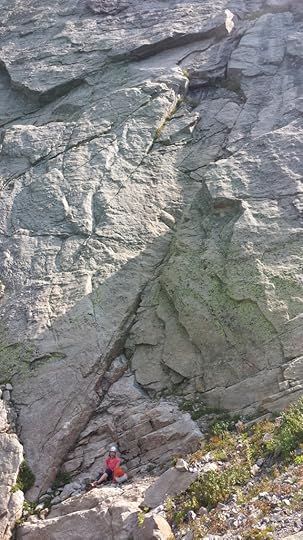 Sarah taking a break at the start of the route as I stepped back to get a good view of the upper pitches.
The first pitch was a lot of fun, easy climbing on mostly solid rock, to a short, well protected crux. The moves were neat and felt on for the 5.7 grade. Portions of the pitch were runout, but the climbing was mellow and I felt strong despite the long approach.
I built a belay and brought Sarah up, who took the gear and set off up the next pitch. Unfortunately, after getting a couple pieces in, it was runout till reaching a small roof. Sarah downclimbed back to the belay, saying she wasn’t in the right head space for that kind of climbing. Knowing your limits and not pushing too hard are critical skill in this setting. A fall will almost certainly be injurious on slabby, broken terrain, and if your not feeling in control, it is best to back off.
So we swapped gear, Sarah put me on belay, and I quested upwards. The moves to and through the roof weren’t horrible, but what followed was. I strung together several marginal pieces, climbing lightly on crumbly rock. The angle steepened, and I couldn’t see any spots for pro for quite sometime. At one point, a large hold I had previously thought solid started pulling off in my hand. I quickly shifted to a less positive, but more stable hold, made a move, and was surprised to find a good crack for pro. Thankfully, the rest of the pitch was less exciting.
I built a belay and hung my backpack off the anchor. As I belayed Sarah up, I tried to calm my heart rate. The loose hold I thought solid had nearly caused me to take a nasty fall. My mind was still trying to recover from the incident. You can do this, I thought, looking up at terrain that appeared to offer solid rock and better protection.
A short distance above, I could see the beginning of the massive dihedral that is the hallmark of the EZ Route. Once in it, I felt we would definitely be on route and could follow it all the way to the midway ledge.
When Sarah arrived, she said she still wasn’t feeling like leading would be a good idea, so I gathered the gear. When I put my backpack on, it felt heavier than ever. Bivying on the midway ledge was adding more weight than I was used to climbing with. We trained with 8 lbs, but were currently climbing with 16.
The first part of the next pitch was easy slab traversing into a corner. The gear was better, and I quickly popped up on a sloping ledge directly at the base of the massive dihedral. I hadn’t climbed far (~100′), so I decided to continue up the corner. From where I stood, it appeared about 40′ of almost vertical climbing to another, higher ledge. This would be a more appropriate pitch length.
As I headed up the corner, gear placements were sparse. There were hardly any cracks, and those present were filled with dirt and grass. Finally I got a piece in, protecting me from a tumbling fall to the ledge below.
I continued upwards. The climbing grew harder. I got another piece in, but it wasn’t confidence inspiring. Higher, a patch of grass was growing through an ancient nut and bail sling, showing someone had rappelled from here at some point. Why would you rap here if you can walk off the ledge? Doubts about the difficulty of climbing above as well as the feasibility of the easy descent deepened.
Questing up through the steep section, the good foot holds vanished and I was left with small hand holds that faced in all the wrong directions. Don’t do any moves you can’t reverse, I told myself, knowing that my last piece, now a body length below me, wouldn’t hold a big fall. My backpack felt like a thousand pounds, but I made one move, then another. Soon, I was even higher above my piece and the holds I thought would be jugs were only slopers. Shit, I thought, knowing I needed to reverse and reassess the situation.
But I’d forgotten the moves. There were no feet, and I’d lost track of the awkward hand holds. Keep it together, keep it together, I repeated, finding first one hand, then another. I still couldn’t find good feet, so I just jammed myself into a short section of offwidth crack in front of me. The stance was better than expected, and I was able to go hands free and breathe. After a minute of rest, I downclimbed back to the sloping ledge, rattled.
Unable to find any gear to build a belay, I simply clove hitched the belayer side of the rope to me, creating an unequalized anchor through the three pieces in the dihedral above. Thankfully, the ledge was big enough to make a braced belay possible.
When Sarah came up, I told her about my earlier experience in the scary dihedral. She encouraged me while handing me pieces from the previous pitch. I breathed deeply, removed my clove hitch, and headed back up. This time, I managed to climb more confidently, and with a couple crucial pieces I didn’t have before, found a few placements that made it less intense. Still not well-protected, but better. Mental duct tape, as I’ve heard it called.
Where I thought a ledge would be, was only a grassy corner, stretching for another 100′. Gear was sparse, and I don’t remember if I actually got anything in. Thankfully the climbing wasn’t hard. I still had to keep focused, however, as I moved past loose rock and sketchy sections.
When I reached the next ledge, all I could find was a single solid piece. Another braced belay. As I brought Sarah up, I pondered the next pitch, which looked remarkably like the one before, a steep section of dihedral/chimney, only this time there was a crack that looked to offer much better protection. It was hard to tell from our position, but I guessed this would be the last pitch. Somewhere above, the A1 lurked. I hoped it was through this steep section, and I could either free it or just pull on cams.
As Sarah gave me gear, we discussed how the previous pitch had felt much harder than 5.7. I think it was at least 5.9, and even with the long approach and heavy pack, it was way more difficult than anything that we’d done on the previous three 5.7 pitches.
Sarah gave me more words of encouragement as I set off again. My mind was starting to feel fried from all the runouts. Now that we were reaching what was supposed to be the most difficult part of the climb, my worry kicked into overdrive. Keep it together. I’ve climbed runout terrain before, even some that was “harder” climbing, but never this sustained or for so many pitches.
From the single piece belay, I moved up carefully, getting in as many pieces as I could to protect us, which wasn’t many. When I reached the steep section, the crack proved to be as solid as I had hoped, taking good gear. Pulling out of the overhang on jugs while being well protected felt so good. I was excited to have the worst of the climbing be over. I was wrong.
Above me, another 100′ of unprotectable climbing followed. I focused and kept moving upward, checking each hand and foot placement. Just as I was nearing a belay ledge, which appeared to have good pro, the climbing got insecure and awkward. I didn’t want to do it. It was just one short move, one that would send me falling all the way back down to the belay if I messed up. Summoning everything within me, I growled loudly, angry that the climb was making me do this bullshit, and pulled the move.
Unfortunately, when I reached the ledge, all the cracks surrounding it were garbage, composed of loose blocks and choss. After further searching, I found a small crack that appeared solid, plugged in a single green C3, and braced myself as best as I could. Sarah flew up the pitch and we contemplated the options.
From our vantage point, we could see the top of the dihedral, and by extension, the midway ledge. We were soooo close! The last pitch looked short and not terribly difficult. It was similar to the ones before it, an overhang in a dihedral. This time though, the overhang was almost a roof, and was composed of stacked loose blocks.
I couldn’t see a way to aid through any of it and I wanted nothing to do with the loose roof. It would put Sarah directly in the line of fire. As I looked at the pitch though, I knew I had to find a way through. We were 800′ up, and only 100′ separated us from the walk off. Time to onsight.
A line began to materialize through the complex system of roofs, overhangs, slabs, and corners just to the left of the rotten rock. I took in several deep breaths, knowing this would be the biggest challenge yet, and set off. The climbing up to the manky roof was harder than I’d anticipated, but I carefully moved up a wide crack. I delicately traversed left under the loose blocks until I found a stance that wasn’t too strenuous. Peering out around the corner, I looked up my intended path. The small dihedral that had looked good from below had no crack for gear, and looked smooth and holdless. No go.
I began to feel a rising panic. I was less than 50′ from the top of the pitch, but I had no way to finish. Traversing further left from the main dihedral would be dangerous, since I had no gear in between and a fall would pendulum slam me into the wall.
Calling down to Sarah, I asked if she could tell what was happening in the next corner to the left of the one I was below. At this point, I was definitely willing to pull on gear or pound pitons, if I could find a place for either. She said it looked like there might be gear, but it was hard to tell.
No other option. I moved further left, into an undercling. This was insecure climbing and I was in a dangerous position, but at least the rock was solid. From the undercling, I still couldn’t see around the corner. The next few moves looked difficult. Need gear.
Awkwardly contorting myself to peer up into the undercling at waist hight, it looked like it would take a green C4. I struggled to place it blindly, having to focus hard to keep my feet on the smeery foot holds. Finally, after checking the piece, dread settled on me. The crack flared and only one set of cam lobes were solid. The piece was “good enough” to allow me to move forward, but not good enough to make me feel safe. I had to continue. You’ve fallen on worse and it held.
As I moved around the corner, I tried to move as deliberately and confidently as possible. My climbing skills were still my best protection, and if I never fell, I wouldn’t have to test the holding power of the janky piece.
After a couple hard moves, I found good footholds and a stance. Above me, the crack offered intermittent protection. I felt a load dissipate off me. I got a few more pieces in, beginning to feel more confident I wouldn’t pendulum into the corner.
The rest of the pitch was fairly mellow by comparison, although with all the traversing and mini-roofs, I set myself up for a heinous case of rope drag. The top out was full of large loose blocks, so I once again tiptoed past, not wanting to knock anything down on Sarah. Moving lightly is hard when you are pulling up an extra 50lbs of rope drag…
(Note: I apologize for the lack of any pictures on the route. It was such an intense experience and I was so focused I didn’t even think of pulling out the camera.)
Sarah followed the last pitch cleanly. We were both on the midway ledge. We looked around, trying to find the bivy spot the guide talked about. Everything sloped downwards and didn’t look terribly comfortable or large. With all the broken, loose rock, it would be difficult to even build an anchor.
With the climbing over, my thoughts turned to the descent. The gully was on the far side of the ledge, and from what I could see, looked precarious. I had scoped the bottom of it from the start of the climb, but couldn’t get a good view of the top. Even if you have to improvise rappels it will be shorter than going down the face.
Since the midway ledge lacked a reasonable spot to lay down, and we didn’t want to do a sitting bivy, we decided to descend the gully. The sun would be setting soon, but we thought we’d have enough time to get back to the more expansive and comfortable ledge at the start of the route.
Getting across the midway ledge proved to be difficult with several sections of loose 4th class and one short bit of low 5th. We belayed across the whole thing, as we were both really tired and a slip would likely be fatal.
When we reached the head of the gully, I felt my heart lighten. It didn’t look too bad. We went a short way down, then got cliffed out on exposed, water polished slab. With no hands or feet, we decided to improvise a rappel off a choke point between two boulders. More scrambling lead to another steep step. Same slick rock, only this time the bottom was overhung. We improved another rap off a single, bomber nut.
The rest of the gully was 3rd class and we popped out at the base of the climb with just enough time to set up a bivy and cook dinner before dark.
[image error]Bivy spot.
[image error]Sarah enjoying the view before we had to put the tarp on.
We covered up with a tarp just as a rain squall moved through. As droplets spattered above us, we stayed warm and dry, joking about how we carried our gear all the way up the climb just to bivy where we started. It was the perfect end to a difficult day. We’d been moving for almost 12 hours.
The next morning, we felt energized and psyched, which I wasn’t expecting. I continue to be amazing at what our training time accomplished. We did the long hike down at a leisurely pace, eating lots of raspberries and huckleberries. It felt good to sit down when we made it back to the car.
[image error]Moving down into the gully between the Upper and Lower Doublets.
[image error]Psyched to get some water along the descent gully.
[image error]Almost through the steep sections, with lots of scree slogging still to go.
In hindsight, I think this route tested every climbing skill I’ve developed over the past eight years. We knew it would be a challenge, and we were ready for it. I learned a lot, and look forward to doing even bigger, more difficult objectives in the future. I wish our skills were up for the headwall (still don’t feel ready for A3 or big wall 5.11), but that will come in time.
Detailed Route Beta:
Description:
The first half of the EZ Route is a worthwhile objective for parties with solid skills. The climbing is fun and engaging, but serious, with long runouts on mostly moderate terrain. While there are a few spots with bad rock, most of the first half is on solid rock. With good fitness and an early start, a car-to-car ascent of the first half (descending from the midway ledge) is possible.
The Select Alpine Climbs to Montana guide calls this first half 10 pitches of 5.6 or 5.7, with a bit of A1/2 on the last pitch. We were able to free everything at 5.9 or 10a in 6 pitches and found some of the 5.7 pitches to be harder than advertised. It is possible we were on a variation, but based on all info we could find, we stayed on route.
Location:
The first pitch starts off the far right side of the large approach ledge. Look for a right tending crack above a rocky flat spot, beginning below the massive dihedral that defines the right hand side of the Upper Doublet. If you get to the talus gully, you’ve gone too far.
Approach:
From the East Rosebud Trail head near Alpine, MT (GPS: 45.197266, -109.635143), hike south on the trail for approximately 2.25 miles, passing the end of the lake, a rock outcrop, a stream crossing, a big waterfall, and up some switchbacks. Leave the trail when you see a broad talus wash leading all the way up to the left side of the Lower Doublet.
Head up this, negotiating chock stones and boulders until you reach the Lower Doublet. If you leave too early, you’ll have to go through lots of deadfall, which is slow going. The best path is hard to describe, but I would recommend continuing up until you pass a cliff band on the right (almost all the way to the Lower) and reach a vertical waterfall. From here, head right, scrambling up a 4th class slab and onto the hillside directly below the Lower.
Traverse along the base of Lower Doublet, being careful not to get too high (will cliff out eventually). When you reach the broad gully (house size boulder at the base) between Upper and Lower, head up it. Near the upper right margin you can skirt your way onto the approach ledge for the Upper Doublet. Walk across this grass/scree ledge until you reach the base of the route. It is possible to bivy here if you don’t want to do the whole thing in a day.
Protection:
We brought doubles from #3-0.75 C4’s, and overlapping sets of smaller cams (.5-.3 C4’s, 3-2 Mastercams, 2-00 C3’s). A set of nuts (including DMM alloy offsets), some quickdraws, and 10 shoulder length slings rounded out the rack. We brought a hammer and a few pins (for the A1 section), but never needed them.
Route:
[image error]The first bit of the EZ Route.
P1: Head up easy terrain, linking crack systems. A bit of runout on ledgy sections to get you warmed up, then good gear before pulling a short finger crack layback crux. Belay below a short dihedral capped by a mini-roof. (5.7 PG-13, 160′)
P2: Climb up the slab, pull the roof, and head up steeping terrain past a small tree. The rock here is marginal and protection sparse, so be careful. Belay at a good stance below and slightly to the right of the massive dihedral. (5.7 PG-13, 160′)
P3: Climb up slab and into an overhanging corner just to the right of the belay. From here, head up and left, onto a large sloping ledge at the base of the massive left facing corner. Solid rock/gear is sparse on the ledge, so get creative with your belay. A few solid pieces can be found up in the dihedral, or you can brace belay. (5.6, 110′)
P4: Venture up into the dihedral, pulling tricky moves to get through the steep (sometimes wet) section. Good gear is hard to get. C3’s make things bearable. Continue up on runout but more moderate terrain till you reach another belay ledge. We belayed from a braced position with one solid orange Mastercam. (5.9R, 160′)
P5: This pitch looks very similar to the last, although the crux is better protected. The overhanging dihedral is easier than it appears, and is pulled on mostly good holds. The rock is relatively solid, and gear in the crack is good. After the crux, continue up easier, but runout terrain. It might be possible to traverse to the left to get gear, but it also might be a trap. We belayed from a braced position with a solid green C3. (5.8R, 180′)
P6: One more pitch and perhaps the most exciting of all. From the belay, head up the corner and wide crack until you hit the chossy roof. Traverse left to a good undercling. Careful here as a fall would swing you hard into the dihedral. I got a green C4 in the undercling and made a move around the corner to the left to better protected terrain. Climb through the short dihedral, then traverse back right and into the main corner to finish the pitch. A bit contrived, but has protection and avoids most of the worst rock on the pitch. (5.9/10a PG-13, 120′)
Descent: If you aren’t up for the A2/3 pitches to finish the route (or the 5.11 pitches of Time Trip), you can 3rd/4th class traverse across the broad ledge to the climbers right to a descent gully. We improvised raps over two steep sections in the gully. Down climbing them might be possible, but the rock is extremely water polished and exposed. It wouldn’t be easy. Eventually, the gully opens up, allowing access to the approach ledge. Reverse the approach back across it and down the gully separating the Upper and Lower Doublets.
(Disclaimer: If you decide to use this beta, you take all responsibility. I’ve done my best to write this from memory, but I may have made mistakes. It is your job to exercise good judgment and not just follow blindly…
August 28, 2017
Direct West Arete (5.7, 850′) – Crazy Mountains, MT
Starting on 8/21/17, we were fortunate enough to have an entire week off from work. It fell during the peak period of our training cycle, which was perfect! Including weekends, we had 9 days to climb as much as our bodies and minds could handle.
We decided to start with the Direct West Arete of the Incisor (10,250′) in the Crazy Mountains of Montana. This route has been on my list for a long time and over the past year, I’ve thought about it frequently. It is a really cool peak (just left of center in the top picture) that requires a bit of a hike to reach. The arete on its west side runs from ground to summit, and the Direct West Arete route climbs near this feature for almost the entire way, creating a logical line up an impressive swath of rock.
My original goal for this season was to do this route car-to-car in a day, something our training had definitely prepared us for. We were also looking for a cool place to watch the eclipse, however, and the weather forecast in the Crazies was clear for the 21st. So we would hike in, climb the route, then bivy so we could watch the eclipse the next day.
Waking up early Sunday, we made the long, bumpy drive out to Cottonwood Creek trail head. The hike to the lake was a bit of a slog, gaining 2,500′ in just over 5 miles. By the time we reached the lake, Sarah and I were both feeling the effects of the wildfire smoke. The air was hazy, but there wasn’t anything we could do about it. We dumped our bivy gear at an open space by the lake and resumed hiking up towards the Incisor.
[image error]Incisor on the left of the big notch, Dogtooth on the right.
Getting up the massive glacial moraine situated between the lake and the base of the formation took us 75 minutes, gaining another 1,000′ in just under a mile. We kicked steps up a soft snowfield until we hit shade and it turned to a sheet of ice. Back to the talus…
[image error]Pushing hard, but still happy.
We were both pretty tired by the time we reached the start of the technical climbing. I think the wildfire smoke was having a pretty big impact on us. My lungs were burning, I was nauseous, and it felt like I was having a bad allergic reaction (like my regular spring allergies). Sarah had similar symptoms, only worse. Her nose was plugged up, and at the time, we wondered if she was coming down with a cold.
[image error]A closeup of the Incisor, taken last fall. The picture doesn’t do a good job showing the scale of the peak.
Pressing on, we racked up and I set off on the first pitch. The climbing was fun: a finger crack in a corner with solid rock and mellow moves. After several short, ledgy steps, I reached a nice belay spot and built an anchor. Sarah followed up the pitch and we both commented how we were feeling better. The lesser exertion of climbing vs. hiking was allowing us to recover. Our training was paying off.
August 10, 2017
White Crystals Crack (5.7, 600′) – Beehive Basin, MT
On our trip up to Beehive Peak a few weeks ago, Sarah and I hiked by a really cool formation and decided we wanted to climb it at some point. The only information I could find was that it was called the Prow, and it had a single route on it: White Crystals Crack. The guidebook listed the hardest pitch as 5.10-, with 4 other pitches 5.7 and under. Given our success on Javaman, we decided to give the route a go.
[image error]The Prow, in profile.
Since the approach, climb, and descent are all pretty short, we decided we didn’t have to get a super early start. The weather forecast didn’t call for thunderstorms until mid-afternoon, supporting this decision.
After arriving at the base of the climb, Sarah decided to lead the first pitch, which ended up being fairly exciting. She quested up the face, linking sparse, questionable gear placements and trying to avoid copious amounts of loose rock. She did an awesome job getting through it, building a belay on top of pillar.
[image error]Lone Peak (Big Sky Ski Resort), hazing out due to wildfire smoke.
When I arrived at the belay, she gave me the gear she had left on her harness and I took off up the next pitch. The first half of the route continued through more loose rock, through a small gully, and across a large ledge. I delicately balanced my way up, carefully checking each hold before committing to it. While I was able to get pro in occasionally, it was constantly no-fall territory.
The face steepened, and I began using the sharp edge of the ridge crest for my left hand, and a stellar splitter crack for my right. The climbing through this upper section was amazing, well protected, and sustained (although it was only 5.6). After the shitty climbing lower down, it felt like a reward.
I finally built a belay when I reached the top of the main pillar, on a comfortable, sloping bivy ledge. After bringing Sarah up, she scoped the next pitch, took the remaining gear, and headed out.
[image error]Sarah working through the 3rd pitch crux.
The third pitch was a 40 meter traverse to the left, terminating on the main ridge crest of the formation. It had a few 5.6 moves at the beginning and end with easier climbing in between. And lots more loose blocks. Sarah built a belay below what was supposed to be the crux 5.10- “White Crystal Crack” pitch, and I worked my way over to her.
Looking up from the belay, I felt my stomach clench slightly. Climbing hard while having to manage loose rock is challenging and based on what I had seen of the rest of the climb, this pitch would have plenty. There was also a small roof to pull, and not much good looking gear between it and the belay. Time to be careful.
I set off up the pitch, finding a small pillar that let me avoid most of the roof, and thankfully offered a few solidish gear placements. Tapping on each hold to make sure it was solid, I pulled up off the pillar and into the White Crystal Crack. Surprisingly, the giant crystals and flakes were solid. I relaxed.
As I continued up, I kept waiting for hard moves, but everything above looked moderate. With so little information about the climb, I felt like I was doing a true onsight. Reaching the top of the crystal crack, I was faced with a decision to head up into jumbled roofs or continue in a large dihedral just right of the ridge crest. This climbing looked solid and seemed to fit the fuzzy topo we had of the route, so I went that way, pulling around another roof onto a large ledge.
Sarah and I could barely hear each other while exchanging belay calls. It was actually easier to hear the people talking on the trails almost 1000′ below, than it was for me to hear my climbing partner.
[image error]View from the 4th pitch belay. So much wildfire smoke!
The last pitch appeared to be a short, mostly 4th class scrambling, but since we didn’t know what to expect (and the last pitch was listed as 5.7 on the topo), we kept the rope on. Sarah finished it quickly and brought me up.
The hike off the Prow and back to the main trail was mellow, heading down scree fields and traversing a ridge. The trail out was super busy (as always). We passed the time talking about how much loose rock we had climbed over and how enjoyable the route was. It was a great day.
July 20, 2017
The Original Route (5.10, 700′) – Beehive Peak, MT
This past weekend, Sarah and I got on the hardest alpine climb we’ve done yet: The Original Route (aka Javaman, 5.10, 5 pitches, 700′), on the south face of Beehive Peak near Big Sky, MT.
After failing in the Bridgers the week before, we were both feeling a bit down, but still wanted to get out and try again. On Thursday, Sarah said she had energy and wanted to do a big day Saturday. I was excited to hear it and began listing some possible areas we might go to. Sarah found the Original Route in the guidebook, and we speculated if we were ready for such a difficult (relative to us) climb. We’ve been training for the past 9 months, but pushing grades in the alpine is not something to take lightly.
After some thought, we decided we were indeed ready to give the Original Route a shot. On Friday, however, the weather forecast was showing a 30% chance of rain in the morning and a 50% chance of thunderstorms in the afternoon. Rain wouldn’t be a big deal, but standing on top of a 10,742′ peak in a thunderstorm is obviously a bad idea.
Instead of scrapping Beehive all together, we decided to do a shorter, less difficult climb: New World Route (5.8, 3 pitches). This would get us up and down much quicker than the Original Route, and we’d beat the afternoon thunderstorms.
On Saturday, we woke up a 4:20 AM, made snacks, filled up our water containers, did one last weather check, and hurried out the door. The drive to Big Sky was uneventful, and we began the hike in at around 6:15 AM. We tried to push our pace a little, but not so much as to burn ourselves out before the climbing.
[image error]Quick photo stop on the hike.
[image error]Early morning at Beehive Lake.
When we got closer to the formation, however, we realized a party of 3 had reached the New World Route ahead of us. Since their leader was just starting up the snowfield and neither of us enjoy climbing below others (rock fall potential and speed considerations), we chose to change plans. We debated for several minutes, trying to decide if we should do a 2 pitch 5.7 route on the right side of the face, or opt for our initial plan of the Original Route.
Doing the shorter, easier climb felt like a bit of a cop out, so we decided to go for the Original Route. The weather was looking good (no rain and few clouds in sight) and the hourly forecast I’d checked when we woke up said the strongest likely hood of thunderstorms wasn’t until 2 PM. If everything went according to plan, we felt we’d be able to summit and get down before then. We racked up, tied in, and I set off up the first pitch.
So many things were running through my mind as I began climbing. Was I making a mistake? Were we pushing too hard? Was it smart to get on the hardest alpine climb we’d ever tried with a marginal afternoon weather forecast? I shut out the doubts, telling myself we could always rappel the route if things got nasty. It would be expensive to leave that much gear behind, but retreat was possible.
The start of the route is in your face and bouldery 5.9, so I had to focus on making smooth, deliberate moves. A fall here would likely mean a broken ankle or leg, and I had no desire to hobble back 4 miles to the car. I linked one move into the next, pulled up over a bluge, and found a perfect section of crack for gear. Several minutes of climbing later, I was building an anchor and bringing Sarah up.
Pitch 2 is the crux, and thinking of it made me nervous. The first pitch had felt good, however, so I figured I should be OK. Sarah gave me the gear she’d retrieved, and I took off again. Given the vagaries of the available beta for this climb, I didn’t really know what to expect. I kept pushing upward, through the first section of 5.9 wide crack, which went down smoothly. The pitch went on and on as my remaining gear dwindled. Where is the crux? I carefully crimped and edged my way up a slab, and then saw it, ten feet of vertical corner. I’d arrived!
Which was a good thing, as I only had a couple pieces of gear left. I plugged a cam under an overlap below the roof, and looked up nervously. I generally like corners, as I find good ways to stem and rest. Unfortunately, this one had a slab below it, with no place to get in gear high enough to prevent decking initially. Just don’t fall.
I pasted my feet on the left wall of the corner, reached up, and searched for holds. Nothing. There were some slopers and a weirdly angled crimp, but nothing good enough to get me to commit. I studied both walls further, discovering a crack out left that I’d totally missed. The problem was that it was too far away to hand jam, or even comfortably stem on. But, it was the only option, so I got my feet up once again, and this time, I stabbed my left foot as far over as I could. My leg was uncomfortably high, and didn’t feel particularly solid, but it was working. I smeared the right side of my body into the corner, found some shitty holds for my hands, and brought my right foot up. I repeated this process a couple times until the crack arched over into reach.
Looking down, I realized the slab was uncomfortably far below me, and I was once again facing a fall with potential injury. Get some gear in. I was still solidly jammed in the corner, with the crack out of my view, so I groped around in it, trying to decide what size piece might fit. Big blue C4, I thought, thankful to still have one on my harness. It was even racked on the correct side. I uncliped the piece, and blindly placed it into the crack, trying to sense the lobe expansion. Feels good.
A foot above, the crack arched into a nearly horizontal rail, juggy in a few places. The feet still weren’t good, and I was tired from the strenuous gear placing position, but at least I had pro in. Once on a jug, I took a quick look at the cam. Not a perfect placement, but probably the best I’ve ever done blindly. I quickly did the final moves, built a belay with my last three pieces, and tried to steady my heavy breathing as I brought Sarah up. 5.10 climbing at 10,500′ is hard on the lungs. The guys on New World Route congratulated me as they set off on their 3rd pitch.
[image error]Sarah getting comfy at the 2nd belay. The crux corner drops down just to the right of her feet.
From here, we had a decision to make: Stick with the original route, or try one of the numerous variations that split off at this point. Since the variations are less well documented, and we were aiming for speed, we stuck with the standard path. I took the gear from Sarah and set off on the traversing 5.7 pitch, which I think I did part of correctly, but then got off route. It turned out OK, because I ended up belaying on a nice ledge in the right general area. Unfortunately, for Sarah, this pitch is not well protected for the 2nd for most of the way and does have some scary, loose rock on it. Thankfully, we both got through without falling or pulling anything off.
The next pitch was another 5.9, but it was a short, exposed roof pull/traverse. After the battle with the 5.10 corner, I was feeling a little drained, but made quick work of it. The climbing eased, and I began running it out, moving as quickly and efficiently as I could. Now that the hard parts of the technical climbing were over, I only worried about weather and the descent.
More easy climbing passed, and I found myself wondering if I might make it to the top in one long pitch. The more I thought about it, however, the more I doubted it was possible. The last two pitches would be around 75M if I combined them, and we only had a 65M rope. Simul-climbing through the 5.9 roof would not be a good option. Instead, I plugged two bomber cams into an overhanging corner, and tried to keep up with the belay as Sarah nearly sprinted up to me. “I heard thunder,” she said breathlessly as she approached.
“Then let’s shift gears,” I replied, taking the few pieces of gear I’d used on the last pitch from her. She quickly put me on belay, and I launched up the final pitch. The climbing was easy, and I soon arrived on a nice ledge. Above me, only 4th class remained. I yelled for Sarah to take me off belay, hauled up the slack between us, and threw the rope around a solid horn. Terrain belays are nice.
The few tiny clouds we’d spotted at the 2nd belay had grown into massive, dark thunderheads. Thankfully, the lightning still sounded far away, and we hadn’t seen any cloud to ground action yet. We quickly packed the rope, put on our approach shoes, and scrambled to the summit.
With no time to pose for a nice photo, I quickly snapped a few pictures to remember the summit by:
[image error]
[image error]A little nervous, and a little out of breath.
After tagging the summit, we quickly scrambled our way down into the descent gully. There is a large slung block at the top to rappel from, but we opted to down climb as getting the rope out would take longer. After a few exposed moves, the gully opened up and we we began churning through scree. Every foot we descended, my anxiety about the weather decreased, while my nerves about entering the snowy 4th of July Couloir increased.
While packing on Friday, I had asked Sarah her opinion if we should bring ice axes or not. One of the guides said the snow was usually easily avoidable on the descent, so we opted not to bring them to save weight and bulk on the climb. We were about to see if we’d made a bad decision.
As we moved further down, Sarah spotted a large fluffy mass crashing down the gully ahead of us. “Mountain goat!” We watched as the spooked fluff ball sprinted headlong down before us. “Wish we could move that fast,” Sarah said, laughing. “Hope he doesn’t get hurt.”
On the way up, I’d spotted an alternative descent that would keep us out of the couloir and completely off the snow, but would require traversing the ridge; prime lightning strike territory. So when we reached the saddle that would take us into the 4th of July Couloir, we crossed the ridge and began heading down. From here, we had just a few hundred feet left to descend.
The scree quickly turned to snow, and we pondered our options as it began to intermittently rain and sleet. The snow was soft enough to kick steps with approach shoes, but it would be a long, tedious, and (without an axe) potentially dangerous decent. Instead, we opted to down climb the troughs that had formed on the sides of the gully, where snow melted away from the rock.
This progressed fairly well, until we reached an overhang with bad feet and hands. A few difficult, scary moves later, and we continued motoring down the trough. At one point we kicked steps across the couloir, changing sides to reach easier terrain.
When we finally made it to the bottom, we both cheered. It was good to be off the peak. The weather wasn’t improving, and we decided to keep our harnesses and gear on until we reached a safer location. After twenty minutes or so, we felt comfortable enough to pack everything up for the rest of the hike out.
[image error]Looking back. The 4th of July Couloir (path of our descent) is the snowy ribbon left of center.
We took our time getting back to the car, feeling excited for what we’d accomplished. Many people were hiking up to check out Beehive Lake and the beautiful scenery despite the rolling thunder. The lot was overflowing with cars by the time we got back. When we stopped our timer for a round trip time of 8 hours, 54 minutes. It was a good day in the mountains.
July 6, 2017
Sacred Hunting Grounds (5.9+, ~550′) – Bridger Mountains, MT
On Independence Day, Sarah and I decided to try Sacred Hunting Grounds, a climb up the Red Cloud wall of the Bridger Mountains. It’s close to home, allowing a fairly casual day trip. On the drive out, we were in lots holiday traffic, and we wondered if there would be any parking left at the trail head. When we arrived at Lower South Fork Brackett Creek Trailhead, however, we found it empty. Have to love Montana!
July 3, 2017
Bangtail Divide 38K Race
I’m not really a runner, although that doesn’t mean I don’t do a fair bit of running. I enjoy it as part of training for alpine climbing, but it’s not my primary focus. When our friend, Jess, asked if Sarah and I wanted to run the Bangtail Divide race with her, I was a bit apprehensive. I’ve never run that far, much less in a race. My one and only official race was a 5K last Thanksgiving in Arizona, which I did manage to finish 8th overall and 1st in my age group. That felt good, but I knew the Bangtail race was going to be full of competitive and well trained people.
I try to support Sarah’s running goals (she loves it and ran cross country through high school and college), and I felt it would be a good challenge. So I agreed to join in.
Last year, before we ran the Bridger Ridge Traverse (not during the official race, and unsupported) we had been running a lot. We spent many days running mountain trails with lots of elevation gain. This year, our training program was different and more focused on alpine climbing. It dictated we carry heavy packs up steep hills at a low heart rate. While the training stimulus wasn’t specific to running, I hoped we’d built up a big enough base to endure the official 23.4 miles with 3045′ of gain / 2523′ of loss the Bangtail race requires.
Unfortunately, when race day arrived on Saturday, I don’t think either Sarah or I felt ready. The most recent long run we’d done was around 10 miles, less than half what we were about to attempt. I felt comfortable with the elevation gain (since not to long before, we’d done a climbing day with 7,000+ feet with packs on), but I really worried about the length. During the Bridger Traverse run, I collapsed just after we finished. That run had less total distance, but more elevation change. Memories of laying on a picnic table, exhausted and delirious, ran through my mind. Should have prepared better. Should have run more… Mentally, I just didn’t know how my body would handle what I was about to attempt.
But when we lined up at the starting line, I resigned myself to the fact that I was here now and would do what I could. I tried to think about all the time we’d spent training, all the heavy squats, box steps, and hill climbs we’d done. I’m fit and ready.
And then at 6:30AM, the race started. Sarah, Jess, and I ran down a dirt road with 147ish other people. It was crazy hearing that many pairs of shoes crunching through the gravel and dirt.
[image error]Separating the pack.
The field quickly spread out, the people who would finish in a little over three hours quickly pulling away. Jess (well trained and having just completed a marathon earlier this year) set a fast pace of her own, and was soon ahead of Sarah and I, who’d agreed to run together for awhile.
After the first mile of gentle elevation gain on the road, the race turns off onto a steep trail, and begins switchbacking like crazy. Sarah and I gained the single track trail ahead of just a few people. We were both freezing from the early mountain morning (running in the shorts and T-shirts we’d need for the later heat). I began worrying I would finish last (if at all). Everyone was so quick, and I felt I was already struggling.
So let me say this: One thing I learned from my only other race experience is that I don’t do well with pacing. I tend to go faster than I should, too soon, especially when someone is ahead of me. Knowing this, prior to Bangtail, I made a plan to not push too hard or let the race aspect drive me. I would treat it as training, which is when I do a great job of focusing and doing what I should.
When we hit the first set of switch backs, something shifted in my mind. I felt like the uphills were going to be the only place I would have an advantage, that I would need to go fast and get as far ahead as possible, so that when the flatter portions of the race came, I could go slower.
I began speed hiking the steep portions of the switchbacks, and running the lesser inclined bits. Most of the people in front of us just walked, and Sarah and I started passing clumps of racers, two and three at a time. I could feel my heart rate climbing out of my planned zone (and my heart rate monitor confirmed it), but I shut that information out, clinging to the new plan that I would go slower once we reached the top of the primary elevation gain.
After a bit of this, Sarah told me she was pushing too hard in order to keep up, and I sort of slowed down. I kept going faster than I’d originally planned though. At one point, when the trail flattened out a bit, I turned to look back at who I thought was Sarah, and give her a high-five. Instead, I found a much older woman who was startled at my upraised hand.
I let her pass, and she motored ahead of me for awhile. After a short distance, she took a direct 90 degree turn off the trail into a small clump of trees. Nature called, apparently. I never saw her the rest of the race.
After the first big hill climb, things became uneventful. I did a horrible job sticking to my plan, which made me anxious about completing the race. Would I have the energy and endurance to finish? My heart rate was way high, but my breathing and muscles felt fine. So I kept pushing, mile after mile, wondering. My average heart rate display kept creeping up, making me feel like an idiot. But I couldn’t make myself slow down. I kept passing people, feeding my inner speed dragon.
When we hit the first aid station at around 4.5 miles, I didn’t even stop. None of the food sounded good, I still had water in my backpack, and I didn’t want to get passed by anyone. More miles went by, and I wound my way up more hills. I felt lonely and missed running with Sarah. I contemplated walking, or even stopping, till she caught up, but a deep part of me had taken over, and I couldn’t quit running.
When I hit the second aid station (at around the half way point), I stopped. I needed to replenish my fuel supply, so I grabbed a couple energy gels and shoved them in my pocket. I downed a shot of Coke and ate a few pickles. They tasted so good.
Jess happened to be at the aid station as well, and we left at the same time. She was holding herself back, thinking about the second elevation gain spike we were going to face during the last quarter of the race. I kept thinking about how I was gambling with my pace, that I might not be able to finish, that the last elevation gain and the huge downhill after it might do me in.
As we moved into the third quarter of the race, Jess effortlessly started pulling away. I couldn’t keep up, even in my passing frenzy. I continued seriously wondering if I might have pushed too hard in the beginning, and would collapse on the final big hill climb. Guess I’ll find out…
[image error]Motoring across one of the few flattish portions of the race. Jess is just ahead, in red.
Now the day was really starting to warm up, and heat became an issue. When I entered a long stretch of dense, old growth forest, it felt like a dream come true. The trail was slightly down hill, but not so much that it really worked me. I flew. I was completely alone through much of this, and I enjoyed listening to trance music cranked up in my earbuds. For a moment, I forgot my anxiety, forgot about what was coming, and just reveled in the primal joy of running hard.
Then, I exited the beautiful, cooling shade, and began ascending the final stretch of hills. It was hot, dusty, and I begin passing people again, which made me push harder. At the final aid station, with just ~8 miles left to go, I took a few more shots of Coke, ate a pickle, grabbed a few gels, and set off once again. Jess had arrived at the station just before me, and left a few people ahead. She quickly disappeared, running hard and obviously knowing she had plenty of energy left to finish the race.
I was not feeling as confident. The Coke gave me an initial burst of optimism, and I was still running the gradual uphills. I passed people, heard them breathing harder than me. Doubt continued to linger about whether I would finish or not.
At one point, I remember the trail turning left at the peak of a hill, marking the last bit of the secondary section of hill climbing. As I crested and turned, I descended into hell… The trail dropped steeply, full of loose rocks, roots, and all manner of things to catch my weary feet on. I stumbled a few times, righting myself before I went full sprawl in the rocky path. My legs burned, my knees ached. I went into my suffer hole. The downhill was unrelenting, punishing. I regretted trying so hard, so early, for so long. I’d tried too hard, and now my legs were going to fail me on the last 4 miles of the race. This was farther than I’d ever run before, and I didn’t feel ready for it.
Thankfully, the angle finally lessened, and I began to feel a little better. I forced energy gels down, knowing fuel was critical. I felt twinges of nausea, like I had just before I collapsed after the Bridger Ridge Traverse. Drink, eat, focus, I kept telling myself, switching to metal music to amp myself up for the last bit of suffering.
Eventually, my GPS said I’d run further than the “official” distance of the race, something I had tried to mentally prepare for. It was still quite a let down. I passed two female runners, and and then after a mile or two, one of them passed me back. Eventually, we all three settled into a steady pace, encouraging each other through the last few grueling miles. Our new leader said we were almost to the finish, and I briefly wondered what her definition of almost was. Then we we heard the cheering from the finish. After another mile, I ran across the line for an official time of 5:07:29.
[image error]
Jess had finished several minutes ahead of me, 4:58:38, and seemed relatively fresh. I found a place to sit, and as we talked, I began ingesting as much cold water and pretzels as my somewhat nauseous stomach would accept. Sarah came in at 6:16:24. She’d done an excellent job of sticking to our original plan and I’m very proud of her.
[image error]Sarah in red.
The three of us hung out for awhile, resting and cheering for more competitors as they came down the trail. Eventually, we took a shuttle to our car, and went back to town for ice cream and Chinese food. A good end to a good day in the mountains.
[image error]Glad to be finished.