Dan Jorgensen's Blog, page 417
January 3, 2018
Tolkien's 'world view'
“The wide world is all about you: you can fence yourselves in, but you cannot forever fence it out.” – J. R. R. Tolkien
Born on this date in 1892, Tolkien was an English writer, poet, philologist, and university professor best known, of course, as author of The Hobbit and The Lord of the Rings trilogy.
John Ronald Reuel Tolkien was born in South Africa to English parents and came back to England at age 3 on what was to just be a family “visit.” But his father died while they were there and the family ended up staying. Tolkien could read and write by age 4 and was a voracious reader early in life. He said he disliked Treasure Island and The Pied Piper and thought Alice's Adventures in Wonderland was "amusing but disturbing.” He liked stories about Native Americans and the fantasy works by George MacDonald and "Fairy Books" by Andrew Lang – all important influences on his own writing as was the epic Anglo-Saxon work Beowulf.
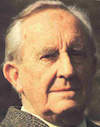 After 5 years in the Army during and after WWI, Tolkien spent 6 years translating Beowulf, and while he didn’t have it published, an article and lecture he did on it in 1936 has had a lasting influence on all Beowulfresearch. His translation was finally published by his son in 2014 and is considered a masterpiece. A naturalist and environmentalist, Tolkien loved nature and the earth and led efforts to help protect both.
“If you really want to know what Middle Earth is based on,” he once said, “it's my wonder and delight in the earth as it is, particularly the natural earth.“
Share A Writer’s Moment with a friend by clicking the g+1 button below.


Relishing the whole wide world
“The wide world is all about you: you can fence yourselves in, but you cannot forever fence it out.” – J. R. R. Tolkien
Born on this date in 1892, Tolkien was an English writer, poet, philologist, and university professor best known, of course, as author of The Hobbit and The Lord of the Rings trilogy.
John Ronald Reuel Tolkien was born in South Africa to English parents and came back to England at age 3 on what was to just be a family “visit.” But his father died while they were there and the family ended up staying. Tolkien could read and write by age 4 and was a voracious reader early in life. He said he disliked Treasure Island and The Pied Piper and thought Alice's Adventures in Wonderland was "amusing but disturbing.” He liked stories about Native Americans and the fantasy works by George MacDonald and "Fairy Books" by Andrew Lang – all important influences on his own writing as was the epic Anglo-Saxon work Beowulf.
After 5 years in the Army during and after WWI, Tolkien spent 6 years translating Beowulf, and while he didn’t have it published, an article and lecture he did on it in 1936 has had a lasting influence on all Beowulfresearch. His translation was finally published by his son in 2014 and is considered a masterpiece. A naturalist and environmentalist, Tolkien loved nature and the earth and led efforts to help protect both.“If you really want to know what Middle Earth is based on,” he once said, “it's my wonder and delight in the earth as it is, particularly the natural earth.“
Share A Writer’s Moment with a friend by clicking the g+1 button below.
January 2, 2018
Shaping images with words
“Writing the past is never a neutral act. Writing always asks the past to justify itself, to give its reasons... provided we can live with the reasons. What we want is a narrative, not a log; a tale, not a trial. This is why most people write memoirs using the conventions not of history, but of fiction.”– Andre Aciman
An award-winning memoirist, Aciman was born in Alexandria, Egypt, on this date in 1951. A naturalized American citizen, he also is author of numerous essays, short stories and novels. His book Call Me By Your Name, winner of the 2007 Lambda Literary Award, is currently in theaters as a highly acclaimed film and considered a contender for an Academy Award. His 1995 memoir, Out of Egypt, won the Whiting Award.
Aciman is distinguished professor at the Graduate Center of City University of New York, where he teaches the history of literary theory and the works of Marcel Proust. The multi-lingual Aciman previously taught creative writing at New York University and French literature at both Princeton and Bard College.
 “What great writers have done to cities is not to tell us what happens in them, but to remember what they think happened or, indeed, might have happened,” he said about how writers help shape images of places. “And so Dickens reinvented London, Joyce, Dublin, and so on.”
Share A Writer’s Moment with a friend by clicking the g+1 button below.
January 1, 2018
A 'starting point' for finding our roots
“History is not everything, but it is a starting point. History is a clock that people use to tell their political and cultural time of day. It is a compass they use to find themselves on the map of human geography. It tells them where they are but, more importantly, what they must be.” – John Henrik Clarke
Born a sharecropper’s son on this date in 1915, Clarke was a historian, professor, and a pioneer in the creation of Pan-African and Africana studies and instrumental in the founding of programs that were emulated throughout higher education beginning in the late 1960s.
“ My mother, Willie Ella Mays Clarke, was a washerwoman for poor white folks in the area of Columbus, Georgia where the writer Carson McCullers once lived,” he said, noting that she never learned to read and write but aspired for her son to have that opportunity. Told in 3rdgrade he should be a writer, he started studying toward that goal and moved to New York at age 18, where he developed his skills as both a writer and lecturer during the Great Depression years, particularly at the Harlem Writers' Workshop.
After serving 4 years in World War II, he co-founded the Harlem Quarterly magazine, and wrote numerous short stories and essays before moving into teaching and scholarly writing. While teaching at prestigious schools like Cornell and Columbia and at major universities in Africa, he founded several professional associations to support the study of black culture and authored 6 scholarly books. He also edited anthologies of writing by African Americans, as well as collections of his own short stories prior to his death in 1998.
 A champion for people finding and writing about their roots, he once noted, “A people's relationship to their heritage is the same as the relationship of a child to its mother.”
Share A Writer’s Moment with a friend by clicking the g+1 button below.
December 31, 2017
Storytelling through popular song
“I was never trying to write a hit. I was just trying to write good songs and get a message out, and it was my great good fortune to be popular.” – John Denver
Born on this date in 1943, Henry John Deutschendorf, Jr., best known by his recording name John Denver, wrote more than 200 songs and recorded more than 300 in his relatively short lifetime, becoming one of the world’s most popular folk/country/soft rock singers and performers. Among his hits were the song known as Colorado’s “unofficial” anthem, Rocky Mountain High, and West Virginia's "unofficial" anthem Country Roads.
A great storyteller, both with his songs and while writing about his love for and activism on behalf of nature, he also wrote beautiful tales about people and relationships. Among them are the very moving Poems, Prayers and Promises, often sung at funerals, and the beautiful Annie’s Song, sung at countless weddings.
And who couldn’t love his raucous Thank God I’m A Country Boy – which I always thought spoke to any kid who was raised on a farm or ranch. In his lifetime, which ended in a tragic plane crash in 1997, Denver’s songs sold a remarkable 33 million copies and they continue to be re-recorded and listened to by new generations.
 To put a little cheer into the end of the year, here is Denver’s happy-go-lucky Grandma’s Feather Bed. Enjoy …. and Happy New Year!
https://www.youtube.com/watch?v=Tn4yA6F4LhQ
Share A Writer’s Moment with a friend by clicking the g+1 button below.
Storytelling through his happy songs
“I was never trying to write a hit. I was just trying to write good songs and get a message out, and it was my great good fortune to be popular.” – John Denver
Born on this date in 1943, Henry John Deutschendorf, Jr., best known by his recording name John Denver, wrote more than 200 songs and recorded more than 300 in his relatively short lifetime, becoming one of the world’s most popular folk/country/soft rock singers and performers. Among his hits were the song known as Colorado’s “unofficial” anthem, Rocky Mountain High, and West Virginia's "unofficial" anthem Country Roads.
A great storyteller, both with his songs and while writing about his love for and activism on behalf of nature, he also wrote beautiful tales about people and relationships. Among them are the very moving Poems, Prayers and Promises, often sung at funerals, and the beautiful Annie’s Song, sung at countless weddings.
And who couldn’t love his raucous Thank God I’m A Country Boy – which I always thought spoke to any kid who was raised on a farm or ranch –In his lifetime, which ended in a tragic plane crash in 1997, Denver’s songs sold a remarkable 33 million copies – and they continue to be re-recorded and listened to by new generations.
To put a little cheer into the end of the year, here is Denver’s happy-go-lucky Grandma’s Feather Bed. Enjoy …. and Happy New Year!https://www.youtube.com/watch?v=Tn4yA6F4LhQ
Share A Writer’s Moment with a friend by clicking the g+1 button below.
December 30, 2017
A poetic foundation
“I began as a writer of light verse, and have tried to carry over into my serious or lyric verse something of the strictness and liveliness of the lesser form.” – John Updike
Born in 1932, two-time Pulitzer Prize winner John Updike was a novelist, short story writer, art critic, literary critic – and poet. He authored 20 novels, a dozen short story collections, several children’s books and 8 books of poetry, the last in 2009, the year of his death.
 Updike wrote poetry for most of his life. In his teens, he was already publishing poems in magazines, and his professional writing career began in 1954 when The New Yorker accepted one of his poems. His first book, The Carpentered Hen and Other Tame Creatures (1958), was a poetry collection. For Saturday’s Poem, here are Updike's In Extremis and November.
In ExtremisI saw my toes the other day.
I hadn't looked at them for months.
Indeed, they might have passed away.
And yet they were my best friends once.
When I was small, I knew them well.
I counted on them up to ten
And put them in my mouth to tell
The larger from the lesser. Then
I loved them better than my ears,
My elbows, adenoids, and heart.
But with the swelling of the years
We drifted, toes and I, apart.
Now, gnarled and pale, each said, j'accuse!
I hid them quickly in my shoes.
*November The stripped and shapely
Maple grieves
The ghosts of her
Departed leaves.
The ground is hard,
As hard as stone.
The year is old,
The birds are flown.
And yet the world,
In its distress,
Displays a certain
Loveliness"
* From A Child’s Calendar
Share A Writer’s Moment with a friend by clicking the g+1 button below.
Launched into writing with verse
“I began as a writer of light verse, and have tried to carry over into my serious or lyric verse something of the strictness and liveliness of the lesser form.” – John Updike
Two-time Pulitzer Prize winner John Updike was a novelist, short story writer, art critic, literary critic – and poet. He authored 20 novels, a dozen short story collections, several children’s books and 8 books of poetry, the last in 2009, the year of his death.
Updike wrote poetry for most of his life. In his teens, he was already publishing poems in magazines, and his professional writing career began in 1954 when The New Yorker accepted one of his poems. His first book, The Carpentered Hen and Other Tame Creatures (1958), was a poetry collection. For Saturday’s Poem, here are Updike's In Extremis and November.In ExtremisI saw my toes the other day.
I hadn't looked at them for months.
Indeed, they might have passed away.
And yet they were my best friends once.
When I was small, I knew them well.
I counted on them up to ten
And put them in my mouth to tell
The larger from the lesser. Then
I loved them better than my ears,
My elbows, adenoids, and heart.
But with the swelling of the years
We drifted, toes and I, apart.
Now, gnarled and pale, each said, j'accuse!
I hid them quickly in my shoes.
November The stripped and shapely
Maple grieves
The ghosts of her
Departed leaves.
The ground is hard,
As hard as stone.
The year is old,
The birds are flown.
And yet the world,
In its distress,
Displays a certain
Loveliness"
Share A Writer’s Moment with a friend by clicking the g+1 button below.
December 29, 2017
Humor, intensity and good examples
“My lessons didn't come at my father's knee. Like all good lessons, they were learned from example.” – Ted Danson
Born on this date in 1947, Danson is not only an award winning actor but also an author and producer. He has starred in numerous television series and movies and is a leading environmentalist and activist for ocean conservation. His first book was written on the subject: Oceana: Our Endangered Oceans and What We Can Do to Save Them, co-authored with Michael D'Orso.
A native Californian, his activism toward clean oceans and the environment began when he would walk the beaches with his kids and find himself “unable to explain why the water was so polluted that they couldn’t go swimming.”
Nominated for numerous Emmys, Golden Globes and People’s Choice Awards, he has won several in each category – primarily for his comedic roles, especially on the long-running series “Cheers.” While he has taken on more serious acting roles and the serious efforts on behalf of our world’s oceans – including continued writing on the topic – he said humor still is important in his own life and for the world.

“When people are in the midst of really heavy stuff and still have a sense of humor, I admire that,” he said. “Humor can bring people under the tent. And a good joke can deflect some of the intensity surrounding a serious subject.”
Share A Writer’s Moment with a friend by clicking the g+1 button below.
December 28, 2017
Reacting to your 'internal universe'
“The writer needs to react to his or her own internal universe, to his or her own point of view. If he or she doesn't have a personal point of view, it's impossible to be a creator.” – Manuel Puig
Puig, who was born in Argentina on this date in 1933, was primarily a novelist, although he wrote a number of television and movie scripts, including one for his own best-selling novel Kiss of the Spider Woman.
 Puig’s writing style often reflected elements of his work in film and television, such as montage and the use of multiple points of view. He also made much use of popular culture in his works. Because of his political views, he was exiled from Argentina in 1973 and spent most of the rest of his life in Mexico, where he died in 1990.
 While writing for film was his first love, he found himself drawn to write fiction, something he began in the early 1960s. “I didn't choose literature,” he said. “Literature chose me. There was no decision on my side. I felt the need to tell stories to understand myself. “
Since his death several of his previous screenplays have been produced, and half-dozen of his novels have been translated and reprinted in English language versions, including his first best seller, Betrayed by Rita Hayworth. “Whenever I write, I'm always thinking of the reader,” he said. “I allow my intuition to lead my path.”
Share A Writer’s Moment with a friend by clicking the g+1 button below.