Laura Madeleine's Blog, page 3
September 24, 2019
A 1978 Playlist
After several requests, I’m delighted to share the 1978 playlist we put together for the launch party of An Echo of Scandal last week. I’m a firm believer in immersive research, and music is a huge part of that for me. My job is made all the easier when the era in question is filled with such a wealth of great songs from totally different music genres. So, without further ado, let’s hop back in time for a few hours, to a hot, July day in Tangier during the summer of 1978…
If you like hearing about research, do consider signing up to my newsletter, where I share my historical discoveries, food from other eras and exclusive recipes just for subscribers.


September 19, 2019
An Echo of Scandal Cocktail
This unique cocktail has been created specially to accompany the launch of An Echo of Scandal. Designed to conjure up a hot summer’s night in Tangier during the heady days of 1928, with jasmine on the air, liquor on the tongue and champagne flowing. Sophisticated cognac combines with heady, floral crème de violette and the bitter-sweetness of Chambéryzette: a vintage strawberry liqueur and vermouth that has not changed for over a century. Add in a squeeze of sharp lemon, a hint of absinthe and – if you’re feeling brave enough – a slosh of champagne, and drink to the past…
[image error]
An Echo of Scandal Cocktail Recipe
A jigger / 45ml Cognac (we used Remy Martin 1738)
Half a jigger / 20ml Dolin Chambéryzette
1 tsp / 5ml raspberry syrup
Half a jigger / 20ml lemon juice
1 tsp / 5ml crème de violette
½ tsp / 2.5ml absinthe
Optional: top with champagne
Combine all the ingredients in a cocktail shaker, add ice and shake well. Fine strain
into a chilled cocktail glass, and if using, top with champagne for added decadence.
This cocktail was created by World Class Finalist Dan Bovey and award-winning
bartender and artist Gareth Aldridge, specifically to accompany the publication of An Echo of Scandal.
September 2, 2019
Dandelion Syrup Cake
This is a cake I first made earlier in the year, when spring dandelions smothered my allotment in bursts of bright yellow. They looked so beautiful and healthy (I’m very good at growing weeds) that it seemed a shame to dig them up and chuck them on the compost heap. So, I picked an entire bag full, with vague memories of Ray Bradbury’s Dandelion Wine swirling around my head:
“And there, row upon row, with the soft gleam of flowers opened at morning, with the light of this June sun glowing through a faint skin of dust, would stand the dandelion wine… Hold summer in your hand, pour summer in a glass… change the season in your veins by raising glass to lip and tilting summer in.” (Dandelion Wine, Ray Bradbury).
As someone who has absolutely zero home-brew experience (apart from sloe gin), actual dandelion wine was a little beyond me. So I was delighted to discover dandelion syrup. The following recipe is a two-parter: how to make a syrup out of dandelion flowers, and then – of course – how to use it in a cake recipe.
If you like this recipe, please do consider signing up to my mailing list: subscribers get access to exclusive recipes, as well as a first look at new books, giveaways, events and more.
Dandelion Syrup
[image error][image error]
Ingredients:
Large bowl of dandelion flowers (between 50-100, depending on size) 1 large apple, chopped juice of 1 lemon 500g caster sugar
Method:
Wash the dandelion flower heads and spread them out to dry on kitchen paper or tea towels Use a pair of scissors to snip the petals away the green stalks (doesn’t matter if a few green bits find their way in) Place the petals in a large pan with about 700ml of water, the chopped apple and the lemon juiceBring to a rolling boil, then reduce the heat and simmer for around 15 minutesRemove from the heat, and leave to cool and steep, with the lid on, for a few hours (at least 2) Strain the liquid through a muslin or a fine sieve into a bowl, pressing all the liquid from the petals and fruitReturn the clear liquid to the pan Add the sugar, and bring to the boil. Simmer on a low heat for around 1 hour to 1 hour 30 mins, stirring occasionally, until the syrup thickens Pour into sterilised, sealable bottles or jars. The syrup should keep in the fridge for a few weeks to a month.
Thanks to The Nerdy Farm Wife and the Traditional Scandinavian Dandelion Syrup recipe for the inspiration!
Dandelion Syrup Cake
[image error]
Now, a use for that beautiful syrup! To me, dandelion syrup has a delicate, floral taste, somewhere between dried hay and honey. It’s just what’s needed when the weather is grey and drizzly (which is more often than not, here in the UK) and you need something that tastes of the sun.
Ingredients:
175g softened butter175g golden caster sugar3 free-range eggs175g self-raising flour1/2 tsp vanilla bean paste (or a vanilla bean pod)zest and juice of 1/2 a lemon 2 tbsp dandelion syrup
For the drizzle:
2 tbsp dandelion syrupjuice of 1/2 lemon 1 tbsp caster sugar
Method:
Preheat the oven to 180C / 350F / Gas Mark 4. Grease and line a 900g loaf tin. Cream together the butter and sugar until pale and fluffy. Beat in the eggs one at a time, adding a tbsp of flour with each to stop the mixture from splitting. Fold in the rest of the flour. Gently stir in the vanilla, zest, juice and syrup. Spoon into the tin and bake for around 35-40 minutes, until risen and golden and a skewer inserted comes out clean. (If the top starts browning too quickly, cover it with some foil). While the cake is still warm, poke holes in it with a skewer and spoon over the dandelion syrup so that it soaks in, followed by the lemon juice and finally the caster sugar, to give it a drizzle-cake style topping.
August 23, 2019
Plum and Hazelnut Frangipane Cake
On my allotment, there’s a huge plum tree that overhangs the fence. Every year it sags almost to the ground under the weight of all the fruit and since I can’t bear to see them rotting on the branches, I, err, tend to liberate a fair few. (It’s not scrumping if no one else cares, right?!) I came home with a bag full the other day, and of course had to figure out a use for them.
My haul made three jars of blackberry and plum jam and this: a Plum & Hazelnut Frangipane cake.
Since this cake is part frangipane, it’s heavy on ground nuts and light on flour. (You could easily make this gluten free by substituting the flour for a GF alternative). Hazelnut frangipane is far superior to almond in my opinion: hazelnuts have such a comforting, warm, rich flavour, especially when toasted. And combined with ripe plums, vanilla and cinnamon, this cake is pretty damn addictive.
[image error]
Plum & Hazelnut Frangipane Cake
Ingredients
100g whole hazelnuts (or use pre-ground if you can find them)140g butter, softened140g golden caster sugar3 free-range eggs60g ground almonds1/2 tsp vanilla bean paste1/2 tsp cinnamon60g self-raising flour4 or 5 fresh plums, depending on sizeHalf a tbsp of honeyIcing sugar and a few more chopped hazelnuts, to decorate
Method
Preheat oven to 160C / 325F / Gas Mark 3. Grease and line a 23cm round cake tin.If you’re using whole hazelnuts, place the nuts in a dry saucepan and set over a medium heat to toast for around 3-4 minutes, shaking frequently to make sure they don’t burn. Tip out onto a clean tea towel and rub vigorously to remove the hazelnut skins. Don’t worry if some don’t come off. Use a hand-held blender or similar to finely grind the hazelnuts. Set aside. Cream together the butter and caster sugar until pale and fluffy. Beat in the eggs one at a time, adding a tbsp of ground hazelnuts with each.Stir in the rest of the hazelnuts, almonds, vanilla and cinnamon. Gently stir in the flour until just combined. Spoon the mixture into the tin.Slice the plums into halves or quarters depending on size and press gently, face-up, into the mixture. Sprinkle with a little caster sugar. Bake for 40-50 minutes until a skewer inserted comes out clean. Cool in the tin for a few minutesDilute the honey with a splash of hot water and – while the cake is still warm – poke a few holes in the surface and spoon over the surface.Decorate with icing sugar and chopped hazelnuts.
April 19, 2018
The Secrets Between Us: Bibliography
(This author’s note can also be found at the back of The Secrets Between Us, but I’m posting it here too for ease of sharing links).
The Secrets Between Us is a fictional work inspired by true events that took place in the Alpes-Maritimes during the summer of 1943.
From February to September of that year, the town of Saint-Martin-Vésubie, situated around forty miles from Nice, was designated an “enforced residence” for displaced Jews. Through a combination of sympathy, politics, altruism and the efforts of Jewish Italian banker Angelo Donati, the Italian Fourth Army moved thousands of Jewish refugees into Saint-Martin-Vésubie and the surrounding villages. For one summer, the valley became something of a safe haven, where the Jews were protected from persecution from German and French forces. It offered respite, relief and a degree of security for the refugees, many of who had already been fleeing for years.
With the announcement of the armistice, and Italy’s withdrawal from the war, the refugees’ safety vanished, and they were left with an impossible choice: stay in villages like Saint-Martin and await the German authorities, or take the perilous old salt roads across the mountain passes, into what they believed would be safety in Italy.
Over a thousand refugees made the crossing from Saint-Martin-Vésubie, not knowing that German forces were waiting for them on the other side. Some of those who escaped were aided by résistance members, anti-fascist groups, or French or Italian civilians, who hid the refugees in barns, attics and remote farms, even presenting Jewish children as their own during the round-ups. Many more of refugees were captured and interned at Borgo San Dalmazzo, before being sent to Drancy, and ultimately, Auschwitz.
In The Secrets Between Us, I decided to set the action in a fictional town named Saint-Antoine, rather than in real-life Saint-Martin-Vésubie. I chose to do this because – while I sincerely hope to bring this underreported area of the Second World War to wider attention – I did not want to conflate my work with the reality of what was experienced by those who were present in Saint-Martin-Vésubie.
For many individuals, that summer in the Alpes-Maritimes was just one chapter in a whole series of heart-breaking, remarkable events. The real-life stories of both the Jews and their French and Italian protectors are ones of bravery and suffering, endurance and survival that need no fictional embellishment.
The Secrets Between Us imagines only a tiny portion of what took place during Italian Occupied France. My research spanned everything from salt mines to crayfish catching, songs in Yiddish to first-hand testimonies, but these are the works I turned to the most.
Holocaust Odysseys: The Jews of Saint-Martin-Vésubie and Their Flight through France and Italy, Susan Zuccotti (Yale University Press, 2008)
La pierre de Juifs, Danielle Baudot Laksine (Editions de Bergier) Book one of five on the subject.
A Pause in the Holocaust (1943: Le temps d’un répit), 2009. Documentary directed by André Waksman.
Mussolini’s Army in the French Riviera: Italy’s Occupation of France, Emanuele Sica (University of Illinois Press, 2016).
Wandering Star, J.M.G. Le Clézio (Gallimard, 1992. Translation: C. Dickson, 2009)
Marche de la Memoire, a yearly walk, held every September to commemorate the exodus of Jewish refugees from Saint-Martin-Vésubie.
APJN page on Saint-Martin-Vésubie: (Anonymes, Justes et Persécutés durant la période Nazie dans les communes de France – “The Unknown, Righteous and Persecuted of the Nazi period in French communes”)
February 18, 2018
Where the Wild Cherries Grow: US Release!
Last week was a great one here; Where the Wild Cherries Grow was released in the US by St Martin’s Press in a beautiful hardback edition.
[image error]
The response from readers and bloggers so far has been wonderful; a huge thank you especially to Erika Robuck for hosting a recommendation, review and giveaway on her blog, and to Deborah Kalb for hosting a Q&A. Thanks, of course, go to the team at St Martin’s Press for all their hard work too.
Keep your ears out for the audiobook version from Macmillan Audio! Where the Wild Cherries Grow has also been translated into Italian (as La Ragazza delle Ciliegie) and German (as Der Duft von Meer und Thymian). Details on the Books page!
You can pick up a copy of Where the Wild Cherries Grow at the following places: Indiebound / Amazon / Barnes & Noble / Books-A-Million / Powell’s
… or of course, your local library. 
January 15, 2018
The Inspiration Behind The Secrets Between Us
I remember the precise moment when the idea that was to become The Secrets Between Us sprang into being. I had been poring over a map, searching the border region of France and Italy (I’m fascinated by borders), when I saw a small town, high in the Alpes-Maritimes, by the name of Saint-Martin-Vésubie. The Wikipedia page briefly mentioned the route de sel, an ancient road used to transport salt from the coast to the city of Cuneo since Roman times; that even today can be followed all the way from the Mediterranean, across the perilous mountain passes into Italy.
My interest piqued, I carried on reading, and learned something remarkable: that during the Second World War, Saint-Martin-Vésubie, and several other mountain villages, became havens of relative safety for Jewish refugees.
In November 1942, following the occupation of France by German forces, the Italian Army marched into Nice and the surrounding area as occupiers. The French populace perceived this as a stab in the back. The Italians were – unlike German forces – seen as neighbours, cousins, especially in regions like the Vésubie valley, where this was often literally the case.
What’s more, it soon became clear that Italian Occupied France was operating under different rules from the rest of the country – then under German occupation – and from Italy, especially when it came to Jewish citizens and refugees. Although persecution and anti-Semetism had been widespread throughout Italy, the Italian military forces refused to deport any Jews or political refugees from the Occupied Zone, despite increasing pressure from the German administration. In the spring 1943, it was decided that many of the refugees who had flooded into Nice would be transferred away from the coast to “enforced residences” in mountain villages, partly for safety, partly to secure the coastline, and partly to stall any threats of action by Nazi officials.
Almost overnight, the population of Saint-Martin-Vésubie doubled as hundreds of refugees arrived; not only French but German, Russian, Polish, Czech, Hungarian, Belgian. For one summer, Saint-Martin-Vésubie became a bustling, cosmopolitan refuge where Jewish people and other refugees experienced some level of relief, safe from persecution by French and German forces.
Once I had read about all of this – the border, the salt road, the Italian occupation and the refugees – I knew I wanted to try and write a story set amongst it all. I knew I wanted to bring these remarkable events to life for readers who may never have heard of them otherwise.
I’ll write another post soon on my research methods; the books I’m indebted to, the trips I took to the National Archives, the articles and documentaries and films I devoured in the writing of this book. But today, I wanted to share my experience of the place that inspired the story.
The Secrets Between Us is set in a fictional village in the Alpes-Maritimes, named Saint-Antoine; a decision I made both to allow myself some narrative freedom, and to respect the history of Saint-Martin-Vésubie and the real-life experiences of all those involved, whose stories of survival and persecution need no fictional embellishment.
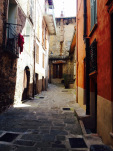
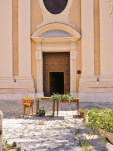
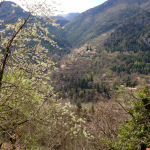
Physically, however, I took much inspiration from Saint-Martin-Vésubie, from the mountains, the surrounding countryside and the villages of the Vésubie valley. I hope to be able to share just a little of this remarkable place with you here.
L x
From The Secrets Between Us:
Our gargouille was different. It wasn’t a monster at all, but a waterway; a stone channel as old as the town, running from a fall in the mountains, all the way along our steep, main street and down into the river. Generations of people had channelled the flow so that it seemed to spout on almost every corner. Its water washed our clothes and bathed our children, filled our cooking pots and drenched our thirsty plants in the summer. It was the throat of the mountain, and we drank from it.
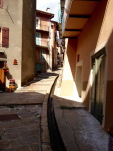
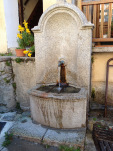
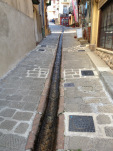
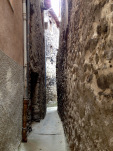
I turned from the hotel, took the back way through twisting passages and narrow alleys. They smelled old, of shadowed stone that never dried, that hadn’t had the sun on its face for more than half a millennium. I shivered, walked faster. Ahead I could see the little square in front of the church, where sunlight fell bright and made the old yellow stone glow. I stepped into it gratefully. All around, moisture seemed to be seeping from the village’s damp-clogged walls, like honey.
Finally, we came to a place where the trees parted around a pile of huge, grey rocks that looked down over town, its roofs a jumble of terracotta shards on the mountain. The sun fell bright; the air was quenching and clean.
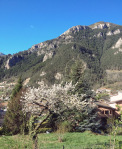
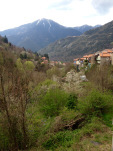
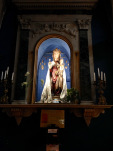
Saint-Antoine, she says; a place of granite and wildflowers, of trees that cling stubbornly to the steepest slopes. A place where marmots cry their warnings, where goats wander, belonging to no one but themselves, and elusive chamois look on from impossible heights. It’s a place where the wind blows from the peaks, tasting of ice even in summer. A place where larches turn the mountainside gold in the autumn, like the candlelit hair of the church’s ancient Madonna.
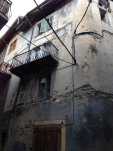
It’s so narrow that I find myself looking up fearfully. Wooden balconies and walkways cling between the buildings, brittle as old bones.
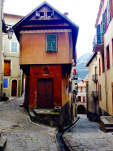
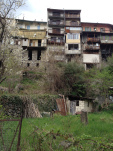
To visit Saint-Martin-Vésubie you can fly to Nice, and either drive or catch one of a few buses a day up the steep, narrow winding mountain roads to the village. (Don’t look over the edge…)
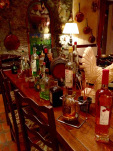
We stayed at La Bonne Auberge; a lovely family-run hotel (which I believe was where the Italian Army held registrations for foreigners during the occupation). There’s a big, Alpine style lounge, simple rooms, and good food, plus an enormous collection of genepi, liqueurs and other spirits…
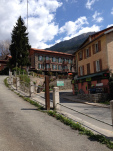
Finally, a little way along from the hotel you can find a series of stone memorials, commemorating the events which took place in Saint-Martin-Vésubie and remembering those who fought, those who resisted and those who were killed.
[image error]
January 9, 2018
The Secrets Between Us Blog Tour #2
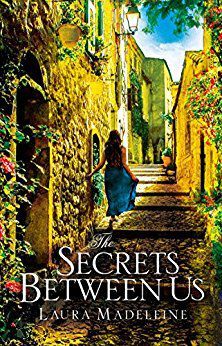
The Secrets Between Us written by Laura Madeleine, publisher Transworld Digital, is available NOW in ebook format. To buy link: https://goo.gl/TEycic Product Details (as per amazon page) High in the mountains in the South of France, eighteen-year-old Ceci Corvin is trying hard to carry on as normal. But in 1943, there is no such thing as […]
via The Secrets Between Us by Laura Madeline blogtour book review — kraftireader
January 8, 2018
The Secrets Between Us Blog Tour
As part of the release of The Secrets Between Us, my wonderful publicist Hannah has put together a blog tour!
[image error]
Writing is a lonely business, and the first weeks of new book’s release can feel especially daunting, before you’ve quite used to the idea of other people reading your words… So I’m grateful for the support and hard work of bloggers, readers and reviewers who all help to kick-start a book’s sales and get the word out there. I’ll share links to the individual blog posts on here as and when they are published.
Many thanks again all; I owe you a glass of wine! (Or a cake. Or both).
L x
The Secrets Between Us: OUT NOW!
My new novel, The Secrets Between Us, is out NOW in ebook format, and the rest of January you can grab it for only £0.99p! (On Kindle and Kobo at least). That’s six months of my life, a lot of swearing, many glasses of wine, a trip to the Alpes-Maritimes, not much sleep, a lot of reading and even more editing, deleting, re-writing and refining for less than a coffee or a fancy croissant!
Here’s the cover blurb:
A gripping mystery with a heart-breaking revelation, The Secrets Between Us is a sublimely satisfying story of lost love, betrayal and the dangers of war. Perfect for fans of Kate Morton’s The Lake House and Dinah Jeffries’ Before the Rains.
High in the mountains in the South of France, eighteen-year-old Ceci Corvin is trying hard to carry on as normal. But in 1943, there is no such thing as normal; especially not for a young woman in love with the wrong person. Scandal, it would seem, can be more dangerous than war.
Fifty years later, Annie is looking for her long-lost grandmother. Armed with nothing more than a sheaf of papers, she travels from England to Paris in pursuit of the truth. But as she traces her grandmother’s story, Annie uncovers something she wasn’t expecting, something that changes everything she knew about her family – and everything she thought she knew about herself…
So if it sounds like something you might enjoy, please do give the ebook a punt. The paperback is due out in April, so physical book-lovers will have to wait until then, I’m afraid. Links below.
As always, it’s an incredibly odd feeling, a new book being released into the world, but so far, I’ve had some great support and reviews from readers and bloggers alike. THANK YOU all!
Now I’m off to work on the next one…
L x