
Ray Ruppert's Blog, page 13
February 14, 2024
Jesus’ Crucifixion Prophesied

Psalm 22 has prophecies about Jesus’ crucifixion. David wrote this Psalm about 1000 years before Jesus was crucified.
On the Cross, Jesus quoted Psalm 22, verse 1 when he cried out, “My God, my God, why have you forsaken me?”
Then in verses 14 through 18 describe what actually happened to Jesus during his crucifixion. Verse 14 says, “I am poured out like water, and all my bones are out of joint; my heart is like wax; it is melted within my breast.”
This describes what happened to his shoulder joints as he hung on the cross. His heart would pound loudly as it tried to keep what little blood he had left circulating. It would feel like it was giving up and melting.
Verse 15 says, “my strength is dried up like a potsherd, and my tongue sticks to my jaws; you lay me in the dust of death.”
A potsherd is a broken piece of an earthenware jar. Abandoned and left alone. It has no strength to do what it was designed to do, to hold water. That’s how it would feel to hang on the cross.
Thirst would dry his mouth and it his tongue would stick to his jaws. He would feel just like he was ready to die.
Verse 16 says, “For dogs encompass me; a company of evildoers encircles me; they have pierced my hands and feet.”
Indeed, the accusers are described in Matthew 27 as taunting Jesus as he hung on the cross. The description of having his hands and feet pierced was unknown in the time of David but was fulfilled by Jesus’ crucifixion.
Verse 17 says, “I can count all my bones—they stare and gloat over me; 18 they divide my garments among them, and for my clothing they cast lots.”
The brutal flogging that Jesus took before his crucifixion would have stripped the flesh from his back and exposed his bones so that they could be counted.
Then, unknown to David, he states exactly what the Roman soldiers did. They cast lots for Jesus’ garments.
The ability to predict this and have it fulfilled after 1000 years is beyond chance. It is a certainty. It is sufficient for anyone to understand that the Bible is true.
But that’s not the end of the story because Jesus died on a Friday and was raised to life on Sunday. The Bible continues to tell us that Jesus’ crucifixion was to pay for our sins, and we can have eternal life when we believe in Jesus for our salvation.
If you want to know more about this, watch my video on YouTube, "The Gospel."
May God Bless you!Copyright by Ray Ruppert


February 10, 2024
John 21:15-25 NASU, Restoration, Feed My Sheep
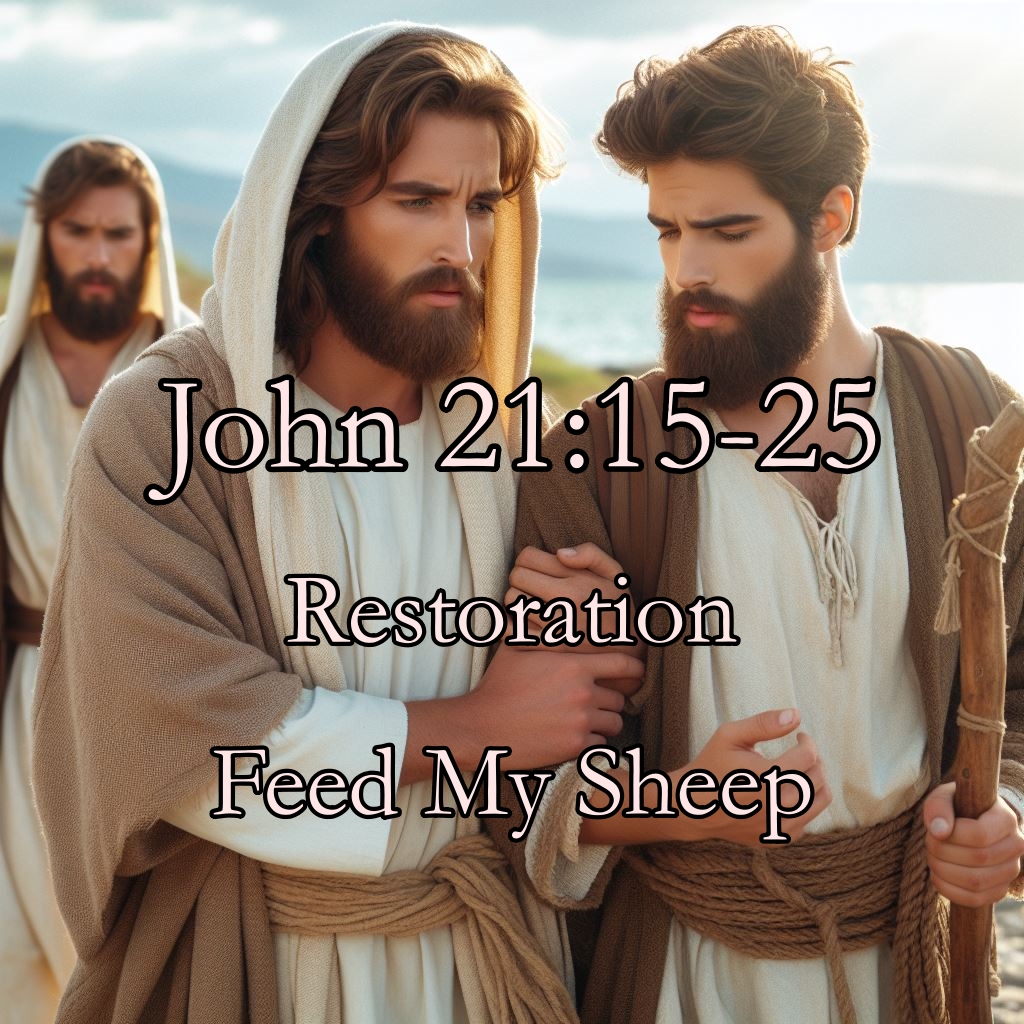
15 So when they had finished breakfast, Jesus said to Simon Peter,"Simon, son of John, do you love Me more than these?" He saidto Him, "Yes, Lord; You know that I love You." He said to him,"Tend My lambs." 16 He said tohim again a second time, "Simon, son of John, do you love Me?"He said to Him, "Yes, Lord; You know that I love You." He said tohim, "Shepherd My sheep." 17He said to him the third time, "Simon, son of John, do you loveMe?" Peter was grieved because He said to him the third time, "Do youlove Me?" And he said to Him, "Lord, You know all things; You knowthat I love You." Jesus said to him, "Tend My sheep.
Now that all the disciples have had a time of fellowshipwith Jesus, he takes Peter aside for a walk on the beach. This is evident fromverse twenty where John is following them and eavesdropping on thisconversation. This was private but not so private that the Lord didn’t wantJohn to hear and record it. Many people have commented on and preached thoughthis conversation so I’m quite sure there is nothing new in what I will sayabout it. Hopefully it will be a good reminder of what those others have drawnfrom it.
Each time that Jesus ask Peter about his love of Jesus, headdresses him very formally. “Simon son of John.” How different this is fromthe very familiar and intimate address of Simon, Simon when Jesus warned himthat Satan would tempt him in Luke 22:31. Here, Jesus is using his full name,and it is like the stern reprimand of a mother or father when they have caughta child in the cookie jar. Yet, Jesus’ question reveals that this isn’t ascolding even though it most likely brings Peter’s attention back to the timewhen he said to him, “Simon, Simon.”
Do you love me is the question that Jesus is asking. And itisn’t just a matter of love, but a matter of a degree of love in the firstquestion. It’s a question we all need to ask ourselves. Do we love Jesus morethan any other person? Jesus taught this before in Luke 14:26. Jesus must havepriority. And again, Jesus said in Luke 14:33, “So therefore, any one of youwho does not renounce all that he has cannot be my disciple.” When Jesus asksPeter if he love him more than all the other disciples, he is also asking us.
Just to be clear, Jesus is using the word, agapao, inhis first two questions. Strong’s defines this as, “to love (in a social ormoral sense).”This is the highest form of love as defined by 1 Corinthians 13:1-8. If youhaven’t read those verses in a while, I suggest you do so and ask the questions,“Do I love others in this way? How would I answer Jesus if he asked me as heasked Peter?”
I’m sure Peter was remembering his denying that he even knewJesus a couple of weeks previously. How could he not replay that over and overand find no way of forgiving himself or wondering if Jesus would forgive him.Now, I’m not advocating that we can forgive ourselves as that is unbiblical.But under such a grievous denial of loving Jesus, it is possible that is what Peterwas feeling. It is a common problem in our unbiblical society and even in manychurches. We are told we must forgive ourselves if we want to feel better afterhaving sinned when the real problem is not believing God’s word. So he mustersup the best he can and answers Jesus that his love is phileo. Strong’sdefines this love as, “to be a friend to (fond of [an individual or anobject]), i.e. have affection for (denoting personal attachment, as a matter ofsentiment or feeling.”Note how much this definition is based on feelings.
Jesus asks again and Peter responds the same way. But thethird time Jesus ask if his love is phileo. And Peter is now grieved.The wound is open, and Peter can’t do anything but trust Jesus. Each time heresponds that Jesus knows his love. How can Jesus keep asking the same questionif he knows? Finally, he clearly appeals to Jesus’ omniscience. Peter truststhat Jesus knows just how much he loves him. And that’s what we need to do whenwe have royally screwed up and need forgiveness. We need to trust that our agapaofalls so far short of this divine love that we can only express our phileofor him.
However, along with Jesus’ questioning Peter is the three-foldinstructions that come after each of Peter’s expression of love. “Tend Mylambs. Shepherd My sheep. Tend My sheep.” All three of these commands couldhave been translated feed. But to shepherd is the word poimonio, which Strong’ssays, “to tend as a shepherd of (figuratively, superviser).”Clearly, Jesus is telling Peter he needs to get over his guilt and do what hehas been called to do, which is to be the leader of this small band ofdisciples. And that is exactly what he does when they go back to Jerusalem. Jesusdoesn’t say one word about Peter’s denial. He doesn’t condemn him. He justpoints him to his task.
We don’t have any Scripture that tells us that Peter askedfor forgiveness. We can only assume that at some point he did. Thisreaffirmation of Peter’s leadership role without one word of condemnation, evenfor not being able to agapao Jesus, should encourage any of us who havefallen from grace and turned back for forgiveness. We can’t forgive ourselves,that is God’s prerogative (Mark 2:7), but we must accept his forgiveness andthen act like it. If we try to hang on to guilt and beat ourselves up then weare adding to our sin, unfaithfulness because we are not believing the Word ofGod specifically, “If we confess our sins, he is faithful and just to forgiveus our sins and to cleanse us from all unrighteousness” (1 John 1:9).
8 "Truly, truly, I say to you, when you were younger, you usedto gird yourself and walk wherever you wished; but when you grow old, you willstretch out your hands and someone else will gird you, and bring you where youdo not wish to go." 19 Nowthis He said, signifying by what kind of death he would glorify God. And whenHe had spoken this, He said to him, "Follow Me!"
There are many verses in the Bible that must have an explanation,or we would not have any idea about the meaning. This is one of them. Putyourself in Peter’s position and listen to Jesus words as if he were tellingyou this. What would you think it meant? I would think that he is telling methat when I was young and didn’t know Christ, I did whatever I wanted. But whenI get old, I’ll have to depend on others to take care of me, even dress me. Iwon’t have any way of deciding where I want to go. Sounds like living after abad stroke.
Since John told us that Jesus was telling him that it wasabout his death and glorify God in his death, we can understand, looking athistory, he was telling Peter he would be crucified. Trying to get anythingelse out of this would be reading what we want into what Jesus said.
However, we can apply Jesus’ command to Peter to follow himto our own lives. Peter is told and presumably understood that Jesus wastelling him he would be crucified. In view of this horrific death, he is stillsupposed to follow Jesus. That is a hard thing to contemplate.
Seldom are we told years in advance how we will die. But weshould all consider that we will die and that no matter how we die, itshouldn’t change our commitment to follow Jesus. So, what has Jesus told usabout this? He said this in Luke 9:23-27:
23 And he said to all,“If anyone would come after me, let him deny himself and take up his crossdaily and follow me. 24 For whoever would save his life will lose it, butwhoever loses his life for my sake will save it. 25 For what does it profit aman if he gains the whole world and loses or forfeits himself? 26 For whoeveris ashamed of me and of my words, of him will the Son of Man be ashamed when hecomes in his glory and the glory of the Father and of the holy angels. 27 But Itell you truly, there are some standing here who will not taste death untilthey see the kingdom of God.”
Indeed, we are told that our relationshipto Jesus may very well be the cause of our death. Everyone who follows Jesusshould be aware of this and accept the possibility. It is sad to consider thatthere are many people think they are followers of Jesus, then deny Jesus under threatof death.
Jesus made it clear to Peter, he would have to make thatdecision in the future but unlike his denial at Jesus’ trial, he would holdfirm to the end.
20 Peter, turning around, saw the disciple whom Jesus lovedfollowing them; the one who also had leaned back on His bosom at thesupper and said, "Lord, who is the one who betrays You?" 21 So Peterseeing him said to Jesus, "Lord, and what about this man?" 22 Jesussaid to him, "If I want him to remain until I come, what is that toyou? You follow Me!"
Here is John, who never gives his name, following Jesus andPeter. If Jesus has a special love for John that was somehow different that hislove for Peter or the other disciples, then it makes sense that Peter mightwant to know if Jesus is going to have John die a martyr also. Peter still hasa long way to go. Here he is, being recommissioned by the Lord and he wants toknow what will happen to John.
It is the same with just about all of us. We may have beencalled to serve in one way or another and we still look at others and wonderabout them. We wonder if the Lord is as pleased with us as he is with them. Wewonder if they are closer to the Lord than we are. We wonder if their ministry ismore important than ours. In the case with Peter wanting to know what wouldhappen to John, it may be envy. Peter apparently forgot the parable of thetalents. “To one he gave five talents, to another two, to another one, to eachaccording to his ability” (Matt 25:15). While we have equal standing before theLord, we don’t have equal ministries, lives, or abilities.
And so, Jesus reminds Peter of this very thing. It doesn’tmatter what the Lord has called another person to do. We follow him. It is whatwe need to remember and do what we are called to do faithfully serving theLord.
23 Therefore this saying went out amongthe brethren that that disciple would not die; yet Jesus did not say to himthat he would not die, but only, "If I want him to remain until I come,what is that to you?"
Ether Peter or John repeated this to others. Perhaps it wasto the other disciple that were gathered that day and asked what Jesus had toldPeter. Without an explanation, people started the telephone game long beforethe telephone. Add this to Jesus’ words, “Truly, I say to you, there are somestanding here who will not taste death until they see the Son of Man coming inhis kingdom” (Matt 16:28). Now, you can see why people may have seriouslythought that John wouldn’t die. But, John tags this at the end of his Gospeljust to set people straight. This wasn’t a promise that John wouldn’t die.
24 This is the disciple who istestifying to these things and wrote these things, and we know that histestimony is true.
It is a mystery why John didn’t use his name in the Gospel.Apparently, everyone who read it knew it was from John. He appeals to theirknowledge of him to verify that everything he wrote was true. It is almost likehe is standing in front of a synagogue and reading the book. In fact, John hadbeen telling everyone what was in the book long before he wrote it down.
25 And there are also many other things which Jesus did, which ifthey were written in detail, I suppose that even the world itself would notcontain the books that would be written.
This has to be a very significant verses in the Bible. Significantnot because it speaks to redemption but because of the mind expanding thoughts whenwe consider the preincarnate Christ who created all things (remember John 1:3) andall that he is still doing since “he is before all things, and in him allthings hold together” (Col 1:17). Out of all creation and all the other thingsthat Jesus did while on the earth, and still does, John chose only to writewhat was sufficient to bring us to faith in Jesus.
So it is evident that John has completed his thesis as theHoly Spirit has breathed it out in this book.
Jesus is indeed God in the flesh. He is divine.
Salvation and life are found only in Jesus.
Strong’s NT:25.
Ibid. NT:5368.
Ibid. NT:4165.
Henry, “John 21:20-25.”
Copyright by Ray RuppertFebruary 9, 2024
“The Dream and the Unseen Conversation”

Once upon a moonlit night, in a small village nestled among rolling hills, there lived a woman named Eliza. She was known for her unwavering faith and her vivid dreams. One night, as she lay in her cozy bed, she slipped into a dream—a dream that would forever change her perspective.
In her dream, Eliza found herself walking along a dusty road. The air smelled of earth and distant flowers. As she walked, she noticed a crowd gathering ahead. Curious, she quickened her pace and joined the throng. In the center stood Jesus, His eyes filled with compassion.
Eliza’s heart raced. She had read about Him, heard stories of His miracles, and now here He was, right before her. She longed to speak to Him, to pour out her heart, but the words stuck in her throat. Instead, she watched as He healed the sick, comforted the brokenhearted, and blessed little children.
But then something unexpected happened. Jesus turned away from her and approached an elderly woman sitting on a rock. Her face etched with wrinkles, she clutched a tattered shawl around her shoulders. Jesus knelt beside her, whispering words of solace. Eliza strained to hear, but the conversation remained hidden from her ears.
Next, Jesus walked over to a young man—a beggar with eyes that held both hope and despair. Eliza watched as Jesus spoke to him, his voice gentle yet firm. The young man’s eyes widened, and he nodded as if receiving a revelation.
Eliza’s heart sank. Why hadn’t Jesus spoken to her directly? She had so much to ask, so much to share. Doubt crept in—was her faith not strong enough? Was she unworthy of His attention?
As the dream continued, Eliza observed Jesus conversing with others—a grieving widow, a struggling farmer, a child lost in the crowd. Each encounter left an indelible mark on their souls. Yet, Jesus never turned to her.
Finally, the dream shifted. Eliza stood alone on the road, tears streaming down her face. She raised her eyes to the heavens and whispered, “Why, Lord? Why didn’t You speak to me?”
A soft breeze rustled the leaves, and a voice—a voice that seemed to echo from within—reached her heart. “Eliza,” it said, “I see you. I know your dreams, your fears, and your hopes. But sometimes, the greatest conversations happen when you listen to others. My love is not limited—it flows through every encounter.”
Eliza woke with tears still wet on her cheeks. She realized that Jesus had indeed spoken to her—through the unseen conversations with others. She vowed to be more attentive, to listen with her heart, and to recognize His presence in every encounter.
From that day forward, Eliza became a beacon of compassion. She visited the elderly, fed the hungry, and comforted the broken. And in those acts of kindness, she felt Jesus beside her, whispering words of love.
(This story was generated by Copilot in response to a search for as similar inspiration story. I didn't ask for it and it presented it to me as if it had found it somewhere on the web. When I asked for the URL, it explained it had made up the story.)
Copilot, OpenAI,“The Dream and the Unseen Conversation”, February 7, 2024, OpenAIConversational AI (Generated Content).
Copyright by Ray Ruppert
February 2, 2024
Psalm 20 – Answered Prayers?

“May the Lord fulfill all your petitions!” (Ps 20:5). Does God answer all our prayers?
Does the Lord answer every one of our prayers the way we want? If so, and we are encouraged to pray though the psalms and make them personal, we may be misled.
Listen to Psalm 20, verses 1 through 5.
May the Lord answer you in the day of trouble!
May the name of the God of Jacob protect you!
May he send you help from the sanctuary
and give you support from Zion!
May he remember all your offerings
and regard with favor your burnt sacrifices!
May he grant you your heart’s desire
and fulfill all your plans!
May we shout for joy over your salvation,
and in the name of our God set up our banners!
May the Lord fulfill all your petitions!
Will the Lord answer you in the day of trouble? Absolutely yes. But we must remember that his answer is always filtered through his foreknowledge of those who love him and are called according to his purpose to make us look like Jesus according to Romans 8 verses 28 and 29.
We also know that he allows or even sends trials to help us grow to be more like Jesus according to Romans 5 verses 3 and 4 as well as James 1 verses 2 through 4.
Jesus even said when we are persecuted for living a godly life, we will be blessed in Matthew 5 verses 10 through 12.
Do you want to escape from the day of trouble and miss the blessings he has for us?
But the Psalm says the Lord will protect us and send help from his sanctuary. The Holy Spirit comes directly from his heavenly sanctuary, the eternal Zion. The Holy Spirit will aid and support us in our trials. He will give us the desire to live a godly life which is what verses 3 and 4 are talking about because we don’t offer burnt offerings anymore and our desires are to please the Lord and not just have a happy, problem-free life.
When we put these verses that seem to say we can name and claim whatever we want from God in perspective of the whole Bible, we see that it is more about the way the Lord saves us than it is us getting what we want. When our focus is on becoming more like Jesus in our days of trouble, we will shout for joy over our salvation and those prayers will be answered.
If you don’t know Jesus, watch my video on YouTube
, "The Gospel."
May God Bless you!
Copyright by Ray Ruppert
January 30, 2024
JOHN 21:1-14 NIV, BACK TO FISHING, IS IT REALLY JESUS?

1 Afterward Jesus appeared again to his disciples, by the Sea ofTiberias. It happened this way: 2 Simon Peter, Thomas (called Didymus),Nathanael from Cana in Galilee, the sons of Zebedee, and two other discipleswere together. 3 "I'm going out to fish," Simon Peter told them, andthey said, "We'll go with you." So they went out and got into theboat, but that night they caught nothing.
This is the last appearance of Jesus that John records. Itis by no means the last time Jesus appears to some of his disciples. The womenwho first saw Jesus were told by an angel that he was going ahead of thedisciples to Galilee (Matt 28:7 and Mark 16:7). It took them more than a weekto even start on the way to Galilee. John records Jesus appearing to thedisciples behind locked doors after eight days. It is after this that they wentto Galilee where Jesus gave them the great commission. Presumably that cameafter this encounter with Jesus as all eleven of the disciples were with Jesuswhen he gave the great commission (Matt 28:16). Some time later, they returnedto Jerusalem where they were told to stay in the city until the Holy Spiritwould empower them (Luke 24:49, Acts 1:8).
Here we have eight of the disciples gathering together inGalilee by the sea. This is a comfortable place for them since most of themlived there before meeting Jesus. Two disciples are not named, and it may bebecause they were not apostles. These guys seem lost. They don’t have anydirection or purpose. So, what do they do? They go back to what is familiar,fishing.
This is what many of us do when our goals and dreams are suddenlyhalted for one reason or another or life gets tough, and we want a break. Wereturn to what is comfortable. It is probably why so many addicts find it hardto be completely free from their addictions. It is why many fall back intofamiliar sins. It doesn’t have to be additions either. It can apply to any ofour sinful habits we had before salvation or struggled with later.
They caught nothing. This wasn’t the first time Peterfished all night and didn’t catch anything. The same thing happened just beforeJesus called him to be a fisher of men (Luke 5:4-11). It should have remindedhim of his original calling. That is something we need to do when we feel lostor unable to continue in ministry. We must remember who we are serving and thatthe “catch” isn’t our responsibility to make happen. We are to be faithful indoing whatever the Lord has called us to do.
5 He called out to them,"Friends, haven't you any fish?"
"No," they answered.
6 He said, "Throw your net on the right side of the boat andyou will find some." When they did, they were unable to haul the net inbecause of the large number of fish.
This is Jesusgetting the attention of the disciples so that he can restore them to ministry.While it is like Peter’s original calling, this time the nets didn’t break.This time, the Lord calls them friends. Before they appeared to be strangers. Jesusis also very specific to tell them to lower the nets on the right side of theboat.
7 Then the disciple whom Jesus loved said to Peter, "It is theLord!" As soon as Simon Peter heard him say, "It is the Lord,"he wrapped his outer garment around him (for he had taken it off) and jumpedinto the water.
Then here is the biggest difference. Previously, Peter wasfrightened by what he had just seen. Luke 5:8 records his response to the catchof fish, “But when Simon Peter saw it, he fell down at Jesus’ knees, saying, ‘Departfrom me, for I am a sinful man, O Lord.’” This time, he can’t wait to be nearJesus. He jumps into the water to get to shore leaving the others behind todeal with the fish.
I always wonder about this. How deep was the water? Otherversions say that Peter threw himself into the sea or plunged into the sea. Thatwould imply it is too deep to wade. Wouldn’t wrapping his garment around him makeit harder to swim to the shore? And how cold was it? He really wanted to benear Jesus. Does that relate to us in any way? How much do we want to be nearJesus. Do we brave a few discomforts to make sure we are studying the Bible,praying, fellowshipping with other Christians, worshiping every week withothers? These are the way we get close to Jesus.
8 The other disciples followed inthe boat, towing the net full of fish, for they were not far from shore, abouta hundred yards. 9 When they landed,they saw a fire of burning coals there with fish on it, and some bread.
10 Jesus said to them, "Bring some of the fish you have justcaught."
There is Peter and then there is the rest of us. We want tobe near Jesus also, but sometimes there are things we must do before we cantake that extra time. The other disciples knew they couldn’t leave the boat andthe fish. This goes to show that there are ways to be close to Jesus other thanwhat I just mentioned. One of the biggest is to do our work unto him. “Whateveryou do, work heartily, as for the Lord and not for men, knowing that from theLord you will receive the inheritance as your reward. You are serving the LordChrist” (Col 3:23-24). In fact, when they got the boat to shore, Jesus did wantsome of the fish. Even though Jesus had already started a fire and had somefish and bread, he asked for more fish. He didn’t need their fish, but hewanted what they had labored for under his direction. Peter had his reward, andthe other disciples had their reward knowing they had done as the Lord wanted.
Then there is the thought that Jesus was serving breakfastto the disciples. During Jesus’ time on earth as a rabbi, the disciples werethe ones who looked after Jesus’ needs, but now there is this uncommonreversal. This may be a foreshadow of what the Lord said in Isaiah 25:6, “Onthis mountain the Lord of hosts will make for all peoples a feast of rich food,a feast of well-aged wine, of rich food full of marrow, of aged wine wellrefined.” It may also remind the disciples of Jesus’ promise in Luke 22:29-30,“I assign to you, as my Father assigned to me, a kingdom, that you may eat anddrink at my table in my kingdom and sit on thrones judging the twelve tribes ofIsrael.” We can all look forward to the time when the Lord will care for us andwipe away every tear (Rev 7:17, 21:4).
11 Simon Peter climbed aboard and dragged the net ashore. It wasfull of large fish, 153, but even with so many the net was not torn.
Two more difference between Peter’s first fishing encounterwith Jesus and this one. The fish are counted, and the nets didn’t break. Youcan read into this several things. I shouldn’t say “read into” because that isme wanting the Bible to say what I want. Instead, I’ve heard theologians andpreachers say, “I can speculate on the meaning.” (Is there really anydifference?) In fact, others have speculated and come to the conclusion thatthe number and size of the fish represents the success of their futureministry. The unbroken net is then a reference to the security of those who aretrue disciples of Jesus.While this sounds very reasonable, there is nothing here that would suggestthis. This is simply John reporting the details that show this was a truehistorical event, just like all of Jesus’ miracles.
12 Jesus said to them, "Come and have breakfast." None ofthe disciples dared ask him, "Who are you?" They knew it was theLord. 13 Jesus came, took the bread and gave it to them, and did the same withthe fish. 14 This was now the third time Jesus appeared to his disciples afterhe was raised from the dead.
Why would the disciple be afraid to ask Jesus who he was?Was it because he was serving them breakfast, something that would seem to bebeneath the risen Savior? Was it because his appearance had changed after his resurrection?That I can understand. But this isn’t the same as when he met the two discipleson the road to Emmaus because their eyes were kept from recognizing him (Luke24:16). Yet John had recognized him from a hundred yards away. Peter must haverecognized him. Presumably all these disciples had seen him when he appeared tothem behind closed doors, so his changed appearance had been seen before.
This passage raises the same questions as when Jesus metwith the eleven on the mountain sometime after this. “And when they saw himthey worshiped him, but some doubted” (Matt 28:17). What did they doubt? Yetthey worshiped him. Several commentaries say that this was when Jesus appearedto the five hundred, yet the context says only elven. The only reason to saythe five hundred is because of the doubter, and the commentators couldn’t bringthemselves to believe that any of the eleven would doubt. Yet, this is also whatwe see in John 21:12.
Yet here, he had already furnished proof to them with amiracle that they should have had no doubts. There simply had to be somethingdifferent about Jesus now that he was risen. As Matthew Henry points out, thereason they may have been afraid to ask who he is was they were afraid toappear foolish after having seen the proof of his power and goodness. He also pointsout that we are not in a different position when we have such proofs of his graceto us and “we should be ashamed of our distrusts … Groundless doubts must bestifled, and not started.”
I’ll have to agree with Henry. I have no doubt that Jesus’post resurrection appearances were most likely overwhelming for the disciples. Henrysaid we must stifle our doubts. This isn’t to conceal or hide but to cut offand eliminate our doubts. The application for us is make sure we rely on whatJohn and the other Gospels have revealed to us about the truth of who Jesus isand his resurrection whenever we have doubts about the identity of Jesus andour salvation through him.
Robert Jamieson, A. R. Fausset, and David Brown, A Commentary, Critical,Experimental and Practical on the Old and New Testaments (Grand Rapids, MI:William B. Eerdmans, 1993), John 21:11.
1. Matthew Henry, Matthew Henry’s Commentary on the Whole Bible: WithPractical Remarks and Observations (Seattle, WA: Biblesoft, Inc, 2006), John21:1-14.
Copyright by Ray RuppertJanuary 27, 2024
Heart Check Up

“How can I know all the sins lurking in my heart?” (Ps 19:12). Only by surrendering our lives to Jesus.
How’s your heart? When was the last time you had it checked? I don’t mean your physical blood pumping heart. I’m talking about your inner being what motivates you to do good or evil.
David wanted a heart check up and he wrote about it in Psalm 19:12-14
How can I know all the sins lurking in my heart?
Cleanse me from these hidden faults.
Keep your servant from deliberate sins!
Don't let them control me.
Then I will be free of guilt and innocent of great sin.
May the words of my mouth
and the meditation of my heart
be pleasing to you,
O Lord, my rock and my redeemer.
 David understood that our hearts are so screwed up that we can’t really understand the evils that are hidden there. Sometimes other people will point them out and we are surprised and even embarrassed. But we get defensive and ignore them.
 So, David goes to the Lord and asks him to cleanse his heart from these sins that he doesn’t even realize are there. You see, only when we turn to Jesus Christ to cleanse our hearts will we be given the power of the Holy Spirit to confess our sins and get rid of the idols in our hearts that produce the sins.
When we turn to Jesus for salvation, we will be freed from the guilt of our sins. Jesus took all our guilt away and when the Father looks at us, he doesn’t see even our great sins. He sees us through Jesus, his Son and there is no guilt.
That doesn’t give us the freedom to sin so we will pray along with David for all that comes out of hearts, our words, and our thoughts, our meditations, to be pleasing to the Lord. All because he is our Lord and Redeemer.
If you want to know more about this, watch my video on YouTube, "The Gospel."
May God Bless you!
Copyright by Ray Ruppert
January 25, 2024
John 20:24-31 NKJV, Doubting Thomas, Jesus’ Deity

24 Now Thomas, called the Twin,one of the twelve, was not with them when Jesus came. 25 The other disciplestherefore said to him, "We have seen the Lord."
So he said to them, "Unless I see in His hands the print ofthe nails, and put my finger into the print of the nails, and put my hand intoHis side, I will not believe."
Why is Thomas called the Twin? This is the second of three timesthat Thomas is called the Twin (John 11:16, 20:24, and 21:2). Several translationsuse the word Didymus instead of Twin. The explanation is very simple. Thomas isthe Aramaic form of the word twin. The Greek word for twin is didumos. So,the translations that use Didymus are using a transliteration of twin. You willnotice that every time Didymus or Twin is used, it is capitalized. Since theverses say he was “called” Twin or Didymus, it is used as his nickname orepithet. Eusebius states that Thomas’ name was Judas and they called him Twinto distinguish between the other two apostles named Judas.
In the third century, an apocryphal book, the Acts of Thomas,was published by the Gnostics. In this book, Thomas is called Thomas Judas orJudas Thomas. In two passages he is called the twin of Jesus by a serpent thenby a donkey (Act 3:31 and Act 4:39). Fromthis heretical book, all sorts of speculations developed trying to persuadeearly Christians that Jesus actually had a twin. Even today, there are thosewho use this to cast doubts upon the deity of Jesus. And this passage is reallyall about Jesus’ deity.
Thomas is better known to us today as “Doubting Thomas”because he didn’t believe that the other disciples had seen Jesus. Perhaps theGnostics seized upon this passage about Thomas as a foil in their writings hopingthat his moment of doubt would encourage others to doubt the veracity of Jesus’resurrection. Gnostics completely reject Jesus’ resurrection because theybeliever the body is like a prison and their goal is to shed the body. Sohaving Jesus die and then regain his body is unthinkable for them. When Thomasasks to be able to put even put his finger in to the print of the nails, theGnostics seize on this and twist it to show that it is unbelievable for Jesusto have a physical resurrected body.
One of the big objections to Christianity today is thecurrent scientific thinking that it is impossible for someone to come back tolife. The Gnostics may believe in the supernatural and have it all wrong, buttoday’s culture has even eliminated the supernatural and therefore dismiss theresurrection out of hand. Jesus has only one thing to say to Gnostics andanyone else who denies his resurrection. He said it in the story of Lazarus andthe rich man. “If they do not hear Moses and the Prophets, neither will they beconvinced if someone should rise from the dead” (Luke 16:31). In other words,people who reject the Bible and anything supernatural are not going to believeJesus was raised from the dead. However, believing that Jesus is raisedphysically is crucial to the Christian faith.
26 And after eight days His disciples were again inside, and Thomaswith them. Jesus came, the doors being shut, and stood in the midst, and said,"Peace to you!" 27 Then Hesaid to Thomas, "Reach your finger here, and look at My hands; and reachyour hand here, and put it into My side. Do not be unbelieving,but believing."
Day one after Jesus is raised, he makes his appearance toMary and other women at the tomb. He appears to two disciples on the road toDamascus and then to the disciples holed up in Jerusalem. Where was he and whatdid he do for the next week? Here it is eight days after his first appearanceto the disciples and it appears that he has not shown himself to anyone elseduring that time. The other Gospels don’t give us any information that helpsunderstand what he did during this time. While Paul tells us that Jesusappeared to five hundred disciples, it could have been any time after his appearanceto the disciples in this house and his ascension.
Unfortunately, the lack of information and the length oftime he was missing has led some to use it as validation of their unorthodoxbeliefs. For instants, the Mormon faith believes that Jesus appeared to peoplein the Americas at some time after his resurrection. They also use John 10:16to bolster this claim as Jesus said he had other sheep the were of a differentfold. Then there are even people who speculate that Jesus had to appear toextraterrestrial aliens. These all point out how far from Christian truth wecan drift when we want to answer questions that the Bible doesn’t answer.
The main point of this encounter is not to speculate onwhat Jesus was doing between appearances as it is to solidify the fact of hisphysical bodily resurrection. The doubter who asked for physical proof to bepresented to his senses of seeing and touch, must be put to reset, not just forhim, but for all who come after him, including the Gnostics.
28 And Thomas answered and said toHim, "My Lord and my God!"
29 Jesus said to him, “Thomas, because you have seen Me, you havebelieved. Blessed are those who have not seen and yet havebelieved."
What would you do or say if someone suddenly said to you,“My Lord and my God?” You would wonder what they had been smoking. If you werea Christian, Jew, or Muslim, you would quickly rebuke them. If you were Jewishat the time of Christ, you would have torn your clothes as a sign of extremegrief and shock at the blasphemy of the statement just as the high priest did inMatthew 26:63 as he accused Jesus of blasphemy.
Of course, Jesus didn’t tear his clothes or rebuke Thomasbecause he is Lord and God. Instead, he commends Thomas for believing though itis a slight rebuke for not believing the testimony of the others without seeingJesus after his resurrection. What follows is a blessing on Christians in thefollowing ages after Jesus’ ascension. While Thomas was blessed in his belief, Jesusmakes it clear that we who have believed without seeing Jesus are more blessed.In that sense, our faith is actually stronger than Thomas’. Peter expressed itthis way:
8 Though you have notseen him, you love him. Though you do not now see him, you believe in him andrejoice with joy that is inexpressible and filled with glory, 9 obtaining theoutcome of your faith, the salvation of your souls. (1 Peter 1:8-9)
Thomas and the rest of thedisciples had to see Jesus before they believed in his resurrection. But wehave believed based on their testimony. When we think about that, it shouldfill us with an inexpressible joy. We didn’t have to see Jesus. We are not likethose who won’t believe even if they did see Jesus because our faith results insalvation. We must also remember that our faith is a gift and that makes iteven more reason to rejoice.
30 And truly Jesus did many other signs in the presence of Hisdisciples, which are not written in this book; 31 but these are written thatyou may believe that Jesus is the Christ, the Son of God, and that believingyou may have life in His name.
The word for signs and miracles is the same in the Greek.The King James Bible uses the word miracle only in John and not in the otherGospels. Other versions are consistent in translating the word as signs. Johnselected only seven of Jesus’ signs to present the truth of his deity, beingthe Messiah, the Son of God.
Turning waterinto wine (John 2:1-12).
Healing the royalofficial’s son (John 4:46-54).
Healing the manat the pool (John 5:1-11).
Feeding the 5,000(John 6:1-15).
Walking on water(John 6:16-21).
Healing a manborn blind (John 9:1-12).
Resurrecting Lazarus(John 11).
Even though Jesus gave us many moresigns, these are sufficient to prove that Jesus is exactly who he said he is. Noone can do these things unless he is indeed God. This is exactly John’s point.He says that this is all you need to have a faith that leads to salvation. Heis also saying that salvation, or eternal life, comes only through believing inJesus. Now that we are coming near the end of the book, John is wrapping up histhesis statements from chapter one.
“Thomas,” James Hastings, John Lambert, and Shailer Mathews, eds., David Smithin Hastings’ Dictionary of the Bible, One-Volume Edition (New Your, NY:Charles Scribner’s Sons, 1909).
M R James, trans., “The Acts of Thomas,” The Gnostic Society Library, 1994,http://gnosis.org/library/actthom.htm.
Copyright by Ray RuppertJanuary 24, 2024
God’s Law

“The law of the Lord is perfect, reviving the soul” (Ps 19:7). Do you need revival in your soul?
I think many people have a really bad understanding of what God’s Law is and what it is for. The basis of the Law is the Ten Commandments but it really applies to the whole Bible.
Here is what David said about God’s Law in Psalm 19 verses 7 through 11
The law of the Lord is perfect, reviving the soul; the testimony of the Lord is sure, making wise the simple;
The precepts of the Lord are right, rejoicing the heart; the commandment of the Lord is pure, enlightening the eyes;
The fear of the Lord is clean, enduring forever; the rules of the Lord are true, and righteous altogether.
More to be desired are they than gold, even much fine gold; sweeter also than honey and drippings of the honeycomb.
Moreover, by them is your servant warned; in keeping them there is great reward.
What do get from the Bible, and I mean the whole Bible not just the New Testament? Do you find your soul being revived. Do you find that you gain wisdom?
When you read about the goodness of God and salvation though Jesus Christ, does your heart rejoice? Do you get understanding so that you see the world clearly?
Do you find that you have an awesome, reverent fear of the Lord because you understand he is righteous and without Jesus, we are not?
Do you desire knowing the Word of God more than food, clothing, riches, and fame?
Do you find warnings in the Word about how to live a godly life and avoid the pitfalls of sin?
If you can’t answer those questions positively, then maybe you need to review the gospel of Jesus Christ and make sure you are saved. You can do that by watching my video on YouTube, "The Gospel."
May God Bless you!Copyright by Ray Ruppert
January 18, 2024
John 20:11-23 ESV, He is Risen, Mary Magdeline, Spiritual Body

11 But Mary stood weeping outside the tomb, and as she wept shestooped to look into the tomb. 12 And she saw two angels in white, sittingwhere the body of Jesus had lain, one at the head and one at the feet. 13 Theysaid to her, “Woman, why are you weeping?” She said to them, “They have takenaway my Lord, and I do not know where they have laid him.”
After telling the disciples that Jesus’ body is missing,Mary returns to the tomb. Perhaps she was hoping that John and Peter would havesome idea about where to find Jesus. But they just went home. Mary must havefelt all alone and abandoned. In shock as to why anyone would take Jesus’ body.Without a body, there is often no closure in grief. Mary didn’t have theadvantage of hearing Jesus telling the disciples that he was going away or thathe would send a comforter. She didn’t get to hear him tell the disciples thathe was going to prepare a place for her. Before Jesus, she had seven demons possessingher and tormenting her. Without Jesus, what was going to happen to her?
Sometimes, we just want to make a bad situation all aboutourselves. We don’t think about how it affects others. For Mary, this was serious,and she could have been weeping about what was going to happen to her now thatJesus was gone. She didn’t know that she would see the living Jesus again nordid she know that the Holy Spirit would soon come upon her and the rest of thedisciples. Personally, if I were in that same situation, I would have probablymade it all about me.
But Mary took one more look into the tomb. This time shesaw two angels. Peter and John didn’t see them. According to Mark, Mary hadalready seen one angel sitting by the tomb and had told her and the other womenthat Jesus had risen. Somehow, his announcement didn’t register. These twoangels want to know why she is weeping. Of all the things they could have saidto her, they asked this. I don’t think angels really get people. The angel inMatthew that told the women Jesus was raised seems to be more intent ondelivering his message than consoling people even though he does tell the womennot to be afraid. After telling them Jesus is risen and to go tell thedisciples, he finishes with, “See, I have told you” (Matt 28:7). It seemsabrupt and doesn’t really connect with the women. The angel that freed theapostles in Acts 5:19 and the angel that led Peter out of prison in Acts 12:7-9were just as abrupt. They are messengers and when they’ve done their job, they aredone. They don’t stick around to make small talk. They didn’t even try to sayany more to Mary.
Mary still doesn’t get it. In her grief and shock, sheisn’t really listening to angels who have clearly told her Jesus is risen. Shehas one thing on her mind and that is trying to find out where Jesus’ body is. So,she asks them as if seeing two angels in an empty tomb were the most normal andunordinary thing possible. If she were really alert, she would have recognizedthem as angels and would have at least thought that the angels had taken him.But her question reveals that she believes some human agents had moved Jesus.
14 Having said this, she turned around and saw Jesus standing, butshe did not know that it was Jesus. 15 Jesus said to her, “Woman, why are youweeping? Whom are you seeking?” Supposing him to be the gardener, she said tohim, “Sir, if you have carried him away, tell me where you have laid him, and Iwill take him away.”
With her eyes clogged with tears and her mind already madeup that someone took the body, Mary doesn’t recognize Jesus. Also, being awoman in her society, she probably didn’t look directly at Jesus but kept hereyes averted. It is no wonder that she thought him to be the gardener.
Jesus goes one question beyond that of the angels. Jesusquestions her, not because he needs to know, but because he wants her to startthinking differently. But she isn’t ready. She reverts to the same answer as shegave the angels. This time she says she will take the body. She really isn’tthinking very clearly. How could she possibly move Jesus’ body by herself?
When we are in a state of grief and shock, we sometimesneed someone to ask us questions when we are headed in the wrong direction andmaking bad decisions. This is where some of the Psalms can be a lot of help,such as Psalm 42:11:
Why are you castdown, O my soul,
and why are you inturmoil within me?
Hope in God; for Ishall again praise him,
my salvation and myGod.
We can always ask these questionsof ourselves. When it comes down to the bottom line, we get out of sync withthe Lord when we forget who he is and that our hope is in him. Our salvationcomes from him.
16 Jesus said to her, “Mary.” She turned and said to him inAramaic, “Rabboni!” (which means Teacher). 17 Jesus said to her, “Do not clingto me, for I have not yet ascended to the Father; but go to my brothers and sayto them, ‘I am ascending to my Father and your Father, to my God and yourGod.’”
Jesus speaks Mary’s name and suddenly, everything changes.Her eyes are open, and she recognizes Jesus. There isn’t any doubt about whathas happened. Jesus is alive. I can imagine she runs to him and wants to givehim a great big hug. Matthew says that Mary wasn’t alone but other women werewith her. Perhaps, she is the first to see him then the others follow as sheshouts for joy. Matthew 28:9 says they, “took hold of his feet and worshipedhim.”
These are strange words of Jesus. Why would Jesus tell Marynot to cling to him? Was there something about his glorified but not yetascended body that he didn’t want tarnished by a sinful human being so that itwould interfere with his ascension? Going down a path like that could end up inall sorts of heresy. No, I think there is a better reason. Mary was not presentwith the disciples in the upper room. She didn’t hear Jesus talking aboutsending the Holy Spirit as I mentioned above. If she would cling to thephysical Jesus, she would not know the ascended Jesus and the Holy Spirit whowas to come. Besides, she would see him again as he spent forty days appearingto the disciples and teaching them (Acts 1:3).
This is a message for all of us. We can’t make our faithall about Jesus in the flesh as Paul puts it in 2 Corinthians 5:16. We can’tregard him as the world does and those who search for the “Historical Jesus.” Maryhad to let go of here earthly relationship with Jesus so that she could embraceand be “in Jesus” through the Holy Spirit.
Mary also had a job to do. She was the first to see Jesusand she was the one who was to tell the disciples. But what Jesus tells her tosay raises questions as well. Did Jesus mean that some time between his talkingwith Mary and his first appearance to the men, he ascended to the Father? Wherewas Jesus between this encounter with Mary and the other women and the eveningwhen he appeared to the disciples in their locked room? We know he spent someof the time talking to two disciples on the road to Emaus. However, there is alot of time unaccounted for. In addition, the disciples are told to go toGalilee and meet Jesus there. In the next chapter, Jesus arrives while they arefishing. It appears that Jesus was moving freely between the physicaldimensions and the spiritual realm. His new body allowed him to appear anddisappear from the physical dimension. Indeed, if he were in the spiritualrealm for any amount of time, he would have by necessity be in the presence ofthe Father. Perhaps, what Jesus said implies that after his resurrection, hewas still in the physical world and had not yet made any of these transitionsbetween realms. After leaving Mary and the others, it is possible that he tookhis first journey into the spiritual realm to present himself to the Father.
If this is correct, then his ascension in Acts 1:9-10 wasdifferent only in the fact that he would not be returning to the earth until hecomes back in judgment. It was his final journey.
18 Mary Magdalene went and announced to the disciples, “I have seenthe Lord”—and that he had said these things to her.
Mary is faithful to declare to Jesus’ disciples the messagehe gave her. We’ve already seen that they didn’t believe her. So what do theydo? They lock themselves in a house and, I imagine they fret. They don’tbelieve Mary, they are afraid of the Jewish leaders, they don’t have a leaderwho they thought was going to conquer Rome. I can’t imagine a sorrier bunch ofguys.
19 On the evening of that day, the first day of the week, the doorsbeing locked where the disciples were for fear of the Jews, Jesus came andstood among them and said to them, “Peace be with you.” 20 When he had saidthis, he showed them his hands and his side. Then the disciples were glad whenthey saw the Lord. 21 Jesus said to them again, “Peace be with you. As theFather has sent me, even so I am sending you.”
And here comes Jesus into the midst of the sorry losers (orso they may have thought of themselves). So, did Jesus walk through the lockeddoors or did the doors unlock themselves like Peter’s escape from prison (Acts 12:6-11).There is just too much speculation by some people who can’t seem to get theirheads around the fact that Jesus has a body that is just one hundred percentdifferent from the one that was crucified. I hear preachers trying to minimizethe difference emphasizing the fact that Jesus’ body is still human andtherefore restricted physically as if he hadn’t ever been resurrected. Get overit, people! This is the resurrected Jesus with a body that Paul describes:
42 So is it with theresurrection of the dead. What is sown is perishable; what is raised isimperishable. 43 It is sown in dishonor; it is raised in glory. It is sown inweakness; it is raised in power. 44 It is sown a natural body; it is raised a spiritualbody. If there is a natural body, there is also a spiritual body. (1 Cor15:42-44 emphasis mine)
Paul is talking about our bodies inthis passage, but shouldn’t it apply even more to our Lord Jesus’ resurrectedbody? His body went into the tomb as a physical body but when it came out itwas a spiritual body. It was no longer restricted to the physical realm and thelaws of physics, chemistry, and biology which bind our bodies to this earth.
However, that doesn’t mean his body must be like a ghost. Thespiritual body is so much more than we can imagine, but it still can bemanifested in the normal physical appearance that Jesus had before his death.For some reason, and this likely to remind us, his body retained the physicalmarks of his crucifixion, at least his pierced hands and side. The only reasonwas to prove to the disciples that this person standing before them was indeed Jesus.
Jesus gives them his shalom. He speaks peace to them. Aftera terrifying couple of day, they needed to hear that more than anything. Theyneeded to hear it from Jesus first of all because they had abandoned him. Peterhad denied him. They didn’t hear condemnation from Jesus but peace.
Then he renews the original plan. He lets them know thatthe overall plan hasn’t changed. They are still going to be sent to preach thegospel, just as he had told them before, he is sending them. This is good newsbut also scary news.
22 And when he had said this, he breathed on them and said to them,“Receive the Holy Spirit. 23 If you forgive the sins of any, they are forgiventhem; if you withhold forgiveness from any, it is withheld.”
This is one of those controversial verses that plaguepeople who want to tie up everything in nice packages without any conflict withother verses in the Bible. It involves when the Holy Spirit was given and the doctrinethat priests have the right to absolve sins or withhold absolution.
Jesus clearly tells the disciples in the room that bybreathing on them, they are to receive the Holy Spirit. Does this mean thatthey are now born again, that the Holy Spirit is now permanently living in them?Perhaps it does. The problem is that we don’t see any true difference in them,and Thomas was not with them, so must he be left out? Then in the next chapter,several of the disciples including Thomas apparently haven’t embraced Jesus’words to be sent. They go fishing. It isn’t until Pentecost that we see theHoly Spirit empowering and directing the disciples. Some people see this aswhat happens when a person is saved and then later is baptized with the HolySpirit and empowered for ministry.
Some simply look at this episode as a foreshadowing or apromise of what will occur at Pentecost. Ifwe take Jesus’ instruction that he had to go away or the Holy Spirit would notcome (John 16:7), as meaning his final ascension into heaven then, then Jesusbreathing on them is a reminder that the Holy Spirit is yet to come as he laterexplains in Acts 1:5, “For John baptized with water, but you will be baptizedwith the Holy Spirit not many days from now.” Yet others take this to emphasizethat the baptism of the Holy Spirit it a second blessing that more or lesscompletes a Christian’s experience of salvation.
But this verse is also in context with Jesus telling thedisciples what appears to be the ability to forgive sins or prevent theforgiveness of sins. When stated in this way, Jesus would be giving them theauthority that the teachers of the Law clearly attributed only to God (Mark 2:6-10).Of course, this is precisely what the Catholic Church teaches. Those ordainedby Jesus when he gave them the Holy Spirit have the authority to forgive sins(what about Thomas). This authority is then passed down to the current Romanand Greek Catholic clergy though there is confusion among some Greek Orthodoxas some clearly agree with the Romans and others do not.
Regardless of what the Catholics say, Protestants are mostlyin consensus agreeing that the meaning of this is that as we preach the gospel,we can assuredly tell people that their sins are forgiven when they turn toJesus Christ. If they reject Jesus Christ, we can just as assuredly tell themthat their sins are not forgiven. Even then, the condition is that they must betruly repentant and have been called to salvation before the foundations of theearth. We don’t know their hearts or their true conviction, but we do know andstand on the Word of God that through Jesus Christ they may have forgiveness.
Albert Barnes, ed. Robert Frew “John 20:22,” (Seattle, WA: Biblesoft, 2005).
Yes, Orthodox priest have the authority to forgive sins. https://www.orthodoxchurchamerica.com...
No, there are some Orthodox who do not hold to this. https://stmaryomaha.com/confession/
Copyright by Ray RuppertJanuary 17, 2024
John 20:1-10 NASU, Gospel Differences, Resurrection Proof

1 Now on the first day of the week Mary Magdalene came early to thetomb, while it was still dark, and saw the stone already taken away from thetomb. 2 So she ran and came to Simon Peter and to the other disciple whom Jesusloved, and said to them, "They have taken away the Lord out of the tomb,and we do not know where they have laid Him."
Why does John leave out so much of the narrative from theother Gospels? John only mentions Mary Magdalene coming to the tomb. Matthewsays the other Mary also came (Matt 28:1). Matthew also includes the earthquakeand an angel who rolled back the tomb stone and sat on it. He tells the two womenthat Jesus is risen and to tell the other disciples. Indeed, as they go Jesusmeets them on the way and reinforces the angel’s message.
Mark 16:1 names the other Mary as James’ mother. He alsoincludes a third woman, Salome. They discuss who will roll the stone away fromthe tomb for them. There is another reason to believe that Jesus didn’t sneakout of the tomb. If three women couldn’t roll the stone away, how could aweakened-almost-dead Jesus? These women are also directed by an angel to tellthe disciples, but he is inside the tomb when they see him. Unlike the othernarratives, the women don’t tell anyone because they are afraid. The verses of Mark16:9-20 are not considered reliable by many because they aren’t in the earliestmanuscripts. But verses 9 and 10 says that Mary Magdeline did tell thedisciples.
Luke 24:1-11 starts out saying they went to the tomb earlyin the morning. “They” refers to the women who witnessed the crucifixion andare named later as Mary Magdeline, Mary the mother of James, Joanna, and otherwomen. The stone was already moved when they arrived and went into the tomb. Apparently,they looked around and didn’t see Jesus or anyone else when two angels appearedto them. (It must have been getting a bit crowed with at least five women andtwo angels there.) They didn’t receive any instructions, just a reminder thatJesus predicted all this. They also returned to tell the disciples, who didn’tbelieve them.
Now that I’ve summarized all the differences in this firstencounter with the empty tomb, I can only say that John may have wanted tofocus primarily on Mary Magdeline as she later encounters Jesus after Peter andJohn leave. It could be that he knew quite well all the details and being thelast to write didn’t see any need to clarify the timing and details.
Skeptics and those who vehemently oppose Christianity pointto these discrepancies and claim that the resurrection was made up. They claimthe Bible is full of errors and not trustworthy as a result. If you want totake that route and listen to them it can certainly shake your faith. However,each of the Gospel writers included only what they believed to be relevant toreach their specific audiences as led by the Holy Spirit. None of them were eyewitnessof what happened when the women arrived. All they had to write had to come fromwhat these women told them. What is important from a legal standpoint is thatthey are all slightly different, and they should be. If they had presented aunited verbatim account, it would have smacked of a conspiracy. You may ask,why didn’t the Holy Spirit make sure the Gospel writers all said the samething? He could have, but you also haveto ask why there are four Gospels, each with different detail as well as somealmost exact details? Again, the answer goes back to the Holy Spirit usinghuman beings, their memories, and their witnessing ability. The Holy Spirit determined who the audienceswould be by selecting these men to write the Gospels. He determined what wasimportant for each and that is what is important for us to remember.
What can we learn from all these different accounts. Oneprimary fact is clear. Jesus wasn’t in the tomb. He was risen. If you don’t believethat then you really aren’t a Chrisitan.
3 So Peter and the other disciple went forth, and they were goingto the tomb. 4 The two were running together; and the other disciple ran aheadfaster than Peter and came to the tomb first; 5 and stooping and looking in, hesaw the linen wrappings lying there; but he did not go in. 6 And so Simon Peteralso came, following him, and entered the tomb; and he saw the linen wrappingslying there, 7 and the face-cloth which had been on His head, not lying withthe linen wrappings, but rolled up in a place by itself.
I really like the reality of what happening here. John isclearly the younger of the two and he outruns Peter. They have just heard thatJesus is not in the tomb and maybe they were so dazed by this that they didn’thear Mary say that one or two angels told her that Jesus was raised. Luke 24:11saysthey thought the women were not believable. Yet here they are running to thetomb. John just stops at the entrance. What he sees stops him in his tracks.The linen wrappings are lying there.
What does it mean that the cloths were lying there. Wiersbeconcludes that they didn’t show any sign of a crime and that they would havebeen like a collapsed cocoon with no body inside. Othercommentaries agree and considering the way a body was wrapped for burial, itwould certainly prove that the body hadn’t been stolen. In haste to move thebody, thieves would not have taken the time to unwrap the body withseventy-five pounds of sticky spices imbedded between the wraps. This wouldalso lead to the conclusion that the wrappings were empty.
John observed in the dark interior of the tomb what he mayhave thought to be Jesus’ body and that is why he stopped. But Peter, beingimpulsive, ran in for a closer look. Peter observed that the head cloth was byitself and rolled up. Other versions say it was folded up. Now who would takethe time to fold or roll up the head cloth? Certainly not thieves. Besides, whywouldn’t they take the head cloth along with the body and the wrappings?
Another difference between the burial accounts in the otherGospels is that Joseph of Arimathea wrapped Jesus in a shroud. However, Luke24:12 agrees with John that Peter saw the linen cloths by themselves. So, itmay be that after wrapping Jesus’ body in strips, Joseph used a shroud for thewhole body. But there is no mention of what happened to the shroud as neitherJohn or Peter saw it.
This is all eyewitness evidence that Jesus was not stolenby some disciple unknown to the eleven and certainly unknown to Peter and John.If they knew where Jesus was, they wouldn’t have run to the tomb. They reportedwhat they saw. While people may have not counted the women as crediblewitnesses, they couldn’t say the same for John and Peter.
8 So the other disciple who had first come to the tomb then alsoentered, and he saw and believed. 9 For as yet they did not understand theScripture, that He must rise again from the dead. 10 So the disciples went awayagain to their own homes.
Now we get down to the real application of this passage. Wecan talk about the differences of the Gospels, we can talk about what the gravecloths mean or not mean. We can even talk about the Shourd of Turin and whetherit is the shroud missing from the tomb or not. But the bottom line is what Johnsaid when he went into the tomb and clearly saw what Peter described. Hebelieved.
They saw the evidence and believed what about Jesus? Thathe was moved and wasn’t there or that he was risen? Surely, they believed he hadrisen. But they didn’t understand that this was predicted by the Scriptures. Weare often in the same boat. We believe what we have heard or read in the Bible,but we don’t necessarily associate it with the rest of Scripture. When we restrictour faith to being only a “New Testament person,” it gives us only a partialunderstanding of the riches that are provided for us in the Bible. People who claimto be a New Testament person say that all they need is Jesus. While that isimportant and necessary for salvation, they often end up simply going to theirown homes like Peter and John did. There is something very hollow and emptyabout a belief that doesn’t understand the Scriptures and the glory of all thatGod did in the past to bring history to this pivotal hour in time and spacewhen God in the flesh came to the earth, was crucified for our sins and wasraised again providing proof of his plan for our redemption. All this wasdecreed by God in the past and so his decree came about (Acts 2:23).
Luke 24:13-34 is the account of Jesus meeting two discipleson the road to Emmaus after his resurrection. He explained to them from theScriptures, that means our Old Testament, that this all had to take place. KnowingJesus outside of the context of the Old Testament is only a partial knowledgeof our Lord. Seek to know the fullness of Jesus in all the Scriptures.
Wiersbe, John 20:3-10.
Copyright by Ray RuppertRay Ruppert's Blog

- Ray Ruppert's profile
- 3 followers

