Goodreads helps you follow your favorite authors. Be the first to learn about new releases!
Start by following Brian Keeble.

Showing 1-11 of 11
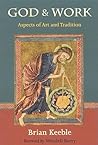
“At its highest, this wisdom arrives at an understanding of how the human maker may act analogously to the Divine Creator, echoing the “art” of God’s creating the phenomenal world from noumenal levels of reality in as much as he, the craftsman, makes from some already existing substance what does not yet exist in nature. He thus is said to “imitate nature in her manner of operation”, in the words of St. Thomas that Coomaraswamy so frequently quotes.”
― God and Work: Aspects of Art and Tradition
― God and Work: Aspects of Art and Tradition
“are there periods of history for which work, vocation, and spirituality were mutually supportive aspects of life:”
― God and Work: Aspects of Art and Tradition
― God and Work: Aspects of Art and Tradition
“By putting “God” and “work” in the same title—in, so to speak, the same breath—Mr. Keeble challenges the modern orthodoxy, which has done its best to keep those terms separate. The great dissociation of which T. S. Eliot and others have spoken has made it likely that people will exclude from their forms of worship any reference to their economic life or the quality of their work, and that they will exclude from their work any sense of religious obligation. By bringing those two words back into their old association, and by the honor he gives to people who conscientiously kept them associated, Mr. Keeble restores to practical viability the idea of good work. He brings again into view the possibility of religion practicable in work, and work compatible with worship and wholly meant. Wendell Berry Lanes Landing Farm Port Royal, Kentucky”
― God and Work: Aspects of Art and Tradition
― God and Work: Aspects of Art and Tradition
“The tool produces according to human needs, the machine regardless of human needs.”
― Art For Whom and For What?
― Art For Whom and For What?
“a community cannot afford to dispense with the intellectual and imaginative forces, the educational and ethical factors which go with the existence of skilled craftsmen and small workshops”. The divorce of art from labor has an outcome injurious to both. From the point of view of the worker, “through the division of labor [he is] no longer able to make any whole thing [but is] confined to making small parts of things. . . . He can never [thereby] rise in virtue of his knowledge or experience in the craft itself. That craft is for him destroyed as a means of culture,3 and the community has lost one more man’s intelligence”.”
― God and Work: Aspects of Art and Tradition
― God and Work: Aspects of Art and Tradition
“Traditionally—if such a contraction be allowed—any form of intellectual aim that did not take account of this antecedent, archetypal order of reality would have been considered all but invalid. Now, in many quarters, to give any sort of credence to its effective presence is likely to be seen as a sign of willful eccentricity.”
― God and Work: Aspects of Art and Tradition
― God and Work: Aspects of Art and Tradition
“So we perhaps begin to see that work is not something we must be freed from - indeed cannot be freed from unless we are freeed entirely from action - but something we must engage in in such way and at such level that it is revealing of our deepest nature. It must contribute to our spiritual life while serving our bodily needs.
The very opposite of this case with the industrial pattern of work which is part and parcel of a social ethos that continually holds out the promise of leisure as a reward for the time and effort put into work. But this escape to a state of freedom from work is not offered as something that will serve our spiritual needs. Far from it.”
― Art For Whom and For What?
The very opposite of this case with the industrial pattern of work which is part and parcel of a social ethos that continually holds out the promise of leisure as a reward for the time and effort put into work. But this escape to a state of freedom from work is not offered as something that will serve our spiritual needs. Far from it.”
― Art For Whom and For What?
“Coomaraswamy could acknowledge that machines had come to stay, so that he was simply of his age in asking by what means they might be controlled: how could “a curse” be transformed into “a blessing”. For, as he suggested in his Introduction, “a community cannot afford to dispense with the intellectual and imaginative forces, the educational and ethical factors which go with the existence of skilled craftsmen and small workshops”. The divorce of art from labor has an outcome injurious to both. From the point of view of the worker, “through the division of labor [he is] no longer able to make any whole thing [but is] confined to making small parts of things. . . . He can never [thereby] rise in virtue of his knowledge or experience in the craft itself. That craft is for him destroyed as a means of culture,3 and the community has lost one more man’s intelligence”.”
― God and Work: Aspects of Art and Tradition
― God and Work: Aspects of Art and Tradition
“What has been made all but impossible by the industrial system is that men and women can attain a livelihood by doing what is both aesthetically and morally sound and economically and practically valid, by a means that allows them both intellectual and spiritual responsibility.”
― Art For Whom and For What?
― Art For Whom and For What?
“Undoubtedly, what the modern industrial and now increasingly post-industrial world offers, in this respect, amounts to our being condemned, during most of our working hours at least, to activities that have no bearing on our final destiny. No doubt, too, this division is yet one more outcome of the fragmentation that characterizes the modern mentality that no longer recognizes a noumenal order of reality (and its organ of perception, metaphysical intuition), which alone can unify natural things with spiritual things.”
― God and Work: Aspects of Art and Tradition
― God and Work: Aspects of Art and Tradition
“Man creates. the machine duplicates. In each case a different principle is appealed to, a different characteristic, called into being. To create is to cause to exist a thing that is unique. To duplicate is to cause to exist a thing that is uniform.”
― Art For Whom and For What?
― Art For Whom and For What?