Goodreads helps you follow your favorite authors. Be the first to learn about new releases!
Start by following Elizabeth F. Loftus.

Showing 1-10 of 10
“[M]any people believe that memory works like a recording device. You just record the information, then you call it up and play it back when you want to answer questions or identify images. But decades of work in psychology has shown that this just isn't true. Our memories are constructive. They're reconstructive. Memory works a little bit more like a Wikipedia page: You can go in there and change it, but so can other people.”
―
―
“Zealous conviction is a dangerous substitute for an open mind.”
―
―
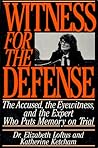
“In court the next morning I sat at a table in the judge’s chambers. On the other side of the table, close enough for me to reach across and touch him, sat Ted Bundy. He’s adorable, I thought, surprised at my first impression, because I’d pictured him in my mind as brooding, dark, intense disdain (p. 83).
(Loftus testified as a defense expert for Ted Bundy in 1976, Bundy was found guilty of aggravated kidnapping)”
― Witness for the Defense: The Accused, the Eyewitness, and the Expert Who Puts Memory on Trial
(Loftus testified as a defense expert for Ted Bundy in 1976, Bundy was found guilty of aggravated kidnapping)”
― Witness for the Defense: The Accused, the Eyewitness, and the Expert Who Puts Memory on Trial
“The thought had occurred to me as I was flying to Salt Lake City earlier that day that Ted Bundy might offer to let me stay in his apartment” (p. 74).
(Loftus testified as a defense expert for Ted Bundy in 1976)”
― Witness for the Defense: The Accused, the Eyewitness, and the Expert Who Puts Memory on Trial
(Loftus testified as a defense expert for Ted Bundy in 1976)”
― Witness for the Defense: The Accused, the Eyewitness, and the Expert Who Puts Memory on Trial
“According to the most outspoken and vituperative Skeptics, therapists specializing in recovered memory therapy operate in a neverland of fairy dust and mythic monsters. Woefully out of touch with modern research, engaging in “crude psychiatric analysis,” guilty of oversimplification, overextension, and “incestuous opinion citing,” these misguided, undertrained, and overzealous clinicians are implanting false memories in the minds of suggestible clients, making “therapeutic lifers” out of their patients and ripping families apart. This”
― The Myth of Repressed Memory: False Memories and Allegations of Sexual Abuse
― The Myth of Repressed Memory: False Memories and Allegations of Sexual Abuse
“Some who question the authenticity of the memories of abuse do so in part because of the intensity and sincerity of the accused persons who deny the abuse . . . the current denials of those accused of sexual abuse are not proof that the allegations are false. Research with known rapists, pedophiles, and incest offenders has illustrated that they often exhibit a cognitive distortion –a tendency to justify, minimize, or rationalize their behavior (Gudjonsson, 1992). Because accused persons are motivated to verbally and even mentally deny an abusive past, simple denials cannot constitute cogent evidence that the victim’s memories are not authentic.
Loftus, E. (1993). The reality of repressed memories. American Psychologist, 48, 518-537.”
―
Loftus, E. (1993). The reality of repressed memories. American Psychologist, 48, 518-537.”
―
“A laboratory analogy to repression can be found in an experiment by A.F. Zeller.
Zeller arranged a situation so that one group of students underwent an unhappy “failure” experience right after they had successfully learned a list of nonsense syllables. When tested later, these subjects showed much poorer recall of the nonsense syllables compared to a control group, who had not experienced failure. When this same “failure” group was later allowed to succeed on the same task that they had earlier failed, their recall showed tremendous improvement. This experiment indicates that when the reason for the repression is removed, when material to be remembered is no longer associated with negative effects, a person no longer experiences retrieval failure.”
― Human Memory: The Processing of Information
Zeller arranged a situation so that one group of students underwent an unhappy “failure” experience right after they had successfully learned a list of nonsense syllables. When tested later, these subjects showed much poorer recall of the nonsense syllables compared to a control group, who had not experienced failure. When this same “failure” group was later allowed to succeed on the same task that they had earlier failed, their recall showed tremendous improvement. This experiment indicates that when the reason for the repression is removed, when material to be remembered is no longer associated with negative effects, a person no longer experiences retrieval failure.”
― Human Memory: The Processing of Information
“Most of the time, perhaps 99 percent of the time, the defendant is guilty; his screams are the final protest of a human being about to lost his most precious possession, his freedom.”
― Witness for the Defense: The Accused, the Eyewitness, and the Expert Who Puts Memory on Trial
― Witness for the Defense: The Accused, the Eyewitness, and the Expert Who Puts Memory on Trial
“Women involved in out-patient treatment for substance abuse were interviewed to examine their recollections of childhood sexual abuse. Overall, 54% of the 105 women reported a history of childhood sexual abuse. Of these, the majority (81 %) remembered all or part of the abuse their whole lives; 19% reported they forgot the abuse for a period of time, and later the memory returned. Women who remembered the abuse their whole lives reported a clearer memory, with a more detailed picture. They also reported greater intensity of feelings at the time the abuse happened.”
―
―
“Perhaps the problem is with therapy itself: a profession that has become our new religion, offering quick and easy answers for life’s complex and essentially unanswerable problems. In its zeal to ameliorate our suffering, has therapy reduced all our problems to symptoms, equating suffering with abuse, and holding forth the false hope of redemption through the resurrection of lost innocence?”
― The Myth of Repressed Memory: False Memories and Allegations of Sexual Abuse
― The Myth of Repressed Memory: False Memories and Allegations of Sexual Abuse