
Art Lovers discussion
Art Lovers News Corner
>
May 2011
date newest »
newest »
message 1:
by
Heather
(new)
May 08, 2011 06:10AM
 Well, I appreciate you guys keeping us up on the 'art news' comments. I guess it's about time I started a thread for May, huh? Sorry about that! Here it is, I look forward to more of your wonderful posts!
reply
|
flag
Artists, activism, and political realitiesby Robin Cembalest
ARTnews
At the Queens Museum of Art last year, Tania Bruguera installed a piece that looked just like Duchamp's Fountain—same model of urinal, same "R. Mutt" signature. The crucial difference: this one was in a men's room, and it worked.
"You can see it, and you can pee in it," she told a crowd assembled in a storefront in Corona, Queens, the neighborhood where she’s based this year. It's the headquarters of Immigrant Movement International, a project she conceived as an "artist-initiated sociopolitical movement." Presented by Creative Time and the Queens Museum and financed by the Annenberg Foundation, the Rockefeller Foundation, and others, the project is intended to operate at the juncture of art, politics, and community, examining and hopefully improving conditions in immigrants' lives.
That day, however, a mostly art-world audience had gathered to discuss one of Bruguera's catchphrases: "useful art." To help define it, several artists explained their own approaches. Presenters included Mel Chin, who is currently lobbying to get lead out of New Orleans soil; Rick Lowe, who built Houston's "Project Row Houses"; and France’s Patrick Bernier and Olive Martin, who use, literally, a novel approach: they try to stop impending deportations by claiming that immigrants are artists and writers. The crowd wrestled with challenging questions: What specific qualities do artists bring to politics? What criteria should be used to judge "useful art"—both as art and as effective activism? Can artists working on immigration, pollution, and housing be part of the solution? Or, by also participating in museums and the market, are they just part of the system like everyone else? Can artists save the world? If they don't try, what's the alternative?
While the discussion didn't yield firm answers, it certainly helped clarify the questions at an urgent moment. One way or another, artists have acted as activists for centuries. But it seems that more and more artists around the world are devising projects that harness their creative sensibilities—and, significantly, their international profiles—to both raise awareness and improve living conditions. Brooklyn-based Swoon, for example, helped build a community center and shelters in Haiti. Vik Muniz advocates for Brazil's garbage pickers. Most famously—and ominously—Ai Weiwei criticized shoddy construction in schools in China's earthquake zones, along with other government policies, resulting in his detention last April.
The art world swiftly and unilaterally denounced his arrest, and the Guggenheim launched an online petition demanding Ai's release. Whether Chinese officials will see the 127,789 (at press time) signatures is an open question. But again, what's the alternative? The petition keeps the story alive and lets people feel their voices are heard, at least by someone. The prospect of more tangible measures—sanctions or a boycott—was regarded by several museum directors I spoke to as beyond the bounds of feasibility, given the realities of traveling exhibitions and loans, among other cultural, political, and financial entanglements.
But others are considering boycotts as a strategic option for activism. A group organized by artists Walid Raad and Emily Jacir released a petition demanding closer regulation of labor conditions for migrant workers at the Guggenheim Abu Dhabi; some signers are already boycotting the museum until "fully verifiable procedures for protecting the rights of the workers" are in place. The museum responded that Human Rights Watch paints an "inaccurate picture" of the progress it has made and continues to make. Another petition was launched by anonymous artists to protest the firing of Sharjah Art Foundation's director, Jack Persekian, over a purportedly offensive piece in the emirate's biennial this past spring. Some signers of that petition have also raised the possibility of a future boycott.
It's clear from these efforts that as centers of power in the art world emerge beyond its longtime traditional capitals, questions of how to evaluate and influence human-rights issues have become more complicated. "I don't think these are the last petitions we'll see," says Creative Time chief curator Nato Thompson, who likens them to social-network activism in Tunisia, Egypt, and elsewhere. "These are new equations. Artists are finding they can organize and have power in a way they didn't used to," he notes. "They're finding ways their community can demand ethical behavior." But each campaign is fraught with its own complexities. Are the Guggenheim Abu Dhabi's conditions worse than those at other museums around the developing world? Will a boycott sever lines of communication with foreign institutions? Are there times when the solutions can become part of the problem? Can the art world really influence China's human-rights policy?
Thompson, for one, doesn't have any illusions. "I don't think it's going to be a quick fix," he says, noting the example of the Dalai Lama. "But when is it ever?"
Robin Cembalest is executive editor of ARTnews.
I wanted to pose several of the above questions if anyone has any comments or opinions:What specific qualities do artists bring to politics?
What criteria should be used to judge "useful art"—both as art and as effective activism?
Can artists working on immigration, pollution, and housing be part of the solution?
Or, by also participating in museums and the market, are they just part of the system like everyone else?
Can artists save the world? If they don't try, what's the alternative?
Is that a Botticelli in your pocket?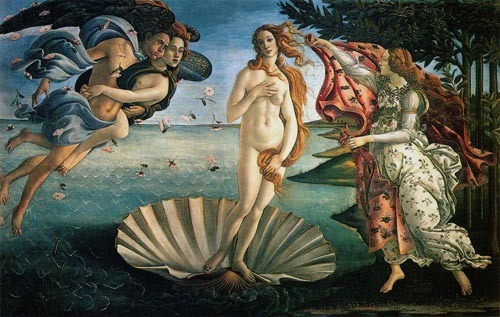
The Art Newspaper
Move over oysters, art is the newest aphrodisiac. A recent study found that viewing art releases the feel-good chemical dopamine into the brain, eliciting the same feelings as being in love. A neurobiologist at the University College London scanned volunteers' brains as they looked at 28 pictures. Works by Botticelli and Monet caused increased blood flow to areas of the brain that are usually associated with romantic love. John Constable, Jean Auguste Dominique Ingres and Guido Reni aroused the highest physiological response — a nearly 10% increase of blood flow — of the artists included in the study. Who knew Constable was such a lady killer?
 LOL. Since I am also interested in science, I thought this would go with that article.
http://www.newscientist.com/article/m...
Fascinating, Aloha! Thank you for sharing!
Can a Picasso Cure You?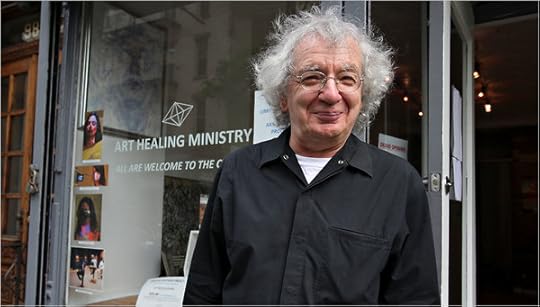
The conceptual artist Alexander Melamid has created a storefront clinic in SoHo where visitors will be "treated" through exposure to fine art.
By CHARLES McGRATH
The New York Times
The Russian-born artist Alexander Melamid is by nature an ironist, so adept at serving as his own straight man that it’s hard to tell how seriously he means to be taken. He may not know himself.
Mr. Melamid and Vitaly Komar, a fellow Russian émigré, were for years a highly visible Conceptual art duo in New York. They were known for monumental paintings, including one of Stalin killing himself in a New Jersey motel, in the style of Socialist Realism, and for teaching elephants in Thailand how to paint like Abstract Expressionists.
Their most famous project was probably “The People’s Choice,” in which they polled people about their preferences in art and determined that what everyone really wanted to look at was a landscape with lots of blue, some animals and a historical figure or two. A painting they did according to this recipe — the ideal painting for Americans, they maintained — featured George Washington and some present-day picnickers by a bucolic lake with a hippo in the background.
In 2003 Mr. Melamid and Mr. Komar parted ways, and since then Mr. Melamid, always the more outgoing, has been on his own. For a while he was painting large, Velázquez-like portraits of rappers and Russian oligarchs. His most recent project, though, is something called the Art Healing Ministry, a storefront clinic at 98 Thompson Street in SoHo, where people can come in by appointment and be treated, by means of exposure to fine art, for a variety of physical and psychological ailments.
According to labels on the wall, these include bulimia nervosa, angioedema and urticaria, premenstrual dysphoric disorder and benign prostatic hyperplasia. (Mr. Melamid loves medical terminology, he said, because it reminds him of art criticism.)
Various art-healing tchotckes are for sale: candles; shoe insoles printed with a van Gogh self-portrait; glass flasks for “charging” liquids with the emanations from paintings by Raphael, Botticelli, Picasso or Lichtenstein that have been reproduced on the inside of the glass; and prayer cards, one for Picasso, patron saint of motorists, and one for Georges Seurat, patron saint of clear, youthful, radiant skin. You can also arrange for a little robotlike gadget bearing reproductions of paintings by van Gogh and Warhol to visit your apartment and scuttle around on the floor for a while, ridding it of impurities.
“We all know the power of art, its power to galvanize, fortify, stimulate, rouse, soothe and enlighten,” Mr. Melamid wrote in a statement announcing the creation of his clinic. In person recently, he explained: “I was always told that art was good for me, but until recently I didn’t know what it was good for. What is good? What is good in the U.S.A. is health and health products.”
How the art-healing process works is not entirely clear, but it may involve invisible particles called creatons. “The creatons are everywhere, and they go into the human body,” said Mr. Melamid, who is small and animated and has a nimbus of white mad-scientist hair. “If the creatons are used properly and nicely, they can enhance your body functions. They will help you to live happier and will also get rid of impurities. They enter through your kundalini and also into your eyes.”
The clinic officially opens on Wednesday, but last week a middle-aged man complaining of work-related stress dropped by for a preview treatment. He looked warily at a vitrine displaying something called an “Art Infuser,” which appeared to be an old VHS tape connected to an enema bulb. But Mr. Melamid reassured him that rectal infusion was now obsolete and instead led him to the back of the clinic, to what looked like a dentist’s chair, with a computer screen and a small projection device.
The clinic officially opens on Wednesday, but last week a middle-aged man complaining of work-related stress dropped by for a preview treatment. He looked warily at a vitrine displaying something called an “Art Infuser,” which appeared to be an old VHS tape connected to an enema bulb. But Mr. Melamid reassured him that rectal infusion was now obsolete and instead led him to the back of the clinic, to what looked like a dentist’s chair, with a computer screen and a small projection device.
While the patient reclined, Mr. Melamid sat in a chair under a portrait of himself and took notes on a clipboard. He wanted to know specifics about the patient’s malady, and about any museums he had visited recently. Told that the patient had been looking at a lot of Whistlers, he nodded and said, “Not enough masterpieces.”
After a moment, he said: “This anxiety of yours is a very typical problem of modern man. And woman. And everything in between. My function is to help you see the right things.”
More.... http://www.nytimes.com/2011/05/25/art...
 Heather wrote: "Can a Picasso Cure You?
The conceptual artist Alexander Melamid has created a storefront clinic in SoHo where visitors will be "treated" through exposure to fine art.
By CHARLES McGRATH
The New ..."
I LOVE this! so funny.

 There IS some merit to these claims....making it a business, hmmm!
I, too, thought it looked interesting. Actually I would be really curious about what kind of art/artist he would recommend for me!
There IS some merit to these claims....making it a business, hmmm!
I, too, thought it looked interesting. Actually I would be really curious about what kind of art/artist he would recommend for me!
 As an experiment I set up an art news feed on my site using Google. It turns up some interesting stuff from time to time, although it sometimes picks up on stories about guys named "Art".
LOL!
As an experiment I set up an art news feed on my site using Google. It turns up some interesting stuff from time to time, although it sometimes picks up on stories about guys named "Art".
LOL!I went to your news feed and it does have some interesting articles...you should post some here, Ed!
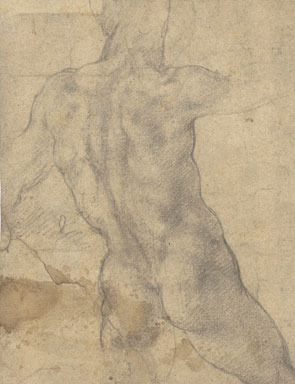
A Glimpse of the Divine: Michelangelo Drawing to be Offered at Christie's in JulyMichelangelo Buonarroti (Caprese 1475-1564 Rome), A male nude, seen from behind (recto); Studies of male nudes (verso) black chalk, watermark crowned eagle (close to Briquet 89) 8.5 x 7 in. US$4,600,000-7,500,000. Photo: Christie's Images Ltd 2011.
LONDON.- Christies will offer an exceptional and rarely seen drawing by Michelangelo Buonarroti (1475-1564) at the Old Masters and 19th Century Art Evening Sale on Tuesday 5 July 2011 in London. Drawn at a pivotal point of the artists career, this preparatory study is one of only 24 sheets related to his seminal, prestigious and lost commission of The Battle of Cascina and the last to remain in private hands. The commission saw Michelangelo pitched directly alongside his elder rival Leonardo da Vinci who was commissioned to paint The Battle of Cascina on the opposite wall of the newly-built Sala del Gran Consiglio in Florences Palazzo della Signoria.
 Kimbell Art Museum Develops iPad App for Picasso and Braque Exhibition
 The iCubist app was designed and produced by Reza Ali for the Santa Barbara Museum of Art and the Kimbell Art Museum.
FORT WORTH, TX.- Picasso and Braque: The Cubist Experiment, 19101912 is on view at the Kimbell Art Museum from May 29 through August 21, 2011, and at the Santa Barbara Museum of Art from September 17, 2011, through January 8, 2012. The iCubist app was designed and produced by Reza Ali.
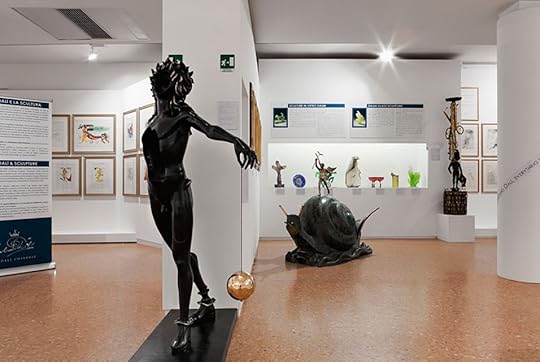
VENICE.- The Dali Universe in Venice is an exhibition entirely dedicated to Salvador Dali, with more than 100 Dali artworks on display. Visitors can admire a collection of artworks lesser known to the public, which include bronze sculpture, rare graphics portfolios, glass pate de verre sculptures and gold objets d’art. This is the only collection of its kind in the world, featuring the most important and largest grouping of Dalí sculptures. The Museo Santa Apollonia in Venice opens its doors to a unique show, curated by Mr Beniamino Levi, president of the Fondazione Ambrosiana. Mr Levi has thus far organised over 80 exhibitions of Dali artworks that have been seen by over 10 million people in numerous countries worldwide.
Bronze sculptures on display include, Homage to Newton, Woman Aflame, Space Elephant and Toreador Hallucinogen. Each sculpture offers the visitor the chance to discover a new and unique aspect of Dali’s surrealism, from the iconographic soft watch of the Persistence of Memory to his homage to the female figure in Space Venus.
The collection of pate de verre sculptures arises from an artistic collaboration between Dali and the french glass-making company Daum Cristallerie during the 1960s. For Dali, glass offered the perfect medium for artistic expression.
The exhibition has on display an important collection of rare, hand-signed graphics illustrating the great themes of literature both contemporary and classic, such as La Vida es Sueno by de la Barca, Le Tricorne by Alarcon.
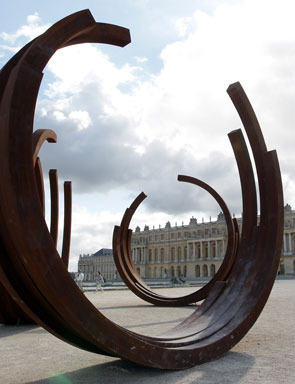
 A monumental sculpture of the french artist Bernar Venet in the Versailles Palace gardens. AP Photo Bob Edme.
PARIS.- Bernar Venet is the Palace of Versailless guest in 2011. He is taking over from Takashi Murakami who, as we know, attracted considerable interest and sizeable crowds in 2010. The exhibition is on view from June 1st through November 1st, 2011. The Palace of Versailles chose Bernar Venet to showcase a French artists meticulous, intense efforts to probe the question about the relationships between art, landscapes and architecture, and therefore between art, time and history. It is also the first time that this institution has decided to display an annual contemporary art exhibition work of art in the Marly Estate, which it is now responsible for....
I started to subscribe to Art Daily News....you can get it sent to your inbox....
I just got myself an iPad 2, so I've been staying off Goodreads to play with it. I'll have to check out those apps. The drawing programs are so good! It draws in real time. There's no time lag in the strokes. And it's great drawing with my finger, although I've purchased a stylus. I feel it's better to draw with the stylus, because the swinging of the pen makes some drawing strokes easier. My favorite is the Auryn Ink program that imitates watercolor. I wanted to be able to draw and write wherever I am, and not be stuck at my desk. I have a lovely beach a few minutes from where I live. I'd like to draw and write on the beach, or hang in a coffee shop with other people. There's a terrific journaling program called Notes Plus that allows me to write and sketch in it.
Nope, can't find those apps in the iTunes store.Ed wrote: "Kimbell Art Museum Develops iPad App for Picasso and Braque Exhibition
The iCubist app was designed and produced by Reza Ali for the Santa Barbara Museum of Art and the Kimbell Art Museum.
..."
Wow! There are a lot of great iPad apps for paintings! There's one called Picasso that lets you view 893 of Picasso's paintings. I'm going to have to download that one and see the quality of it. There's Monet, Michelangelo, etc. Things look so great on the iPad. It's a great place to look at those paintings.
I just downloaded about $20 worth of art apps from Overdamped, their HD collection. I can't wait to see how they look on my iPad.
That's awesome, Aloha! I have to say I'm kind of jealous!
Thanks, Heather. I've come to rely on my iPhone for everything, notes about what I'm reading for writing reviews, taking pictures, reading books, audios, etc. The iPad is like a big iPhone. I've been waiting a long time to get it. I am so thrilled with this gadget!
Overdamped has a terrific collection. They're extensive and they look great. Michelangelo's Sistine Chapel looks wonderful! I just had an idea. I can take a screenshot of one of the paintings, import it into the ArtRage app that allows you to have an image to trace from. Then trace or modify the image of the original. How fun!
Overdamped even has an app called Home Interior Ideas! I'm downloading that one. At mostly 99 cents a pop, it is a great deal, considering that you can spend up to over $1,000.00 for an art book. Yes, I used to collect art books. The priciest one was $1,200, a rare one of Hiroshige. I'm going in to get the rest of their collection. Don't anybody dare stop me!
There is an iPad app called Art Authority that is incredible. It has great overviews of art history from Early (up to 1400s) to Contemporary, with over 50,000 art work, organized by period and artist. You can also do a search for work by title, subject and location. The subject search is pretty neat. For example, if I wanted all art work containing fireplaces, it will pop up all work containing fireplaces. Their subject list is pretty extensive, too.
Me again! WOW! I think I want one of those! I would love the Home Interior Ideas probably just as much as the art, I have to admit. :)
I'm telling ya! It's the best gadget next to the iPhone. It's full of power and versatility, if you know how to take advantage of it.

