
Terminalcoffee discussion
Help! I Need Help!
>
Gardening questions and answers

message 101:
by
Scout
(new)
Sep 01, 2011 08:39PM
 Any hints you can give me for growing broccoli and cabbage? I have no experience with them. Do you plant seeds? Any insect problems?
reply
|
flag
 I have grown broccoli from plants from the nursery. Seeds would take FOREVER. Cabbage is succeptable to cabbage worm. I find it cheaper to just buy cabbage from the grocery, as the worms usually get my cabbages.
Thanks, Cynthia.
I have grown broccoli from plants from the nursery. Seeds would take FOREVER. Cabbage is succeptable to cabbage worm. I find it cheaper to just buy cabbage from the grocery, as the worms usually get my cabbages.
Thanks, Cynthia.I've been using a large covered plastic pot, probably ten gallons or so, as a composter. I've put all my vegetable kitchen scraps in during the summer. Now it's really a big, soupy mess - nothing close to the fluffy stuff I expected. This is my first time trying composting, and I think maybe I should have put in some dirt or something else to soak up the liquid.
Next to our recycling center, there are heaps of ground-up stuff to use for mulch. I have an unused tomato cage that I could use for compost. Maybe I could alternate putting in what I've collected with putting in the mulch. Or should I just throw away what I have and try again next year?
I thought of the tomato cage because it would let in air. I also have some chicken wire that I could use, but it's so flimsy.I don't like to think that all the vegetable scraps I've put in this summer will go to waste. I'd like to use them, and I'm going to try to save them using
your brown-material suggestions.
I don't have much to compost in the winter. If I can't use what I have, I'll start over next year.
 Mod
BunWat wrote: "Okay.
Mod
BunWat wrote: "Okay.Compost need three things. Air, water, and the right mixture of green and brown materials.
I'm going to describe this backwards.
Green/Brown. Green materials are things like kitc..."
This is the best explanation of composting I have ever read. Great job, Bun!
And Scout, when your compost is ready it will weigh about as much as peat moss. Nice and light and fluffy.
I add veg. peels and egg shells and coffee grounds to my pile all winter. Just toss it in the snow, on top of all those chopped up leaves from my yard. In the spring you give it a good turn and it heats up nice and warm in the middle.
 We can't do piles around here. They attract mice and rats. Tumblers work better in areas where those are concerns.
Mod
We can't do piles around here. They attract mice and rats. Tumblers work better in areas where those are concerns.
Mod
 Mod
BunWat wrote: "Thanks Cynthia!
Mod
BunWat wrote: "Thanks Cynthia!Maybe put the chicken wire around the inside of the tomato cage, Scout? It would be kind of a mini composter"
Hey, that's a good idea. I do need it enclosed, as my dog would - well - smell like compost.
Lobstergirl wrote: "Don't you eat vegetables in winter? (And eggs result in eggshells and coffee, coffee grounds.) You can compost just in a heap, without an enclosure. The worms and bugs already in the earth will ..."Yes to eating vegetables in winter, but not as many fresh ones as in summer. I'm thinking that cooked vegetables (at least mine) have salt in them, so not good for composting. I've only put in fresh scraps so far, along with eggshells and some grounds. If I can get a winter garden going, I'll have more fresh stuff to put in. I will switch to an enclosure on the ground, surrounded by wire. Good idea that the worms and bugs should be able to get in, instead of something up off the ground like I've seen in the catalogs.
I can put in stale bread, ashes, and dryer lint? Great! I always felt like I should stuff something with the dryer lint. This is better. And the ashes won't turn into lye?
Mod
Cotton lint makes sense to me. As you point out, it is a plant. I only use and wear cotton, so the lint is going into the compost pile, along with the fall leaves. I'm reserving judgment on the ashes, though.
Mod
Fancy seeing you here, Larry (strange expression, that). I've read about making lye soap in the old days using ashes and hog fat. If ashes make lye, which is caustic, that doesn't sound good for plants. Then again, plantation owners here do controlled burns, and the plants come back looking great, so I'm missing something. In any case, I'm forgetting about plastic composters and going for composting on the ground in a wire enclosure to keep the pup out and let the worms in.
I get it, Bun. You always have the info, and you share.
It's supposed to freeze tonight, so I've covered up the delicate plants outside. I've never gotten it, though, about covering up plants. Isn't it just as cold under the cover as above? Plants don't generate heat, right? Maybe the covering keeps in the heat from the ground? Or just keeps off the frost? I don't know.
Mod
 But when you're camping, it's better to put a blanket under you than over you, because if you don't the heat from your body will leech into the ground.
So we react opposite the way plants do?
Mod
Mod
So if you're camping on a chilly night with only one blanket (let's assume it won't wrap around your whole body), you'd lie on top of it rather than under it? That seems so counterintuitive. You've got to cover up when it's cold.
Lobstergirl wrote: "Phil wrote: "But when you're camping, it's better to put a blanket under you than over you"So if you're camping on a chilly night with only one blanket (let's assume it won't wrap around your who..."
Intuition doesn't keep you alive, preparedness does. I'd be camping with a sleeping bag, not a tiny blanket. But in your scenario, I'd build a bed of leaves and soft branches to get myself off the ground, then cover up with the blanket. If I didn't have a hat, I would wrap the blanket around my head and shoulders.
Tip for survival: Never sleep directly on the ground. Lay down some grass or other insulating material to keep the ground from absorbing your body heat.
That makes sense.Having a greenhouse would be the best thing for over-wintering plants, I guess. Plastic keeps the cold out and keeps the heat in.
No questions or answers, just want to talk about bulbs. I bought 5 different daffodil bulbs today, didn't label them, so I'll be surprised to see what comes up where in the spring. Also bought two nice red amaryllis bulbs for Christmas, one for me and one for my neighbor who loves flowers like I do. Something to look forward to :)
Mod
"
I grew calibrachoa in that pot last year. That would be awesome if it turned into calibrachoa."
This is pretty cool - I think it is turning into purple calibrachoa. I totally thought it was a weed all this time, growing there next to my lobelia.
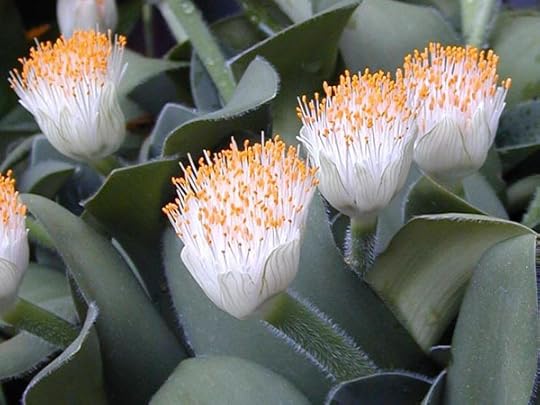
 My African Blood Lily is in bud. I am excited .

 I just planted white caladium bulbs. Hoping they'll look like this:
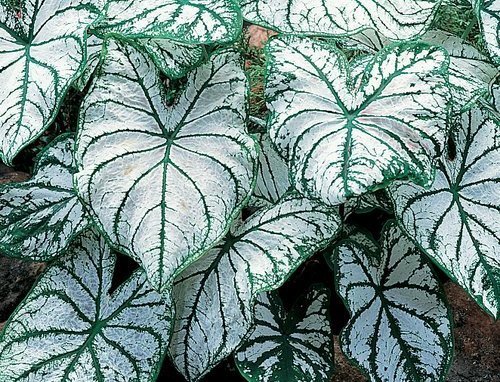 Scout wrote: "I just planted white caladium bulbs. Hoping they'll look like this:
"
I like those!
Me,too. Like elephant ears, but smaller and prettier. The bulbs will have to be dug up at the end of the season and stored in a paper bag. Can you leave your blood lilies in the ground over the winter?
Yes . It will flower during the next few weeks,then some of the leaves will die off during winter. Just before it buds there is a flush of new growth. The leaves alone make it an attractive plant. My plant is in a pot and has multiplied, so if it were in a garden bed it would really flourish, and have plump luscious leaves.
I've been busy planting too!Three weeks ago: a blackberry bush and a raspberry bush, both of which will make Bo very happy. The blackberry seems to love where it is, as it is already flowering.
In the last week or so:
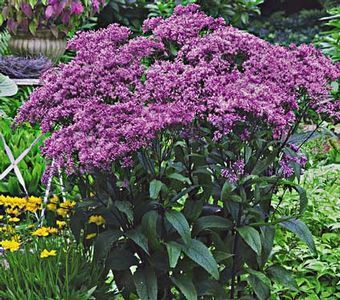
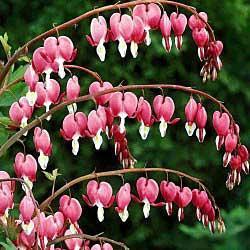
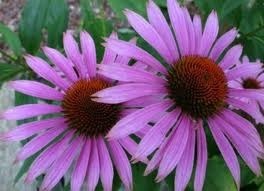
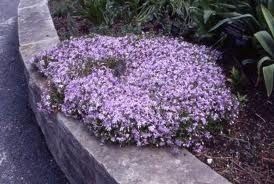

All of them are native to the area, so I'm hoping they do well.
Then I transplanted my sage and apple mint and my early girl tomatoes. The other tomatoes will have to wait another week to get flipped upside down, since I want them to get rained on this week and once I put them in the upside down containers I need to water them every day.
 Sarah Pi wrote: "I've been busy planting too!
Three weeks ago: a blackberry bush and a raspberry bush, both of which will make Bo very happy. The blackberry seems to love where it is, as it is already flowering.
I..."
Beautiful! And I love home grown tomatoes, nothing compares :)
Sarah Pi wrote: "I've been busy planting too!Three weeks ago: a blackberry bush and a raspberry bush, both of which will make Bo very happy. The blackberry seems to love where it is, as it is already flowering.
I've just been reading about berries and antioxidants.
A great choice to grow. If you were a few decades older you could make "little old ladies jam."
evie wrote: "A great choice to grow. If you were a few decades older you could make "little old ladies jam." "I already do!
 Emily wrote: "Beautiful! And I love home grown tomatoes, nothing compares :) ."
Agreed. Warm from sun, just off the plant, with some fresh mozzerella and basil and bread. Hurry up, summer.
Do your tomatoes do well in the upside down containers, Pi? I tried it last year, and the tomatoes were so small! It seemed there wasn't enough room for the roots to grow, and they dried out so fast. On the plus side, weeds weren't a problem.
I've tried upside down tomatoes before but I picked the wrong variety, it had large tomatoes which were too heavy and it was all the poor thing could do to grow three of them! If I was going to try again I'd use cherry tomatoes or a similar variety.

