
Constant Reader discussion
Reading List
>
2666 by Roberto Bolaño

 I'm still reading the part about Fate, I'll reserve judgment until I've completed the whole novel. I do hear it comes together really well at the end.
One pattern I'm noticing is an unfavorable depiction of the cult to the author/artist.
The section about the critics is long but you come out of it with what I think is a fairly good understanding of who they are. To me it seems they have very few attractive qualities. The attitudes, especially of Pelletier and Espinoza, toward other professors, their students, prostitutes, taxi drivers, and people they consider to be lesser intellectuals are disgusting.
I compare Lola's (Amalfitano's wife in the second section) obsession with the poet to the critics' obsession with Archimboldi. I think her obsession and its consequences drive home the point that this kind of hero worship is not a good thing.
Jane, I too have made it through all five parts and have to say that I am still looking for a way in which to make all the parts cohere into a unified whole. The most I would say is that the first three parts perhaps amount to the buildup to the 'real story' and that their relationship doesn't become clearer until later, if then, when things begin to wrap up in the final two parts. At least that is how it seems to me, so far. In the meantime, yes, I think the thing to try to to do is to spot the cross-connections, as you have started doing, and also to try to establish the timeline for the events of the various parts. My impression is that the first three parts occur during more or less simultaneous time intervals during which the murders are actually occurring.
 One more link: Time did an interesting, short review of this book:
http://www.time.com/time/arts/article...
As I finished Book 3, I started to wonder if the killings are a metaphor but I'm still working out exactly what it is. I do know that I don't think this can be read as a murder mystery.
And, though I'm often confused, I find myself growing fond of Bolaño's extremely dry humor. Naming the journalist Oscar Fate was a nice touch.
For any of you who read or understand spoken Spanish this page is helpful. I haven't consumed it all yet. One of these days I'll share some insight's from there.http://www.elortiba.org/bolano.html#L...
He chose The Metamorphosis over The Trial, he chose Bartleby over Moby-Dick, he chose A Simple Heart over Bouvard and Pecuchet, and A Christmas Carol over A Tale of Two Cities or The Pickwick Papers. What a sad paradox, thought Amalfitano. Now even bookish pharmacists are afraid to take on the great, imperfect, torrential works, books that blaze paths into the unknown. They choose the perfect exercises of the great masters. Or what amounts to the same thing: they want to watch the great masters spar, but they have no interest in real combat, when the great masters struggle against that something, that something that terrifies us all, that something that cows us and spurs us on, amid blood and mortal wounds and stench.
I like two things about this quote from the end of the section on Almalfitano.
First, he's forming an opinion about the pharmacist based on what he likes to read. Don't we all do this a little with Goodreads? I know I've checked out other people's to-read shelves.
Second, I think Bolaño is trying to do combat, rather than spar, with this novel. It is not a light read in any sense. The subject matter is serious, the characters are not very likable, the narrative style requires effort, and the 1100+ page Spanish language version is unwieldy. Here's a quote from a critic that leads me to this opinion.
Bolaño once wrote that in the Americas, all modern fiction springs from two sources: The Adventures of Huckleberry Finn and Moby-Dick. The Savage Detectives, with its carousing characters, is Bolaño’s novel of friendship and adventure. 2666 chases the white whale.
Read more: http://www.newyorker.com/online/blogs...
Notes Toward an Annotated Edition of 2666 (from then English language translator, Natasha Wimmer)http://us.macmillan.com/CMS400/upload...
 "2666 chases the white whale." I like this description. I think you have heard of the border murders in Juarez Mexico. This is suppose to be about those murders. He fictionalized the town and I think the victims names. I think as of this date there have been almost 400 murders of women and girls. I am skipping some of the murders though. I just can't read them.
 I'm in the midst of the Crime section. Would it be a presumption for me to ask the meaning of the title? Is it ever disclosed?
I'm very favorably impressed by the translator. Had I not known this was originally written in Spanish I would never have realized it was a translation. Often with translated books I feel as if I've been shoved back a notch from involvement with the text on the page. Not so here. And it's an amazingly easy and smooth read. Altho so detailed and so full of digressions that I'm taking it slowly.
 I read somewhere that the name "Archimboldi" references "Archimboldo", the guy who did those pastiche type portraits made with fruit and vegetables. Like this one: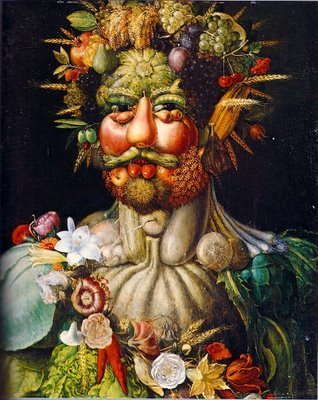
The whole idea of pastiche seems somehow appropriate to 2666. Trouble is, I can't make out the figure that it puts together. There seems to be a very loose common thread (no, not the murders) stringing the five books together, but I'll get to that when everyone's finished.
And I must say, there's one point in Book 1 when there's a crazy long sentence that goes on for more than one page. It's in the part of the account of the story by the German widow of her time in South America. At that point, I almost threw the book down and gave up.
 He talks more about Arcimboldo and choosing his name (which he then spells differently) in the 5th section.
I've just re-read the Wiki article and a review of 2666 from the Guardian. http://www.guardian.co.uk/books/2009/...
Below is a tiny quote which the Guardian article throws in -
'Both the next two sections are set in Santa Teresa but the critics have disappeared from view (this is a novel with many disappearances).'
I wonder whether this isn't deserving of more consideration - Bolano evidently was writing this book at the time he knew his health was also failing - is there a link with this and the disappearances, both of characters who disappear and return, those who just disappear from the story and those who disappear having been murdered? We all, in our own little ways, disappear eventually, don't we.
The other thing which I didn't know, not having read any of Bolano's books before (nor, blushingly admitting, having ever heard of him) is that he usually wrote about literary figures - often poet, of which he was one.
Lots of things to ponder.
When I started reading 2666 I didn't know much about it. I had heard Bolaño was hailed as a genius and had seen the daunting copies of 2666 in the stores and in the library, but I didn't know anything about the book itself, its structure or what it was about. It has been an interesting journey so far - I've just finished book three. My favorite part is still the first part, mainly because it is about the literary world. Bolaño has quite an imagination and I can't help but admire him for that, even though I might not fully understand 2666.
Do you think the publishers should have adhered to Bolaño's original plan to release this as five books instead of one huge volume? I do. You have time to ponder the first and anticipate the remainder ,before your mind goes into overload. I am glad it was decided to take two months to read this.
As far as I know the main reason Bolaño wanted it to be published as five books was because he knew he was going to die and that way he knew his children were provided for. They decided to publish it as one book because they felt that would do justice to the book from a literary viewpoint.
Yes I had read that also. But my gut instinct makes me think he was thinking on both levels. He certainly was an intense writer. I think I will need to read something else of his to get a clearer picture in my mind.
Thanks for that link, Ricki. It gives me a bit of a map for this journey I'm taking.
Sibyl,I thought he had changed his mind and wanted it to be published as one book also. The Guardian article says otherwise -
'Like its predecessor, 2666 is a novel of stupefying ambition with a mock-documentary element at its core. It is divided into five loosely connected sections, each of which could stand as a novel in their own right (and indeed Bolaño expressed a wish, ignored by his executors, for them to be published separately)'
I'm not sure which view is correct. I can see that it might have been useful to publish it as five books but I'm not actually sure I would have read all five so, for me, I think it's better that it was done as one; I would have missed a good experience otherwise.
A lot of readers probably wouldn't have read all of it if it wasn't published as one book. Maybe now less people start reading it because it is so big, but there's a better chance of them finishing it. I know it will help me, if I had to wait a year for every new book as Bolaño had intended I probably wouldn't have had the patience.
 I translated a couple of questions and answers from the interview that Caeliban posted earlier, as I though it might shed light on Bolano. This is all my free translation, and my Spanish is only as good as the words resemble Portuguese, so be aware. And anyone fluent, please feel free to correct me.
 ¿Cómo es el paraíso?
How is paradise?
-Como Venecia, espero, un lugar lleno de italianas e italianos. Un sitio que se usa y se desgasta y que sabe que nada perdura, ni el paraíso, y que eso al fin y al cabo no importa.
Like Venice, I hope, a place full of Italian women and men. A site that is used and deteriorates and that knows that nothing outlasts, not even paradise, and that this at the end does not matter.
¿Y el infierno?
And Hell?
-Como Ciudad Juárez, que es nuestra maldición y nuestro espejo, el espejo desasosegado de nuestras frustraciones y de nuestra infame interpretación de la libertad y de nuestros deseos.
Like Ciudad Juárez, that is our curse and our mirror, the disquieted mirror of our frustrations and our infamous interpretation of liberty and of our desires.
¿Cuáles son los cinco libros que marcaron su vida?
What are the 5 books that left a mark in your life?
-Mis cinco libros en realidad son cinco mil. Menciono éstos sólo a manera de punta de lanza o embajada aviesa: le Quijote, de Cervantes. Moby Dick, de Melville. La Obra Completa, de Borges. Rayuela, de Cortázar. La conjura de los necios, de Kennedy Toole. Pero también debería citar: Nadja, de Breton. Las cartas de Jacques Vaché. Todo Ubú, de Jarry. La vida, instrucciones de uso, de Perec. El castillo y El proceso, de Kafka. Los aforismos de Lichtenberg. El Tractatus, de Wittgenstein. La invención de Morel, de Bioy Casares. El Satiricón, de Petronio. La Historia de Roma, de Tito Livio. Los Pensamientos, de Pascal.
My five books in reality are five thousand. I mention those that are in a way the spearhead or twisted embassy: The Quixote, by Cervantes. Moby Dick, by Melville. The Completed Works (my translation) by Borges. Rayuela, by Cortazar. A Confederacy of Dunces by Kennedy Toole. But I also should mention: Nadja, by Breton, The Letters of Jacques Vache. Ubu Roy, by Jarry. Life, An Users Manual, by Perec. The Castle and The Trial by Kafka. The Tractatus, by Wittgenstein. The Invention of Morel, by Bioy Casares. The Satyricon by Petronio. The History of Rome, by Tito Livio. Thoughts, by Pascal.
(I mentioned somewhere else in CR that “The Invention of Morel” has been popping out everywhere I turn. When I saw it here I decided I better buy and read it sooner than later)
Then, at some point in the interview he says this phrase, that is also the mentioned somewhere else in the article, was the elegy he wrote for himself.
El mundo está vivo y nada vivo tiene remedio y ésa es nuestra suerte.
The world is alive and nothing alive has a cure and this is our luck.
 I happy to see that the discussion is taking off like this. You all bring up so many interesting points, and thank you, Capitu, for your translations.
I looked up Santa Teresa in my National Geographic Atlas, and there are actually two towns by that name in the state of Sonora, Mexico. One is near Nogales and the other is further south and east. The other names are real because my father worked in the state of Sonora for a couple of years, and I actually visited him in Cananea. My point is that Bolano (my computer doesn't like to do a tilde unless I write this in Word and paste) used a real town name here. I assume it is for a reason.
I think I get annoyed with this book because I want the threads to lead somewhere. For example, at one point towards the end of the first book Espinoza mentions that there is a strong odor of chemicals in the air, near Rebeca's house. I wanted that to lead somewhere. So far, it hasn't.
I have found some quotes that I like. Here is one:
p. 40 ...life of our four friends proceeded smoothly, flowing along on the placid river of European university German departments, not without racking up one upset or another that in the end simply added a dash of pepper, a dash of mustard, a drizzle of vinegar to orderly lives, or lives that looked orderly from without, although each of the four had his or her own cross to bear.
Somewhere along the line I read an interview with Bolano which contained an intriguing remark by him. But now that I look for the interview, of course I can't find it again online, or the particular remark. Nevertheless it has stuck in my mind because it also appears at least twice in the novel. So, the following is from recollection, which might not be quite accurate, and anyone is free to correct my faulty memory.
Bolano was being interviewed when the interviewer asked a question something like: "What is 2666 about?" and Bolano replied (seeming somewhat irritated) "Can nobody see?" as if there were an obvious message, or meaning, or story right in front of our nose that would stand out clearly when one finally "saw" it after being exposed to all the incomplete pieces. Or at least that is how it sounded to me (from the printed words).
My reaction is that Bolano was painting his story on a very large canvas, with a larger meaning in mind, and that the individual sections might be seen in some larger symbolic sense.
The critics, for example, are a group of people who travel internationally and they all are wrapped up in their own particular research quest to learn everything there is to know about one Archimboldi. They only find out about the murders by one of them accidentally noticing an article in a newspaper and, as I recall, they show no particular interest in the murders or the girls. They think of going to Santa Theresa only to follow a lead that might turn up some information about their own pet interest, namely Archimboldi.
Well, how like most people in the world that is! Most of us included, in fact, who might not have noticed any murders of anonymous girls over the border in Juarez, except for reading or hearing of this book. Or cared much if we had indeed heard of them.
The fact of their being academics or critics is not particularly necessary for such an interpretation of them as "everyman." So I would suggest that Bolano's large canvas might have a heavily symbolic interpretation, perhaps a wry comment on the human condition, or life in general, or perhaps a political comment on mankind, or society, or perhaps the regime in Mexico.
The book may deliberately be a puzzle with only the outlines of its intended meaning sketched, but revealing a picture once one sees it.
I'm just rambling and speculating. But at two key points that question or its paraphrase is indeed asked in the book, "Can nobody see?"
So I think that may be the task for us -- to finally see the obvious.
Bolano was being interviewed when the interviewer asked a question something like: "What is 2666 about?" and Bolano replied (seeming somewhat irritated) "Can nobody see?" as if there were an obvious message, or meaning, or story right in front of our nose that would stand out clearly when one finally "saw" it after being exposed to all the incomplete pieces. Or at least that is how it sounded to me (from the printed words).
My reaction is that Bolano was painting his story on a very large canvas, with a larger meaning in mind, and that the individual sections might be seen in some larger symbolic sense.
The critics, for example, are a group of people who travel internationally and they all are wrapped up in their own particular research quest to learn everything there is to know about one Archimboldi. They only find out about the murders by one of them accidentally noticing an article in a newspaper and, as I recall, they show no particular interest in the murders or the girls. They think of going to Santa Theresa only to follow a lead that might turn up some information about their own pet interest, namely Archimboldi.
Well, how like most people in the world that is! Most of us included, in fact, who might not have noticed any murders of anonymous girls over the border in Juarez, except for reading or hearing of this book. Or cared much if we had indeed heard of them.
The fact of their being academics or critics is not particularly necessary for such an interpretation of them as "everyman." So I would suggest that Bolano's large canvas might have a heavily symbolic interpretation, perhaps a wry comment on the human condition, or life in general, or perhaps a political comment on mankind, or society, or perhaps the regime in Mexico.
The book may deliberately be a puzzle with only the outlines of its intended meaning sketched, but revealing a picture once one sees it.
I'm just rambling and speculating. But at two key points that question or its paraphrase is indeed asked in the book, "Can nobody see?"
So I think that may be the task for us -- to finally see the obvious.
Has anyone finished the book? I think some of Your questions Russ are answered in parts 4 & 5. I think of part one as an introductory to the rest of the book. At first I thought it was unnecessary ,but now that I am in the last part it is an intricate part of the book..It is the stage setting, I went back and scanned the first part again. I am still reading this so I am trying to formulate my thoughts. So I will be back.
 I'm doing a happy jig around the house... I just finished book three! I bought the book on Monday. I struggled through 25 pages that day. Tuesday, I managed to read 80 pages. I started having nightmare flashbacks of being in college, forced to read a book I couldn't stand. Once I got past book one though, things took off. Had this been published as 5 books, I would have never bought book 2. I'm glad it's all together in one story.
I was severely annoyed by the critics. Their self absorption, and the love triangle. (rectangle?) I didn't care who was in love with whom... I found myself gritting my teeth.
Things picked up for me with Barry Seaman, which just goes to show how different we are all. I read on the other thread that some were very annoyed by that character. That's when I decided I could actually read this book.
This book requires a lot of thought. I feel like you could basically go page by page, and analyze a million different things. Bolano is definitely a thinker.
I did highlight one quote. I love the imagery!
At that same moment the Santa Teresa police found the body of another teenage girl, half buried in a vacant lot in one of the neighborhoods on the edge of the city, and a strong wind from the west hurled itself against the slopes of the mountains to the east, raising dust and a litter of newspaper and cardboard on its way through Santa Teresa, moving the clothes that Rosa had hung in the backyard, as if the wind, young and energetic in its brief life, were trying on Amalfitano's shirts and pants and slipping into his daughter's underpants and reading a few pages of the Testamento geometrico to see whether there was anything in it that might be of use, anything that might explain the strange landscape of streets and houses through which it was galloping, or that would explain it to itself as wind.
Yes, Carol, I have actually finished the book and will be extremely interested in hearing your comments next month about how it all connects.
I am still not finished. I am not as well read as the rest of you, so I may be totally off in what I am thinking. I am still trying to gather my thoughts about the first three books.I think for now I will just read what everyone else is saying and see if I can make some sense out of this. In each book he has a character that is struck by madness, I can't express what the reason would be. I think it is relevant some how . I just don't know why though.
Capitu wrote: "This is all my free translation, and my Spanish is only as good as the words resemble Portuguese, so be aware. And anyone fluent, please feel free to correct me."Capitu, your translation communicates the meaning well enough. I can't remember who it was that said all translations are traitorous by nature. I think the argument was playfully supported by the similarity of the words in Italian: tradutorre and traditorre. No egregious violations worth correcting on your part.
Jane wrote: "I think I get annoyed with this book because I want the threads to lead somewhere. For example, at one point towards the end of the first book Espinoza mentions that there is a strong odor of chemicals in the air, near Rebeca's house. I wanted that to lead somewhere. So far, it hasn't."I could be wrong, but I think that might be a bit of grain sticking out of the head of the pastiche figure of Archimboldi.
I take it to be another sign of the poisonous environment in Santa Teresa and the irony of the opportunity the border town maquilas created. They are such great employment opportunities and pull so many young women north to work in them, but, with the number of deaths, poor working conditions, and health concern that the chemicals represent you have to ask whether it is really worth it. What does hell smell like?
Here are some links to learn some basics about maquilas:
http://www.corpwatch.org/article.php?...
http://en.wikipedia.org/wiki/Maquiladora
http://www.twinplantnews.com/whatIs.htm
And here's a nasty little quote from one of the links that I believe is probably from the year 1999:
"Under NAFTA, maquiladora employment increased by 54% in Ciudad Juárez, spurring significant population growth. Yet Juárez still has no waste treatment facility to treat sewage produced by the 1.3 million people who now live there."
That is what I gathered also . The stink was the environment caused by the governments lack of basic welfare and sanitation in Santa Teresa(Cuidad Juarez.)It is worse for women as they are second class citizen's anyway. at one time the authorities were thought to turn a blind eye to these murders . Even When Mr. Fate wanted to do the story about these murders his editor said people did not care about that. He wanted him to just report on the fight because that was more important.
Book two has some great imagery. I liked the way Bolano said the wind put on the clothing that was hanging on the line and turned the pages of the book as if it were reading.
Caeliban, it is reassuring that you approve of my translation. I found the interview quite telling of Bolaño, the person and the writer. Thanks again for that link and the others about the maquiladoras – I have not read then though. I seem to be spending a lot of time reading about Bolaño on the internet instead of going back to the book. I stopped reading at the beginning of “The Part About Fate”, but I know that the murders are going to start, and I am struggling to return to the book. It is surprising how tense and worried I am about the girl that sells carpets at the market, and about the professor’s daughter. For all the detachment I seem to feel for the characters up to now, Bolaño has obviously managed to engage me at some emotional level.
The murders are to intense for me. I hit and miss them. If they appear to grisly I give it a miss, unless I see something while scanning that might be essential to the story line .
I'm in the middle of the murders now, and I'm reading every word. You'd think either one would be sickened, as perhaps Carol is, or one would get bored. I'm neither. It's all written so well.
I'm still in The Part About Fate...maybe half way through, I haven't read in a few days.
Capitu,
I feel the same about the girls you mention. Bolano does have the knack to emotionally involve the reader so seamlessly we don't notice it till it is gnawing at us.
Capitu,
I feel the same about the girls you mention. Bolano does have the knack to emotionally involve the reader so seamlessly we don't notice it till it is gnawing at us.
The points made by Russ and Caeliban bring me to what feels like the metaphor that is the murders. Obviously, I'm just casting about trying to identify a sort of subconscious feeling. But, no one truly cares about the loss of human life in these murders. They are a bit embarrassed that they can't find the murderer. But, what is valued is the helter-skelter development, the money that is being made. In the fact of all the employment opportunities, etc., no one really wants to take time to worry about the loss of life, unless it is directly connected to them.
I thought the murders were rather lightly treated in terms of detail that might have been mentioned -- perhaps appropriate for 'throw-away' girls. And I use the phrase because that seems to be the reaction of almost everyone in the book, except a loved one. In broad generality, no one cares, it seems to me. And my suspicion is that that is exactly the point that Bolano is making.
[Added in edit: And I now see that Barbara (Msg 34)and I were typing at the same time and ended up cross-posting, both making the same point. Great minds and all that :) ]
[Added in edit: And I now see that Barbara (Msg 34)and I were typing at the same time and ended up cross-posting, both making the same point. Great minds and all that :) ]
 I know we're not supposed to talk about Part 4 now, but since you're talking about the murders, I'll say that I'm reading each word, too. The sheer number of them and the repetition of the description of the murders is riveting. I think with each new victim, we might get a better picture of what is happening. Each murder has a little bit more information. We're circling around and round.
 2666
Oh dear, I guess I skipped ahead. I'll try to restrain myself.
In regards to part three :that is the point Mr. Fate was trying to bring up . The officials cared more about a fight arena than bringing the murders to the world arena. I think these murders of women affected Bolano deeply .
It is difficult to NOT talk about the murders after you've read book 4. The author takes the Mexican justice system to task and rightly so. It will be interesting to discuss that. As an aside, I just bought IRON RIVER, a mystery by T. Jefferson Parker. It is about the river of guns that flow from this country to Mexico and these guns are used in crimes. Did you know that there have been 15,000 drug-related murders in Mexico in the last few years? I know that is another subject, but the narcos are mentioned in Book 4. Those are the people with the big money.Back to book one - At the beginning of THE PART ABOUT THE CRITICS, the author spoke of the four characters as college professors. On p. 71, we learn that Espinoza and Pelletier have given awful presentations at one of the many conferences they attend. RB refers to the "latest litter of Archimboldians" as "people less interested in literature than in literary criticism." Boy, did that hit home with me, because when I was getting my degree, I got so sick of reading literary criticism that I now try to avoid it. I think RB is using the term "critics" as a pejorative term. These four are not artists who create their own works. They make their living from studying the works of others.
 I know Bolano became almost obsessed with the murders of Mexican girls that took place in the maquiladoras of Ciudad Juarez (Santa Teresa) that had been set up by US corporations. The US corporations wanted to take advantage of loopholes in health, safety, and wage issues, so they set up manufacturing plants just across the US border in Mexico. For some reason, these US manufacturing plants employed girls and women almost exclusively (I have no idea why, maybe because the men have left Ciudad Juarez for more lucrative jobs in the US?).
The maquiladoras were located in a rural area, so the US corporations would at least bus their workers to and from the factory every day. In the 1990s, I think it was, women began to turn up missing. Sometimes their bodies would be found along the bus route. It became a well known fact that gangs of men would rape and kill the girls/women. The police force of Ciudad Juarez didn't do anything about these murders as they considered the women "expendable" and they wanted to protect the US factories.
I got this as the gist of the book, but what does Archimboldi have to do with all of this? Simply because the book is a pastiche? I admit, I have no idea.
I have to admit, I do not like the book. I think literature should possess clarity and this book doesn't for me.
Gabrielle,I haven't finished Book 5 yet, but I am hoping that everything will come together. I have about 125 pages to go, and Archimboldi (not yet Archimboldi) is in Germany still.
I appreciate clarity also, and I am hoping that this discussion will help me appreciate the book more. It has been a chore for me to read it.
Jane said: "These four are not artists who create their own works. They make their living from studying the works of others." If it were just studying, I would feel differently. But it seems to be pecking it to death, having factions and rivalries and "sides." It's the antithesis of what I think the best of literature is. It seems to be just like politics and nothing about art.
Sherry,I do agree. They seem to spend most of their time traveling to conferences and sleeping around.
 I can't say as I have any sense of clarity, and it is not a fast read for me, yet I love it. Hopefully I will have something intelligent to contribute as the discussion continues. I just wanted to chime in to say that I'm glad we're reading this book and I appreciate everyone's comments to date. Already it's an interesting discussion.
Thanks for nominating this, Jane. And thanks to everyone who voted for it. I did not, and am happy once again to have lost.
I'm enjoying the book more than I thought I would. I kind of had to push myself through the first three books. In fact, the second book nearly had me screaming. But now I'm rolling along with it.When I got out of grad school, I felt the same way about art criticism as you do about lit crit, Jane. I was nigh unto death sick of it. I still have trouble reading it, and also with lit or poetry crit. Sometimes it seems more about the critic's contemplating his own navel than about the work itself.
If the critics are there merely to get us to Santa Teresa, then why does he spend so much time with them? There must be a reason.
Ruth said: If the critics are there merely to get us to Santa Teresa, then why does he spend so much time with them? There must be a reason.I am wondering the same thing, and I am waiting for an answer.
I can't figure it out. The critics are European critics and all of them are rather obsessed with Archimboldi. So, learning that he (Archimboldi) went to Santa Teresa, they go there in search of him and get caught up in the mystery of the murders. But when the scene changes to Santa Teresa, the literary critics have disappeared and have been replaced by the Spanish professor and the journalist. So, what gives? I'll admit, I have no clue.
Is the spanish professor the scholar, or are the four critics who claim to be the scholars? I can't figure out the reasoning for each segment having an unstable character .I am still trying to figure out if it is relevant or a smoke screen.
I do not know, Carol.
At first I thought the critics might symbolize the "boom" in Latin American literature, but now I don't think so as the critics were French, Spanish, Italian, and English, I think. There there's this conversation:The first conversation began awkwardly, although Espinoza had been expecting Pelletier’s call, as if both men found it difficult to say what sooner or later they would have to say. The first twenty minutes were tragic in tone, with the word fate used ten times and the word friendship twenty-four times. Liz Norton’s name was spoken fifty times, nine of them in vain. The word Paris was said seven times, Madrid, eight. The word love was spoken twice and the word happiness once (by Espinoza). The word solution was said twelve times…The word euphemism ten times…. The words eyes or hands or hair fourteen times. Then the conversation proceeded more smoothly. Pelletier told Espinoza a joke in German and Espinoza laughed. In fact, they both laughed, wrapped up in the waves or whatever it was that linked their voices and ears across the dark fields and the wind and the snow of the Pyrenees and the rivers and the lonely roads and the separate and interminable suburbs surrounding Paris and Madrid.
Why does Bolano tell us how many times certain words are said? No idea.
The critics are all united by one thing - their fascination with Archimboldi, who does not really exist, of course. Could WE be the critics, who are fascinated with Bolano? Or even 2666? But they exist.
I am really confused.
Gabrielle wrote: "For some reason, these US manufacturing plants employed girls and women almost exclusively (I have no idea why, maybe because the men have left Ciudad Juarez for more lucrative jobs in the US?)."The way I've heard this explained in the past is that the young girls will work for longer hours, at a lower wage, and are easier to control/manipulate in the workplace. Men and women stand up for themselves more, organize, etc. I don't know if this is really what was/does go on there. It's just something I heard once.

Constant Reader
Books mentioned in this topic
El gaucho insufrible (other topics)2666 (other topics)
Monsieur Pain (other topics)
Monsieur Pain (other topics)
Underworld (other topics)
More...

I know that many of you are wondering why I nominated this book. It was chosen as the book of the year by Time Magazine in 2008, and it did well on many other lists. I decided I wanted to read it, and I didn't want to read it alone, so I nominated it for our reading list. Even though I am in book 5, I can't say that I like it.
This first month, we talked about discussing the first three books and leaving books 4 and 5 for February. If possible, adhere to those rules so that we won't be giving spoilers of the last two parts.
Bolaño was born in Santiago, Chile, in 1953. Here is a link to an article about him on Wikipedia. http://en.wikipedia.org/wiki/Roberto_...
I read the article before I started the novel, and I saw that the book was about the murders in Santa Teresa, Mexico. The author seems to be circling around the subject of the murders in the first section, and I can't figure out why the critics are in the book. The first mention I found of the killings was on p. 43 of my edition:
Around this time, Morini was the first of the four to read an article about the killings in Sonora, which appeared in Il Manifesto and was written by an Italian reporter who had gone to Mexico to cover the Zapatista guerrillas. The news was horrible, he thought. In Italy there were serial killers, too, but they hardly ever killed more than ten people, whereas in Sonora the dead numbered well over one hundred.
I looked for themes and characters that appeared in all three novels, and I didn't come up with much. There is Amalfitano who is introduced in novel one. Novel two is about him, and he makes a brief appearance in novel three. There is the madness of artists and poets. What else did you find?
I have many questions and I know the excellent members of Constant Reader can help me understand this novel.