
The History Book Club discussion
NORTH AMERICA (US/CANADA/ETC.)
>
TEXAS
date newest »
newest »
 Mod
Mod
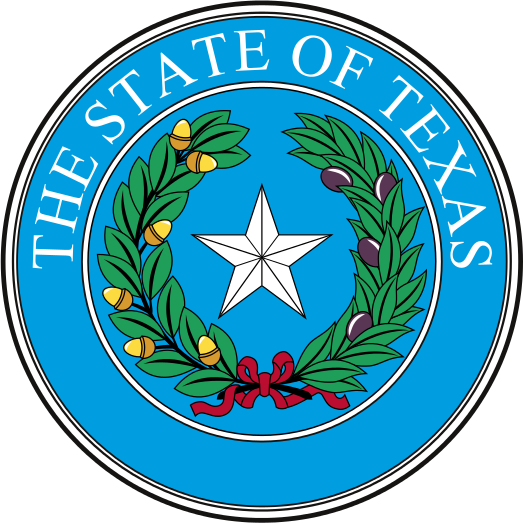
Here is a link which tells you more about the state seal of Texas:
http://en.wikipedia.org/wiki/Seal_of_...
Source: Wikipedia
Mod
Friendship State:
Lone Star State: (currently used on license plates)
Chili State
Source: Wikipedia
Mod
Friendship
What does the word "Texas" mean?
Texas is from the Caddo Indian word "teyshas" (meaning "friends" or "allies"). In the 1540s Spanish explorers took this to be a tribal name, recording it as Teyas or Tejas. It came eventually to mean an area north of the Rio Grande and east of New Mexico. The alliance concept is also incorporated into the state motto, which is simply "Friendship
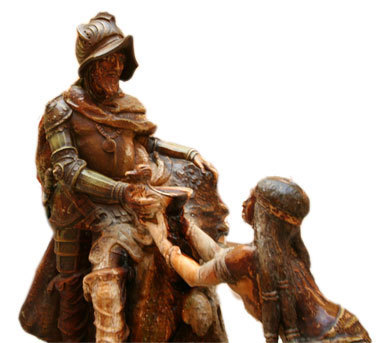
Statue of Hernando de Soto receiving a gift from a Caddo Indian maiden; photo by madame_urushiol on Flickr (noncommercial use permitted with attribution / no derivative works)
Source: Wikipedia
Mod
Texas, Our Texas
"Texas, Our Texas" is the official state song of Texas. It was written in 1924 by William J. Marsh, who was born in Liverpool, England, and emigrated to Texas as a young man, and Gladys Yoakum Wright, a native of Fort Worth, Texas, and selected as the state song by a concurrent resolution of the Texas Legislature in 1929 following a statewide competition. Older songs, such as "The Yellow Rose of Texas" and "Dixie", were also considered but ultimately it was decided a new song should be composed. At times, there have been movements to replace "Texas, Our Texas" with the better known "The Eyes of Texas."
The first word of the third line was originally largest, but when Alaska became the largest state when it was admitted to the United States in 1959, the word was replaced with boldest
This song was sung in group by elementary students in Texas at the beginning of their school classes during the 50s. At that time "largest" started the third line of the first verse. As of the 1980s, this song was still sung before classes, along with the pledge to the American and Texas flags, but with "boldest" instead of "largest."
Lyrics:
Texas, Our Texas! All hail the mighty State!
Texas, Our Texas! So wonderful so great!
Boldest and grandest, withstanding ev'ry test
O Empire wide and glorious, you stand supremely blest.
(chorus)
Texas, O Texas! your freeborn single star,
Sends out its radiance to nations near and far,
Emblem of Freedom! it set our hearts aglow,
With thoughts of San Jacinto and glorious Alamo.
(chorus)
Texas, dear Texas! from tyrant grip now free,
Shines forth in splendor, your star of destiny!
Mother of heroes, we come your children true,
Proclaiming our allegiance, our faith, our love for you.
Chorus:
God bless you Texas! And keep you brave and strong,
That you may grow in power and worth, throughout the ages long.
God bless you Texas! And keep you brave and strong,
That you may grow in power and worth, throughout the ages long.
Here it is being performed:
Arranged by David Kneupper
Guest Conductor Gary Lewis
Performed January 14, 2012 by the Allen High School Band, Choir & Orchestra at the Allen ISD Performing Arts Center Dedication Gala
https://vimeo.com/36094028
Map of Texas:

Source: Wikipedia
Mod
English
More: http://en.wikipedia.org/wiki/Language...
Spoken languages:
Predominantly English
Spanish spoken by sizable minority
Demonym:
Texan
Texian (archaic)
Tejano
Mod
Austin
Largest city:
Houston
Largest metro:
Dallas–Fort Worth–Arlington
Area:
Ranked 2nd
- Total - 268,581 sq mi
(696,241 km2)
- Width - 773 miles (1,244 km)
- Length- 790 miles (1,270 km)
- % water - 2.5
- Latitude - 25° 50′ N to 36° 30′ N
- Longitude - 93° 31′ W to 106° 39′ W
Mod
Ranked - 2nd
- Total - 26,956,958 (2014 est)
- Density - 98.1/sq mi (37.9/km2)
Ranked:
26th
Elevation:
- Highest point - Guadalupe Peak
8,751 ft - (2667.4 m)
- Mean - 1,700 ft (520 m)
- Lowest point - Gulf of Mexico sea level
Before statehood:
Republic of Texas
Admission to Union:
December 29, 1845 (28th)
Governor:
Greg Abbott (R)
Lieutenant Governor:
Dan Patrick (R)
Mod
Texas Legislature
- Upper house - Senate
- Lower house - House of Representatives
U.S. Senators:
John Cornyn (R)
Ted Cruz (R)
U.S. House delegation:
25 Republicans
11 Democrats (list)
Time zones:
- most of state - Central: UTC −6/−5
- tip of West Texas - Mountain: UTC −7/−6
Abbreviations:
TX
Tex
US-TX
Website:
www.texas.gov
Source for (messages 6, 7, 8, 9): Wikipedia
Mod
The Yellow Rose of Texas
Roy Rogers - Yellow Rose of Texas
http://youtu.be/rPM7zzElj-Q
The Yellow Rose Of Texas Mitch Miller Orchestra 1955
http://youtu.be/5uS5cPfbIjw
Source: You Tube
Lyrics:
The Yellow Rose of Texas
Mitch Miller
There's a yellow rose in Texas that I am gonna see
Nobody else could miss her not half as much as me
She cried so when I left her it was like it broke her heart
And if I ever find her we never more will part
She's the sweetest little rose bud that Texas ever knew
Her eyes are bright as diamonds they sparkle like the dew
You may talk about your Clementine and sing of Rosa Lee
But the yellow rose of Texas is the only girl for me
Where the Rio Grand is flowing and the starry skies are bright
She walks along the river in the quiet summer night
I know that she remembers when we parted long ago
I promise to return and not to leave her so
She's the sweetest little rose bud that Texas ever knew
Her eyes are bright as diamonds they sparkle like the dew
You may talk about your Clementine and sing of Rosa Lee
But the yellow rose of Texas is the only girl for me
Now I'm gonna find her for my heart is full of woe
We'll do the things together we did so long ago
We'll play the banjo gaily she'll loves me like before
And the yellow rose of Texas shall be mine forever more
She's the sweetest little rose bud that Texas ever knew
Her eyes are bright as diamonds they sparkle like the dew
You may talk about your Clementine and sing of Rosa Lee
But the yellow rose of Texas is the only girl for me
Mod
Deep in the Heart of Texas
"Deep in the Heart of Texas" is an American popular song elaborating on the merits of the state of Texas.
The 1941 song features lyrics by June Hershey and music by Don Swander. The song was recorded by Perry Como with Ted Weems and His Orchestra on December 9 of that year for Decca Records in Los Angeles, California. It was a single release (4138 A) on the flip side of the song "Ollie Ollie Out's In Free." "Deep in the Heart of Texas" spent five weeks at the top of Your Hit Parade in 1942
The song's title was borrowed for the name of a 1942 Western film starring Johnny Mack Brown as a man instrumental in restoring Texas to the United States following the American Civil War. It featured Tex Ritter and the Jimmy Wakely Trio singing the title song. Gene Autry sang the song in Heart of the Rio Grande (1942) and his version may be the most well known.
The first recording was by Alvino Rey on November 21 for Bluebird. Bing Crosby with Woody Herman's band recorded a version[1] that reached #3 on the Billboard charts that year.[citation needed] Other artists to record the song include Dale Evans and Roy Rogers, Ray Charles, Hank Thompson, Bob Grant, George Strait, and Nickel Creek.
The University of Texas Longhorn Band performs the song during each football pregame at Darrell K. Royal-Texas Memorial Stadium; The Spirit of Houston Cougar Marching Band often performs the tune for home football games at Robertson Stadium; and the Texas Christian University Horned Frog Marching Band performs an arrangement during each pregame at Amon Carter Stadium. Fans sing "Take Me Out to the Ballgame", followed by "Deep In the Heart of Texas" during the seventh-inning stretch of Houston Astros, Rice Owls, and Houston Cougars baseball games, and in the middle of the fifth inning at Rangers Ballpark.
In 1942, the BBC banned the song during working hours on the grounds that its infectious melody might cause wartime factory-hands to neglect their tools while they clapped in time with the song.
Deep In The Heart Of Texas Song - Texas Chamber of Commerce
http://youtu.be/VGF4ibgcHQE
Perry Como Rendition:
http://youtu.be/laKThepytbQ
Source: You Tube
Lyrics:
The stars at night are big and bright
Deep in the heart of Texas
The prairie sky is wide and high
Deep in the heart of Texas[1][3]
The sage in bloom is like perfume
Deep in the heart of Texas
Reminds me of the one that I love
Deep in the heart of Texas
The coyotes wail along the trail
Deep in the heart of Texas
The rabbits rush around the brush
Deep in the heart of Texas
The cowboys cry, "Ki yippee yi!"
Deep in the heart of Texas
The dogies bawl and bawl and bawl
Deep in the heart of Texas
The stars at night are big and bright
Deep in the heart of Texas
The prairie sky is wide and high
Deep in the heart of Texas
Mod
https://youtu.be/wv5H-aNN8Lc
Note: There are some objectionable parts and language - yet this was on television in 2004 - be forewarned.
Source: You Tube
 Mod
Mod
 by T.R. Fehrenbach (no photo)
Synopsis:
Here is an up-to-the-moment history of the Lone Star State, together with an insider's look at the people, politics, and events that have shaped Texas from the beginning right up to our days. Never before has the story been told with more vitality and immediacy. Fehrenbach re-creates the Texas saga from prehistory to the Spanish and French invasions to the heyday of the cotton and cattle empires. He dramatically describes the emergence of Texas as a republic, the vote for secession before the Civil War, and the state's readmission to the Union after the War. In the twentieth century oil would emerge as an important economic resource and social change would come. But Texas would remain unmistakably Texas, because Texans "have been made different by the crucible of history; they think and act in different ways, according to the history that shaped their hearts and minds."
Mod
 by Stephen L. Hardin (no photo)
Synopsis:
Hardly were the last shots fired at the Alamo before the Texas Revolution entered the realm of myth and controversy. French visitor Frederic Gaillardet called it a "Texian Iliad" in 1839, while American Theodore Sedgwick pronounced the war and its resulting legends "almost burlesque."
In this highly readable history, Stephen L. Hardin discovers more than a little truth in both of those views. Drawing on many original Texan and Mexican sources and on-site inspections of almost every battlefield, he offers the first complete military history of the Revolution. From the war's opening in the "Come and Take It" incident at Gonzales to the capture of General Santa Anna at San Jacinto, Hardin clearly describes the strategy and tactics of each side. His research yields new knowledge of the actions of famous Texan and Mexican leaders, as well as fascinating descriptions of battle and camp life from the ordinary soldier's point of view.
This award-winning book belongs on the bookshelf of everyone interested in Texas or military history.
Mod
 by
by
 H.W. Brands
Synopsis:
In Lone Star Nation, Pulitzer Prize finalist H. W. Brands demythologizes Texas’s journey to statehood and restores the genuinely heroic spirit to a pivotal chapter in American history.
From Stephen Austin, Texas’s reluctant founder, to the alcoholic Sam Houston, who came to lead the Texas army in its hour of crisis and glory, to President Andrew Jackson, whose expansionist aspirations loomed large in the background, here is the story of Texas and the outsize figures who shaped its turbulent history. Beginning with its early colonization in the 1820s and taking in the shocking massacres of Texas loyalists at the Alamo and Goliad, its rough-and-tumble years as a land overrun by the Comanches, and its day of liberation as an upstart republic, Brands’ lively history draws on contemporary accounts, diaries, and letters to animate a diverse cast of characters whose adventures, exploits, and ambitions live on in the very fabric of our nation.
Mod
Mod
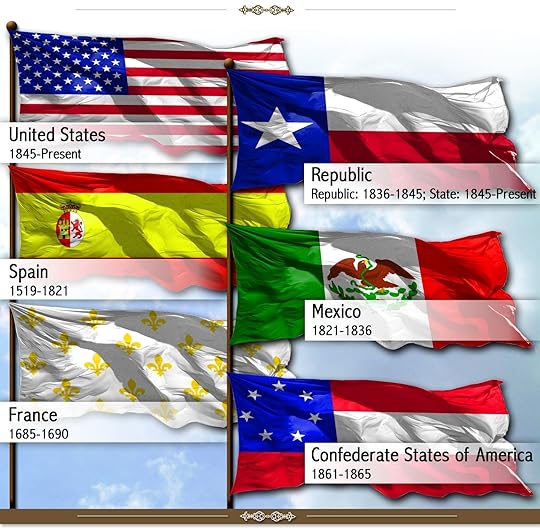
"Six flags over Texas" is the slogan used to describe the six countries that have had sovereignty over some or all of the current territory of the U.S. state of Texas: Spain (1519–1821), France (1685–1690), Mexico (1821–1836), the Republic of Texas(1836–1845), the Confederate States of America (1861–1865), and the United States of America (1845–1861; 1865–present).
This slogan has been incorporated into shopping malls, theme parks (Six Flags), and other enterprises. The six flags are also shown on the reverse of the Seal of Texas.
In 1997 the Texas Historical Commission adopted standard designs for representing the six flags.
Remainder of Article: http://en.wikipedia.org/wiki/Six_flag...
Source: Wikipedia
Mod
 by Randolph B. Campbell (no photo)
Synopsis:
Historian Randolph Campbell ranges from the first arrival of humans in the Panhandle some 10,000 years ago to the dawn of the 21st century, offering an interpretive account of the land, the successive waves of people who have gone to Texas, and the conflicts that have made Texas as much a metaphor as a place. Campbell presents the epic tales of Texas history in a new light, offering revisionist history in the best sense - broadening and deepening the traditional story, without ignoring the heroes of the past. Americans to the rise of the oil industry and ultimately the modernization of Texas. Campbell provides swift-moving accounts of the Mexican revolution against Spain, the arrival of settlers from the United States, and the lasting Spanish legacy (from place names to cattle ranching to civil law). The author also paints a rich portrait of the Anglo-Texan revolution, with its larger-than-life leaders and epic battles, the fascinating decade of the Republic of Texas, and annexation by the United States.
 The first time I went to San Antonio, I was shocked to see that the Alamo was right in the middle of town. I don't know why I thought it would be out somewhere by itself....well, I guess it was once. Visiting was a great experience (and so was the River Walk!!)
Mod
The first time I went to San Antonio, I was shocked to see that the Alamo was right in the middle of town. I don't know why I thought it would be out somewhere by itself....well, I guess it was once. Visiting was a great experience (and so was the River Walk!!)
Mod
FICTION
 by
by
 Cormac McCarthy
Synopsis:
All the Pretty Horses tells of young John Grady Cole, the last of a long line of Texas ranchers. Across the border Mexico beckons—beautiful and desolate, rugged and cruelly civilized. With two companions, he sets off on an idyllic, sometimes comic adventure, to a place where dreams are paid for in blood.
LITERARY AWARDS:
National Book Award for Fiction (1992), National Book Critics Circle Award for Fiction (1992)

The History Book Club
Books mentioned in this topic
All the Pretty Horses (other topics)Gone to Texas: A History of the Lone Star State (other topics)
Lone Star Nation: How a Ragged Army of Volunteers Won the Battle for Texas Independence - and Changed America (other topics)
Texian Iliad: A Military History of the Texas Revolution, 1835-1836 (other topics)
Lone Star: A History Of Texas And The Texans (other topics)
Authors mentioned in this topic
Cormac McCarthy (other topics)Randolph B. Campbell (other topics)
H.W. Brands (other topics)
Stephen L. Hardin (other topics)
T.R. Fehrenbach (other topics)
We have World Hosts that are folks who are helping out with the country and state threads. There can be multiple group members who are World Hosts for any country or state.
You may add books that take place in this state, are about this state, have a scene that takes place in this state or have events where this state is mentioned. There is no self promotion on the History Book Club.
Texas is the second most populous (after California) and the second largest of the 50 U.S. states (after Alaska) in the United States of America. Geographically located in the south central part of the country, Texas shares an international border with the Mexican states of Chihuahua, Coahuila, Nuevo León, and Tamaulipas to the south and borders the U.S. states of New Mexico to the west, Oklahoma to the north, Arkansas to the northeast, and Louisiana to the east. Texas has an area of 268,820 square miles (696,200 km2) and a growing population of over 26.9 million residents (July 2014).
Houston is the largest city in Texas and the fourth-largest in the United States, while San Antonio is the second largest in the state and seventh largest in the United States. Dallas–Fort Worth and Greater Houston are the eighth and tenth largest United States metropolitan areas, respectively. Other major cities include El Paso and Austin—the state capital. Texas is nicknamed the Lone Star State to signify Texas as a former independent republic and as a reminder of the state's struggle for independence from Mexico. The "Lone Star" can be found on the Texas state flag and on the Texas state seal today. The origin of the state name, Texas, is from the word, "Tejas", which means 'friends' in the Caddo language.
Due to its size and geologic features such as the Balcones Fault, Texas contains diverse landscapes that resemble both the American South and Southwest.
Although Texas is popularly associated with the Southwestern deserts, less than 10 percent of the land area is desert. Most of the population centers are located in areas of former prairies, grasslands, forests, and the coastline. Traveling from east to west, one can observe terrain that ranges from coastal swamps and piney woods, to rolling plains and rugged hills, and finally the desert and mountains of the Big Bend.
The term "six flags over Texas", as can be seen in the Grand Prairie-based large national and international amusement park operator Six Flags, came from the several nations that had ruled over the territory. Spain was the first European country to claim the area of Texas. France held a short-lived colony in Texas. Mexico controlled the territory until 1836 when Texas won its independence, becoming an independent Republic. In 1845 it joined the United States as the 28th state. The state's annexation set off a chain of events that caused the Mexican–American War in 1846. A slave state, Texas declared its secession from the United States in early 1861, and officially joined the Confederate States of America on March 2 of the same year. After the consequent Civil War and the restoration of its representation in the federal government, Texas entered a long period of economic stagnation.
One Texas industry that thrived after the Civil War was cattle. Due to its long history as a center of the industry, Texas is associated with the image of the cowboy. The state's economic fortunes changed in the early 20th century, when oil discoveries initiated an economic boom in the state. With strong investments in universities, Texas developed a diversified economy and high tech industry in the mid-20th century. As of 2010 it shares the top of the list of the most Fortune 500 companies with California at 57. With a growing base of industry, the state leads in many industries, including agriculture, petrochemicals, energy, computers and electronics, aerospace, and biomedical sciences. Texas has led the nation in export revenue since 2002 and has the second-highest gross state product.
Remainder of article:
http://en.wikipedia.org/wiki/Texas
Source: Wikipedia
Location:
Flag: