
Middle East/North African Lit discussion

This topic is about
Granada
The Prizes Project
>
Granada by Radwa Ashour

 Nile daughter wrote: "Nomination number two from Egypt Granada by Radwa Ashour . it is a trilogy but the English translation is available only for part one. Ashour won the Cairo Internati..."
I definitely want to read this book, but won't be able to start it until later this month. Just let me know Nile Daughter and I'll be happy to help in a discussion.
 Mod
Mod
 Hello, my name is Reem. We just finished reading The Woman From Tantoura over at the Year of Reading Women 2015. Zanna told me about your group. I have just joined. I see a few familiar faces here. I will need to order the book first. I look forward to reading with you! :)
Mod
Hello, my name is Reem. We just finished reading The Woman From Tantoura over at the Year of Reading Women 2015. Zanna told me about your group. I have just joined. I see a few familiar faces here. I will need to order the book first. I look forward to reading with you! :)
Mod
By the way , We have a whole discussion thread dedicated to Radwa Ashour in here :
https://www.goodreads.com/topic/show/...
N.B
Do you speak Arabic ?
 I have ordered the book = )
 I already own the this book so I definitely plan to join on this one.
Hi Nile Daughter. I've been so delinquent lately here!
Nile daughter wrote: "Welcome Reem :) I was following that discussion (Sue invited me to that wonderful group ) , you were doing a great job :D ! I started reading "The Woman From Tantoura" but I was delayed , I hope to..."Hello Nile, Thanks for the welcome. I'm so glad that you checked out our Ashour thread. Brava to Sue for sharing it. I do speak Arabic. I ordered my copy of Grenada in English. Thanks for leaving a link, as it is quite difficult to navigate this group as you have so much going on! I look forward to our read together!
 Mod
Mod
If anyone has ideas for easier navigation, feel free to share. What about a menu on the side of the page...like a Table of Contents...does this kind of thing exist in Goodreads??
Melanie wrote: If anyone has ideas for easier navigation, feel free to share. What about a menu on the side of the page...like a Table of Contents...d..."
No worries Melanie. I look forward to exploring some of your previous reads.
Do have a look at all these different covers for Granada or the Granada Trilogy. Which appeals to you?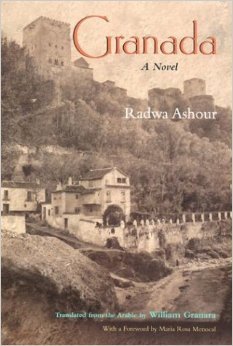
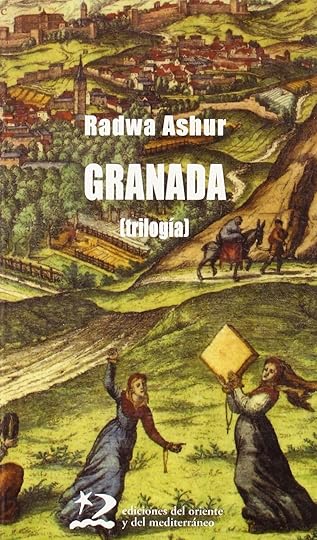


 I do like this one!!!
 A few wouldn't post:
https://raote.files.wordpress.com/201...
https://peutsagoe.files.wordpress.com...
I like the first and second best
The first is the edition I have.
Mod
Sue , it is allways a pleasure to have you with us :)
Reem , feel free to explore and don't hesitate to ask any questions .
*******
I tried to organize the trilogy books on Goodreads as much as I could , it seems that the three books are also available in Spanish .
https://www.goodreads.com/series/1491...--
Mod
https://www.goodreads.com/topic/show/...
Mod
 Mod
Mod
i like the Arabic cover :)
(at least i think that's Arabic lol)
 I just requested this book from my University library; I'm not sure when it will arrive, but I'm going to start as soon as I pick it up.
I am very much looking forward both to reading Granada and then discussing it with all of you!
Melanie wrote: "I like the two Arabic covers (stylized woman's face and pomegranate) and the English cover (landscape / citadel)."
I just requested this book from my University library; I'm not sure when it will arrive, but I'm going to start as soon as I pick it up.
I am very much looking forward both to reading Granada and then discussing it with all of you!
Melanie wrote: "I like the two Arabic covers (stylized woman's face and pomegranate) and the English cover (landscape / citadel)."Ah the pomegranate. I tend to post a lot around the topic, so if it becomes annoying, do let me know.
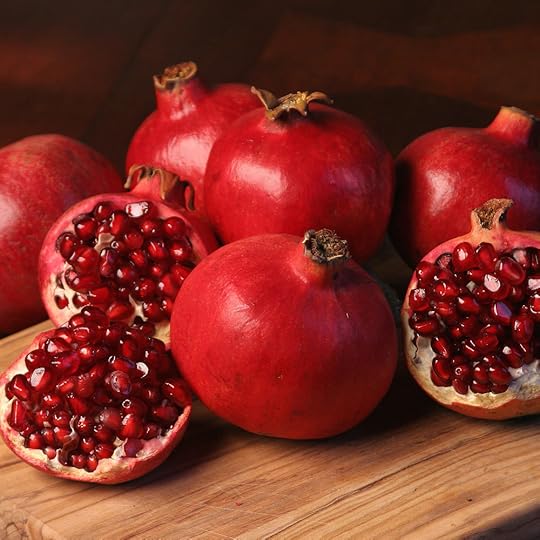
The Pomegranate Processing throughout History
A stroll through history reveals many references to the pomegranate among diverse cultures and religions. The ancients were aware of its health benefits, and it was a featured icon in the art and writings of numerous religions.
In Christianity the pomegranate is a symbol of the resurrection and eternal life of Jesus. Depicted in religious illustrations and art, the pomegranate is often found in devotional statues and paintings of the Virgin and Child.
In medieval legend the pomegranate tree is a fertility symbol and an important feature in the hunt of that magical creature, the unicorn. Tapestries from the period show the wounded unicorn bleeding pomegranate seeds. Once captured, the only way to tame and hold onto the mythical beast was to chain it to a pomegranate tree.
In Judaism, the pomegranate is venerated for the beauty of the tree and its fruit. The seeds are said to symbolize sanctity, fertility, and abundance. One of the seven sacred varieties of plants mentioned in the Bible, the pomegranate is said to have 613 seeds – one for each of the Bible’s 613 commandments. In the Biblical Song of Songs the rosey cheeks of a bride are likened to two halves of a pomegranate. Depictions of the fruit have also featured in Judaic architecture and design. They decorated the pillars of King Solomon’s temple and the robes and regalia of Jewish kings and priests.
In Islam, the Koran speaks with reverence of the pomegranate, which is described as containing one seed that derives from heaven. Paradise as described in the Koran consists of four gardens with shade, springs, and fruit trees, among them the pomegranate.
In Bedouin custom the pomegranate features as a fertility symbol at weddings. The groom breaks open the fruit as he and his bride enter their home, with abundant seeds ensuring many children.
In Buddhism three kinds of fruit are held as sacred – the orange, the peach, and the pomegranate. In Buddhist art the fruit represents the essence of favorable influences. Buddha is said to have cured the demoness Hariti of her evil habit of devouring children by feeding her a pomegranate.
In Japan this demoness cured by the pomegranate is known as Kishimojin and is invoked to enhance fertility.
In China the pomegranate frequently appears in ceramic art symbolizing fertility, abundance, prosperity, numerous and virtuous offspring, and a blessing.
In Greek mythology, the changing of the seasons is attributed to Persephone’s surrender to the temptations of the pomegranate.
Pomegranates represent symbolism above allMultiple fruits contained within a single hull make pomegranates a symbol of fertility. A ripe pomegranate is broken on the doorsteps of newlyweds to ensure future prosperity
The symbolic meaning associated with some plants actually surpasses the value of their taste characteristics; the pomegranate is definitely one of those fruits.
The pomegranate is actually a bush-like plant which is pruned so as to prevent it from growing tall. It requires as high a temperature as possible to become sweet and is therefore best grown in the Mediterranean and the Middle East. The fruit, although it looks like a perfect sphere to the human eye, actually has a hexagonal shape. Because its edible part is found inside in the form of hundreds of small seeds, one gets the feeling that the whole fruit is made up those seeds. It is for these reasons that one can almost say the pomegranate is a “fruit of illusions.”
It is believed that the homeland of the pomegranate is today’s Iran and that it moved from there to northern India, where it is also widely consumed. In any case, it has existed near the Mediterranean and Black seas – which could be considered a hinterland of the Mediterranean – for thousands of years, as traces of pomegranates have been found in prehistoric sites in Georgia.
Meanwhile, its presence in Greek mythology, and specifically among Homer’s verses, suggests that it has existed in Europe since the earliest stages of history. Moreover, it has had a place in the writings of almost all Mesopotamian religions, with the Virgin Mary seen holding a pomegranate in her hand in many Christian depictions. Some views even state that the “tree of knowledge” mentioned in the Bible is a pomegranate tree. As for the Quran, it makes allusions to the pomegranate in three different places, one of which is where its tree is mentioned among the beauties of Eden. The two other references are at points where the good things created by God are being described.
Because of the multiple seeds it contains within a single husk, the pomegranate has become a symbol of fertility; it is believed to possess the key to as much abundance as the number of seeds it contains. It is due to this belief that in most Mediterranean countries, a ripe pomegranate is broken on the doorstep of newlyweds, allowing its seeds to spread about and ensure richness in the couple’s future life together.
The pomegranate used to hold a special symbolic value for the Ottoman society as well. “The existence of many within the single” has been especially popular as a recurring theme in various Ottoman artistic creations.
As for the Greek culture, the pomegranate has a noteworthy place as the symbol of Persephone, a goddess strongly associated with fertility. According to mythology, Persephone, the daughter of the harvest and fertility goddess Demeter, was kidnapped by Hades, the god of the underworld and the dead. The only precondition for her resurrection is that she does not eat anything while she is below the earth. She keeps to this rule until Hades desperately places a pomegranate in front of her as a last resort. His trick works because Persephone cannot resist the pomegranate and, eating four seeds of it, becomes the underworld goddess, “the pomegranate-captive Persephone” forever.
Pomegranates are not only consumed as a fruit in regions where they are widely grown. Its juice is a source of energy, especially in winter, and its sherbets and molasses are regional delicacies. Pomegranate sherbet has been a source of refreshment for the Middle East ever since Ottoman days, while its molasses is a very strong candidate for the place of lemon juice and vinegar as an ingredient for salad dressings all over the world today. It is also widely used in Turkish cuisine to add flavor to desserts, to compliment the taste of many wheat-based dishes such as bulgur and to marinate meats.
The magical city of Granada has the same name as the Pomegranate. The Spanish word for the fruit is Granada and therefore the symbol of the city, the pomegranate appears throughout the streets as you wander around the city.Check out these photos: Pomegranates everywhere!
http://www.piccavey.com/pomegranates-...
It's been quiet in here as we await our book to arrive. I just read this and thought I would share it with you...plotting to take back their Granadan homeland, Sayyida al-Hurra, the Beloved, Avenging Islamic Pirate Queen
http://pictorial.jezebel.com/sayyida-...
Audre Lorde wrote an essay called Granada Revisted, which appears in the collection Sister Outsider. I read that book last year and that essay made me cry with rage
Zanna wrote: "Audre Lorde wrote an essay called Granada Revisted, which appears in the collection Sister Outsider. I read that book last year and that essay made me cry with rage"Zanna, Audre Lorde wrote Grenada Revisted, not Granada Revisited. I'm glad you mentioned it though because I hadn't read it before.
Audre Lorde first visited Grenada, the homeland of her mother,
What are the words you do not yet have?
What do you need to say?
What are the tyrannies you swallow day by day and attempt to make your own,
until you will sicken and die of them, still in silence? (p. 41)
You do not have to be me in order for us to fight alongside each other.
I do not have to be you to recognize that our wars are the same.
What we must do is commit ourselves to some future that can include each other
and to work toward that future with the particular strengths of our individual identities.
And in order to do this, we must allow each other our differences
at the same time as we recognize our sameness (p. 142).
http://blog.lib.umn.edu/puot0002/8190...
Oh thank you Reem! Damn, I know nothing!
lol ZannaGrenada, Granada tomayto, tomahto :)
I picked up the book yesterday from my University library and read a couple of pages. The writing is beautiful. I can't wait to read some more.
Hahaha!But ahhh I get it, it's the Spanish Grenada doh
Good news is that my copy has arrived :-)
ReemK10 (Paper Pills) wrote: "It's been quiet in here as we await our book to arrive. I just read this and thought I would share it with you...plotting to take back their Granadan homeland, Sayyida al-Hurra, the Beloved, Aven..."
That was very interesting article ReemK10! Thanks for posting it. I remember when I read Amin Maaloufs Leo Africanus also about a family expelled from Granada, the Barbary Pirates are mentioned.
So how did the word for pomegranate become "Roman" in Arabic?
Jalilah wrote: "So how did the word for pomegranate become "Roman" in Arabic?"I found this Jalilah:
Etymology and terms for pomegranate in other languages[edit]
An opened pomegranate
The name pomegranate derives from medieval Latin pōmum "apple" and grānātum "seeded".[4] This has influenced the common name for pomegranate in many languages (e.g. granada in Spanish, Granatapfel or Grenadine in German, grenade in French, granatäpple in Swedish, gránátalma in Hungarian, and pomogranà in Venetian). Mālum grānātus, using the classical Latin word for apple, gives rise to the Italian name melograno, or less commonly melagrana.[5]
Perhaps stemming from the old French word for the fruit, pomme-grenade, the pomegranate was known in early English as "apple of Grenada"—a term which today survives only in heraldic blazons. This is a folk etymology, confusing Latin granatus with the name of the Spanish city of Granada, which derives from Arabic.[6]
The genus name Punica refers to the Phoenicians, who were active in broadening its cultivation, partly for religious reasons.
Garnet comes from Old French grenat by metathesis, from Medieval Latin granatum, here used in a different meaning: "of a dark red color". This meaning perhaps originated from pomum granatum because of the color of pomegranate pulp, or from granum in the sense of "red dye, cochineal".[7]
The French term grenade for pomegranate has given its name to the military grenade.[8] Soldiers commented on the similar shape of early grenades and the name entered common usage.
While most European languages have cognate names for the fruit, stemming from Latin granatum, exceptions are the South Slavic languages, which have terms derived from Persian anaar (انار). There is also the Albanian word shega, and the Portuguese term romã which is derived from Arabic rumman (رمان), and has cognates in other Semitic languages (e.g. Hebrew rimmon) and Ancient Egyptian rmn.
Glad you liked the post on Sayyida al -Hurra
Jalilah, the roman is of course mentioned in the Quran.Plants Of The Quran: Pomegranate
Pomegranates are mentioned three times in the Qur’an: As one of the fruits that will be found in paradise:
“In both of them [gardens] are two springs, spouting […]In both of them are fruit and palm trees and pomegranates. So which of the favors of your Lord would you deny?” (Quran, 55:66-69)
As a reminder of God’s sustenance on earth,
“And He it is who produces gardens (of vine), trellised and untrellised, and palms and seed-produce of which the fruits are of various sorts, and olives and pomegranates, like and unlike; eat of its fruit when it bears fruit, and pay the due of it on the day of its reaping, and do not act extravagantly; surely He does not love the extravagant.” (Quran, 6:141)
And as a sign of his artistry,
“And it is He who sends down rain from the sky, and We produce thereby the growth of all things. We produce from it greenery from which We produce grains arranged in layers. And from the palm trees – of its emerging fruit are clusters hanging low. And [We produce] gardens of grapevines and olives and pomegranates, similar yet varied. Look at [each of] its fruit when it yields and [at] its ripening. Indeed in that are signs for a people who believe.” (Quran, 6:99)
In Arabic a pomegranate is known as the royal word ‘rumaan‘, in Urdu ‘anaar‘ and interestingly, because of its resemblance to many fragments resulting from detonating a grenade, in Hebrew the word ‘rimon‘ may mean both pomegranate and shell.
http://www.greenprophet.com/2012/07/p...
Also found this:Pomegranate is a very popular fruit all over the Middle East. Though it can't be proven definitely, the fruit of the Tree of Knowledge (ets ha-daat [עֵץ הַדַּעַת]) mentioned in the biblical history of creation most probably was meant to be a pomegranate — though most Westerners would hardly believe it, it’s nowhere said to be an apple!
Etymology
The name pomegranate is of ancient origin. In classical Latin, the fruit was known either as malum punicum or malum granatum (also melogranatum). In these names, malum means apple, granatum derives from granum grain and means (multi)grained (alluding to the many seed grains). The adjective punicus properly refers to Phoenicia in Asia Minor, but was in Latin more frequently used with respect to Carthage, a Phoenician colony in Northern Africa (also Rome’s only source of Silphion); the Romans suspected pomegranate to be of African origin. The botanical genus name Punica is the feminine form of that adjective, as is appropriate for a fruit-bearing tree.
Pomegranate flower
Flowering pomegranate plant
Names of pomegranate in contemporary West and Central European tongues are adaptations malum granatum, for example Italian melograno, which is a direct successor of the Latin term, or milgroym [מילגרױם], a rare case of a Romance loanword in Yiddish. In other languages, the first part usually gets translated: Examples are German Granatapfel, Icelandic granatepli or Finnish granaattiomena. The English name pomegranate has a similar structure, but contains Latin pomum fruit, apple (French pomme apple) instead of malum; the Old English term is cornappla grain-apple. In some languages, the apple-element is dropped completely, e. g., Ukrainian granat [ґранат] and Spanish granada.
In many European languages, the weapon shell has names similar to granate or grenade. These derive from the same Latin word granum grain: The reference is to the many fragments resulting from the detonation of a shell. Remarkably, also in Hebrew the word rimon [רימון] may mean both pomegranate fruit and shell. The underlying Semitic root, rmm, means high, exalted and does not refer to grainyness. The plant name is also found in Arabic (ar-rumman [الرمان]) and Coptic (erman [ⲉⲣⲙⲁⲛ]), but without the secondary shell meaning.
The Farsi name anar [انار] already existed in Middle Persian; many language from Eastern Europe to the Indian Ocean have similar or identical names, which are probably direct or indirect Persian loans, e. g., Dhivehi annaaru [އަންނާރު], Punjabi and Kazakh anar [ਅਨਾਰ, анар], Armenian nur [նուր] and Turkish and Bulgarian nar [нар]. There might be a connection to ancient languages of Mesopotamia: Akkadian nurmû and Sumerian nur [
To read more http://gernot-katzers-spice-pages.com...
I was intrigued by this idea of Eve and a pomegranate."Some scholars even go as far as to say that ”the fruit eaten by Adam and Eve in the Garden of Eden may have been a pomegranate. These scholars argue that it is unlikely that apples would have flourished in the first garden.
While this is highly unlikely to be true, it does make sense that the pomegranate with its abundance of blood red seeds would serve as the ideal symbol of everything from Persephone’s temptation in Greek mythology to the fruitfulness of the Promised Land and Abraham’s many descendants to the passion of a young maiden’s crimson lips and cheeks or the blood of martyrs to the unity of all individual believers brought together in Christ’s church."
Posting Botticeli's Madonna of the pomegranate
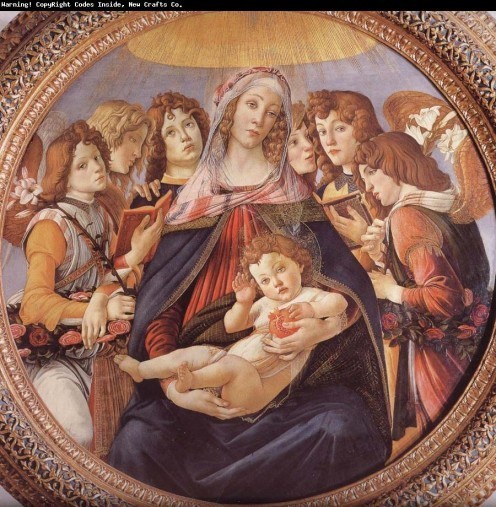 I found this really interesting pdf about the forbidden fruit of The Kite Runner that mentions John Milton writing about Adam and Eve and mentioning the apple in Paradise Lost, but it is believed that apples weren't grown in Mesopotamia and it is believed that the pomegranate is the best interpreation of the forbidden fruit.
https://www.english.uga.edu/fyc/barne...
La Granada - The Pomegranate in New SpainA recurring motif in art and literature worldwide and in New Mexico
THE POMEGRANATE, la granada in Spanish, has been a recurring motif in art and literature for more than 2000 years. It is depicted in Chinese porcelains, Turkish textiles, Italian paintings, Norwegian coverlets, Spanish chests, Mexican embroideries and New Mexican colcha. It is mentioned in Greek mythology, in the Qur’an, the Bible and the Torah. Oscar Wilde wrote about it and Botticelli painted it.
The History & Symbolism of the Pomegranate
The pomegranate is a most interesting fruit, not only for its beauty and the challenge of eating it, but also for its renown as a religious, mythical and metaphorical symbol over the centuries. The significance of the pomegranate crosses geographical, political and religious boundaries. One of the earliest references to the pomegranate still familiar to us today is in the Greek myth of Demeter and Persephone. Persephone, daughter of Demeter, mistakenly eats some pomegranate seeds in the company of Hades and thus is committed to spending a portion of each year in the Underworld. Demeter, in her despair, does not allow anything to grow in her daughter’s absence, thereby creating our seasons.
In the Koran, pomegranates are mentioned as one of the gifts of Allah. In the Jewish faith, the pomegranate was said to have 613 seeds representing the 613 commandments of the Torah, and it was often used to decorate the Torah and its coverings. The pomegranate flower was featured on the shekels and half-shekels minted during the Jewish Revolt in 66–70 CE. They were decorated with a chalice on one side with the year of the revolt and three budding pomegranates on the other, a reference to the Holy Temple built by Solomon in Jerusalem, on which was carved 200 pomegranates. In early Christian doctrine, the pomegranate’s many seeds were symbolic of the individual members of the church that were brought together by their faith. Some believe that Eve was tempted with a pomegranate in the Garden of Eden rather than an apple: the actual fruit is not identified in the Old Testament Book of Genesis.
Check out: http://www.collectorsguide.com/fa/fa1...
Just got my copy of Granada!!! How special to have Maria Rosa Menocal write a foreword for Radwa Ashour. How perfect! We have lost two very special women. :(I have to say I may start reading this right now! Too delicious to be able to wait. Are we all intent on waiting for April 1st as a starting date, or can we start now?
LOL, my book arrived with no book cover! Just a hardback rust colored binding.
ReemK10 (Paper Pills) wrote: "Just got my copy of Granada!!! How special to have Maria Rosa Menocal write a foreword for Radwa Ashour. How perfect! We have lost two very special women. :(I have to say I may start reading this..."
I can't start early but enjoy Reem. I also second Nile Daughter's recommendation of The Ornament of the World: How Muslims, Jews, and Christians Created a Culture of Tolerance in Medieval Spain. Very interesting book and the reason I became interested in Granada.
Even though I can't start for a few weeks, ( and I'm supposed to be the discussion leader) Im fine if a number if you want to get started now!
Mod
Marieke wrote: "I didn't know Menocal died!"Oh sorry Marieke to bring this up when you didn't know. I found out when I was reading her " The Arabic Role in Medieval Literary History: A Forgotten Heritage" during our Dante read. She was one of the very few scholars who would give credit where credit was due!
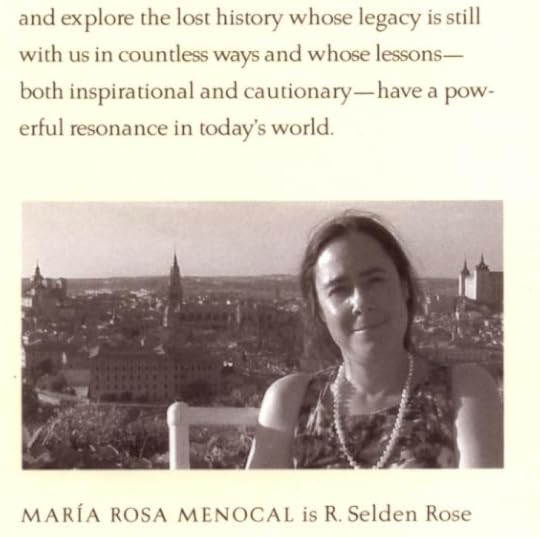
In memoriam: María Rosa Menocal
http://news.yale.edu/2012/10/15/memor...
A huge loss! Devastating!
Culture in the Time of Tolerance: Al-Andalus as a Model for Our Timehttp://news.yale.edu/sites/default/fi...
I'm really keen to read The Ornament of the World too
Zanna wrote: "I'm really keen to read The Ornament of the World too"We had a good discussion here.
Mod

Middle East/North African Lit
Books mentioned in this topic
Leo Africanus (other topics)Leo Africanus (other topics)
Leo Africanus (other topics)
The Hand of Fatima (other topics)
Leo Africanus (other topics)
More...
Authors mentioned in this topic
Amin Maalouf (other topics)Radwa Ashour (other topics)
Radwa Ashour (other topics)
More
http://www.jstor.org/discover/10.2307...
http://www.aawsat.net/2014/12/article...
http://www.theguardian.com/books/2014...