
21st Century Literature discussion

This topic is about
Aetherial Worlds
2020 Book Discussions
>
Aetherial Worlds - Whole book (spoilers allowed)
date newest »
newest »
message 1:
by
Hugh
(new)
-
rated it 4 stars
Feb 15, 2020 03:49AM
 I have decided that a single spoiler thread is enough for thus book, partly because the stories vary so much in length, which means there are no natural break points. So this is the place to discuss whatever you like. Any favourite stories? Any thoughts on where the boundaries between memoir and fiction lie?
reply
|
flag
 For me it's difficult to draw the boundaries for Tolstaya because, as I was reading, I had a sense they were constantly shifting. Also, the transformations came in many shapes.
 In "Official Nationality", for example, "His Excellency the Eternally Great Saparmurat Turkmenbashi” with all his absurd and hilarious decrees that border on farcical and even magic realism did indeed exist (Saparmurat Niyazov) and she didn't make anything up. She didn't have to. He created this unreal world, stretching autocratic rulings to their comical limits, but it wasn't fantasy.
In other stories, she of course mostly invented the imaginary world, characters or scenes. In her most autobiographical story despite its title "Aetherial Worlds" I doubt that a woman was so obese that she got stuck between the door frames. I think she just inserted it for comic relief, otherwise the prose is realistic and this short period of her life in America was clearly not a happy one.
I suspect that the affair with a married man in "Smoke and Shadows" may well have happened to her or her friend (it depends who the "I" represents) but she gives a clever twist in the end that it was all in her imagination.
And there are many other ways in which she blurs the boundaries between reality and fiction...
I had several favorites, but my absolute favorite was "The Invisible Maiden" for its lyricism, beautifully painted nostalgia for her carefree childhood days, and memorable characters that walked through their summer dacha (and her life), all of whom are long gone into the vanished world.
Thanks Vesna. I liked The Invisible Maiden a lot, and suspect quite a lot of it was true, but one can never be too sure, and as in the title story some elements may have been exaggerated. I liked some of the short pieces a lot, particularly Without and 20/20. The Window is interesting too - it is the most overtly imaginary story, but I think it must have been inspired by the way ordinary Russians reacted to the fall of communism, and I was not entirely sure what the political message was.
Hugh, I think you are spot on about "The Window." At first I didn't pick up on the post-communist transition and wrote briefly to myself that it's a modern fable critical of the culture of materialism. But, as it's one of two pieces I read to my partner, he right away picked up on her allusion to the Russian transition to a free market. "20/20" was my second favorite for her marvelous way of recounting the awakening of her inner voice as a writer, and then come a few others including "Without".
 I will be joining this discussion.
I have had the book sitting on my kindle.
Just started last night but enjoying the bitter wit along with the humor.
Beverly wrote: "I will be joining this discussion.I have had the book sitting on my kindle.
Just started last night but enjoying the bitter wit along with the humor."
Thanks - I will look forward to your thoughts.
I am about 60% through with this collection.My initial overview thoughts based on what I have read:
- a lot of what I am reading feels like "auto-fiction", so yes in many parts it feels like a memoir.
- I thought that "short" pieces feel crisp and meditative to me.
- On the longer pieces, the author has a way of pulling me into the characters and time and place.
This is my first time reading a work by Tatyana Tolstaya.
 I hope to be starting this book in a couple of days and looking forward to the discussion. Tolstaya is a new author for me.
 About 50% through here.
Yes, I was amused by the term "autofictional novel" that was used in a New Republic review of Rachel Cusk.
Here, Tolstaya smoothly moves from memoir to fantasy, much as real memories shade into dreams of earlier events; "Did I do that?" Psychoanalysts sometimes worry about whether a given memory is true; the reality is that if a memory is present in your thoughts, it helps to guide your present, whether or not it actually happened.
The persona in "Smoke and Mirrors" reminds me of Phoebe Waller-Bridge's Fleabag character.
 My favorite story is, "The Square." It is a case where that essay/story colored all the others. Lev Grossman did not think it belonged in the collection.
https://www.nytimes.com/2018/04/05/bo...
IMO, it lifts the rest.
Sam, thanks for that link! Any author would be thrilled to have Lev Grossman as a reviewer. While he felt that there might have been some "filler," he uses his immense command of English to come down pretty clearly on the positive value of the writing throughout. He singles out "Passing Through" as lightweight; I tend to agree, though after the horror of "20/20," I'm perfectly happy to have a lightweight story spun for me. (On the subject of missing objects, the best evocation is Or All The Seas With Oysters by Avram Davidson. I remember reading it when it was first printed.)As to "Square," mistrustful me looked up Malevich to see if he was real; he is.

Her shifting "reality fields" extend into images: the 2018 slipcover image
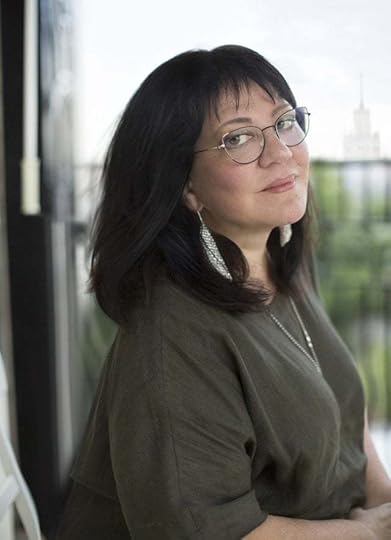
is quite different than the Wikipedia image of her in 2008:
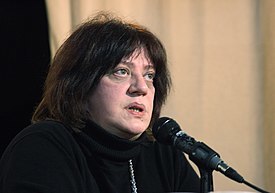 I have read the first 8 stories. I liked the all but Father was my favorite. I liked how she contrasted her memory of her father as a young man against her children's memory of their grandfather. It had me remembering by father, who, unfortunately, never made it to "old" but who I have very different memories of from the age of 10 and the age of 25.
Ah, "Aetherial Worlds" (the chapter, not the book): a little bit of A Year in Provence, but set in the piney woods of Princeton, New Jersey. Her acerbic perspective is fun to read, if awful to contemplate as reality.
I have read the first 8 stories. I liked the all but Father was my favorite. I liked how she contrasted her memory of her father as a young man against her children's memory of their grandfather. It had me remembering by father, who, unfortunately, never made it to "old" but who I have very different memories of from the age of 10 and the age of 25.
Ah, "Aetherial Worlds" (the chapter, not the book): a little bit of A Year in Provence, but set in the piney woods of Princeton, New Jersey. Her acerbic perspective is fun to read, if awful to contemplate as reality.The imagery is so vivid, as in her description of her stygian commute to her job 200 (!) miles north:
...going north-by feel, slicing through the inky darkness, diving down hills into valleys, on empty narrow roads, past sleeping villages and lonely farms demarcated by tiny beads of light.
This pitch-black hour is the most horrible in my life; it repeats week after week, year after year. I am half reclined in a sarcophagus scattered with litter, as if a long-forgotten, distant
relative of some pharaoh, surrounded by her ushabti and her vessels for eating and drinking...
I'm finished now. I liked most of the stories. Unlike Sam and Mark, I did not like The Square. The other one I did not enjoy was Swedenborg - I found myself skimming in order to get through it. Father, as noted above, was a favorite. I also liked the title story. The Window was good, although I did not catch the relation to the post-communist world until it was mentioned here. It was a 3.5 read for me. I rounded down because by the time I was halfway through Swedenborg, I just wanted to be done.
I had been thinking of how magic is a delicate thing for a author to control. The first passages of a work determine what sort of liberties will be allowed in the book, and deviations from that feel loose and unjustified. Here, Tolstaya in "20/20" opened a door between the title's aetherial worlds and modern reality. In "Smoke and Mirrors" and "The Invisible Maiden," that door was edged even wider. In some ways, the essays "The Square" and "Swedenborg" are unsatisfying because of Tolstaya's petulant insistence on remaining on the reality side of that door, though both are willing to peer around the corner a little, enlivened by her brilliant understandings and sly humor.And then...
Oh! Perhaps because I'm reading The Original Folk and Fairy Tales of the Brothers Grimm, I easily fell into the rhythms in "The Window," even without "Once upon a time" to start. And then the magical gifts included pleather and a cordless phone!
As the first act of the story built up , I was internally hopping with glee. The rest of the story built steadily (magic baby powder! Magic charcoal grill!), right up to the Maupassantian ending. Thank you, Tatyana!
Mark wrote: "About 50% through here.Yes, I was amused by the term "autofictional novel" that was used in a New Republic review of Rachel Cusk.
Here, Tolstaya smoothly moves from memoir to fantasy, much as r..."
Yes, I liked how Tolstaya memory throughout the diversity of the types of stories in this collection. Are memories reality or are they perceptions of how we wants something perceived or a blend of the two.
I chuckled when reading "Passing Through", thinking Tolstaya took something that I thought about often when my children were young and it seemed like the washing machine was always "eating" one of a pair of socks.But unlike her and probably because my Americanism, I had less patience with keeping the one sock for more than a a week or two.
Thanks for all of these interesting comments!
Beverly wrote: "But unlike her and probably because my Americanism, I had less patience with keeping the one sock for more than a a week or two."I laughed out loud about those disappearing socks. I wonder if this is her spin on Seinfeld who was popular at the time when she lived in the US. There is a hilarious episode about lost socks in washing machines. Also, there is a passage in "Official Nationality" where she seems to spin on the "no soup for you" (Soup Nazi episode from Seinfeld) - "If those three come together, you have 'the Russian people'; if not…no 'Russian people' for you." She can be very funny.
The socks and the washing machine story was very good. My washing machine often disappears socks and I do hold on to singles, as occasionally the mate returns!
Hugh wrote: "Thanks Vesna. I liked The Invisible Maiden a lot, and suspect quite a lot of it was true, but one can never be too sure, and as in the title story some elements may have been exaggerated. I liked s..."Yes, "The Invisible Maiden" was also one of my favorite stories. I do enjoy stories that tell me about about a certain time/place through its characters. And the language once again allowed me to visualize the scenes.
Sam wrote: "My favorite story is, "The Square." It is a case where that essay/story colored all the others. Lev Grossman did not think it belonged in the collection.https://www.nytimes.com/2018/04/05/bo......"
One of the aspects that I liked about this collection is the variety of the stories as the author/narrators makes comments on different times/people from ordinary events that most can relate to and then those that had me learning a thing or too.
I did enjoy "The Square" and learned about Malevich and how he saw is art in entertaining way.
I felt the same way about "Swdenborg"
Sometimes for me if stories in a collection have too much sameness between the stories then I can get bored with the collection.
I tend not know what to expect each time I would start a story, but for the most part I was pleased.
