
21st Century Literature discussion

This topic is about
Border Districts
2019 Book Discussions
>
Border Districts - Whole book spoilers allowed (June 2019)

 I loved his narrative voice. It felt like taking a gentle stroll along the peaks and valleys of his mental landscape.
 I loved how images impacted him and conjured up memories of how the same or similar images impacted him in the past. He imbues images with meaning, using them as a trigger.
And no, my memory is less visual. That's why it took me a while to figure out what he was doing. I'm "wordy." In my review I stated he does with images what some of us do with words:
We can read the same book many times over and experience it differently with each reading depending on our life experiences at the time. If we are astute and deliberate readers, we can recall which passages in the book left an impact on us, when, how, and why. This exercise reveals as much about the reader as it does about the book.
It's the first time I encounter anything like this. I can see why some people may get frustrated by it, but I thought it was brilliant --the best book I've read all month.
My review: https://www.goodreads.com/review/show...
 Gerald Murnane is one of my favorite authors at present and I plan to read more of him I will answer the questions in a day or two, letting others have a chance, first.
 I found this book to be boring. I could not relate to his memories. I had no problem with his narrative voice. It could have been fact or fiction - either way, not enjoyable for me.
 My memory is sometimes visual and sometimes not, but never visual in the way the author's was in this book. Sometimes, when I am walking, a particular spot will trigger the memory of a book I was listening to when I passed that spot at one time.
 I also found this book boring. In fact, I used it as a sleep aid. This was effective in that I only read a few pages each night. By the end of the book, it struck me that the images and memories presented by Murnane would have more meaning for me as lyrics to song rather than written in "A Fiction". I did enjoy the descriptions of the Shaker Song, "mostly level grassy landscapes" invoked by pieces of music, and "many-coloured glass" in a Shelley poem.
I was spellbound by it; others found it boring.
I also found this book boring. In fact, I used it as a sleep aid. This was effective in that I only read a few pages each night. By the end of the book, it struck me that the images and memories presented by Murnane would have more meaning for me as lyrics to song rather than written in "A Fiction". I did enjoy the descriptions of the Shaker Song, "mostly level grassy landscapes" invoked by pieces of music, and "many-coloured glass" in a Shelley poem.
I was spellbound by it; others found it boring. It's fascinating to me how the same book can elicit such varied reactions. I think that's a good thing because if we all enjoyed the same books, it would make for a pretty dull planet :)
 Thanks for all of those comments. I am not surprised that some of you found the book boring, there were one or two moments when I felt similarly, particularly at the start when he was talking about Catholic education, but overall Murnane won me round and I will probably read more at some point - I believe And Other Stories have plans to reissue more of his work in the UK, and Tamarisk Row is already available so that would be an obvious place to start even without Sam's recommendation.
One think that interested me was the way Murnane organised his visual memories. Visual memory is rather alien to me - like Tamara I think more in words, music and other sounds than in pictures - I have never been able to draw from memory and my ability to recognise faces in quizzes is terrible, as is my ability to remember fine art and architectural detail.
I was also interested by the narrative voice, which while seeming a little random is actually very precise and ordered in a way that reminded me a little of Thomas Bernhard.
As for the fact vs fiction debate, I included that question partly as a response to the inclusion of "A fiction" as a subtitle, and the fact that the narrator, who shares biographical details and many interests with the author, only really started to talk about fiction towards the end when he starts discussing the woman he has imagined who shares his background and the life of the writer he has heard talking on the radio.
I have now written a review, but I am not sure it does justice to the book.
 I haven't finished and have mixed feelings. It certainly is original but I too struggled with the tone, which I found somewhat boring. I thought the connections the narrator makes interesting, how he went from sexual abuse to religion and then romance. I found the painting he is referring to, by Samuel Cousins.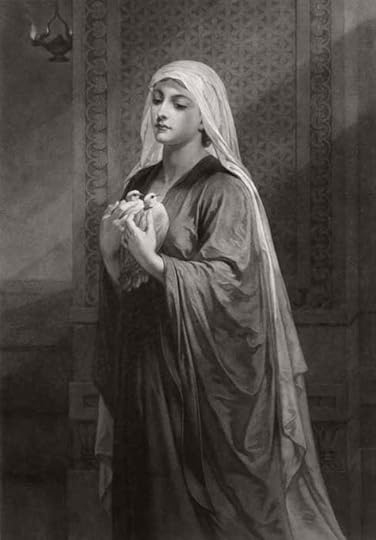
It seems to combine purity and sexuality.
I am visually inclined, but don't have such a precise memory. I find the concept behind the book quite fascinating.
I tried to find the biography of George Gissing in order to see the photo of the author but couldn't find it. This reliance on images reminds me of Sebald, but the tone is quite, quite different. Whereas I love reading Sebald, I'm not sure I appreciate the exactitude of Murnane's descriptions, but I am intrigued by the metaphor he draws on in reference to coloured fragments. Our perceptions are constantly changing depending on our perspective. It also struck me as odd the way Murnane shifts from first to third person point of view.Of course, the refence to Gissing is relevant. As many of you may know, Gissing was expelled from Oxford for stealing money. He was involved with a lower class woman, a prostitute, I believe, and needed the money for her. He spent his life writing about the underclasses. His fall seems to tie in with the priest introduced at the beginning and the subsequent mention of sexual abuse. Both relate to the social repression of sexuality and the tainting of sexualized women (and men). I suppose this is what makes Cousins' painting Mater Purissima significant.
Just another couple of references:The children's book by Richard Jeffries mentioned is Wood Magic, though this is a modern reprint Wood Magic: A Fable, the sequel to Bevis, and is available in the public domain and the last chapter has, "the boy addressed by the wind."
The Transylvanian Trilogy is by Miklos Banffy. They Were Counted, They Were Found Wanting,They Were Divided.
I don't think it will add anything to your understanding to know the above, but purists may be interested.
The quote at the end of the book is important, IMO and is from Adonais. Did anyone else get that impression?
This was my second full read of Border Districts since it was released, and I was doubly pleased with the book this second read. One thing I can say about this book is that it is packed, and I feel only about 50% complete in unpacking the book after this second read, so I need more reads.How do you feel about the author's narrative voice?
I love it. The author's way of digressing, repeating, and then returning to topic is effective in moderating the book's reading pace which reflects the meditative, thought inspiring themes.
what is fact and what is fiction?
I have seen Murnane criticize readers for assumptions about this in the past, so I am cautious. The narrator of the text claims the piece is not fiction, though Murnane is known to differentiate between himself and his narrator's. In this case, I think the author has created a narrator who is composing, pondering, and commenting on the piece as he composes. (I do think the narrator/author is commentating on the autofiction discussion with perhaps an ironic tone.)
Did it leave you wanting to read more?
Most definitely. The author is a completist IMO. I'll be starting on A Season on Earth soon after this.
Does your memory work like his or is it less visual?
I think in both visual and abstraction. I can only recall dreams in visual. If I am composing a written piece, I will usually think in terms of myself thinking of composing the sentences without visuals. If I am trying to compose a musical piece, I will only be thinking of the notes following the rises and falls of a melody but without sound, only a sense of the notes moving in sequence.
Overall, I consider this book to be a contemporary fiction that explores consciousness, imagination, and fiction from this author's point of view as opposed to that of a philosopher's or neurologist's. In the author's exploration, there is an attempt to grasp, or rationalize an infinite or special metaphysical connection with the cosmic through imagination.
I finished it yesterday. I was reminded of the cartoons from Bizarro because I did find the book weird. Murnane is certainly original.I wondered why he wouldn't name the capital city or the country and county he was referring to; then he went on to comment on how the road signs on the highway were distracting, interferring with the actual view. This led me to think Murnane was suggesting constructs obscure our perception of reality. I found this confirmed in the Shelley quote at the end. The dome is like the coloured fragments or glass, constructs shading our perceptions. I am inclined to think Murnane wants to highlight our inability to apprehend reality. This is certainly emphasized by the faulty memories, since memory figures so prominently.
I would have to say that Murnane is an interesting writer, highly original. But I did not find the experience of reading him at all pleasant. He demands complete concentration; after a while I felt like my mind was caught in a vice. This was reinforced by the strangely repetitive rhythm of his sentences. I would hesitate to read another of his books -- but would probably do so anyway. It may also be that he appeals more to male readers. The Shelley quote was surprising in that his writing has a gentleness to it. In contrast I found Murnane quite harsh. Perhaps it was due to a certain relentlessness in his repetitions.
Thank you, Sam, for the reference to Wood Magic. I loved the notion of the wind talking to the boy. It was a much lighter touch.
I did try and look up the Thomas the Rhymer reference. He came from Earlstown which used to be spelt Erceldoune, and I found a couple of references to Erceldoun in connection with Australian racing, but not enough for me to be sure...
 Elaine wrote: "...It may also be that he appeals more to male readers. ..."
I distrust such generalizations, Elaine. Are you willing to defend it or should I just accept it as your reaction and observation?
Elaine wrote: "It may also be that he appeals more to male readers..."Elaine, FYI--I'm a female and I loved it. It was the best book I read all month. I think he uses images in the same way some of us use passages in books. I thought it was brilliant.
See my review: https://www.goodreads.com/review/show...
 I also struggled with the tone of this book and was not able to finish it. I found the somewhat stream of consciousness type of narration and repetition of sentences quite boring.
I did enjoy the visual aspect of the narration and I feel I have a similar visual memory so I can relate, although I am not sure if I will remember images later in life as well as the narrator did.
Tamara wrote: "Elaine wrote: "It may also be that he appeals more to male readers..."Elaine, FYI--I'm a female and I loved it. It was the best book I read all month. I think he uses images in the same way some ..."
Yes, I think a simple male/female split is an oversimplification. I know plenty of male readers that probably wouldn't like it either...
As per my saying I think it appeals more to male readers, please let me add that I have focused on women's writing for many years and have also taught upper level courses on women's writing. I have come to see that there is a difference, although the lines can be blurred.I wrote my dissertation on Henry James and would add that he is a bit of an anomoly as he seemed to understand the female position to an uncanny extent, so some male writers can come very close to the female perspective.
I am not saying that women wouldn't like reading Murnane, only that I believe men would prefer his writing. Reading his novel, I was very much aware of it being written by a male. At the beginning, when he mentions the priest urinating into the wine for communion, I couldn't help but think this was typically male. I wouldn't say a woman couldn't write that, but that it is less likely.
I don't think it's an over-simplification to say there are differences between men and women. Of course there are many differences amongst women and amongst men, but the gender divide does seem to exist. This is my perspective. It's not to suggest that men and women aren't equals, it's just that they're different. In part the differences are cultural, but that's not the only difference.
Anyway, I am not saying you must agree with me, only that this is what I have come to understand.
Thank you for your review, Tamara. Again, I ended up with a different take on Murnane's thesis. Yes, he contrasts words with mental images, the images that constitute his memories, but in the end even these images that he privileges are not accurate representaions of his experiences. They become confused, at times overlapped. My way of understanding the novel is that the words and images both become signs, constructs in current language. These constructs correspond to the dome in Shelley's poem that separate us from reality. It is certainly something well worth considering.
Elaine wrote: "I am not saying that women wouldn't like reading Murnane, only that I believe men would prefer his writing. Reading his novel, I was very much aware of it being written by a male...."Elaine, I understand what you're saying, but I would like to qualify it a little.
I don't think it is so much that men would prefer his writing. In my mind, the divide is not between men and women, per se, because gender identity is a fluid, social construct. The divide is based on our gender socialization. Men can be socialized to value and adopt qualities traditionally associated with the feminine and women can be socialized to value and adopt qualities traditionally associated with the masculine.
I would argue Murnane writes in the way he does not because he is a man but because he has been socialized as a man. In the same manner, I would argue Jane Austen's novels could have only been written by an individual--man or woman--who has been socialized as a female.
I don't know if I'm making any sense here. But I think it is important not to draw the line between men and women. I'm much more comfortable drawing the line based on gender socialization--a fluid, social construct that can vary from one time frame to another and from one culture to another.
Thank you for your comments. You've certainly given me food for thought.
Elaine wrote: "As per my saying I think it appeals more to male readers, please let me add that I have focused on women's writing for many years and have also taught upper level courses on women's writing. I have..."Elaine -- thank you for your comments at 18. While I appreciate knowing a bit more about your curriculum vitae, I was far more interested in your reasoning as to why you considered Border Districts more likely to appeal to male readers than female ones. I think your comments have helped me understand your position. Yet, perhaps because so much of my own reading has been such a mish-mash of male and female authors, I'm still not grasping the underlying distinction about appeal you seem to be making. Certainly I am not surprised to see differences between what men and women experience and hence record in the written word. But Murane's story, while I am not experiencing an intuitive like nor an easy read, I find no more off-putting than Jelinek or Coetzee or Mueller, each of whom I find can challenge my ability to understand their unique ways of observing the world. And so far, that is how Border Districts seems to be presenting to me.
 Hugh wrote: "Thanks for all of those comments. I am not surprised that some of you found the book boring, there were one or two moments when I felt similarly, particularly at the start when he was talking about Catholic education..."
I found most of it intersting, perhaps especially the parts about Catholic education.
I tried to work out who the Gissing biographer was. There seems to have been many but Virginoa Woolf stands out to me as the most likely. He mentions that she is an author herself and was born 40 years after Gissing (if memory serves - this is when I wish I had read on Kindle so I can find the passage).
A recurring theme is what is supposed to be in the glass; almost all are leaves (I have forgotten the other two words describing the texture of the glass). Also, photographs of young women, return verandas. I guess he is applying his most visible memories to other memories.
Tamara, I did say that I thought the difference between men and women was in part cultural, which is to say a result of socialization. I'll add a large part but not all.On a practical level, I'd like to mention that I have graded thousands of essays. It is this experience that enabled me to make the distinction. I know that some colleagues have had the same experience. Yet it is very hard to say exactly what the difference is.
As I mentioned in my comments on Murnane, I found his writing to be very harsh in that it demanded complete concetration. There was something relentless, too, in his repetitions that grated on me, as if I were being forced to do something unpleasant. Perhaps it was having to submit to the style that felt most uncomfortable and made me feel the writer's masculinity. Their was very little relief offered, which contrbuted to the sense of relentlessness.
Since Virginia Woolf was mentioned, I would say her writing is extremely different because it is so fluid. But as far as I know, the only biography she wrote was of the art critic Roger Fry. Of course, there's also the fictional biography of Orlando.
Elaine wrote: " On a practical level, I'd like to mention that I have graded thousands of essays. .."Just as an FYI, I was a professor of English for 18 years before I moved into administration. So, like you, I have graded thousands of essays, but mine were at the undergraduate level. I can't say I saw any difference in the writing between male and female students other than to say the quality was pretty abysmal across the board, for the most part.
I also taught college level courses in Women in Literature and Women's Studies. But since very few males enrolled in those classes, I really can't comment on the male/female difference in writing.
Elaine wrote: "As I mentioned in my comments on Murnane, I found his writing to be very harsh in that it demanded complete concetration. There was something relentless, too, in his repetitions that grated on me, as if I were being forced to do something unpleasant."
I think you have hit the nail on the head here. I agree completely that his writing was relentless and demanded complete concentration. But I didn't feel I was being forced to do something unpleasant. I was willing to immerse myself in his words and follow the landscape of his thinking. I found it fascinating to follow his trail of thoughts and also refreshing to escape from my own humdrum head and into something challenging and thought-provoking.
Again, Elaine, I appreciate your comments because they force me to examine why I derived such pleasure from reading the book.
You are right, Elaine, Virginia Woolf did jot write a biography of Gissing. She wrote an introduction to a collection. I read through the wikipedia entry too quickly in search of female biographers. There is one by Gillian Tindall and the author photograph looks like it could be the one Murnane describes.
Thanks for this, Ang. That must be the bio, but I can't find the back cover photo. Tindall looks like an interesting writer herself.
I found it here. I needed to create an account and borrow the book in order to see the author photo.https://archive.org/details/bornexile...
I am sure now that this is the biography he writes about (pages 49 to 54 in the And Other Stories edition.) Gissing died nearly 40 years before she was born, and Tindall wrote 5 novels, both of these facts disclosed by Murnane.
The photogragh is in profile but I can't see any of the light fragments or background that he writes about. I also certainly do not see a marble pressed to her eye.
Thanks again! The photo is very dark, but I think Murnane must have made up the description of the marble.And thanks, too, Tamara, for sharing your background. We have taught some similar courses.
Early on, during some comp grading sessions, it was brought to my attention that others (with more experience) could differentiate between male and female writers. Once I started to pay attention, I also noticed the difference, but it happens on an intuitive level so is hard to define.
I also agree that the construction of gender, i.e., socialization, plays a huge role. But I have come to accept that it is not all that accounts for gender differences. We don't begin with a blank slate. But culture certainly influences how underlying differences will play out. I'm not even sure that they can be differentiated. This becomes extremely important in relation to sexuality, i.e., being gay. If it were indeed only the result of socialization, there would be grounds for conversion therapy, which I have heard is a nightmare and rarely a success. What's the point of being straight if it is so uncomfortable? As Jeanette Winterson puts it in the title of her book, Why Be Happy When You Could Be Normal?
 What a fantastically weird book. I finished half of it in one sitting. Like others, I found I can't just pick it up when I have 15 minutes--the novel demands complete concentration. I found if I couldn't immerse myself in his words, the book was boring (as others have said). But when I find time to give in to his mind exploration, it's quite a fascinating read.
 What an interesting detour to try to determine if men prefer the writing over women. I never would have gone there. In my reading, I've been unable to discern male perspectives versus female perspectives. I've noticed men and women authors are equally adept at writing about different genders. I took the writing at face value. It's a male's perspective of the world which doesn't mean it appeals more to men. I've enjoyed the author's dalliance into the musings of his mind.
Elaine wrote: "This becomes extremely important in relation to sexuality, i.e., being gay. If it were indeed only the result of socialization, there would be grounds for conversion therapy, which I have heard is a nightmare and rarely a success. .."Just to be clear--my comments were not meant to address sexual orientation, which is a whole separate issue and has little--if anything--to do with socialization.
Count me as another female who adores Murnane's writing. I loved how he refers to the previous paragragh, etc. The last reply in the interview linked in the other thread had me laughing out loud.
 Given the idea for this book, it is not surprising that experiences of it are polarized. When a book is designed to present the contents of his thoughts in the manner that he thinks them it seems like being fascinated or being bored are the two most likely reactions. For me it was mind-numbingly boring and I quit a third of the way through.
One thing I was hoping to see more of in the discussion here was some detailed discussion of particular sections of the book and what about those sections people who liked it found interesting. So far the comments have been more general or about background information about the things he references. It makes me wonder if the appeal to those who liked the book might not be actually grounded in the content of what he talks about, but more in the structure and style of the writing. Does that sound right?
David wrote: "Given the idea for this book, it is not surprising that experiences of it are polarized. When a book is designed to present the contents of his thoughts in the manner that he thinks them it seems l..."David, I was thinking the same thing. I'm more interested in the content of Murmane's book so I'm going to start a thread that I hope will lead to a discussion of some of the novel's interesting associations.
Stained glass. It permeates the book. I'm intrigued about what it means. The first thing that strikes me is how looking at glass from a darkened angle makes the image clearer. Also, it's not as clear as when viewed straight on.
Toward (or towards if you're British or Australian) the end of the novel, Murmane hints that the stained glass represents "spirit or soul or psyche." (p. 74) He goes so far as to suggest the glass represents a person's inner organs. He states:
I had never been able to read or hear the words spirit or soul or psyche without my seeing a mental image of an ovoid or diamond-shaped or rhomboidal or many-sided zone of one or more colors superimposed on or congruent with or permeating the space occupied by the inner organs of its possessor.
(p. 74) Did anyone else pick up that the stained glass parts of the "report" and perhaps even the marbles represent soul and spirit? I'm curious about your reactions as to what the stained glass means.
Ang wrote: "I found it here. I needed to create an account and borrow the book in order to see the author photo.https://archive.org/details/bornexile...
I am sure now that this is the bi..."
Thanks for finding the back flap Ang. The author seems obsessed with the back of book jackets. I found that entertaining.
I'm most interested in what the marble represents. No, we don't see it in this photo. But, she's taking in a sideways view of her surroundings, rendering it more clear in Murmane's view. Also, I wonder if the idea of the marble pressed to her eye represents her ability to see the soul, the psyche, and the spirit of whatever she observes. Murmane seemed to use fragmented, colored glass as a symbol for the psyche, as I explained above. Do you disagree?
 Well I'm done. I did enjoy the narrative voice, and I could relate to visual memories. I just wanted his thoughts to mean something to me and they didn't.
Even when he wrote about reading and writing, I just didn't relate to his comments. Maybe my mind might picture something similar, but my thoughts go in a completely different direction.
Erin, I think you're onto something about soul and spirit. I had the feeling throughout, but especially with the verses at the end about eternity, that it had to do with what lasts. He is an older person on the edge of life, and is thinking--in a completely non-religious way--about what continues.
Overall I'm glad I read this, but won't be seeking out any more Murnane. If someone can write all these thoughts and none of them resonate with me, then I probably won't get on with his other work either. I am very curious about everyone else's opinions though!
Elaine wrote: "I find the concept behind the book quite fascinating. ..."Elaine, I've been pestering you on this discussion, for which I apologize. But I'm going to do it again. Know you can always ignore me. Would you put into words what you consider to be the concept behind "Border Districts"? (I haven't gotten to where I can do that yet...)
Incidentally, I am enjoying the discussion of this book! Thanks to all who are contributing.
I have found this interview with Murnane to be of particular value:
https://www.nytimes.com/2018/03/27/ma...
Erin wrote: "Did anyone else pick up that the stained glass parts of the "report" and perhaps even the marbles represent soul and spirit? I'm curious about your reactions as to what the stained glass means..."He is fascinated with colored glass and marbles and with the way light filters through them to modify their appearance. The thing they have in common is their transparency—they allow light to penetrate to a greater or lesser degree. He does seem to suggest colored glass symbolizes the soul or psyche. However, he also suggests the qualities he endows to colored glass and/or marbles are not inherent. In other words, someone else looking at the same image may “read” something different.
The key passage for me is when he examines a photograph of the colored glass window in his friend’s home. He says the following:
“ . . . a part of my seeing was investing the glass with qualities not inherent in it—qualities probably not apparent to any other observer and certainly not detectable by any sort of camera; that what I missed when I looked at the photographic prints was the meaning that I had previously read into the glass.”
I understood him to mean how an image is read is in the eye of the beholder. Colored glass may make him think of the soul or psyche at the time he perceives it, but it might not contain the same meaning when he perceives it at a different time. It might even represent something entirely different to someone else.
I go back to my training in literature. Our interpretation of a symbol in a literary work can vary depending on a number of factors. But however we choose to interpret a symbol, we must be able to ground our interpretation in the words of the text.
Similarly, our reading of colored glass (or any other image) can vary as long as we ground the image in its context and within the time frame that we perceive the image. What may be true for our reading of the image today may not be true tomorrow.
I think that is one of the qualities I find fascinating about the book. I've never thought of images in that way. The idea that images can function in the same way as words in a book just blows me away. I feel as if I need to be far more cognizant of images and learn to "read' them the way I read a book.
Sorry for the length of this message. I just hope it makes sense.
Ang wrote: "I found it here. I needed to create an account and borrow the book in order to see the author photo.https://archive.org/details/bornexile...
I am sure now that this is the bi..."
I found it ironic to note this quotation at the top of the book flap:
“With such writers [as Gissing] we establish a personal rather than an artistic relationship. We approach them through their lives as much as through their work.” -- Virginia Woolf
I presume most here know Woolf's father, Leslie Stephen, was an editor of the English Dictionary of National Biography, sort of a Who's Who of Britain. At times in Woolf's writings, one picks up a satirical attitude towards hagiography.
I hope my views are respected even if I do not have formal credentials for commenting on novels. Accordingly, I will comment on what the symbol of stained glass means to me.Regarding the photographs of stained glass, I took that section to mean that trying to photograph the glass removed the glass of spirit, soul, and psyche. The photos were empty, devoid of spirit as opposed to the character of the glass when one observed objects through it.
Interestingly to me, the objects remained exactly the same for Murmane over time. I think Murmane is saying the objects do NOT change over time when viewed. However, his feelings toward them change.
As for the colored glass, I saw the same colors and shapes in each mental image but in different surroundings
p. 72.
During my visits to the restored house, so to call it, I looked boldly and often at the coloured glass. I understood that every detail there was exactly as it had appeared to me fifty years before, and yet I got from my sight of those details a certain reassurance and satisfaction.
p. 73 (Years before, he felt gloom.) What seems to change are his feelings, i.e., from gloom to satisfaction. So he sees the same things through the glass over time, but his feelings change. This sounds a lot like his spirit or psyche are changing over time. Cf. a passage that follows in the book:
(Murmane is looking through the stained glass windows above the bed that are lit by a streetlight) [I thought of becoming an animist] so that I could not only think of every person and every living being as possessing an inner luminous essence but could speculate often as to the colors of one after another of those glass-like entities against one after another source of light.
p. 75. This reinforces for me that the glass is spirit, psyche, and soul. The interpretation seems to hold up when comparing the glass to a kaleidoscope or marble. The object viewed takes on a type of soul absent when the glass is removed (such as in the photos).
Feel free to show me I'm wrong. I can take it!
Kathleen wrote: "Well I'm done. I did enjoy the narrative voice, and I could relate to visual memories. I just wanted his thoughts to mean something to me and they didn't.Even when he wrote about reading and writ..."
Kathleen, I hear what you are saying. The narrative was, frankly, boring. It was only when considering what the different symbols he uses mean that the book held interest for me. I'm hung up on the glass, marbles, and kaleidoscope right now. I'm also interested in the real significance of "border district." It seems to mean more than just urban versus country.
Erin wrote: "I hope my views are respected even if I do not have formal credentials for commenting on novels. Accordingly, I will comment on what the symbol of stained glass means to me.Regarding the photogra..."
Erin, you don't need formal credentials for commenting on novels.
Erin wrote: "Feel free to show me I'm wrong. I can take it!.."
There's no right or wrong in any of this. All contributions are valued since they expand our understanding of the work.
If I understood you correctly, I think you and I are saying the same thing but, perhaps, going about it in different ways.
When I said how he perceives an image may change over time (#38), unless I misunderstood you, I think you're saying the same thing here:
Erin wrote: "So he sees the same things through the glass over time, but his feelings change. This sounds a lot like his spirit or psyche are changing over time..."
Whereas I used the term perception, you use spirit or psyche. Doesn't that amount to the same thing because how we perceive an image is contingent upon our spirit or psyche at the time of perception? Or have I misunderstood you?
Erin wrote: "I'm also interested in the real significance of "border district." It seems to mean more than just urban versus country..."I'm also curious about the significance of "border district." Like you, I think it means more than just urban versus country. But I'm not sure exactly what. I suspect it refers to a liminal psychic space--the space between two psychic states i.e. the space or no-man's land between the before and after.
I also think it may have something to do with looking at things sideways/obliquely:
“In all my adult life, I had merely glanced or looked sideways at such things, partly from my belief, mentioned earlier, that a glance or a sideways look often reveals more than a direct gaze and partly from my reluctance to make any sort of show of my interests or motives.” (94)
I'm not sure what to make of it. I'm still struggling to piece it together.
Thank you for the comments, including the ones on meaning(s) of the title. That was one of the topics on which I wanted to ask the views of us here discussing the book. (I haven't gotten through all the reviews yet -- insights may be among them as well.) I too feel that while "border districts" is earthed in the political (man-designated) geography of Australia it has meanings along the lines Tamara suggests.I finished my reading tonight. I feel as if it deserves another reading, but right now my time doesn't support that. We shall see if I ever return to it. In the meantime, I'll just comment that I felt I had been allowed to enter the realm of another person, always, to me, a privileged, if sometimes uncomfortable, place to be. I had a sense of self-inflicted loneliness, to which I could relate. I rather enjoyed the immersion in what was sometimes a clearly masculine perspective -- perhaps a bit because the discussion here had heightened my awareness of that aspect of the writing (and I consider "writing" to be encased in a set of considerations not necessarily overlapping those of "reading," although obviously not entirely independent). Specifically, I was troubled by the word "stain" in the final quotation from Shelley -- I sat and played, without success, for another word. (And I was troubled, both from the perspective of Murnane and of Shelley. Is eternity "purer" than life, or are the colors just more thoroughly intermingled, or is life where the color is, or ...?)
I have no literary qualifications either Erin! I have been enjoying this debate but I am struggling to find much to contribute...
David wrote: "Given the idea for this book, it is not surprising that experiences of it are polarized. When a book is designed to present the contents of his thoughts in the manner that he thinks them it seems l..."In answer to your question of whether I prefer style or content, I would say that in this book, the answer is both while taking the whole of his work into consideration, it is Murnane's specific voice and style that appeals to me. I see this book as a kind of portrait of the artist as an old man if you will forgive how that sounds. The narrator meditates and reflects on memories, trying to give them meaning, and as others are noticing, I think there is an aspiration by the narrator, a striving to have it all make sense and for there to be something beyond what his senses have revealed, perhaps an infinite meaning or reality, that could be detected through sidelong glances or colored glass. This fascinates me.
But overall, it is Murnane's unique voice and vision that I admire. When considering comparative author's, numerous names come to mind, but one I am reminded of is Ernest Hemingway. There are not a whole lot of seeming similarities between Murnane and Hemingway, except for a uniqueness in style and vision. Perhaps to use a comparison from film, I would think of David Lynch. We tend to appreciate David Lynch films as David Lynch films no matter the content. It is that wau with Murnane.
David wrote: "One thing I was hoping to see more of in the discussion here was some detailed discussion of particular sections of the book and what about those sections people who liked it found interesting. So far the comments have been more general or about background information about the things he references. It makes me wonder if the appeal to those who liked the book might not be actually grounded in the content of what he talks about, but more in the structure and style of the writing. Does that sound right?"For me, content cannot recover the book if I don't like the writing, so the structure and style are more important. An example being recent Women's Prize winner An American Marriage - great idea, bad execution from my point of view. Obviously, plenty of people, including the WP judges, disagree with me.
I did mention something of content earlier though, wondering about why he sees leaves in most of the stained glass he talks about. It is a recurring description.
Do you have anything to say about the content in the third that you read?
When I first read this book a year ago, I felt challenged and at times bored. I was determined to get through it and persisted, since I saw merit despite some boredom and found myself rewarded around the time the narrator tries to tune in the radio for a horse race broadcast and instead the radio picks up a female author being interviewed. The pacing of the novel seemed to speed up at that same time and the little boost carried me to the conclusion. Reflecting on that first read, I was amazed at how Murnane controlled that pacing. The experience reminded me of Reservoir 13, where a highlight for me was noticing how McGregor had crafted the work so that I could see how my reading attention perked every time a bit of evidence was introduced about the missing girl. ( I get a little kick seeing how my mind works)My second read, though very rewarding, did not yield the same sense of the change in pacing. I was much more aware of how Murnane was doing so with his prose styling and my boredom was much less as well. My mind had learned a little and where I was bored while Murnane digressed from a point or repeated a thought, now I was expecting this and determined to retain the point while patiently awaiting the digression to get back to point. I even started to retain the digressions and process them into the whole. I will need more reads, but the novel becomes less boring as one attunes to the style.
Ang, I think Murnane, from having taught literature, would have well been aware of leaves and stems to be connotative of "The Garden," but do not presume he is necessarily meaning that here. I think he would perceive that a reader would see possible symbolism. It is the same with the perception through glass motif. Paul's phrase from 1 Corinthians "For now we see through a glass, darkly," comes to mind even though Paul is referring to a mirror. My belief is tha Murnane would be aware that a reader might make the association.
Whether it helps us in understanding the text is still in question.
I just want to say I am finding this discussion absolutely fascinating. I think it is a testament to Murnane's skill as a writer that we're all chewing over his words and trying to figure out what the heck he's doing :)

21st Century Literature
Books mentioned in this topic
The Plains (other topics)Travels with My Aunt (other topics)
Something for the Pain: A Memoir of the Turf (other topics)
Reservoir 13 (other topics)
Border Districts (other topics)
More...
How do you feel about Murnane's narrative voice? Where do you think this book sits - what is fact and what is fiction? Did it leave you wanting to read more? Does your memory work like his, or is it less visual? Feel free to add your own questions or thoughts on anything else...