
Solarpunk discussion

This topic is about
The Weight of Light
Previous Group Reads
>
The Weight of Light: A Collection of Solar Futures (May 2019)
date newest »
newest »
 I’m gonna join you all for this one! Just downloaded it. You can get it for free!
 Mod
Mod
 This time, I'll try to join too. :)
As with my previous readings, I'll be adding notes as I read.
This time, I'll try to join too. :)
As with my previous readings, I'll be adding notes as I read.Here I go:
~ Already the beginning of the first essay, "Designing in Sunlight," made me realize how far behind the times my knowledge is:
Solar energy is growing rapidly. The world added more new solar energy in 2017 than any other source of electricity. In total, in 2017, humans built 100 Gigawatts (GW) of new solar power plants. For comparison, the Palo Verde nuclear power plant in Phoenix, Arizona, one of the world’s largest, is 4 GW. Think about that for a moment. In one year, people all over the globe installed the equivalent of 25 new, large-scale nuclear power plants’ worth of solar energy.
Looking forward, the growth of solar energy should continue to accelerate. Saudi Arabia recently announced plans to build 200 GW of solar power plants by 2030, enough to cover an area the size of Chicago. In their 2018 Global Energy Perspective, consultants at McKinsey estimated that 64% of worldwide energy investments over the next three decades will be in solar energy, for a total of 7.7 TW by 2050.
(...) Global growth in solar energy is being driven by steep, steady, and persistent price declines. Recent contracts for solar energy in Mexico and Saudi Arabia set record lows for the price of electricity. On average, U.S. families pay roughly 10 cents for each unit of electricity; these new plants generate it at less than 1.8 cents. No other form of electricity is price-competitive with solar at the moment. In Arizona and New Mexico, recent contracts have priced solar at roughly 2.3 cents. By 2030, McKinsey predicts that, in Britain, not exactly known for its sunshine, it will be cheaper to build new solar power plants than to operate existing natural gas plants.
Wow, is this exciting! :)
~ Andrew Dana Hudson's "Under the Grid" hooked up the linguist in me right from the start:“I have a theory that we could measure cultural sophistication by the occurrence rate of puns,” Trevor texted. “The more concepts and connections in a time-place, the more linguistic opportunities for people to make bad jokes.”
“Uh huh.” Ingrid only half watched the noties, focusing instead on swiping through paperwork (...). “Guess that ‘PhoTown’ branding really is an indicator of successful urban renewal then.”
“Mayhap one day we’ll be so complex that every possible combination of words will constitute a pun,” Trevor continued. “This is my singularity.”
Soon afterwards, we get to the gist of the conflict: Ingrid's mom is taking care of birds in her allotted space. How do animal rights sit against human rights in the future?
“Well, there’s the matter of the birds. Some neighbors think they’re a nuisance. They dirty solar panels, rip up crops, disrupt repair and delivery drones.”
“The algorithm has dispensations for biodiversity.”
“Yes, for native species,” David said, filling his voice with exaggerated patience. “Your mother is basically running an avian refugee camp. Birds migrating with the climate shifts, escaped pets. Emergency calls those pests.”
And why should it be animal against human?
“Mama, why do you gotta bring them here? The Grid’s not good for them. There are birding groups for seniors. They’d take you out to the country.”
“I don’t ‘bring them here,’ baby. Times have forced them out. We built over their homes or made it too hot. Now we’re saying, ‘move along, this spot ain’t for you.’ Where have I heard that before?”
This may well turn out to be my favorite story in the anthology. It captures complexity superbly, mixing human foibles and fallibility with community considerations with interspecies interactions. The not-quite-happy ending reinforces this sense of complexity: in an increasingly complicated world, good solutions don't come at the snap of our fingers; we need to keep looking (and working) for them. At the same time, it's not miserable enough to cross into the land of mainstreamish cynicism ... ugh.
The only thing that bothered me a bit was the relationship between daughter and mother. What keeps us from being more open to each other, more often? But then, who am I to talk ....
I just finished “Under the Grid” and admit to haven skipped around the book a bit so far. What strikes me right up front as a writer is how most of the stories I’ve read so far are fairly well-written. This is a striking difference to most publisher solar punk stories I’ve read so far in other collections. I’ve had a very hard time thus far digesting and appreciating solar punk up until now because so much of it is just poorly written. Great ideas get lost in bad writing. So this collection is refreshing. Not perfect but a massive improvement. I also love the very concept behind this book: bringing teams together to co-create a visionary but yet grounded possible future. All of what I read so far feels believable and accessible and possible. That is right where this genre needs to be. The idea that we can envision and create our future instead of having it created for us is powerful. And true. We write our own future. Let’s not give up that power.
I’ll be curious to see which if any stories tackle some of the political challenges we currently face in getting to a sustainable future.
Is there a way to comment on the comments others have made? I can’t seem to do that and would like to.
Mod
 Mod
Mod
https://csi.asu.edu/books/weight/"
Thanks Rebecca - I love the pictures they've got on that page, too, they're possibly going to end up on my walls :)
Maybe it’s because I’m using the iPhone app but there isn’t a “reply” option on comments for me. I’ll look using my desktop.
Mod
Mod
~ The following passage from Wesley Herche's essay "Light and Shadows on the Edge of Nowhere" epitomizes why I like the approach of this anthology:Design thinking is a solutions-focused approach. Instead of trying to isolate and fix problems, teams instead work to build up ideas and potential solution sets in an iterative and organic fashion. Design thinking is especially well-suited to tackle so-called “wicked problems” (as opposed to tame or well-defined problems) where the challenges are beset with social complexities and system interdependencies.
Each story in the anthology has been conceived and written by a team of people using this approach. Consequently, even when the writing is not quite on par with the ideas (probably because of the tight 48-hour schedule), the stories feel more realistic and thoughtful than most.
Teamwork for the win! ;)
Mod
It's something I come across at work a lot, the idea that answers to questions about the future of an industry aren't set in stone, but waiting to be designed. It's the first time I've really seen it applied to an energy resource space and it's got me well and truly excited for the upcoming stories.
@Kalin. I totally agree. The approach to this collection of stories is unique and in my opinion it is a great success. I’m about 1/2 way through. Most of the stories are believable and accessible and best of all thought-provoking in a grounded way that opens possibility to activists. Many of the solutions or options offered in here are Very possible. Take for example “under the grid” where entirely reals and currently existing structures combine with some very real possibilities to lay out an option for how we might go about making shifts in community organization and energy production. I’m also enjoying the post story analysis essays that break down the thinking behind the stories. These are very helpful to me.
I found the story “big rural” rather irritating and I’m curious what others thought. Perhaps I was taken aback from the get go with the country song that proclaims rural people have been forgotten and left behind by city people and so on. I live in rural America and find this attitude very common and very irritating - because it’s an unfounded belief based in pure victimization. This irritation may have blinded to to the other values of the story. Rural America isn’t left behind nor misunderstood. Rural America benefits from massive and in my opinion unjust subsidies and a vast array of other taxpayer financed benefits from retrainings and subsidies to cultural programs and infrastructure development.
The idea that rural America is a victim is a
Self produced and self perpetuating falsehood that has resulted in its own cultural creation. It doesn’t exist but people deeply believe it exists. As someone who lives in a rural area, it is maddening.
And I live in the rural southwest USA where this story takes place.
Rural communities have befitted massively from the alternative energy boom. Solar and wind jobs are plentiful and pay quite well.
Most rural people are eager for these kind of jobs. And yet the political discourse in rural America continues to proffer that these people ...my people .... have been left behind.
Mod
Thanks for such a well thought out comment Jim, especially since you have a viewpoint from the area in question! I've spent a lot of time living in similar NZ areas and find that they suffer the same issues of feeling ignored by the country, while in fact receiving more attention and funding than plenty of urban centres. Particularly in Taranaki, which is where a huge amount of NZ's dairy industry comes from.
And you mentioned subsidies, where I completely agree with you again, because those subsidies are almost always harmful to the industry they intend to encourage. At least with alternative energy there's an ongoing industry there - so far at least.
Mod
http://news.nationalgeographic.com/20..."
That's actually horrific - neck snares and leg traps? On an organised scale, in this modern day? Taking out the "nasty predators" and completely ignoring that they're in a local ecological system for a reason...no wonder this organisation is so secretive, they're monstrous. I had no idea that existed, Lena, what a nightmare!
Mod
I'm done:https://www.goodreads.com/review/show...
Thank you for pointing me to it, fellow solarpunks. :)
I finished this book today and got a lot out of it. Thank you for bringing it to my attention.
Mod
Mod
A couple of comments from me - Under the Grid, which was just phenomenal. Kalin's comment really captured a lot of what I liked! It links back to the ecosystems we were just talking about re: Wildlife Services - all life is linked, and that really does make things complicated. But that complexity just makes for a more interesting challenge.
I read Jim's comment before reading Big Rural - it irritated me too, Jim. Though I liked the ending solution, the idea of people hanging onto an outdated system simply because they don't know what to replace it with, and simply trying to stop progress with anger? Gah. Sounds all too familiar.
And finally, Small Rural. Ramish society, and the idea of adapting yourself to the environment, rather than the other way around, really appealed to me. This story was much more along the lines of other Solarpunk stories I have read, and I greatly enjoyed it.
Overall a real winner, and the combination of stories and essays was fantastic - there was so much I didn't know about the current (heh) state of solar technology, and this collection was a real eye opener. Thanks for another excellent group read!
Mod

Big Urban ★★★★☆
Short story about a whistleblower effecting change through truth, and protest, about public power.
I loved the idea of The Snake. In a hot place like Arizona it could be artistic, provide shade, beauty, and power.
Mod

Small Urban ★★★½☆
Painful story of an America in transition that has given up its power to HOAs.
Mod
Painful story of an America in transition that has given up its power to HOAs."
I am so glad the HOA hasn't made it's way here yet. There's all sorts of horror stories on reddit, they sound like the absolute worst.
Mod
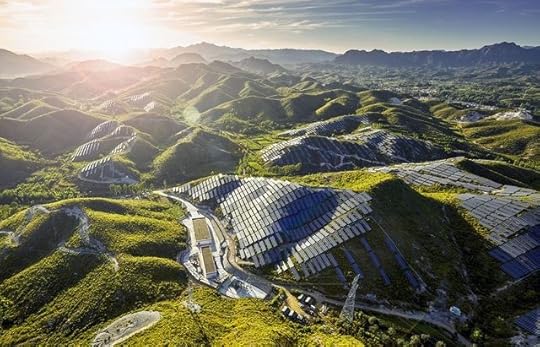
Big Rural ★★★☆☆
This story deals with the setting up of a large solar farm in a rural ex-coal town.
It brought up two good points.
1. Solar farms should have a sense of place. Ex. China’s übercute Panda Solar Farm!
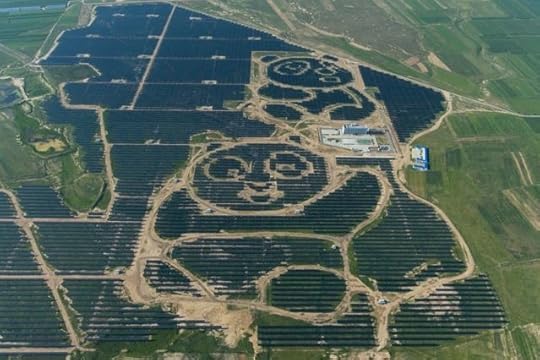
2. Agrosolar! Yes, you can grow vegetables under those panels! Ex. The Cochin International Airport! https://youtu.be/54iuCZq2Qws
What I did not understand about the story was the MCs sudden turnaround perspective of Aaron’s view on coal. Actually, the whole story was “solved” like an episode of Sesame Street.
Mod

Small Rural ★★★½☆
“Her facial sol tats glowed a fierce gold as she carefully hoved towards me in the chaotic dark. There were arms around me and I was up and out. And in love.”
I enjoyed reading about the Ramish and hope that the Saudis can move their society forward in this inclusive, colorful, ecological manner. It was a striking juxtaposition with Americans donning the homogeneous white linens.
Mod
https://www.goodreads.com/review/show...
I loved these collaborative efforts of fiction and non fiction, even when I didn’t agree!
The lively discussion has also been amazing guys!


What will it be like to live in the photon societies of tomorrow? How will a transition to clean, plentiful energy transform our values, markets, and politics? The Weight of Light emphasizes that the design of solar energy matters just as much as the shift away from fossil fuels.
Solar technologies can be planned, governed, and marketed in many different ways. The choices we make will profoundly shape the futures we inhabit.
The collection features stories by award-winning science fiction authors, working in collaboration with illustrators, graphic designers, and experts in policy, ethics, climate science, and electrical, environmental, civil, and aerospace engineering.