
Art Lovers discussion
Just For Fun
>
Game Of The 7 Errors With Lucas Cranach The Elder
date newest »
newest »

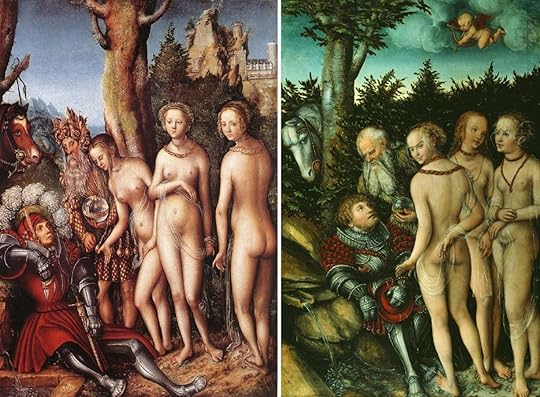
The Judgment of Paris
left: 1512-1512, Wallraf-Richartz Museum,
Cologne;
right: 1540, Windsor Castle
What differences do you see?
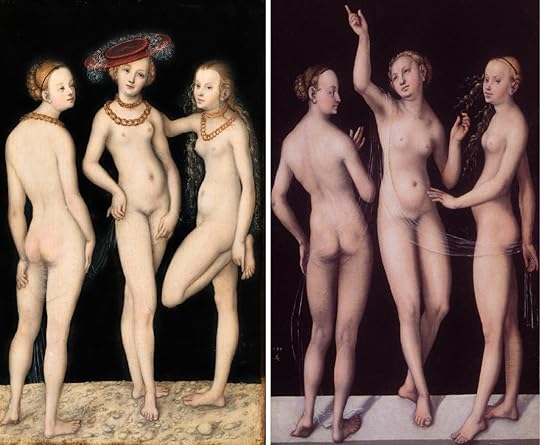
The Three Graces
left: 1531, Louvre Museum;
right: 1535, The Nelson-Atkins Museum of Art
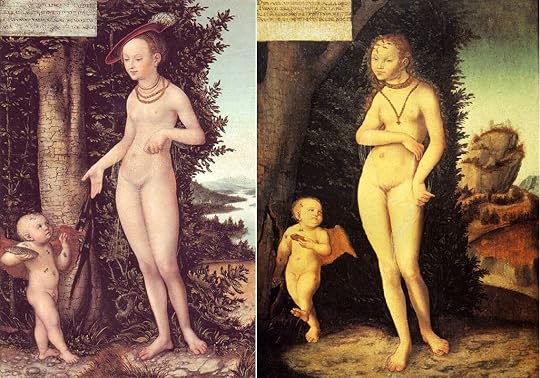
Venus and Cupid
left: 1534, Bavarian National Museum;
right: date unknown, private collection
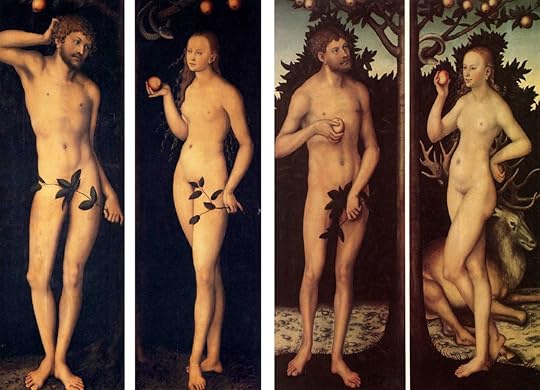
Adam and Eve
left: 1528, Uffizi Gallery;
right: 1525, Royal Museums of Fine Arts of Belgium
 How the study of anatomy (and the image of a "beautiful" body) changed in hundred years:
This is from Rubens exactly 1 hundred years later:

And Rubens certainly painted (or sketched) after live models. I have my doubts if Lucas Granach did.
Dirk wrote: "How the study of anatomy (and the image of a "beautiful" body) changed in hundred years:This is from Rubens exactly 1 hundred years later:
And Rubens certainly painted (or sketched) after live models. I have my doubts if Lucas Granach did.
Whether he did paint after live models or didn't isn't the question or the 'point'. You didn't even express any differences in the several almost equivalent paintings above. You didn't even compare any of the paintings by the singular artist. Where does Rubens come into all of this?
In case you missed it, THIS was the 'point' Your mission is to identify seven differences between the artworks of Lucas Cranach the Elder It does not ask to compare the works of Lucas Cranach the Elder to Rubens. Where your comment came from, I can't figure out. Try again!
"just for fun" heather. I thought it fun to point out how the ideal beauty image of the female body changed over hundred years.
Were you expecting something like this?
Seven differences? more like a dozen or so...
Dirk wrote: "Were you expecting something like this?Seven differences? more like a dozen or so..."
That's one way to do it, thank you, Dirk!
Would you like to comment on that which you circled? I'm sure there are many more than 7 'errors' (though I don't believe they are 'errors') in all the paintings. They are just multiple paintings he did of the same subject at different times. I copied this question/game from the website which called it "7 Errors" just for the fun of examining the two paintings side by side.
Thank you for playing! Feel free to comment on those which to comment.
 Dirk wrote: ""just for fun" heather.
 I thought it fun to point out how the ideal beauty image of the female body changed over hundred years."
I sure agree as when I took figure drawing we mostly had super thin models. It seems that a few years ago the anorexic look was in! Creeps me out to see bones.
I like the Renaissance look myself. That new ‘anorexic’ look discourages me! Plus I think it lol unhealthy and ugly IMO lol
I remember the lessons figure drawing and I think it's mostly the same: you draw whoever the model is.One year we had a male model, skinny, tall sharp features and a long ponytail. We called him the indian. He could hold the poses for more than a quarter of an hour: that was great for us, at least we could finish something ;-)
Heather wrote: "I like the Renaissance look myself. That new ‘anorexic’ look discourages me! Plus I think it lol unhealthy and ugly IMO lol"I also feel it is very unhealthy. My husband gets more upset than I do however.
Dirk wrote: "I remember the lessons figure drawing and I think it's mostly the same: you draw whoever the model is.One year we had a male model, skinny, tall sharp features and a long ponytail. We called him t..."
We also had a model who could hold poses for much longer than average but I can't recall how long now. I remember that she had fascinating bushy hair. Everyone in class had to sit as a model for Figure Drawing I. Did you also have to sit? I would give out fast.
Yes sometimes in class when the model didn't show up, we had to do that. But I didn't like it at all. At least we could keep our cloths on ;-).But about the bodyshape: I think it's much more rewarding and fun if the model is a bit more rounded, like the Rubens ladies, don't you think?
We also had to do it when they couldn't find a model. I can remember weeks when we had to rotate as no one was available. Finally I think they found Jassy. I guess that was her name. She and her husband were art majors.


Your mission is to identify seven differences between the artworks of Lucas Cranach the Elder
Lucas Cranach the Elder (1472-1533) was a Germanic painter: having been born as Lucas Sonder, he adopted the name of his hometown, Kronach, and from an early age he practiced the art of painting, which he had learned from his father. In the early 1500s, he attracted the attention of Frederick III of Saxony and became court painter in 1504. At the time of Cranach, the practice of making variations on the same theme was completely normal. Among the recurring themes in Cranach’s work, we find a typical emphasis on biblical and mythological subjects.
http://www.dailyartmagazine.com/lucas...