
Pasadena Bodhi Seeds discussion

This topic is about
Gone Beyond (Volume 1)
Gone Beyond
>
Reading Notes
date newest »
newest »
 Mod
Mod
though the dharmakaya cannot be experienced by others (such as non-Buddhists, sravakas, and pratyekabuddhas), intelligent bodhisattvas will see or realize it when they enter this path by having committed to memory the meaning taught in the sütras—that one is able to accomplish the dharmakaya through that which has the character of the ten dharma practices, such as generosity.
---
"O me, O life? that the powerful play goes on and you may contribute a verse.”
May contribute the verse blessed by bodhicitta (emptiness with a heart of compassion)?
-------------
pg. 225:
The illusionlike nondual wisdom of a buddha bhagavàn is the actual [prajnàpàramità]. By virtue of being concordant with attaining this
[actual prajnàpàramità], the scriptures (collections of words and
sentences) and the paths (which have the characteristics of seeing
and so forth) are also called “prajnàpàramità,” [but] this is [just]
nominal.586
Mod
If generosity and so on are not blessed by bodhicitta (emptiness with a heart of compassion), they do not represent the practice of accomplishing.
In the mahayana, there are three sets of practice. (1) The bodhicitta of aspiration is the practice of entering. (2) The bodhicitta of application (the ten paramitas) is the practice of accomplishing, which means to accomplish what one has aspired
for or to excellently accomplish the fruition. (3) The practice of accomplishing of a buddha consists of the enlightened activities of the dharmakaya.
Dharmamitra denies these as ten fold of Dharama practices:
(1) writing the letters of the dharma;
(2) venerating it and those who proclaim it;
(3) practicing generosity for both of these;
(4) listening to it;
(5) reading it;
(6) memorizing it;
(7) explaining it to others;
(8) reciting it;
(9) reflecting on it;
and (10) meditating on it.
Therefore, it should be the 10 paramitas:
(from wikipedia: https://en.wikipedia.org/wiki/P%C4%81...)
In Mahāyāna Buddhism, the Prajñapāramitā sūtras, the Lotus Sutra and a large number of other texts list the six perfections:
Dāna pāramitā: generosity, giving of oneself (in Chinese, Korean, and Japanese, 布施波羅蜜; in Tibetan, སྦྱིན་པ sbyin-pa)
Śīla pāramitā : virtue, morality, discipline, proper conduct (持戒波羅蜜; ཚུལ་ཁྲིམས tshul-khrims)
Kṣānti pāramitā : patience, tolerance, forbearance, acceptance, endurance (忍辱波羅蜜; བཟོད་པ bzod-pa)
Vīrya pāramitā : energy, diligence, vigor, effort (精進波羅蜜; བརྩོན་འགྲུས brtson-’grus)
Dhyāna pāramitā : one-pointed concentration, contemplation (禪定波羅蜜, བསམ་གཏན bsam-gtan)
Prajñā pāramitā : wisdom, insight (般若波羅蜜; ཤེས་རབ shes-rab)
Note that this list is also mentioned by the Theravāda commentator Dhammapala, who says it is equivalent to the above list of ten.[9]
In the Ten Stages Sutra, four more pāramitās are listed:
7. Upāya pāramitā: skillful means (方便波羅蜜)
8. Praṇidhāna pāramitā: vow, resolution, aspiration, determination (願波羅蜜)
9. Bala pāramitā: spiritual power (力波羅蜜)
10. Jñāna pāramitā: knowledge (智波羅蜜)
Mod
8 topics:
The knowledge of all aspects,
the knowledge of the path,
the all-knowledge,
The full realization of all aspects,
The attainment of culmination,
the serial one,
The full realization in a single instant,
the dharmakâya
Mod
1) [Its definition] is “that which serves as the remedy for the afflictive
obscurations through realizing personal identitylessness.”
2) “Then, the all-knowledge” refers to that which, then, knows all entities
(skandhas, dhàtus, and àyatanas) to lack a self.
Mod
Subhuti (one of ten principal disciples) understood the potency of emptiness. Major disciple in Diamond Sutra.
Mod
[The knowledge of all aspects consists of]
(1) generating bodhicitta, which represents the seed of perfect enlightenment;
(2) the instructions of the mahàyàna, which are the conditions for maturing and purifying this [seed];
(3) the first fruition of making this a living experience, the branches of the path of seeings penetration,603 which are the fourfold path of preparation
that serves as its cause; {14b}
(4) the disposition as the foundation of practice, which has the nature of the dharmadhatu since the disposition [of being established] in the mahàyàna is definite, once the [path of preparation] is attained;
(5) the focal object of this practice;
(6) the aim of this practice; then, in terms of classifying this practices own nature,
(7) the practice of donning the armor in order to not be struck by antagonistic factors;604
(8) the practice of the activities of engaging in the battle of the mahàyàna, after the armor has been donned;
(9) the practice of accumulating the equipments of combat, once one has entered the battle; and
(10) the practice of final deliverance, the [eventual] victory over the enemies
Mod
Rhinos: In the Abhidharma-samuccaya, Asaṅga describes followers of the Pratyekabuddhayāna as those who dwell alone like a rhinoceros or as solitary conquerors (Skt. pratyekajina) living in small groups.
"White rhinos are more sociable and can be found in large groups of over seven animals. Black rhinos usually live alone but sometimes they can be found with over five animals of the same age but these groupings don't last long."
https://www.earthrangers.com/wildwire...
Mod
[The full realization of all aspects consists of] (1) that with which [bodhisattvas] should familiarize—the aspects of consciousnesses with referents; (2)
how they should familiarize with them—the trainings; (3) the qualities of
their having familiarized in this way; {15b} (4) the flaws that interrupt this
[training]; (5) the characteristics of [the divisions of] this training; (6) the
[first temporary] result of training—the path of accumulation that represents
the factors conducive to liberation; (7) its maturation—[the path of preparation] that represents the factors conducive to penetration; (8) the persons
as those who cultivate the training—the assembly of irreversible learners;
(9) the training in realizing samsaric existence and nirvanic peace as equality; (10) transforming ones own pure lands into [having] unsurpassable
qualities; including (11) the training in skill in means, which makes others
mature.6
--------------
note ******:
(9) the training in realizing samsaric existence and nirvanic peace as equality;
Mod
Šáriputra, here, a bodhisattva mahàsattva should abide in
prajñápáramitá in the manner of nonabiding, thus perfectly practicing the pàramità of generosity in the manner of no giving since something to be given, a giver, and a recipient are not observable in generosity and all other [pàramitàs].624
----
I simply like the word "observable" - so modern
----
They should train in the object of bodhicitta, which is the desire to establish miserly sentient beings in generosity; those with distorted ethics, in [proper] ethics; the malicious, in patience; the lazy, in vigor; the distracted, in dhyàna; and those with distorted prajñá, in consummate prajñá.
Mod
ten great aspiration prayers might refer to Samanthabhdra's:
To pay homage and respect to all Buddhas.
To praise the Thus Come One-Tathagata.[2]
To make abundant offerings. (i.e. give generously)
To repent misdeeds and evil karmas.
To rejoice in others' merits and virtues.
To request the Buddhas to continue teaching.
To request the Buddhas to remain in the world.
To follow the teachings of the Buddhas at all times.
To accommodate and benefit all living beings.
To transfer all merits and virtues to benefit all beings.
In Chinese:
一者:禮敬諸佛;
二者:稱讚如來;
三者:廣修供養;
四者:懺悔業障;
五者:隨喜功德;
六者:請轉法輪;
七者:請佛住世;
八者:常隨佛學;
九者:恆順眾生;
十者:普皆迴向。
Somehow, I like the Chinese version of being so uniform.
Mod
Here, when bodhisattva mahâsattvas engage in prajñápáramitá,
they do not see any bodhisattva mahâsattvas as if they were existing bodhisattvas ... “bodhisattva” ... are mere words.
Mod
As for the persons who abide in the fifteen moments of the path of seeing, those of duller faculties are called “pursuers by means of confidence”and those of sharper faculties are called “pursuers by means of the dharma.”
At the time of attaining the realization of the sixteenth moment, these two persons are called “those who are convinced through confidence” and “those who attain through seeing,” respectively. This also applies to the ones below.
LT: It seems that the writer doesn't distinguish those with duller & sharper faculties. The both can "attaining the realization" of the moments but through different course.
Mod
False imagination; neither correct
Nor false; nonimagination;
And neither imagination nor nonimagination—
This expresses all knowable objects.
Needs to review Buddhist logic.


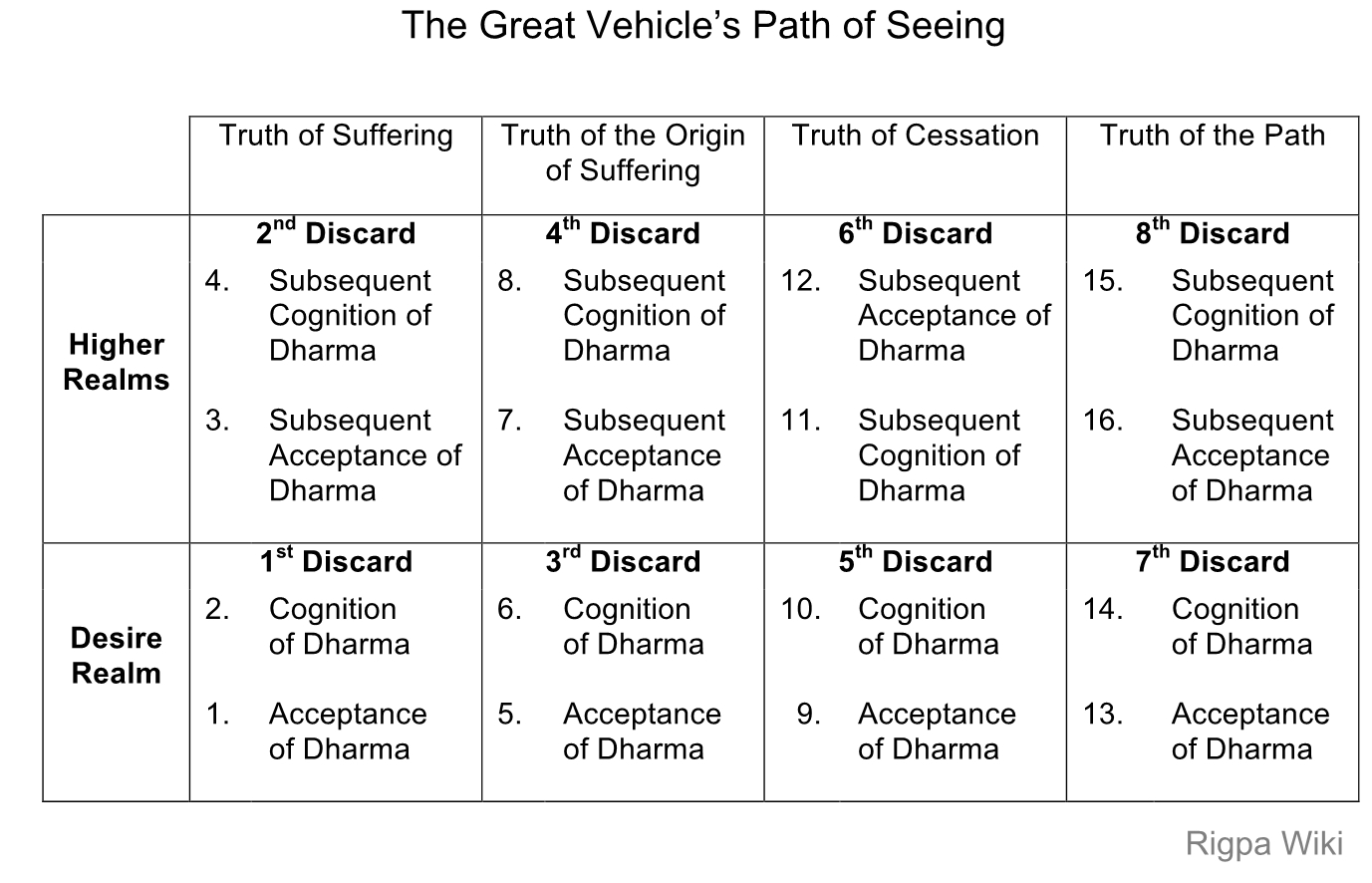
pg 213-214:
1. "the wheel of the four realities” (or four noble truths: suffering, origin, cessation, path)
2. “the wheel of the lack of characteristics” (emptiness)
3. “the wheel of excellent distinction.” (between expedient and definitive meaning)
Other sutras/shastras seems like a rephrase of the above.
From The Sun of Wisdom: Teachings on the Noble Nagarjuna's Fundamental Wisdom of the Middle Way, the author write on pg XIII:
....
the teachings of the first turning of the wheel, called the stage of no analysis-no analysis of the true nature of the phenomena about...
...
This second stage is called the stage of slight analysis
the point at which phenomena are analyzed and found to be lacking in inherent nature, to be empty of any truly existent essence....
In the third stage, the stage of thorough analysis, the Buddha taught that we must also give up our clinging to nonexistence if we are to realize the simplicity, the freedom from all conceptual fabrications, that is reality's ultimate essencewhich the Buddha taught..