
The Filipino Group discussion

This topic is about
The Great Ideas of Philosophy
note: This topic has been closed to new comments.
Buddy Reads
>
The Great Ideas of Philosophy by Daniel Robinson | Chapter 11: Hippocrates and the Science of Life

 Oh, darn. I missed this. Which lecture are you currently listening to/reading? I'm too late. I started watching this course a couple of years ago but I stopped in the talk about Pythagoras; I got sidetracked by other things. :D
Your posts are a pleasure to read. You guys are so smart and knowledgeable. I feel smart already just hanging out here. :D
 Hullo, Dante! You are welcome to swing by anytime. We're just wrapping up Lecture 5: The Greek Tragedians on Man's Fate and will be starting Lecture 6: Herodotus and the Lamp of History by today. Unless we decide to blabber on some more if we don't get to tie all the loose ends. But feel free to post your thoughts and react on the comments.
Hi Ycel!
Hullo, Dante! You are welcome to swing by anytime. We're just wrapping up Lecture 5: The Greek Tragedians on Man's Fate and will be starting Lecture 6: Herodotus and the Lamp of History by today. Unless we decide to blabber on some more if we don't get to tie all the loose ends. But feel free to post your thoughts and react on the comments.
Hi Ycel!Ooo, that's nice! Not yet very far, I see (or so I think hehehe). Okay, I'll try to catch up. Thanks much! :)
Dante: Btw, we're listening to the audio which is 10 lectures short of the original video lecture. The audio stops at the lecture on Four Theories of the Good Life.
Ycel: Ah, I see. So the audio lecture is incomplete? I have the video version, but I may want to download them as MP3s so that I could listen to them while I'm driving. :)
The audio was compressed to 50. As it is, it's already a looooong series to tackle, but if we're all up to it and get to complete the audio, we can switch to the video. Some lectures that are 3 lectures long in the vid were compressed to 1 audio lecture. But we can tackle the last vid lecture and I'm sure it's quite interesting, that lecture titled God---Really?
We posted the link to the audio on the first few posts in the thread.
Ah, okay, I'll download them, thanks! :)
DC:My mom dropped by yesterday at the Manila Seedling Bank, and got me a lot of new plants to name and take care of. (I’ve got Pepper Peter and Pepper Patricia now, in addition to Pepper Portia!) Maybe you can start there :D
Yey! But wait, I have to think of names, too! I think my daughter would like that :)
First off: Thanks on your notes for the film viewing :) I like storytime! *gazes dreamily between bent elbows*
I just realized on hindsight that this week is a 4-day work week, so we should have pushed the film viewing on 300 to this date. And it coincides with Herodotus. Nevertheless, I will watch the film today and drool on super buff bodies. LOL! So yes to storytime :)
Your thoughts on the philosophical novel-->eloquently said, but it’s not my question so Angus will be the one to decide if your reasoning is acceptable to him. LOL! But kudos to him for bringing up the topic because I have a feeling he was fishing for a debate. LOL!
On the Science-Theology-Philosophy debate-->OK, I did not realize that quoting Bertrand Russel would be tricky, but let’s park this for now. We will go back to this when we have covered the scientists and the theologians. No rush.
MARK:I will drop by MegaSmall today and check out the books in St. Paul :)
 Oh, hello, Dante! Welcome to the thread :D
I think that's a good idea, Ycel! Think I'll have a 300 movie night too :)
Let's postpone Chap 6 for tomorrow then?
(Will check other comments later!)
 WARNING -- Shameless plug!!! I'm offering up for sale a copy of this famous edition of The Histories by Herodotus. Here's the goodreads link to this edition: http://www.goodreads.com/book/show/74...
•THE HISTORIES by HERODOTUS [Hardcover] Translated by George Macaulay. Only P560!!!
Reason for selling: I have two of these and I decided to let one of them be enjoyed by someone else. The translation is superb and the language is easy and powerful. Plus, the notes are awesome! :-)
While on the topic of the Persian wars, I'm also offering up for sale Steven Pressfield's GATES OF FIRE http://www.goodreads.com/book/show/13... and also TIDES OF WAR (this is about the Peloponnesian War). http://www.goodreads.com/book/show/13... The goodreads links I provided are of the same edition I'm offering. These two books on offer for P700 only :-)
Thanks everyone! :-)
Will take Herodotus!
Thanks! I'll take pictures of The Histories when I get home and will upload to fb and you could see :-)Welcome to the thread Dante! :-)
Re: Herodotus -- I LOVE THIS GUY! :-) If you're just reading The Histories for the first time be ready for some good hearty laughs, and also get set to be amazed by the ancient world! Herodotus presents the world through fresh eyes. I really love this book! :-)
OFF-TOPIC TEASER: One of the most memorable passages from Herodotus concerns the "giant gold-digging ants" from India. What this animal was in reality remained a mystery for more than 2,000 years. Recently, a French explorer found what could have been the animal mentioned by Herodotus! :-) http://en.wikipedia.org/wiki/Gold-dig...
On the art-for-art's-sake issue: (Spoiler-ized because I'm not sure if it's on topic, plus it could turn into quite the debate if we're not careful :P) (view spoiler)
Ycel: (view spoiler)Mark wrote: "Re: Herodotus -- I LOVE THIS GUY! :-) If you're just reading The Histories for the first time be ready for some good hearty laughs, and also get set to be amazed by the ancient world! Herodotus pre..."
Haha, that just excites me for the next chapter then :D Also, Herodotus talked about an animal that was only validated existence 2,000 years after he made mention of it?! Man, that's awesome :D
Oh, and for those who have just found this thread, please note that you needn't start with Chapter 1 to "catch up" with the current discussion. You may begin immediately with the chapter we're currently discussing, since each chapter is standalone enough :)
Lecture 6: Herodotus and the Lamp of HistoryLink to audio file: https://docs.google.com/file/d/0B37rZ...
Guide Questions
1. Explain whether the past is prologue.
2. Summarize whether the writing of history presupposes what is now widely doubted—namely, that events taking place at one time under unique conditions can help explain yet other events, widely separated in time and context.
DC:On the art-for-art's-sake issue:
Whoa!!! Step on your brakes and let’s rewind. But you’re right, this issue could explode on our face if we’re not careful. Maybe it’s time to remind ourselves of the house rules: keep an open mind and be prepared to have our beliefs and ideas tested. Ito na ‘yun!
(view spoiler)
 06: Herodotus and the Lamp of History
My very hurried lecture notes, because I won’t have time until tonight:
“We can rise to truly heroic levels of behaviour.”
Herodotus wrestling with the problem of knowledge, i.e., what are the causes of war and looking at the appalling consequences--- the deaths produced, the suffering and rift between and among people, the collapse of trade, the creation of hostile attitudes that might take generations to get over, the redrawing of political boundaries , alterations in the economy, the sudden increase in the class of slaves won victoriously by the winning side---this is an extraordinary happening, and one has to understand the causes of something like this. That problem of knowledge presents itself most vividly when we ask the question: why are we like this?
Men at war do not hate each other. It’s not aggression that brings about armies, it’s devotion. The legions are moved by words, they’re moved by symbols.(view spoiler)
The Persian Wars – a sociology of events and a psychology of the participants.
Why is it you want posterity not to forget the deeds of these brave men? Such a history teaches---it teaches at the level of our common humanity. Through the study of history, we illuminate the commonalities that constitute human nature, that wherever you find human beings, these lessons are lessons worth learning, and no matter the differences, there is a root humanity that is reached by the events of the world and that allows us to predict how we’re likely to behave under certain conditions and how those conditions should be promoted or shunned depending on whether the behaviour is laudable or reprehensible.
To know ourselves is to give an account of what we’ve done.
Solon and Croesus
Solon (638 BC – 558 BC) and Croesus (595 BC – 547 BC) historically never met but Herodotus added a little colloquy between them, with Croesus asking Solon who is the happiest of men? Definitely seeking the wise man seal of approval. LOL on the top ten bit :)
(view spoiler)
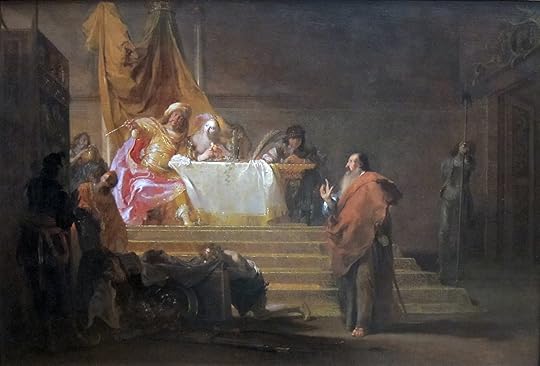
“Who would you say is the happiest of men? Who would you describe is most fortunate of all human beings of your acquaintance? Nothing personal here, mind you, just tell me, here in this royal setting in which you find me with a smile on my face, this temple of opulence and good health and strong children and loyal and obedient subjects and all that ships that float and horses that run fast. Who would you say is the most fortunate of people? Who would you say is the happiest of men?”
And Solon’s reply: Cleobis and Biton (Huh? Who? What?)
(view spoiler)
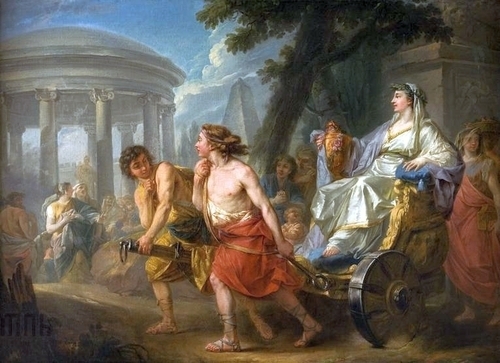
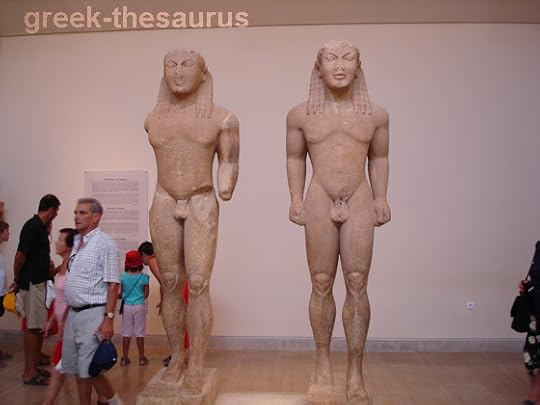
These stories were inserted as a précis on the nature of happiness. We cannot know until our days are over.
The lecture does not dwell in detail about Leonidas and the Battle of Thermopylae (which means we have to do an independent study), but concludes with this thought:
“We’re going to discover that Plato, like Herodotus, and in an interesting way like Aristotle himself, sees in the conflagration and immediacy of one’s own mortality something so richly character-forming as perhaps to have no substitute. Thus we find Aristotle much later saying, that truth be told, the virtues to be developed fully probably will only be developed in warfare. What a daunting and chilling thought that is, and how awful if it’s true.”
 My quick go-over of Chapter 6: (view spoiler)
Introduction to The Histories:
THESE are the researches of Herodotus of Halicarnassus, which he publishes, in the hope of thereby preserving from decay the remembrance of what men have done, and of preventing the great and wonderful actions of the Greeks and the Barbarians from losing their due meed of glory; and withal to put on record what were their grounds of feuds.
Will go over questions and other comments later :)
DC:And YES, I sometimes role-play a soldier, a fighter, a killer in video games I play, but it just seems to different in reality. Wanna talk about this angle of videogame violence though? I'm game, but probably in another forum :D
The only video game violence I ever participated in was years ago (Counter Strike) and I think I did it for 3 months (really got addicted) and totally stopped after I killed my boyfriend (now husband) and his cousin. Mission accomplished.
I had to give a cough on the mention of not having enough data. With my current work as a researcher, I always have this antsy I-don't-have-all-the-answers feel when I go about my reports and whatnot. No matter how well I prepare and gather data about it!
You will always get that antsy feeling because you can’t know everything. Do you do financials, too? Cos the bottom line is what really matters to the decision makers. In MBA, people are taught the obligatory SWOT analysis, until an AIM professor told me that the way SWOT analysis is being taught is wrong. The correct way is to do a chaos SWOT analysis. Talk to you about it some time. It’s very enlightening.
I just did a quick Google search, but is this Herodotus' The Histories? --> http://www.documentacatholicaomnia.eu...
It should be the same source, just a different translator. This is the copy that I got, except that the cover is different.
My last word on the art-for-art’s sake issue. Promise.
I did not get this passionate exchange in Art History (Humanities II, right?). Mostly the class just sat in the dark looking at art works projected on the screen, and then trying to squeeze our little brains to interpret what the artist meant (we mostly just said a lot of shit to pass the course). But I like it that art can be a dynamo and see how people view its influence in shaping society and culture.
I stand by my view that artists have a moral obligation. My influence in holding this view is mostly Plato (who’s a great poet but holds moral order sacred). Although he insisted that the Dialogues are not his but entirely Socrates’, in his hands the Dialogues became a masterpiece not just of philosophy but of art. It’s a major kilig moment when I saw a young Clark Kent(!) holding a book on Plato, and I’d like to think that Plato convinced the Man of Steel that he has a moral obligation to save the humans. And of course, you know my game. This is a nice little segue to start the next lecture :)
I'm alive! Whoosh! (view spoiler) Here are my answers to the guide questions for Chap 6:1. Explain whether the past is prologue.
Well, to say that "the past is prologue" means that it's the pretext of something right? Something like - today is where your book begins; the rest is still unwritten? :)
[Note: I have this personal principle about “living life to the fullest” and “enjoying what’s here now rather than later”, so this kind of ideal might affect my elaboration below :)]
Personally speaking, I believe that your past circumstances should not determine your present, nor your future. You, as an individual, should not look at your history as something that serves as your yoke for your future life; it should be your prologue – a mere description of what happened to you and what you did and all that.
Of course, I think that people usually have a feeling towards the past, since, it is, after all, the summation of what you’ve been through as a person – your first crush, your first kiss, your first heartache, your first love. It also holds things sacred and not so sacred, as well as taboo experiences and hurts. Our past is not always pleasant; I’m sure that in each of us, we hold memories that are painful to look at and behold.
Of course, there’s the phrase – "Those who cannot remember the past are condemned to repeat it" (view spoiler) – so while I think that you shouldn’t allow yourself to be burdened by your past, I also believe that you shouldn’t turn a blind eye towards it either. Learn from your mistakes, and take joy in your victories. Your troubles may have been gone – but what did you learn from them? Do you want to get into that kind of trouble again? Your wins may have been shortlived – but what did you learn from them? Do you want to experience that kind of win again?
Don’t skip the Intro of Your Life – it might just be the most important part of Your Book :)
... Pwede na bang guru? Haha! Not sure, too, if I answered the question right :P
Segue: Since I’ve mentioned the book over at the Classics thread, I might as well mention it here. The History of Tom Jones, A Foundling interestingly touches on the subject of a man who had to undergo all this trouble merely because he was born “wrongly”. He had the yoke of a past history that people deemed unworthy! It is sad how people look at him as if his kind of birth is supposed to determine what kind of person he is. HOWEVER, I think this is a different discussion? Hmm. I guess I could discuss it further in the spoiler below:
(view spoiler)
I now realize that perhaps I could have taken a more macroeconomic view of the whole case, but, heh.
2. Summarize whether the writing of history presupposes what is now widely doubted—namely, that events taking place at one time under unique conditions can help explain yet other events, widely separated in time and context.
I believe that the writing of history CAN presuppose this, and yet, at the same time, it cannot.
It CAN:
At the heart of history, we will see the figure of Man. Whether born as a Spartan or in the troubled times of Germany, it does not matter. We may each be unique in personality and dress, but there are certain behaviors that we all share – such as the propensity to be afraid, the society we all share, and the search for our purpose.
While the technology may be different and the armaments changed, we cannot help but see that some events in history may have been avoided, if only leaders learned to look at past experiences and learned from them. (Say, for example, not learning from the year-by-year floods of certain cities and being surprised by them each time around.)
It CANNOT:
Unfortunately, it is also right that there are unique conditions each and every time an event is done. The mere fact that by the time you’ve read this now (while earlier reading the words “It CANNOT”), there has already been different circumstances that has been happening around you (say, for example, that your seatmate has just now burst into song), means that there has infinitely been more changes between the events of before and today.
A good note to this would be technology and globalization. Both of these have changed so much about the world, making it a smaller place. For example: (view spoiler)
These developments also mean that the problems of before are not necessarily the problems of today. (view spoiler) Therefore, it's rather difficult to say that the events of yesterday can, exactly, help explain the events of today.
President Truman supposedly asked for a one-armed economics advisor because his two-armed economics advisors were always saying, “On the one hand... but on the other hand...” (Mankiw’s Principles of Economics)
YCELOn Chap 6 :
The lecture does not dwell in detail about Leonidas and the Battle of Thermopylae (which means we have to do an independent study)
>>> Philo class group film watching of the 300 movie sequel? :D (Though it’s still to show next year. (view spoiler)) And other
“What is past is prologue” is a famous quotation by William Shakespeare from his play The Tempest.
>>> Sweet! I, of course, didn’t look it up. Thanks :D
My favourite history quote: “History does not repeat itself exactly, but behaviour does” is apt to illustrate the cyclical nature of our election history. People in the lower ranks of society, the most susceptible to bribes, keep electing the same mayor who did nothing for his constituents in his last term save for waiting sheds bearing the mayor’s name as if he used his own money. The middle class, seeing this endless cycle of nonsense, keeps an apathetic position. The rich, with their desire for more money and power, props up politicians who will further the rich man’s interests. And so the people at the low end of the food chain is kept ignorant by policy because they are the tool that will give the votes to keep the cycle going.
>>> Ironically, I am very, very happy to read this. (view spoiler)
Interestingly enough, now that I think about it, I think that what would make a good change to the whole political process would be education – and if you educate someone, you effectively have the chance to change their behavior. Interesting. BUT (view spoiler)
This is a simple example of how desire trumps out rationality. Multiply that by the desires of a megalomaniac and you’ll see why wars and expansionist ambitions dot every page of history.
>>> I see you’ve noted behavior again as important in the scheme of things :) Tell me then- can we change the mindset of our people in order to not have ambitious megalomaniacs dot our history with wars?
The others: (view spoiler)
On arts for arts sake: (view spoiler)
DC:Thanks for your post and I really appreciate it. But my comments will have to wait as I am currently experiencing an unbelievably stressful situation (no kidding) in the office. I shall give you my undivided attention as soon as I get past this. Anyways, I'll see you in the F2F :)
*dashes in for a quick comment*DC:
>>> I see you’ve noted behavior again as important in the scheme of things :) Tell me then- can we change the mindset of our people in order to not have ambitious megalomaniacs dot our history with wars?
Education is key to changing the mindset of the people. But so is the correct prioritization of government budget. Randy David wrote a very well thought out commentary yesterday regarding the urban poor. *poofs*.
Cramming for Kav&Clay. Obviously.
DC:Of course, I think that people usually have a feeling towards the past, since, it is, after all, the summation of what you’ve been through as a person – your first crush, your first kiss, your first heartache, your first love.
Wala lang. Gusto ko lang i-emphasize ;D at mangulit. I need to de-stress. Pffffffffffffttttttttttt!!!
Of course, there’s the phrase – "Those who cannot remember the past are condemned to repeat it" [also: “Those who misquote George Santayana are condemned to paraphrase him” (hide spoiler)]
I’m actually trying to recall whether I’ve ever been guilty of this. Nah.
Interestingly enough, now that I think about it, I think that what would make a good change to the whole political process would be education – and if you educate someone, you effectively have the chance to change their behavior. Interesting. BUT [the means of educating the poor are effectively held by their representatives – which in current cases mean the rich – and thus, at current, it is a tricky question as to whether their representatives will do what’s best for the (poor) or what’s best for the (rich). (hide spoiler)]
I know that I agreed about education in my earlier comment, but sometimes I think it’s too easy to say that education is the answer. IT IS, but the practical question is how do we do it? Do we rely on government? Can we trust that the legislators will make judicious budget allocation to education and not to their pork barrel? Because if we wait for the government it will not happen. Can we do something in our own little way? I think we can. When my kids’ yaya first worked with us, she left her daughter with her parents in Surigao, but she kept complaining that her parents spent the money that she sent every month on something else (useless stuff, really, and not to buy things that her kid needed for school). So I told her to fetch her kid so she can go to school here in Manila and she can help out in the house when she doesn’t have school. This was five year ago. She’s graduating from college soon. Why did we do it? My husband and I thought that it would be a shame if yaya’s only daughter would end up a maid, so the only way that yaya can have a comfortable retirement is for her daughter to have a decent job. And we’re happy to do it, because yaya and her daughter love our kids to death. Yaya has been with us for 11 years (my eldest is 11). It’s a good retention strategy. Plus we’re able to help. It’s such a great win-win situation. I know people will say that I got lucky getting someone like her, because yaya horror stories abound. But the point is, we took a chance to help someone and it paid off. To think that she was just a walk-in applicant…
I think the point is whenever we find an opportunity to send a kid to school and we think it will be a game changer for this kid, we should. I am reminded of an old colleague who landed a great job. She got her university education on taxpayer’s money (UP Diliman, engineering graduate). She’s paying it forward by setting up an endowment fund for poor but intelligent kids. She puts her money to good use :)
Thanks, Ycel! Will go over comments later :)Before we formally move on to Chapter 7 (I'll post the guide Qs and link later!), I just want to ask: What do you think of the Cleodis and Biton story? The entire happiest of men note?
DC:This poem! Am in awe.
CLEOBIS AND BITON
by Charles Bryant
Greek myths weave and interweave
like Celtic scrollwork;
written on the bodies of once living men
and in the memory of generations.
From the Argive treasury at Delphi
two and a half millennia ago
this precious load of ancient stony cargo:
brothers, lovers, friends, in the old Greek way;
this seeming pair of Martians, spooky, stiff;
their bodies so earthbound, heavy,
they appear to be dragging mother's chariot still.
Cleobis is 'famous'; Biton a 'wild ox'
(Robert Graves has told us so.)
Their mother is All Mankind; and they are Striving.
They take the place of oxen, pull the wagon,
rough tough sons of Cydippe priestess of Hera
who, were she not to reach the goddess' shrine on time
would certainly have been slain.
(Gods and goddesses were cruel then, men no better.)
The oxen had wandered off, could not be found.
Cleobis and Biton took the yoke,
placed it on their shoulders, drew the cart.
The sculptures are straightforward to a fault:
bug-eyed thick-thighed archaic Greeks with Afro hair
(nothing in the world is ever new)
watched by a sleepy sphinx.
(view spoiler)
Cleobis and Biton, harnessed to mother's chariot,
drew her, serenely-sourly smiling, to the shrine;
then lapsed into unconsciousness and died -
so the guide book tells us, telling nothing.
We wonder: is there a moral to this tale?
Is it remembrance of some ancient rite
involving human sacrifice?
(Only the strongest loveliest and best
is fit to die for the deity -
with virgins, male and female, tastiest of all!)
Look at the old Greek text and you will read
how Hera whispered in Cydippe's ear
and with such evil foresight
unforgiving, accepting, relishing all:
"Your boys are good, the best of men,
ask for them whatever you desire."
And Cydippe: "Grant them, Lady,
of all earth's luscious fruit the finest."
So Hera, while they slept after their labour,
took away their breath and let them die.
Loved by the gods, only the pure die young.
The archon Solon tells us this good news;
and I sometimes wonder if he wasn't joking,
law-giver, poet, merchant - and a wag!
Or was he so utterly solemn he couldn't see
the risible nature of his story's climax?
So there they stand,
the brothers, side by side,
with weird Egyptian faces and big balls;
penisless, castrated in course of time
whether with intent or by bad luck.
Muscle-Marys of the ancient world
with protruding enormous buttocks;
like their pornographic counterparts today,
blanks on which we write our own reflections.
**************
The poet did a great reading here.
Chapter 7: Socrates on the Examined Life
Link to audio file: https://docs.google.com/file/d/0B37rZ...
Questions to Consider:
1. Socrates assembles his friends in the years following the defeat of Athens at the hands of Sparta. Explain whether Socrates’s philosophy is the thought of the “losing side.”
2. If Socrates was undermining the values and received wisdom of his polis, conclude whether he was justly prosecuted.
Ycel:On your comments: (view spoiler)
Ycel wrote: "DC:
This poem! Am in awe.
CLEOBIS AND BITON
by Charles Bryant
Greek myths weave and interweave
like Celtic scrollwork;
written on the bodies of once living men
and in the memory of generations...."
>>> Hah! I actually thought of this too. I mean, come on, the story is fantastical, and Hera totally set up that wish!
But did they really die the happiest of men? What if they were thinking: "Aww, man, all the chicks are impressed." "We did good, bro."
(... My example: I guess that would make them the happiest of men indeed, hahaha!)
And Daniel Robinson noted this:
"Have the life others wish they could have lived." "... having the admiration of good people, based on virtuous conduct..." "... fundamentally decent"
While I personally admit that this is very good for you to think about, what if you are personally not inclined to do something like that? What if all you actually wanted to do was explore the worst parts of society/being, and people of your time hate you for it -- but people in the future are grateful for it? Take for example, I guess, France's civil wars.
I wonder what entails you being the happiest of men, indeed?
What if Socrates is right? "Who knows if to live is to be dead, and to be dead, to live?"But of course no one came back to prove the latter. Pfffttt!
Ycel wrote: "What if Socrates is right? "Who knows if to live is to be dead, and to be dead, to live?"But of course no one came back to prove the latter. Pfffttt!"
But what is "to live"? Hahaha, I guess we'll find out in the next chapter - literally! Will post my notes and thoughts later :)
(I STILL am very amused about the entire happiest of men thing, though we'll probably get to that later on :D)
You remember Istak's character in Dusk/Po-on? I think in the end when he came face to face with death, I imagine that he accepted it calmly and gave it his all in the end. I don’t know, he and Luna probably died happy in Tirad Pass. Or Rizal. And all those nameless heroes.What I know is that living is hard. And extremely so for the unfortunate ones. Maybe the happiest ones are those who went through the pains of living, gave it their best shot and did not flinch when death came knocking at the door. I wonder what they felt. Calm? Relief? I guess this is a question that each one of us will know all on our own.
Socrates did say that the point of philosophy is to prepare us for death :)
For now, my notes on Chapter 7: (view spoiler)That is such a great chapter. Kind of like an introductory course on Socrates. I do like this Socrates fellow, yes I do.
But, essentially, let me see if I understand this, to have a "worthy life", you should examine yourself? And if you don't examine yourself - you're not leading a "worthy life"? Or perhaps you do not know if you're leading a "worthy life", and thus flail about with your unexamined life not knowing if you're doing something "worthy"?
Also, to call a life "worthy", that essentially stems from inside you? That there are no fixed standards for a "worthy" life - as long as you don't live steeped in prejudices and self-deceptions? It's about the TRUTH? The valid TRUTH, which you can only claim WITHIN YOURSELF?
Ycel wrote: "What I know is that living is hard. And extremely so for the unfortunate ones. Maybe the happiest ones are those who went through the pains of living, gave it their best shot and did not flinch when death came knocking at the door. I wonder what they felt. Calm? Relief? I guess this is a question that each one of us will know all on our own.">>> Interesting. There's a note in the chapter about Socrates' saying stuff about interpretation of the validity of what we do - so I guess it's not so much about what people have actually done, but how they validated what they've done within themselves?
... And I guess that's how philosophy prepares us for death: on how we have lived our lives as we can, based on how we perceive ourselves. If we have validated it truly and believed that we did is "worthy", then I guess we can rest at ease and welcome Death with tea & cookies. (Like that third brother and the Deathly Hallows.)
---
Oh, but is this the only chapter in the series about Socrates? I see we're off to Plato next. HMM.
Lecture Seven: Socrates on the Examined LifeProf. Robinson opens the lecture with “Who is Socrates? What is the Socratic method?”
“Who is Socrates?”
(view spoiler)
“What is the Socratic method?”
(view spoiler)
You know, guys, it's also good to read other books on philosophy, such as Copleston's History of Western Philosophy and also Guthrie's Greek Philosophers From Thales to Aristotle. It is possible that that book on philosophy you're using is faulty and may lead you to having a poor or even mistaken appreciation of what these ancient Greek philosophers are really saying.
Mark wrote: “You know, guys, it's also good to read other books on philosophy, such as Copleston's History of Western Philosophy and also Guthrie's Greek Philosophers From Thales to Aristotle. It is possible that that book on philosophy you're using is faulty and may lead you to having a poor or even mistaken appreciation of what these ancient Greek philosophers are really saying.”Thank you for your well-meaning comment. Copleston’s encyclopedic work is praise-worthy but it is worth noting, too, that his view was essentially Thomistic and that he was also a Jesuit. So to balance the discussion, we would like to see what, for example, Bertrand Russel (an atheist) had to say. It will be very much appreciated if you can point specifically which posts are faulty and then let us know what Copleston had to say and,more importantly, what you think. I think that would enrich the discussion a great deal, which is really the point of this thread.
This topic has been frozen by the moderator. No new comments can be posted.

The Filipino Group
Books mentioned in this topic
The Book of Virtues (other topics)The Great Ideas of Philosophy (other topics)
The Fifth Discipline: The Art & Practice of The Learning Organization (other topics)
Simulacra and Simulation (other topics)
Being and Time (other topics)
More...

downloading :)