
The History Book Club discussion
EUROPE - EUROPEAN HISTORY
>
CYPRUS
date newest »
newest »
 Mod
Mod
 by
by
 Lawrence Durrell
Synopsis on Goodreads:
One of a three-part series of Lawrence Durrell's writings. In this volume he explores the island of Cyprus, evoking the sun-drenched landscapes, dazzling light and vivid blue skies of the Aegean.
 The financial crisis is Cyprus has world-wide ramifications in global finance. The link below will provide a little of the history of how this crisis began and what it means.
http://en.wikipedia.org/wiki/2012%E2%...
 I love Cyprus, spent nine months living and working over there in 1995 and would love to go back. While I was there I worked as a volunteer on this archaeological dig at Paphos: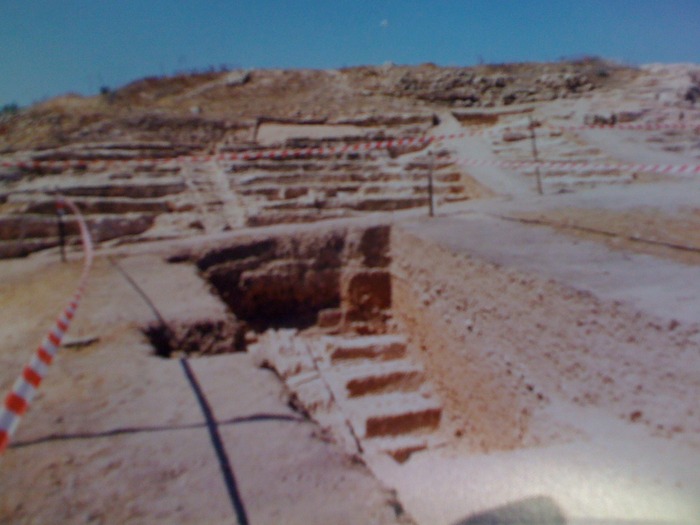
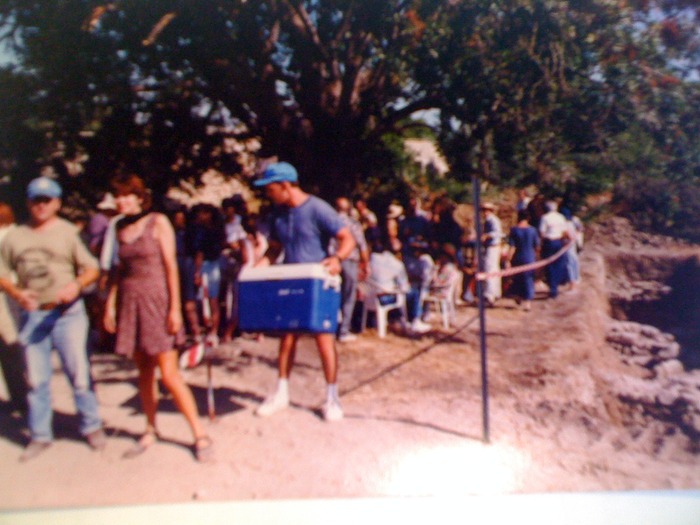
The images aren't very good as they are just scanned photographs.
Mod
Mod
http://en.wikipedia.o..."
Yes, Jill things are not A-OK financially. Thanks for the add.
Hi Bentley, I'm the guy to the left in the photo, it was taken next to the dig (on the right) welcoming dignitaries and locals to the commencement of that seasons dig.
The one book that I could recommend on Cyprus is this title which I purchased whilst on the Island and read very quickly: by David Hunt
Mod
by David Hunt
Mod
OK the one with the blue hat and jeans on. I guess they must have had some cold drinks with the guy and the cooler unless he was carrying artifacts (smile). Now what has happened to that dig location now - is it open to the public - is there a museum there and what happened to the artifacts? Are they on display?
I did not know that you were involved with archaeology although you loved the Loeb Classics (ancient classics).
Thanks for the add.
Hi Bentley,I'm afraid that where there are Australians there is usually some cold beer :)
Here are a few links to the site, its developed a lot since I worked on it in 1995:
http://sydney.edu.au/arts/archaeology...
http://www.paphostheatre.com/
Mod
I bet Cyprus gets hot and that cooler probably looked mighty good that day.
 Libby, that one looks fantastic. Thank you.
Libby, first I thought it was a biography, but I think instead it is historical fiction. Right?
Mod
Mod
Libby, I am really happy you brought it to my attention. I read both non-fiction and historical fiction. I want to thank you.
Mod
Mod
Libby wrote: "I hope you enjoy it and look forward to your opinion of this book...."
Libby, that one looks fantastic. Thank you.
Libby, first I thought it was a biography, but I think instead it is historical fiction. Right?
Mod
Mod
Libby, I am really happy you brought it to my attention. I read both non-fiction and historical fiction. I want to thank you.
Mod
Mod
Libby wrote: "I hope you enjoy it and look forward to your opinion of this book...."Libby, I finished The People in Between: A Cyprus Odyssey. The history was made very simple and easy to follow, and that is why I picked up the book. For that I gave it three stars, but I was being kind of generous. However the fictional content is too sweet, cute and contrived. The writing is unexceptional. While reading the book, I complemented with articles in Wiki.
 by
by
 Gregory S. Lamb
Mod
Gregory S. Lamb
Mod
 I haven't read any books about Cyprus but we stayed in Paphos last year - the Mosaics were awesome.
 Mod
Mod
 by Nick Van Der Bijl (no photo)
Synopsis:
The UK has been involved in Cyprus for over 125 years. Strategically placed in the Eastern Mediterranean, it was initially ideal for protection of the Suez Canal and more recently as a ‘listening post’ for the troubled Middle East and southern flank of NATO.
The British faced two serious problems – the first, the Greek Cypriots’ desire for Enosis, (union with Greece) and, second, the intense rivalry and antipathy between the Greek and Turkish communities.
In 1955 the former resulted in a bitter EOKA terrorist campaign led by Colonel George Grivas. This resulted in the deaths of over 100 British servicemen. Nicosia’s ‘Murder Mile’ was the scene of many shootings. The Governor Field Marshal Harding narrowly escaped assassination in his residence. Even British families were targeted.
The next phase was the Turkish Government’s military intervention in 1974 to prevent what they saw as the Greek takeover. In a bloody invasion which saw widespread ‘ethnic cleansing’ and displacement of communities, the Island was divided into two sectors policed by the United Nations. This exists today, as do the British Sovereign Base areas at Dhekalia and Atrokiri/Episkopi.
This book describes the most troubled years of this beautiful island which is so well known to British servicemen, their families and holiday makers.
Mod
Mod
 by Tabitha Morgan (no photo)
Synopsis:
On a sweltering day in July 1878, the men of the 42nd Royal Highlanders - the Black Watch - waded ashore at Larnaca Bay to begin the British occupation of Cyprus. Today, Britons on sunbeds colonise the same stretch of sand, the latest visitors to an island which has long held a special place in the English imagination - and a controversial role in British imperial ambitions.
From Britain’s acquisition of the island in 1878 up to independence in 1960, a true understanding of the complexity of Cypriot society and its aspirations eluded most British administrators. In the late 19th century, the British worked furiously to outmanoeuvre a restless Russian Empire bent on southward expansion. In this ‘Great Game’ of superpowers, few episodes were bolder than the British acquisition of Cyprus through a secret treaty with the Ottoman Empire.
Initially considered strategically vital for the defence of India, the island soon lost its importance as a military staging post, when Britain occupied Egypt. Nevertheless, Cyprus became a major centre of Allied espionage and counter-espionage in both World Wars - a role that up to now has never been fully revealed.
But despite the island’s importance, British rule on Cyprus was often somewhat lackadaisical: low salaries resulted in a colourful staff of hard drinking colonial rejects and scholarly classicists of independent means. Disastrous governance combined with a misunderstanding by the British of the growing desire for enosis, the union of Cyprus with Greece, contributed to increasing Cypriot disillusionment with British rule.
Drawing on largely unpublished material, Morgan reflects on why successive administrations failed so catastrophically to engage with their Cypriot subjects, and how social segregation, confusion about Cypriot identity and the poor calibre of so many administrators all contributed to the bloody guerilla conflict that led, finally, to Cypriot independence.
Sweet and Bitter Island explores for the first time the unique bond between Britain and Cyprus and the complex, sometimes tense, relationship between the two nations which endures to the present day. Extensively researched and lyrically written, this is the definitive portrait of British colonial life on the Mediterranean island.
message 27:
by
Jerome, Assisting Moderator - Upcoming Books and Releases
(last edited Dec 08, 2014 03:36PM)
(new)
Mod
Release date: May 19, 2015
Fighting EOKA: The British Counter-Insurgency Campaign on Cyprus, 1955-1959
 by David French (no photo)
Synopsis:
Drawing upon a wide range of unpublished sources, including files from the recently-released Foreign and Commonwealth Office 'migrated archive', Fighting EOKA is the first full account of the operations of the British security forces on Cyprus in the second half of the 1950s. It shows how between 1955 and 1959 these forces tried to defeat the Greek Cypriot paramilitary organisation, EOKA, which was fighting to bring about enosis, that is the union between Cyprus and Greece.
By tracing the evolving pattern of EOKA violence and the responses of the police, the British army, the civil administration on the island, and the minority Turkish Cypriot community, David French explains why the British could contain the military threat posed by EOKA, but could not eliminate it. The result was that by the spring of 1959 a political stalemate had descended upon Cyprus, and none of the contending parties had achieved their full objectives. Greek Cypriots had to be content with independence rather than enosis. Turkish Cypriots, who had hoped to see the island partitioned on ethnic lines, were given only a share of power in the government of the new Republic, and the British, who had hoped to retain sovereignty over the whole of the island, were left in control of just two military enclaves.
Mod
 by Anastasia Yiangou (no photo)
Synopsis:
World War II marked a pivotal point in the history of Cyprus, yet surprisingly, this period of the island's history has been little studied to date. Anastasia Yiangou here provides the first major study of the impact of World War II on the political development of Cyprus. In doing so she traces shifting Cypriot attitudes to the war and the formation of a triangular conflict in the island between the Left, Right and British colonial power. She explains how the British and Cypriots fought a war alongside each other, yet remained far apart in discussions on the future of the island. Yiangou's original and compelling analysis highlights how the post-1945 landscape of Cypriot political struggles was shaped by forces set in motion during the war itself.
Mod
Mod
Mod
DECEMBER 27TH, 2016 ELIAS HAZOU CYPRUS, CYPRUS TALKS
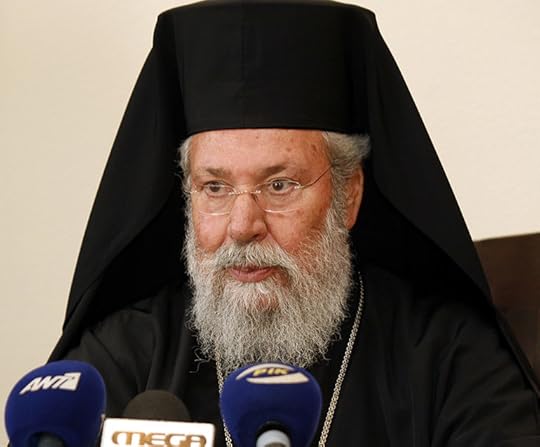
Archbishop Chrysostomos
The Greek Cypriot side must find a way to disentangle from the current track of ongoing reunification talks, where Turkey’s true aim is to gradually take over the whole of the island, Archbishop Chrysostomos has warned.
In his Christmas message, read out across churches in the south on December 25, the prelate entreated his flock to be vigilant of plans afoot to “Turkify” the island.
Remainder of Article:
http://cyprus-mail.com/2016/12/27/arc...
Source of Article: CyprusMail
More:
 by John Hackett (no photo)

The History Book Club
Books mentioned in this topic
A History of the Orthodox Church of Cyprus from the Coming of the Apostles Paul & Barnabas to the Commencement of the British Occupation (other topics)Cyprus in World War II: Politics and Conflict in the Eastern Mediterranean (other topics)
Fighting EOKA: The British Counter-Insurgency Campaign on Cyprus, 1955-1959 (other topics)
Sweet and Bitter Island: A History of the British in Cyprus (other topics)
The Cyprus Emergency: The Divided Island 1955 - 1974 (other topics)
More...
Authors mentioned in this topic
John Hackett (other topics)Anastasia Yiangou (other topics)
David French (other topics)
Tabitha Morgan (other topics)
Nick Van Der Bijl (other topics)
More...

Cyprus is now deemed part of Europe even though very closely aligned with the Middle East. Therefore, I am moving this thread to the Europe folder.
About Cyprus:
Cyprus i/ˈsaɪprəs/ (Greek: Κύπρος [ˈcipɾos] Kýpros; Turkish: Kıbrıs [ˈkɯbɾɯs]), officially the Republic of Cyprus (Greek: Κυπριακή Δημοκρατία [cipɾiaˈci ðimokɾaˈti.a] Kypriakī́ Dīmokratía; Turkish: Kıbrıs Cumhuriyeti [ˈkɯbɾɯs d͡ʒumhuɾijeˈti]), is an island country in the Eastern Mediterranean Sea.
Cyprus is the third largest island in the Mediterranean Sea after Sicily and Sardinia, and a member state of the European Union. It is located east of Greece, south of Turkey, west of Syria and Lebanon, northwest of Israel and the Gaza Strip, and north of Egypt.
The earliest known human activity on the island dates to around the 10th millennium BC.
Archaeological remains from this period include the well-preserved Neolithic village of Khirokitia, which has been declared a World Heritage Site with an "enhanced protection" status in the event of armed conflict by UNESCO, along with the archaeological sites of Paphos and the Painted Churches of the Troodos Region.
Cyprus is home to some of the oldest water wells in the world.
Cyprus was settled by Mycenean Greeks in two waves in the 2nd millennium BC. As a strategic, location in the Middle East, it was subsequently occupied by several major powers, including the empires of the Assyrians, Egyptians, and Persians, from whom the island was seized in 333 BC by Alexander the Great.
Subsequent rule by Ptolemaic Egypt, the Roman Empire, the Byzantines, Arab caliphates for a short period, the French Lusignan dynasty, and the Venetians, was followed by the Ottoman conquest in 1571.
It remained under Ottoman control for over three centuries. Cyprus was placed under British administration in 1878 until it was granted independence in 1960,[15] becoming a member of the Commonwealth the following year.
In 1974, seven years after the intercommunal violence between Greek Cypriots and Turkish Cypriots, an attempted coup d'état by Greek Cypriot nationalists Cyprus i/ˈsaɪprəs/ (Greek: Κύπρος [ˈcipɾos] Kýpros; Turkish: Kıbrıs [ˈkɯbɾɯs]), officially the Republic of Cyprus (Greek: Κυπριακή Δημοκρατία [cipɾiaˈci ðimokɾaˈti.a] Kypriakī́ Dīmokratía; Turkish: Kıbrıs Cumhuriyeti [ˈkɯbɾɯs d͡ʒumhuɾijeˈti]), is an island country in the Eastern Mediterranean Sea.
Cyprus is the third largest island in the Mediterranean Sea after Sicily and Sardinia, and a member state of the European Union. It is located east of Greece, south of Turkey, west of Syria and Lebanon, northwest of Israel and the Gaza Strip, and north of Egypt.
The earliest known human activity on the island dates to around the 10th millennium BC. Archaeological remains from this period include the well-preserved Neolithic village of Khirokitia, which has been declared a World Heritage Site with an "enhanced protection" status in the event of armed conflict by UNESCO, along with the archaeological sites of Paphos and the Painted Churches of the Troodos Region. Cyprus is home to some of the oldest water wells in the world.
Cyprus was settled by Mycenean Greeks in two waves in the 2nd millennium BC. As a strategic, location in the Middle East, it was subsequently occupied by several major powers, including the empires of the Assyrians, Egyptians, and Persians, from whom the island was seized in 333 BC by Alexander the Great. Subsequent rule by Ptolemaic Egypt, the Roman Empire, the Byzantines, Arab caliphates for a short period, the French Lusignan dynasty, and the Venetians, was followed by the Ottoman conquest in 1571.
It remained under Ottoman control for over three centuries. Cyprus was placed under British administration in 1878 until it was granted independence in 1960, becoming a member of the Commonwealth the following year.
In 1974, seven years after the intercommunal violence between Greek Cypriots and Turkish Cypriots, an attempted coup d'état by Greek Cypriot nationalists and elements of the Greek military junta with the aim of achieving enosis (union of the island with Greece) took place
Turkey used this as a pretext to invade the northern portion of the island. Turkish forces remained after a cease-fire, resulting in the partition of the island; an objective of Turkey since 1955.
The intercommunal violence and subsequent Turkish invasion led to the displacement of over 150,000 Greek Cypriots and 50,000 Turkish Cypriots, and the establishment of a separate Turkish Cypriots political entity in the north.
These events and the resulting political situation are matters of ongoing dispute.
The Republic of Cyprus has de jure sovereignty over the island of Cyprus and its surrounding waters, except for the British Overseas Territory of Akrotiri and Dhekelia, administered as Sovereign Base Areas.
However, the Republic of Cyprus is de facto partitioned into two main parts; the area under the effective control of the Republic, comprising about 59% of the island's area, and the Turkish-controlled area in the north, calling itself the Turkish Republic of Northern Cyprus and recognised only by Turkey, covering about 36% of the island's area.
The international community considers the North as occupied territory of the Republic of Cyprus.
Cyprus is the third most populous island in the Mediterranean Sea and a major tourist destination in the Mediterranean.
An advanced, high-income economy with a very high Human Development Index, the Republic of Cyprus was a founding member of the Non-Aligned Movement until it joined the European Union on 1 May 2004.
On 1 January 2008, the Republic of Cyprus joined the Eurozone. and elements of the Greek military junta with the aim of achieving enosis (union of the island with Greece) took place.
Turkey used this as a pretext to invade the northern portion of the island. Turkish forces remained after a cease-fire, resulting in the partition of the island; an objective of Turkey since 1955.
The intercommunal violence and subsequent Turkish invasion led to the displacement of over 150,000 Greek Cypriots and 50,000 Turkish Cypriots, and the establishment of a separate Turkish Cypriots political entity in the north.
These events and the resulting political situation are matters of ongoing dispute.
The Republic of Cyprus has de jure sovereignty over the island of Cyprus and its surrounding waters, except for the British Overseas Territory of Akrotiri and Dhekelia, administered as Sovereign Base Areas.
However, the Republic of Cyprus is de facto partitioned into two main parts; the area under the effective control of the Republic, comprising about 59% of the island's area, and the Turkish-controlled area in the north, calling itself the Turkish Republic of Northern Cyprus and recognised only by Turkey, covering about 36% of the island's area.
The international community considers the North as occupied territory of the Republic of Cyprus.
Cyprus is the third most populous island in the Mediterranean Sea and a major tourist destination in the Mediterranean.
An advanced, high-income economy with a very high Human Development Index, the Republic of Cyprus was a founding member of the Non-Aligned Movement until it joined the European Union on 1 May 2004.
On 1 January 2008, the Republic of Cyprus joined the Eurozone.
Source: Wikipedia
http://en.wikipedia.org/wiki/Cyprus