
Dragons, dragons and-you guessed it, dragons! discussion
Dragonology
>
Hidden Secrets of Dragonlore
date newest »
newest »
 welcome to Dragonologist-lore the world of dragonology!
(which the real name is draconology, which uses the latin for dragon, "draco" like most modern terms) But I'll call it Dragonology... for now so its easier
Dragonologist are people who study dragons...sometime they actually meet them! Every Dragonologist has it's master altough, as an ancient saying goes " when the pupil is ready the master will appear."
Introduction to Dragons
Despised in the West and revered in the East, dragons have a long history in human mythology. How did the myth start? No one knows the exact answer, but some "dragon" bones probably belonged to animals long extinct — in some cases dinosaurs, in others, fossil mammals. Starting in the early 19th century, scientists began to find a new kind of monster, one that had gone extinct tens of millions of years before the first humans evolved. Because the first fragments found looked lizard-like, paleontologists assumed they had found giant lizards, but more bones revealed animals like nothing on earth today. Did these terrible lizards ever coexist with people? No. Although some creationists claim that medieval dragons were really dinosaurs that survived into modern times, this notion enjoys no support from any credible scientist. - from Primus
Most dragons were thought to be large; however, the Chinese combat dragon was considered to be the size of a thimble. As with every mythological creature, dragons are perceived in different ways by different cultures. Dragons are sometimes said to breathe and spit fire or even acid or ice (depending on the type). They are commonly portrayed as serpentine or reptilian, hatching from eggs and possessing extremely large, typically feathered or scaly bodies; they are sometimes portrayed as having large yellow or red eyes, a feature that is the origin for the word for dragon in many cultures, and are often (but not always) portrayed with a row of dorsal spines, keeled scales, long crested ears, slitted eye pupils, leathery bat-like wings and fiery breath. Some dragons do not have wings at all, but look more like long snakes, such as Asian versions of the dragon, sometimes called the Lung. Dragons can have a variable number of legs: none, two, four, or more when it comes to early European literature. Modern depictions of dragons are very large in size, but some early European depictions of dragons were only the size of bears, or, in some cases, even smaller, around the size of a butterfly or even a flea.
Although dragons (or dragon-like creatures) occur in many legends around the world, different cultures have varying stories about monsters that have been grouped together under the dragon label. Chinese dragons (simplified Chinese: 龙; traditional Chinese: 龍; pinyin: lóng), and Eastern dragons generally, are usually seen as benevolent, whereas European dragons are usually malevolent (there are of course exceptions to these rules). Malevolent dragons also occur in Persian mythology (see Azhi Dahaka) and other cultures.
Dragons are particularly popular in China, and along with the phoenix, the 5-clawed dragon was a symbol of the Chinese emperors. Dragon costumes manipulated by several people are a common sight at Chinese festivals.
Dragons are often held to have major spiritual significance in various religions and cultures around the world. In many Eastern and Native American cultures dragons were, and in some cultures still are, revered as representative of the primal forces of nature, religion and the universe. Many pre-Columbian cultures were fascinated by the power of dragons. The Moche people depicted dragons frequently in their ceramics. [1] They are associated with wisdom—often said to be wiser than humans—and longevity. They are commonly said to possess some form of magic or other supernatural power, and are often associated with wells, rain, and rivers. In some cultures, they are also said to be capable of human speech.
The term dragoon, for infantry that move around by horse yet still fight as foot soldiers, is derived from their early firearm, the "dragon", a wide-bore musket that spat flame when it fired, and was thus named for the mythical creature. - from Wikipedia
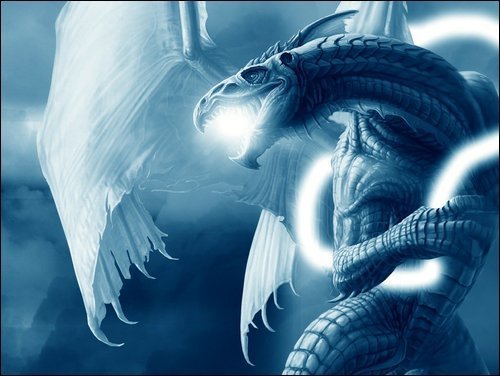
...white dragon
 Hello I am 11 and I think we should talk about the dark evil dragons


These precious scrolls that were once under lock and key are now being re-read in the light of day, hence i must ask that what you read here must be kept secret! Tales of Dragonriders, the very first colony and Dragons versus the human lore are controversial topics, so be descrete in your telling...