
More on this book
Community


Kindle Notes & Highlights

Read between
July 23 - July 28, 2025

inspiration to William Butler Yeats, whose meditations in poetry and prose on the mysteries of Byzantium led me there and gave me a number of underlying motifs along with a sense that imagination and history would be at home together in this milieu.
and we knew not whether we were in heaven or on earth. For on earth there is no such splendour or such beauty, and we were at a loss how to describe it. We know only that God dwells there among men, and their service is fairer than the ceremonies of other nations. For we cannot forget that beauty.
Writers of history often seek the dramatic over the truth. It is a failing of the profession.
The Emperor had no living sons, and his three nephews had rather spectacularly failed a test of their worthiness less than a year before and had suffered appropriate consequences.
Gesius the eunuch, Chancellor of the Imperial Court, pressed his long, thin fingers together piously, and then knelt stiffly to kiss the dead Emperor’s bare feet. So, too, after him, did Adrastus, Master of Offices, who commanded the civil service and administration, and Valerius, Count of the Excubitors, the Imperial Guard.
mostly mercenaries, defending the open spaces of Trakesia from the barbarian incursions of the Karchites and the Vrachae, both of whom had been quiescent of late. The strategos of either military contingent could become a decisive factor—or an Emperor—if the Senate delayed.
He drew a deep breath, aware that his heart was pounding, aware of how important it was to conceal any such intensities.
He offered silent thanks to the god that his own sister-son was a better man, by so very much, than Apius’s three nephews.
The Emperor was dead. There was no Emperor in Sarantium.
and proud, calm men—pagans though they might have been—debated the best way to shape a realm. But by the time Rhodias in Batiara was the heart and hearth of a world-spanning Empire—four hundred years ago, now—the
Those fabled palace gardens were clotted with weeds now, strewn with rubble, the Great Palace sacked and charred by fire a hundred years ago. Sad, shrunken Rhodias was home to a weak High Patriarch of Jad and conquering barbarians from the north and east—the Antae, who still used bear grease in their hair, it was reliably reported.
Slit nostrils and gouged eyes ensured that Apius’s exiled sister-sons need not be considered by the Senators.
But how else, clerics back in Soriyya and elsewhere had preached in opposition, had the ineffable, blindingly bright Golden Lord of Worlds made himself accessible to lowly mankind?
But here in Sarantium issues of faith were endlessly debated everywhere, in dockfront cauponae, whorehouses, cookshops, the Hippodrome, the theaters.
views on Heladikos or the proper liturgy for the sunrise invocations.
Fotius saw the brooch on the sand beside him. He palmed it quickly. No one else seemed to notice. He would sell it, not long after, for enough money to change his life.
those worshippers of the two moons might well do evil for its own sake.
Echoing among marble and mosaic and precious stones and gold,
His dreams shattered—subtle, intricate designs slashed apart—as
The cry that had begun when he brought them word of Daleinus’s death reverberated through the huge space where the chariots ran and people cheered.
Night. A western sea breeze cooling the room through the open windows over the courtyard below. The sound of falling water drifted up from the fountains, and from farther away came the susurration of wind in the leaves of the trees in the Imperial gardens.
All the highest officers of the Empire. Flattened before him on a green and blue mosaic floor of sea creatures and sea flowers.
In the ensuing stillness, one of the mechanical birds began to sing. Valerius the Emperor laughed aloud.
“Oh City, City, ornament of the earth, eye of the world, glory of Jad’s creation, will I die before I see you again?”
every tongue and every dialect. To say of a man that he was sailing to Sarantium was to say that his life was on the cusp of change: poised for emergent greatness, brilliance, fortune—or else at the very precipice of a final and absolute fall as he met something too vast for his capacity.
The Posting Inns on the roads of the Empire were the finest in the world, and Pronobius Tilliticus regarded it as a positive duty to make sure she was gone when next he rode through.
War and plague were part of the world the god had made.
The clerics, even when they disagreed about doctrine or burned each other over Heladikos, all taught submission and faith, not a vainglorious attempt to comprehend.
There was lime ash in there, too, and some other elements mixed in. They were said to help contain the bitter spirits of the dead and what had killed them.
Gray and white showed clearly against green and blue in sunlight.
Did a man always understand his own actions?
was loud, arrogant as all Sarantines seemed to be when they came to Batiara, his words thick with the accent. Everyone heard him.
He never did see his mosaic torch on that sanctuary dome outside the walls of Varena.
“I am an artisan, Majesty. No more than that. I have no place in the intrigues of courts.” He wished he hadn’t put down the wineglass. “And,” he added, too tardily, “I am not going to Sarantium.”
am told you are choleric and of dark humor, and not inclined to be properly respectful. Also that you are skilled at your craft and have attained a measure of renown and some wealth thereby. None of this concerns me.
But no one has reported you to be cowardly or without ambition. Of course you will go to Sarantium. Will you carry my message for me?”
“Empires,” she murmured, “live after us. So does a name. For good or ill.
Valerius II, who was once Petrus of Trakesia, has wanted to regain Rhodias and this peninsula since he brought his uncle to the Golden Throne twelve summers ago.
and we Antae know how to make war. And his enemies east and north—the Bassanids and the northern barbarians—will never sit quiet and watch, no matter how much he pays them.
“You might. You have pure Rhodian blood on both sides. They acknowledge that, still, in Sarantium, though they complain about you. Valerius is said to be interested in ivory, frescoes . . . such things as you do with stones and glass. He is known to hold conversation with his artisans.”
And when he finds that I am not Martinian of Varena?
But he was going to Sarantium. After
Crispin was thinking about the power of memories, the way they had of coming back so fiercely and unexpectedly. A scent could do it, the sound of rushing water, the sight of a stone wall beside a path.
He was remembering that day in the tree, and the recollection of terror took him a little further back, to the image of his mother’s face when the reserves of the urban militia returned from that same year’s spring campaign against the Inicii and his father was not with them.
But he couldn’t cling to any memory of a face that did not blur into an absence. For a man who lived for image and color—who flourished in the realm of sight—this was hard.
Time passing did complex things, to deepen a wound or to heal it. Even, sometimes, to overlay it with another that had felt as if it would kill.
Light nurtured him, as did clean, sharp colors, and the day was offering both. He wondered if he’d ever be able to create a forest with the browns and reds and golds and the late, deep green of the one he could see now beyond the bare fields. With tesserae worthy of the name, and perhaps a sanctuary dome designed with windows enough and—by the god’s grace—good, clear glass for those windows, he might.
In Sarantium these things were to be found, men said. In Sarantium, everything on earth was to be found, from death to heart’s desire, men said.
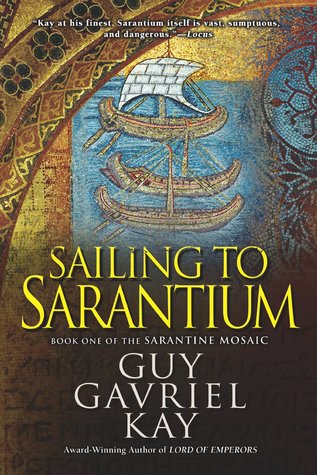
He was a grown man, a respected, well-known artisan, a widower. Sailing to Sarantium.
wanted to go to Sarantium myself once. I had ambitions in the world, and wished to see the Emperor and be honored by him with wealth and women and world’s glory.
