
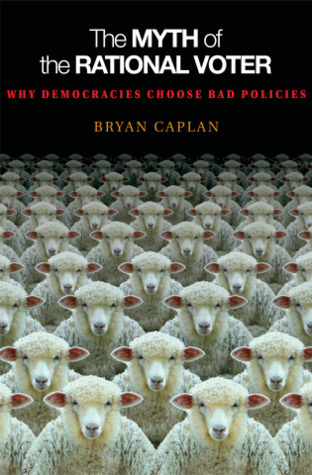
More on this book


Kindle Notes & Highlights

by
Bryan Caplan
Read between
November 13 - December 3, 2018

Protectionist thinking is hard to uproot because it feels good. When people vote under the influence of false beliefs that feel good, democracy persistently delivers bad policies.
An irrational voter does not hurt only himself. He also hurts everyone who is, as a result of his irrationality, more likely to live under misguided policies. Since most of the cost of voter irrationality is external—paid for by other people, why not indulge? If enough voters think this way, socially injurious policies win by popular demand.
now that democracy is the typical form of government, there is little reason to dwell on the truisms that it is “better than Communism,” or “beats life during the Middle Ages.” Such comparisons set the bar too low. It is more worthwhile to figure out how and why democracy disappoints.
economists typically conclude that the man in the street—and the intellectual without economic training—underestimates how well markets work.12 I maintain that something quite different holds for democracy: it is widely over-rated not only by the public but by most economists too. Thus, while the general public underestimates how well markets work, even economists underestimate markets’ virtues relative to the democratic alternative.
there is another kind of empirical evidence that can discredit the Miracle of Aggregation. The Miracle only works if voters do not make systematic errors. This suggests that instead of rehashing the whole topic of voter error, we concentrate our fire on the critical and relatively unexplored question:21 Are voter errors systematic?
But as far as economics is concerned, the jury is in. People do not understand the “invisible hand” of the market, its ability to harmonize private greed and the public interest.
People underestimate the benefits of interaction with foreigners.
People equate prosperity not with production, but...
This highlight has been truncated due to consecutive passage length restrictions.
Lastly, people are overly prone to think that economic conditions are ...
This highlight has been truncated due to consecutive passage length restrictions.
Economic policy is the primary activity of the modern state, making voter beliefs about economics among the most—if not the most—politically relevant beliefs. If voters base their policy preferences on deeply mistaken models of the economy, gove...
This highlight has been truncated due to consecutive passage length restrictions.
The median voter would be better off if he received less protection than he asked for. But competition impels politicians to heed what voters ask for, not what is best for them.
For example, supply-and-demand says that above-market prices create unsaleable surpluses, but that has not stopped most of Europe from regulating labor markets into decades of depression-level unemployment.27 The most credible explanation is that the average voter sees no link between artificially high wages and unemployment.
When he affirms that “science is the great antidote to the poison of enthusiasm and superstition,”33 Smith is not thinking about errors that harmlessly balance out.
Bastiat attacks dozens of popular protectionist sophisms, for example, but does not bother to criticize any popular free trade sophisms. The reason is not that bad arguments for free trade do not exist, but that—unlike bad arguments for protection—virtually none are popular!
Most voters never take a single course in economics. If it is disturbing to imagine the bottom half of the class voting on economic policy, it is frightening to realize that the general population already does.
Sensible public opinion is a public good.40 When a consumer has mistaken beliefs about what to buy, he foots the bill. When a voter has mistaken beliefs about government policy, the whole population picks up the tab.
Instead of fairly weighing all claims, we can show nepotism toward our favorite beliefs. Ayn Rand calls it “blanking out”: “the willful suspension of one’s consciousness, the refusal to think—not blindness, but the refusal to see; not ignorance, but the refusal to know.”
Human beings want their religion’s answers to be true. They often want it so badly that they avoid counterevidence, and refuse to think about whatever evidence falls in their laps.
As Nietzsche uncharitably puts it, “ ‘Faith’ means not wanting to know what is true.”
Eric Hoffer famously expands on this point in his short classic The True Believer, declaring that “all mass movements are interchangeable”: “A religious movement may develop into a social revolution or a nationalist movement; a social revolution, into militant nationalism or a religious movement; a nationalist movement into a social revolution or a religious movement.”
As with religion, extreme ideologies lie at the end of a continuum. One’s political worldview might compare favorably with the outlook of the sole member of a Maoist splinter faction, but remain less than rational.55 To many people, for example, blaming foreigners for domestic woes is a source of comfort or pride.
The more incorrect your beliefs, the more poorly tailored your actions are to actual conditions.58 What is the full price of ideological loyalty? It is the material wealth you forego in order to believe.
Suppose that Robinson Crusoe’s ideology teaches that native islanders like Friday are unable to farm. It flatters his pride to believe that only Europeans can understand agriculture. If Crusoe’s belief is in fact correct, he wisely specializes in agriculture and has Friday do other kinds of work. But if Crusoe’s belief is blind prejudice, keeping Friday out of agriculture reduces total production and makes both men poorer. The difference between Crusoe’s potential living standard and his actual living standard is the full price of his ideological stance.
What is the expected loss of material wealth for a Crusoe who indulges this preference? He forfeits not the per capita reduction in wealth, but the per capita reduction discounted by the probability that he flips the outcome of the election. If the per capita cost of keeping Fridays out of agriculture is $1,000, and the probability of being a tiebreaker is 0.1%, then a Crusoe who votes to keep them out pays $1 to adhere to his cherished fallacy.
In real-world political settings, the price of ideological loyalty is close to zero.59 So we should expect people to “satiate” their demand for political delusion, to believe whatever makes them feel best. After all, it’s free. The fanatical protectionist who votes to close the borders risks virtually nothing, because the same policy wins no matter how he votes. Either the borders remain open, and the protectionist has the satisfaction of saying, “I told you so”; or the borders close, and the protectionist has the satisfaction of saying, “Imagine how bad things would have been if we hadn’t
...more
Recall that the expected material cost of error for one Crusoe was only $1. If a majority of the individual Crusoes find this price attractive, though, each and every Crusoe loses $1,000. Voting to keep the Fridays out of agriculture sacrifices $1,000,000 in social wealth in order to placate ideological scruples worth as little as $501.
A recurring rejoinder to these alarmist observations is that precisely because confused political ideas are dangerous, voters have a strong incentive to wise up. This makes as much sense as the argument that people have a strong incentive to drive less because auto emissions are unpleasant to breathe. No one faces the choice, “Drive a lot less, or get lung cancer,” or “Rethink your economic views, or spiral down to poverty.” In both driving and democracy, negative externalities irrelevant to individual behavior add up to a large collective misfortune.
Democracy is the theory that the common people know what they want, and deserve to get it good and hard.
Contrary to popular stereotypes of the rich Republican and the poor Democrat, income and party identity are only loosely related. The elderly are if anything slightly less supportive of Social Security and Medicare than the rest of the population. Men are more pro-choice than women.
If self-interest does not explain political opinion, what does? Voters typically favor the policies they perceive to be in the general interest of their nation. This is, however, no cause for democratic optimism. The key word is perceive. Voters almost never take the next step by critically asking themselves: “Are my favorite policies effective means to promote the general interest?” In politics as in religion, faith is a shortcut to belief.
What are the implications for democracy? Standard rational choice theory rightly emphasizes that politicians woo voters by catering to their preferences. But this means one thing if voters are shrewd policy consumers, and almost the opposite if, as I maintain, voters are like religious devotees. In the latter case, politicians ha...
This highlight has been truncated due to consecutive passage length restrictions.
The conventional complaint about politicians is “shirking”—their failure to do what voters want.64 I maintain that “shirking” should be dethroned in favor of “demagoguery.” Merriam-Webster’s Collegiate Dictionary defines a demagogue as “a leader who makes use of popular prejudices and false claims and promises in order to gain power.”65 Put bluntly, rule by demagogues is not an aberration. It is the natural condition of democracy. Demagoguery is the winning strategy as long as the electorate is prejudiced and credulous.
Some deviation from voter wishes is bound to occur. But how much? How strictly do elections constrain politicians? My view is that it depends on voters themselves. If they care deeply about an issue—like public use of racial slurs—politicians have almost no slack. One wrong word costs them the election. In contrast, if voters find a subject boring—like banking regulation—if emotion and ideology provide little guidance, their so-called representatives have “wiggle room” to maneuver.
Politicians’ wiggle room creates opportunities for special interest groups—private and public, lobbyists and bureaucrats—to get their way. On my account, though, interest groups are unlikely to directly “subvert” the democratic process. Politicians rarely stick their necks out for unpopular policies because an interest group begs them—or pays them—to do so. Their careers are on the line; it is not worth the risk. Instead, interest groups push along the margins of public indifference.68 If the public has no strong feelings about how to reduce dependence on foreign oil, ethanol producers might
...more
Voters have beliefs—defensible or not—about how the world works. They tend to support politicians who favor policies that, in the voters’ own minds, will be socially beneficial. Politicians, in turn, need voter support to gain and retain office. While few are above faking support for popular views, this is rarely necessary: Successful candidates usually sincerely share voters’ worldview. When special interests woo politicians, they tailor their demands accordingly. They ask for concessions along policy margins where the voice of public opinion is silent anyway. The media, finally, do their
...more
I see neither well-functioning democracies nor democracies highjacked by special interests. Instead, I see democracies that fall short because voters get the foolish policies they ask for.
Logical minds, accustomed to being convinced by a chain of somewhat close reasoning, cannot avoid having recourse to this mode of persuasion when addressing crowds, and the inability of their arguments always surprises them.
A mechanic who fails to notice correlations in a laboratory experiment may ably diagnose your car trouble. Voters might have sensible views about the issues of the day even though the clunkiest computer on the market beats them in chess. It is hard to remain cavalier, however, if your mechanic affirms that cars run on sand instead of gasoline. How could anyone who holds this belief be trusted with a car? The error is directly relevant to practical decisions, and points its adherent in a dangerous direction. Roughly the same is true if voters think that the biggest item in the federal budget is
...more
the public systematically overestimates the share of government spending on welfare and foreign aid, and underestimates the share devoted to national defense and especially Social Security.
“The second pattern among policy questions is for fully informed opinion to hold more progressive attitudes on a wide variety of social policy topics, particularly on those framed as legal issues.”18 Most notably, a more knowledgeable public would be more pro-choice, more supportive of gay rights, and more opposed to prayer in school.
“The third pattern in policy questions is for simulated opinions to be more ideologically conservative on the scope and applications of government power. In particular, fully informed opinion tends to be fiscally conservative when it comes to expanding domestic programs, to prefer free market solutions over government intervention to solve policy problems, to be less supportive of additional government intervention to protect the environment, and to prefer a smaller and less powerful federal government.”
While political knowledge increases support for equal opportunity, it decreases support for equal results.
It is hard to swallow the idea that if people knew more, they would agree with you less.
Why not conclude that more informed people favor free-market policies because the rich correctly identify their own interests? This objection misses the whole point. The distribution of enlightened preferences is more promarket than the actual distribution of preferences primarily because people of all income levels become more promarket as their political knowledge increases. In fact, Althaus shows that as knowledge rises, promarket views increase disproportionately in the bottom half of the income distribution.
Charles Schultze, head of Jimmy Carter’s Council of Economic Advisors, proclaims, “Harnessing the ‘base’ motive of material self-interest to promote the common good is perhaps the most important social invention mankind has yet achieved.” But politicians and voters fail to appreciate this invention.
“The virtually universal characteristic of [environmental] policy . . . is to start from the conclusion that regulation is the obvious answer; the pricing alternative is never considered.”
It would be hard to find an economist more in favor of free markets than Ludwig von Mises. Yet does he argue that unresponsive elites force big government on an unwilling majority? No, he freely grants that the policies he opposes reflect the will of the people: “There is no use in deceiving ourselves. American public opinion rejects the market economy.”
Every individual is continually exerting himself to find out the most advantageous employment for whatever capital he can command. It is his own advantage, indeed, and not that of the society, which he has in view. But the study of his own advantage naturally, or rather necessarily leads him to prefer that employment which is most advantageous to the society.
Analogies between individual and social behavior are at times misleading, but this is not one of those times.
policy changes are often sold as ways to “create jobs.” . . . Jobs can be created in two ways. The socially beneficial way is to enlarge GNP, so that there will be more useful work to be done. But we can also create jobs by seeing to it that each worker is less productive. Then more labor will be required to produce the same bill of goods.
