
More on this book

Kindle Notes & Highlights

Read between
April 9 - May 20, 2025

As vice president, Jefferson wanted someone to talk sense into the French before President Adams could persuade Congress to declare war on France. As Kosciuszko was already being invited by the Directory to talk about issues concerning Poland, he was the best choice for the assignment. Kosciuszko confided to one of his officers in Paris that Niemcewicz was too conspicuous and that the diplomatic overtures to France had to be made quietly. “Since Jefferson thought that I would be the most effective intermediary with France,” he told Colonel Drzewiecki, “I accepted the mission without an
...more
In the parlor was a painting of the Marquis de Lafayette and his family along with a gift from the French general, a small crystal lantern that housed the actual key to the Bastille in Paris.90 In contrast, in the parlor at Monticello, Jefferson hung a portrait of Kosciuszko.91 It was a reminder that while Jefferson had his favorite foreign officer from the American Revolution, Washington also had his.
The legions were hoodwinked by Napoleon’s promise to “restore Poland” and thought that they would march across Europe to free their homeland. They would have to wait: The French were playing the Poles like a fiddle.
France was also facing problems because it was creating too many enemies. By 1799 Austria, Russia, and Great Britain had formed a coalition to push back at the expansionist desires of the French. Napoleon’s expedition to Egypt and Syria to challenge England’s communication routes with its colonies in India proved to be a mistake. While he was away Russia and Austria attacked the French troops stationed in northern Italy, killing thousands of them at the Battle of Trebbia. Thousands of Polish soldiers were slain fighting alongside the French.
A relieved and cheering crowd greeted Napoleon when he returned to Paris on October 16. The next day he was on his way to meet with the five members of the Directory, but stopped on the way to surprise Kosciuszko in his Left Bank apartment on the Rue de Lille. Napoleon warmly greeted the Pole as if he were a brother-in-arms, saying, “I urgently wanted to meet the hero of the north.” Kosciuszko, who expected Napoleon to be an ally, replied, “And I am happy to see the conquerer of Europe, and the hero of the East.”38 The meeting continued with all the niceties of diplomacy, but the Polish
...more
Instead of farming his new property Kosciuszko asked Jefferson if he could find a sharecropper to cultivate the land. He offered that a tenant could have it rent free for five years, and afterward continue at one percent below the market rate. The Pole would never see his land on the Scioto River, which would eventually become Columbus, Ohio.
The peace accord with France that Jefferson was looking for came when Napoleon concluded that it did not make sense to antagonize the Americans at a time when he was at war with Great Britain and much of continental Europe. France ended the quasi war that it started with the United States and signed the Treaty of Mortefontaine. For the occasion, Napoleon even trotted out Lafayette, whom he despised, and raised his glass before the assembled guests, toasting, “To the manes of the French and the Americans who died on the field of battle for the independence of the new world.”59
Lafayette detested the “ancient system and ancient princes of the European continent,” that had imprisoned the peasant masses and divided Poland, and he was a true republican who wanted to wipe out “bigotries of every kind.” He attended a banquet held by the Poles to honor Kosciuszko.61 Lafayette and Kosciuszko also attended a Fourth of July celebration held by the Americans in Paris. The feelings that Lafayette had for the Polish leader were obvious to anyone who visited his apartment. In his room Lafayette kept a bust of George Washington on a small cabinet. Hanging above it was a portrait
...more
No longer having to worry about war with the United States, Napoleon shifted his focus to consolidating power. He exchanged friendly letters with Czar Paul of Russia, while at the same time leading the Poles on, letting them believe that an invasion of eastern Europe was imminent. Yet on February 9, 1801, France signed the Treaty of Luneville with Austria. The war was over.
Napoleon’s control over European affairs soon stretched from Paris all the way to the border of Russia. He signed the Treaty of Tilsit with Czar Alexander, but rather than reestablish Poland as a republic or a kingdom, he created the Duchy of Warsaw as a satellite of France. Once again the Poles had been duped.
But when it came to Napoleon, Kosciuszko told the officer: “He will not resurrect Poland—he thinks only of himself. He detests every great nation and especially the spirit of independence. He’s a despot, and his only aim is personal ambition. He will not create anything durable, I am sure of it. But you, young man, don’t let this bother you. Stay near him to acquire experience and learn strategy. He is a superb leader, and while he will not revive our fatherland, he can train many of our officers, without which things will be bad, even if God later sends us lucky circumstances. I repeat, learn
...more
Jefferson got down to business, admitting: “I must turn to another of unpleasant hue, and apologize to you for what has given me much mortification.” He was in hock, and had borrowed $4,500 from Kosciuszko’s funds to help pay off his debts. The retired president promised to pay back the loan at 8 percent interest.111
The czar did not commit to any of Kosciuszko’s requests, but Prince Adam Czartoryski assured the general that Alexander was someone they could trust and work with. Alexander set up a civil and military committee to start work on concepts for the new Polish legal code. Kosciuszko worked with the committee and wrote a memorandum that was a road map for gradually leading the serfs out of feudalism. He also worked with the military committee to plan an officer corps based on merit.
The monarchies fought over the borders, and once again Europe was on the brink of war, with England, Austria, and France on one side, and Russia and Prussia on the other. The Poles were filled with dread as the powerful monarchies maneuvered against one another and rolled over Poland’s ambitions for independence. Poznan would remain part of Prussia, Krakow was to be a free city controlled by the Austrians, and the center of the country would be called Congress Poland, under Czar Alexander’s control, while the eastern Polish territories would remain part of Russia. Complicating matters further,
...more
In the end, none of the money that Kosciuszko had set aide to free and educate slaves went for its intended purpose.
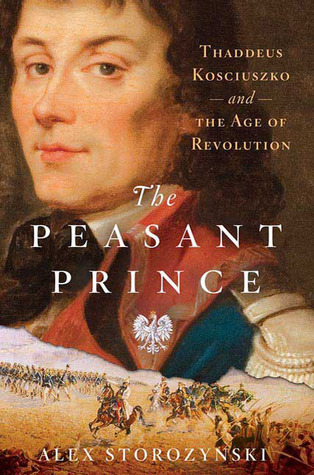
Feudalism was gradually phased out in Europe, but it was not until after World War I that Poland’s national freedom was restored. When that happened the Poles finally brought the bronze urn containing Kosciuszko’s heart back to Poland. The peasant prince had finally returned.
