
More on this book
Community


Kindle Notes & Highlights


The educational and scientific crisis had begun modestly enough, when administrators of the Dover, Pennsylvania, school district met to discuss which biology textbooks to order for the local high school. Some religious members of the school board, unhappy with the current text’s adherence to Darwinian evolution, suggested alternative books that included the biblical theory of creationism. After heated wrangling, the board passed a resolution requiring biology teachers at Dover High to read the following statement to their ninth-grade classes: The Pennsylvania Academic Standards require
...more
This highlight has been truncated due to consecutive passage length restrictions.
Darwin matters because evolution matters. Evolution matters because science matters. Science matters because it is the preeminent story of our age, an epic saga about who we are, where we came from, and where we are going. -Michael Shermer
You can find religions without creationism, but you never find creationism without religion.
A curious aspect of the theory of evolution is that everybody thinks he understands it. —Jacques Monod
the naturalist Alfred Russel Wallace, came up with it at about the same time, leading to one of the most famous simultaneous discoveries in the history of science.
If the entire course of evolution were compressed into a single year, the earliest bacteria would appear at the end of March, but we wouldn’t see the first human ancestors until 6 a.m. on December 31.
So the appearance of species through time, as seen in fossils, is far from random. Simple organisms evolved before complex ones, predicted ancestors before descendants. The most recent fossils are those most similar to living species. And we have transitional fossils connecting many major groups. No theory of special creation, or any theory other than evolution, can explain these patterns.
It is always easier to document evolution in the fossil record than to understand what caused it, for although fossils are preserved, their environments are not. What we can say is that there was evolution, it was gradual, and it varied in both pace and direction.
microevolution—
(macroevolution).
The best way to experience the drama of evolution is to see the fossils for yourself, or better yet, handle them. My students had this chance when Neil brought a cast of Tiktaalik to class, passed it around, and showed how it filled the bill of a true transitional form. This was, to them, the most tangible evidence that evolution was true. How often do you get to put your hands on a piece of evolutionary history, much less one that might have been your distant ancestor?
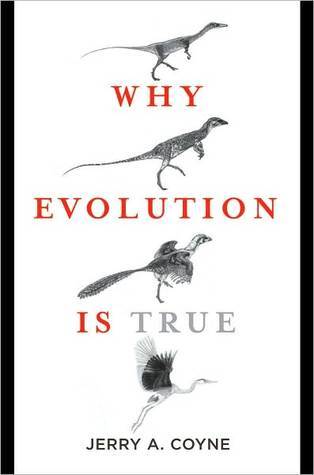
But we no longer have to only imagine this step: we now have the fossils that clearly show how flying birds evolved.
is perhaps the most famous of all transitional forms: the crow-sized Archaeopteryx lithographica, discovered in a limestone quarry in Germany in 1860.
Finally, evolutionary change, even of a major sort, nearly always involves remodeling the old into the new. The legs of land animals are variations on the stout limbs of ancestral fish. The tiny middle ear bones of mammals are remodeled jawbones of their reptilian ancestors. The wings of birds were fashioned from the legs of dinosaurs. And whales are stretched-out land animals whose forelimbs have become paddles and whose nostrils have moved atop their head.
Nothing in biology makes sense except in the light of evolution. —Theodosius Dobzhansky
(why would a creator use exactly the same bones in flying and flightless wings, including the wings of swimming penguins ?), but of evolution from flying ancestors.
