
More on this book


Kindle Notes & Highlights

Read between
August 29 - October 8, 2024

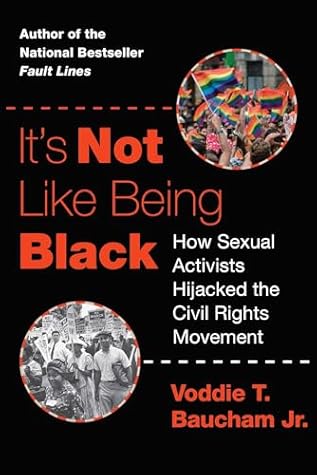
And at the heart of much of the change is the idea that the battle for the rights of so-called “sexual minorities” is the latest front in America’s civil rights struggle, stemming from a single lie that took root in our culture: “Sexual orientation is no different than race.”
If we buy the lie that sexual proclivities and preferences are equivalent to race; if we believe that the fight for the rights of “sexual minorities” is the final frontier in the struggle for civil rights, we are not only opening Pandora’s box, but are insulting whole swaths of people who have fought legitimate civil rights struggles.
I am a black man, a descendant of slaves. I was born in South Los Angeles and have spent the last eight years living and serving in Africa. Anyone looking at me can see that I am black. I don’t “define and express my identity” as black. I was born black, and I will die black. So allow me to state one thing here that we’ll spend the rest of this book unpacking:
Whether you identify as gay, lesbian, bisexual, transgender, trigender, multigender, two-spir...
This highlight has been truncated due to consecutive passage length restrictions.
otherkin, or as a mermaid, a British Columbian wolf, or an avian-human hybrid:15 Not one of those...
This highlight has been truncated due to consecutive passage length restrictions.
December 2008, America’s leading gay magazine, The Advocate, ran a cover article under the headline “Gay Is the New Black.”
The idea that the battle over same-sex marriage was a continuation of the civil rights battles of the 1960s was both strategic and ubiquitous at the time. Gay activists had made a concerted effort to burn this idea into the collective conscience of America decades earlier, and it had worked. The idea that homosexuality was equivalent to race had caught on. To be fair, even the proponents of this argument knew it was a stretch. The author of The Advocate article admitted, Our oppression … is nowhere near as extreme as blacks’, and we insult them when we make facile comparisons between our
...more
Rachel Dolezal, the leader of the NAACP chapter in Spokane, Washington, made headlines when people discovered she was a white woman who had been pretending to be black for many years.
She was working to leverage political power by pretending to be part of an aggrieved minority group. And, like those who identify as homosexuals, her identification was rooted in a history of deep personal feelings and a lifestyle based on living in accordance with those feelings.
Consider what Kennedy wrote in Obergefell. Far from seeking to devalue marriage, the petitioners seek it for themselves because of their respect and need for its privileges and responsibilities. And their immutable nature dictates that same-sex marriage is their only real path to this profound commitment.4 (emphasis mine) Kennedy identified homosexuality as having an “immutable nature,” skipping right over the argument that it is genetically determined—a highly debatable claim at best—to the idea that it cannot be changed. He offered no evidence for his assertion because there is none. In
...more
These two stories continue to bear their contradictory witness. One proclaims that you are what you declare you are (and how you choose to live), and that the law must respect and reflect that choice. The other proclaims that you have no right to declare yourself to be a member of a minority group without sufficient biological evidence to back up that claim.
To answer the first question, let’s look instances where we don’t use the term “minorities.” Somewhere around 5 percent of college students major in engineering,9 but we would never refer to those people as “academic minorities.” Why? Because the term has a special connotation in contemporary culture. It is not a mathematical term, but a political and philosophical one. For example, even though most undergraduate university degrees are granted to female students,10 no one would refer to men as “academic minorities”—but we refer to women not only in academic but professional settings as
...more
When progressives use that word, they are usually referring to people who are not part of the hegemonic power structure. The assumption is that white, male, heterosexual, cisgendered, able-bodied, native-born Christians are in the driver’s seat and everyone else is an oppressed minority.
The sexual minority myth is rooted in neo-Marxist critical theory assumptions about hegemony. For the Critical Theorist, the traditions of Western civilization in general, and Christianity in particular, are neither true and beautiful, nor good; they simply hold sway because of their position of hegemonic dominance. To the intersectional Critical Theorist, ideas like cis-heteronormativity are mere inventions designed to favor and empower certain groups and individuals and allow them to oppress others. The question is not “What hath God said?” because in their minds, there is no God to
...more
The majority opinion Kennedy wrote also equates “desire” with “rights” by arguing that “the petitioners seek (marriage),” and should have it granted to them “because of their respect and need” for it. The decision also reduces marriage to a set of “privileges and responsibilities” granted by the state instead of an institution created by God that the state privileges as a way of acknowledging its unique, God-given nature. The Consequences Obergefell has far-reaching consequences. The standardization of same-sex marriage overturned thousands of years of human history and tradition, threatened
...more
. In many ways, history is only a collection of a series of changes that take place over time. However, there are some things that don’t change, or do so only slightly and rarely—and marriage is one of those things. It is a foundational institution that has defined and distinguished humanity across all cultures. There have been changes to its structure (i.e., arranged marriages, dowry, polygamy, etc.), but not to its essence. At its core, marriage has always united men and women.
To sum up: Gay is not the new black; it is merely the old sodomy. And standardizing the recognition of same-sex “marriage” is nothing at all like doing away with the antimiscegenation laws that once prevented black people from marrying white people. We’ll talk about that in the next chapter.
The common refrain from critical and post-colonial theorists is that America was and is uniquely racist, and that racism was and is uniquely Christian.
Second, as Thomas Sowell has aptly noted, “Slavery was not based on race, much less on theories about race.”4 This is why before the modern era, by and large Europeans enslaved other Europeans, Asians enslaved other Asians, Africans enslaved other Africans, and the indigenous peoples of the Western Hemisphere enslaved other indigenous peoples of the Western Hemisphere.5
What was unique about American slavery was not the fact that it existed, but that it met moral opposition (by the Christian abolitionist movement) and ended within a century after America’s founding.
On its face, that argument seems to make sense. Antimisce-genation laws discriminated against people by forbidding them to marry based on race (an immutable characteristic).17 Marriage laws historically have discriminated against people by forbidding them to marry based on sexual orientation (also deemed to be an immutable characteristic).
Central to the argument of this book is the fact that humans do not get to define marriage. Nor do governments define marriage; they merely acknowledge the definition of marriage. God alone gets to define marriage.
The first is that the changes we have seen in state and federal law, as well as our culture, are not based on scientific facts, but on political maneuvering and the manipulation of public opinion.
The second lesson is that the political maneuvering and manipulation of public opinion is vulnerable to frontal assault.
The last lesson is that it doesn’t take much to expose the lie and flip the script. That is why progressives engage in the politics of character assassination. They can’t win based on the merits of their arguments, so they engage in vicious, emotional, manipulative tactics. That’s why conservatives and Christians can’t just be wrong on the issues; we have to be “homophobes.” We can’t just have a difference of opinion, we have to be guilty of “spreading hate.”
In 1948, Kinsey published a book that is considered the gold standard for understanding human sexuality, Sexual Behavior in the Human Male.
Harry Hay, one of Kinsey’s interviewees and one of the earliest and most prominent gay activists “carried the Kinsey Report with him everywhere, like a religious zealot carrying around a Bible.
Kinsey’s work was used to validate the idea that children are sexual from birth and that what we consider to be “deviant” behavior really isn’t. As we watch the world at large embrace the normalization of multiple kinds of sexual perversions, pedophilia gain greater acceptance, and government schools become bastions for the grooming and molestation of children, remember this: The fraudulent work of Alfred Kinsey, the sadomasochistic, voyeuristic pedophile, is the playbook the people pushing those things are all using.
Not only are Money’s arguments still being used in the burgeoning field of sex reassignment today, but they are now being expanded upon by counselors who claim that giving puberty-blocking drugs to young children and adolescents is harmless and the effects reversible (a lie).
In 2004, at age thirty-eight, Bruce/Brenda/David Reimer committed suicide. Tragically, Brian, who was also abused in Money’s experiments, later died of a drug overdose. Dr. Miriam Grossman—an author and board-certified child and adolescent psychologist who is one of the seeming few still standing for the truths of biology and science—notes that “the entire gender ideology, and all these clinics and hospitals and gender education and the flags and the whole movement—which has become a civil rights moment basically—is entirely based on a concept that was never proven.”33
In fact, their repeated reference to the statistic that “one in ten” Americans is gay is derived from Kinsey’s research. They state, “If we must draw the line somewhere and pick a specific percentage for propaganda purposes, we may as well
stick with the solidly conservative figure suggested by Kinsey decades ago.”
This propaganda campaign had three main parts: desensitizing, jamming, and conversion.
One of the inevitable consequences of the “gay is the new black” paradigm is the eventual elimination of religious freedom protections. Several Republicans justified their support of the “Respect for Marriage Act”—which protects same-sex marriages nationwide from federal nullification even if the U.S. Supreme Court someday overturns Obergefell—by denying this inevitable reality. However, this rationale is naïve at best. If it is true that homosexuality is as innate and immutable as race and forbidding same-sex marriage is tantamount to antimiscegenation, then it must follow that allowing the
...more
kind of mainstream acceptance) is as morally reprehensible as Loving v. Virginia. At the time of this writing, the coercion is limited to moral pressure applied by institutions—but the day will come, and probably not long from now, when the full weight of the law will be brought to bear on churches that hold to a biblical view of marriage and ensure that their orthopraxy matches their orthodoxy. There is a long list of “sexual minorities” who are now poised to capitalize upon the gay community’s successes in hijacking the rationale that led to black Americans’ victories in the civil rights
...more
For instance, the original flag, created by Gilbert Baker in 1978, was comprised of eight colored stripes stacked on top of each other, not the six we see today. I also learned that Baker assigned a specific meaning to each color: pink for sex, red for life, orange for healing, yellow for sunlight, green for nature, turquoise for magic, indigo for serenity, and violet for spirit. In 1979, the pink was dropped due to a shortage of pink fabric, and indigo and turquoise were replaced with blue due to concerns about the legibility of the lighter colors.
2018 by nonbinary American artist and designer Daniel Quasar.1 It is a combination of several ideological flags, including the transgender flag, created by Monica Helms in 1999; the Philadelphia City Hall pride flag, which added black and brown stripes in 2017 to highlight the discrimination against black and brown people, and the Seattle pride flag, which added five new colors to the 1979 rainbow flag in 2018.
Today, it is almost universally assumed that homosexuality is a matter of orientation rather than preference or proclivity, despite the fact that there is no conclusive evidence supporting the idea. Of course, the term “orientation” is almost always defined either loosely or not at all by those who use it. We know there are no biological markers that can predict homosexuality, despite numerous attempts to prove a biological cause. Even propagandists like Kirk and Madsen, who “argue that … gays should be considered to have been born gay,” admit that “sexual orientation … seems to be the product
...more
And, for girls, awareness of same-sex attraction often follows questioning instead of preceding it. That is, girls don’t question because they feel attracted to their friend; they feel attracted to their friend as a result of questioning.7
Bisexuals, according to Merriam-Webster’s Dictionary, are “characterized by sexual or romantic attraction to people of one’s same sex and of the opposite sex.”13 Note the lack of any biological indication in that definition. This is simply a matter of “sexual or romantic attraction.”
Remember, the argument is that bisexuality is an “orientation” like being lesbian or gay. These are supposedly as innate and immutable as ethnicity, yet questions like, “Does the term bisexual give me a sense of comfort?” are supposedly relevant to discovering whether one has this innate, immutable orientation.
The conventional “wisdom” is that gender and sex are unrelated concepts. Sex has to do with our biology; gender is about our roles. Sex is “assigned” at birth. Gender is learned and shaped by culture. At least that’s what we’re told. All of this is false.
As with the triggering of lesbianism, there is currently an epidemic of trans identification among teen girls. Abigail Shrier’s controversial book, Irreversible Damage, offers unsettling insight into the phenomenon.
