
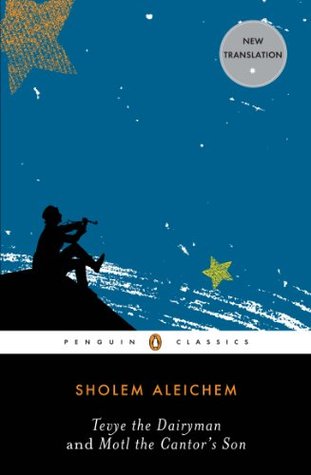
More on this book

Kindle Notes & Highlights


The author aimed to create a child narrator who could nevertheless convey adult truth.
it is high time for the shtetl culture to leave the historical stage for something else, no matter how primitive and crass, as long as it is alive and healthy; that being an orphan is, under certain circumstances, preferable to being burdened with a moribund ancestry.
The function that he is to fulfill demands a Peter Pan-like narrator, and therefore, while the locations and social environments that Motl observes and describes are in constant flux, he himself remains static, a fixture, his character immune to the process of aging and to being reconditioned by drastically changing life situations.
an eternal summer.
should not be contaminated by any vestige of the traditional shtetl culture;
Drawing, being essentially a non-Jewish art (did not the Lord prescribe through Moses: “Thou shalt not make unto thee any graven image, or any likeness of anything that is in heaven above, or that is in the earth beneath, or that is in the water under the earth” [Exodus 20:4]?), dovetails with the innovative, nontraditional aspects of Motl’s personality. Above all else, being a cartoonist rather than a musician goes hand in hand with his detached manner of observing and describing.
they present the metamorphosis of a people, driven by the sheer instinct of survival, in the harsh terms of a comic epic that rarely if ever allows the pathetic fallacy to cloud its mimetic transparency.
What died with shtetl culture had already, for a long time, not been really alive; shtetl culture had been for some
time a caricature o...
This highlight has been truncated due to consecutive passage length restrictions.
Its social order had been bankrupted; its ethos of communal unity and responsibility was a fraud, as Motl’s family...
This highlight has been truncated due to consecutive passage length restrictions.
the option they represent is preferable to the one they reject.
the vitality and talent for survival that render their metamorphosis possible, and he functions as its epic recorder.
The analogy between him and his only friend, the calf Meni, speaks for itself: healthy, normal, and equipped with the biological tools necessary for living and savoring life, Motl is primed for slaughter.
yikhes (pedigree, good parentage) and no money,
Motl’s environment—exploitative, grotesque, sick, vitiated both physically and mentally—is quite ready to swallow him, to quash his high spirits, to imbue him with its lugubrious moribundity, and to stunt his mental and emotional growth forever.
Motl is the only one in which the fire of child rebellion is not extinguished, and the child’s libidinous and instinctual egotism is not crushed by a brutal process of socialization.
orphanhood and pauperization not only saved Motl’s life but also freed the entire community
from paralysis and propelled it in search of food and shelter.
variations on the themes of sickness and death versus health and rebirth.
the two old ladies a hilarious scene of competition over who is more miserable.
The greatest challenge in translating Tevye is Tevye’s frequent (mis)quoting of scripture.
Tevye is presented as Tevye’s account of his life as he relates it to his friend Sholem Aleichem, who records Tevye’s words.
Motl, like Tevye, is written in the first person, but its narrator is a clever, mischievous nine-year-old boy, high-spirited and insatiably curious, eager to try anything for the fun of it. His vocabulary needed to reflect these qualities, something I had great fun with.
The dimming of his usual bright, sharp style alerted me to bad things to come. He was dying as he was writing the very words I was translating, and yet Motl the cantor’s son lives on.
I don’t know what you found so interesting that you would devote your time to an insignificant person like myself, to write me letters and, unbelievably, to put my name in a book, make a big fuss over me, as if I were who knows who.
Without wisdom and a good idea—you might as well ride a dead horse.
You can lead a horse to water but you can’t make him drink.
a Jew, so long as he has a breath of life in him, cannot give up hope.
At that time I wasn’t at all the man you see today. Of course, I was the same Tevye but not really the same.
Soon you’ll see how, if I so decree, your luck can change in a split second, and where there was darkness there will be light.
God decides who will ride and who will go on foot.
The main thing i...
This highlight has been truncated due to consecutive passage length restrictions.
A Jew must hope, must keep on hoping. So what if he goes under in the meantime? What better reas...
This highlight has been truncated due to consecutive passage length restrictions.
Thou hast chosen us—there’s good reason for the whole...
This highlight has been truncated due to consecutive passage length restrictions.
