
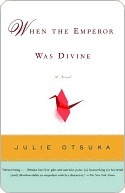
More on this book
Community


Kindle Notes & Highlights

“It’s been a wet year.” The woman nodded. “But we’ve had some nice days.”

Mundanity before disaster. This section is very external, as if the narrator cannot see inside her head. - 3
“That’s a nice red dress,” he called out after her.
Is this a romantic thing? - 2
the picture of Jesus in the foyer,
They are Christian - 1
It bothered her, the way those peasants were forever bent over above that endless field of wheat.
Forshadowing - 2
It was the fourth week of the fifth month of the war and the woman, who did not always follow the rules, followed the rules.
Subtle commentary: this is intended to separate people who are spies or enemies of state, who in the US' eyes "don't follow the rules" - 4/5
Every few days he was allowed to write her a letter. Usually he told her about the weather. The weather at Fort Sam Houston was fine. On the back of every envelope was stamped “Censored, War Department,” or “Detained Alien Enemy Mail.”
He is forbidden from telling her what is really going on - 2
Everything looked the same except the earth was a little darker where the hole had been. Darker and wetter.
Symbolism
Tomorrow they were going on a trip.
Birds of America.
Irony: they are being called anti-American - 3
“People were staring.”
People know about the order - 2
“You have the most beautiful face I have ever seen.” “You’re just saying that.”
“Do I have to?”
The woman thought for a moment. “No,” she said, “only if you want to.” “Tell me I have to.” “I can’t.”
Longing for normalcy - 2
“Get over here,” he said, “get over here now.” He sounded just like her husband. If she closed her eyes she could easily imagine that her husband was right there in the room with her.
On the map the lake was called Intermittent. Intermittent Lake. Because sometimes it was there and sometimes it wasn’t. It all depended on the rain.
for the last four and a half months,
as her mother slowly rubbed her back. “Don’t touch me,” said the girl. “I want to be sick by myself.” “That’s impossible,” said her mother. She continued to rub her back and the girl did not push her away.
The girl shook her head and said she was sorry, she only spoke English.
He would think, There goes the train, and then he would not think about the train again. He would think about other things. What was for supper, maybe, or who was winning the war. She knew it was better this way. The last time they had passed through a city with the shades up someone had thrown a rock through one of the windows.
“How many do you think we’ll see?” “Quite possibly, eight.” The boy seemed satisfied with this answer. He laid his head down on his sister’s lap and drifted off to sleep.
“Eat lots, grow up to be big American boy!
His fingers were long and fine and they moved with great precision. He tugged once at the knot to make sure it would hold and it did. “You can keep it,” said the girl. “It’s not mine to keep,” said the man. He gave the ribbon back to her and she slipped it into her pocket.
“Last night it was too cold,” she said, “but now it’s so hot I can hardly breathe. Everything keeps on changing.”
“Someday it might be,”
“That’s her job,” he said. “She’s tired. I can see it in her eyes. Tell her everything will be all right.”
The doll had curly yellow hair and big china eyes that opened and closed.
She looked for his ring finger but his ring finger was one of the fingers that was missing.
Bright yellow lines were painted on the asphalt but the trucks had not parked
The girl did not know what it meant when a man touched his hat. Maybe it meant the same thing as a nod, or a hello. It meant that you had been seen. Or maybe it meant nothing at all.
“What’s wrong?” “Nothing,” said the boy. “I forgot my umbrella. I thought I brought it but I didn’t.” His mother gave him an orange. “You can’t remember everything,” she said. “And even when you can you shouldn’t,” said the girl. “I wouldn’t say that,” said her mother. “You didn’t,” said the girl.
and then a line of text that had been blacked out by the censors.
For it was true, they all looked alike. Black hair. Slanted eyes. High cheekbones. Thick glasses. Thin lips. Bad teeth. Unknowable. Inscrutable. That was him, over there. The little yellow man.
knives. No chopsticks. An endless sea of bobbing black heads.
Far away, on the other side of the ocean, there was fighting, and at night the boy lay awake on his straw mattress and listened to the bulletins on the radio. Sometimes, in the darkness, he heard noises drifting from other rooms. The heavy thud of footsteps. The shuffling of cards. Over and over again, the creaking of springs. He heard a woman whispering, “Lower, lower, there,” and a man with a high voice singing,
“Just say sayonara, Frank.
“Do not touch the barbed-wire fence,” she had said, “or talk to the guards in the towers. “Do not stare at the sun. “And remember, never say the Emperor’s name out loud.”
IT WAS NOT LIKE any desert he had read about in books. There were no palm trees here, no oases, no caravans of camels slowly winding across the dunes. There was only the wind and the dust and the hot burning sand.
Kill the Nazis! Kill the Japs!
Repeating what they've heard; irony/contradiction - 2
on the other side of the fence,
Mostly, though, they waited. For the mail. For the news. For the bells. For breakfast and lunch and dinner. For one day to be over and the next day to begin.
trying to remember the way home. Did she go left on Ward and then right on Grove? Or was it right on Ward and left on Grove? And when had they taken down all the street signs, anyway? Whose bright idea was that? Should she continue to wait for the bus? Or should she just start walking? And when she finally got there, then what?
THE MAN SCRUBBING pots and pans in the mess hall had once been the sales manager of an import-export company in San Francisco. The janitor had owned a small nursery in El Cerrito. The cook had always been a cook. A kitchen’s a kitchen, it’s all the same to me.
I tried to tell her that she no longer worked for me. ‘Mrs. Ueno,’ I said, ‘here we’re all equals,’ but of course she wouldn’t listen.
Sometimes he worried he was there because he’d done something horribly, terribly wrong. But then when he tried to remember what that horrible, terrible thing might be, it would not come to him. It could be anything. Something he’d done yesterday—chewing the eraser off his sister’s pencil before putting it back in the pencil jar—or something he’d done a long time ago that was just now catching up with him. Breaking a chain letter from Juneau, Alaska. Flushing his dying pet goldfish down the toilet before it was completely dead. Forgetting to touch the hat rack three times when the iceman drove
...more
EVERY FEW DAYS the letters arrived, tattered and torn, from Lordsburg, New Mexico. Sometimes entire sentences had been cut out with a razor blade by the censors and the letters did not make any sense. Sometimes they arrived in one piece, but with half of the words blacked out. Always, they were signed, “From Papa, With Love.”
In the mess hall we are collecting nails for Uncle Sam. Yesterday my kite got stuck on the fence.
THE RULES about the fence were simple: You could not go over it, you could not go under it, you could not go around it, you could not go through it. And if your kite got stuck on it? That was an easy one. You let the kite go.
It seeped under doors and around the edges of windows and through the cracks in the walls.
Her watch had said six o’clock for weeks. She had stopped winding it the day they had stepped off the train.
When he thought of the world outside it was always six o’clock. A Wednesday or a Thursday. Dinnertime across America.
