
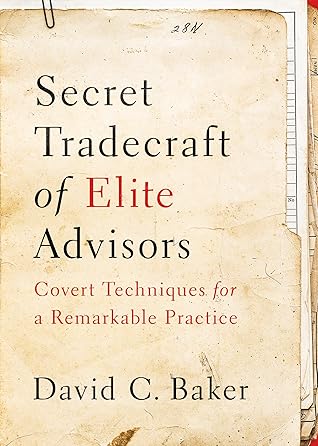
More on this book
Community


Kindle Notes & Highlights

An expert is someone whose thinking is regularly sought and paid for.
An expert is more likely to listen than to talk.
The observation is either new, or familiar but expressed in an interesting way, but seven things are always true:
The expert has a point of view (or perspective). The expert is concise. The expert is believable. The expert can answer follow-up questions without choking. The expert seems confident. The expert holds many principles subject to later modification. The expert—in a work setting—believes the “how” is just as important as the “what.”
I would argue that many experts aren’t rewarded in the marketplace simply because they don’t know how to apply their expertise.

Key
They haven’t developed their own proprietary method of working.
what you should be talking about is whether you are a mutual fit and how you will go about solving their challenge. Nothing else.
Key
But if you don’t have a proprietary means of applying your expertise, you’ll be unable to resist the urge to start solving their problem before you have been engaged. That wastes your time and knocks you off the expert perch.
People have expressed an interest in hiring you for your thinking. You are in an entrepreneurial position in a small firm. There aren’t that many people in the world who know as much about that one thing as you do. You long to really make a difference. You want more control over your consulting engagements. You cringe when you have to introduce yourself as a consultant and would rather be called a valued advisor. You have reached a respectable level of success but feel like there’s another orbit above you that’s yours for the taking. You’ve read The Business of Expertise or at least understand
...more
You’re always reaching a little bit further than your competence would suggest you should. You want to learn, press, explore.
First, make sure your positioning is not interchangeable with more than 200 other advisors, but make sure you can find at least 10 other advisors who do the same thing as you. Not who do it the same way as you, but who do the same thing as you. As a secondary check on your positioning, make sure that there are at least 2,000 addressable prospective clients, but no more than 10,000.
Second, have a simple lead generation plan. This must include the regular development of insight that’s disseminated somehow, but you’ll need at least one higher-impact tactic that fits your personality and takes advantage of the context in which you work: speaking engagements, events, research reports, a book, etc. The goal is to secure more opportunity than you have capacity to serve, because the delta between the two represents your ability to say “no” and maintain more control over your client base.
If you don’t have that business depth, no one is going to pay you a lot of money to solve their challenges. If you don’t have that broad personal life, your expertise will drift in a sea of irrelevance where you’ll be the most interesting person alive … without a place in a world that values narrow expertise.
One of the things that impactful experts do is make connections between disparate areas of knowledge. They see things in one field and apply them in another. Useful nuggets of insight are buried everywhere.
I was always on the lookout for insight that could be applied across industries.
If you lose your confidence for longer than brief intermittent periods, you are doomed as an advisor.
advisors who have a provisional POV and not advisors who are too hesitant with a declared perspective. This requires a certain degree of mental health.
Your clients are too close to things and your objectivity (i.e., distance) gives you a reliable perspective. As much as they try, they can’t step outside of their own reality and see what’s really happening.
Being an outsider is part of what makes you valuable.
That ability to have those tougher, more intense conversations is what will endear your clients to you, but along the way it won’t be like some parade of adoration.
These four building blocks are wrapped in a process that is your tradecraft. Your methodology. Your approach.
The most effective advisors don’t care too much about the wrong things (being liked, having a locked-in future, being around for years). They do what’s right regardless of where that takes them.
Key
This is not your inevitable calling, okay? You have to get over that karma-like insistence that you are destined to succeed.
(and other) pressure is the father of compromise and you cannot do that.
The more insight you publish for free, the less you need to invest in the sale.
The distinction here is that the free stuff is unapplied, leaving the prospect to figure out what parts work and which ones need to be modified. Your clients, though, pay you good money to figure that out for them.
So true
You will take the same toolbox to every engagement. There’s seldom a problem they’ll encounter that you haven’t seen before. But all the little issues will be combined in a client’s own unique form of dysfunction and it’s your job to know which tools—in which order—to apply in solving that for them.
So so true
Your “less-exchangeable” insight, given away for free, earns you a seat at the table and shortens the sales cycle because they feel like they already know you, even before that first conversation takes place.
Wanting things too badly makes you desperate, and desperate people do stupid things.
Don’t just be an expert in what you deliver to clients, but be an expert in how you talk about what you deliver to clients, too.
Key
One of the biggest dangers in business development is wasting time chasing prospective clients who are just kicking the tires,
So if the new relationship is not meant to be, the sooner you find that out the better.
Describe the typical mix between strategy and implementation in your work. Must you do strategy at the outset, or would you go straight to implementation to get a foot in the door and then swim upstream later?
If you require a significant portion of the fee at the outset,
And you won’t impact great clients if you care too much about that specific relationship.
Being an expert in large part means working on the right things, in the right way.
One of the only reasons you can actually help them is that you are not in their world.
but you’ll never pull this off well without strong powers of observation as well as the courage to describe what you see.
From there, after that accurate diagnosis, there has to be a prescription.
There’s something else you could be selling, too, and that’s coaching, or ongoing assistance where you get down in the mud and help them implement things.
The longer you are around, the more you are part of the problem and not the solution.
Second, clients will not pay a premium for ongoing presence, long term. They will only pay a premium for episodic presence.
The residents of a country welcome a liberating force more than ...
This highlight has been truncated due to consecutive passage length restrictions.
Key
Don’t be the occupying force.
They have the staff to do that, and typically each phase is done by different people to preserve their standing with the client.
Your mental model must not depend on “accomplishing all the right things” but on “doing most of the right things,” regardless of the result.
You will need to be okay with walking away, again and again, from unfinished business as clients make your advice their own, adapting it, bending it, interpreting it.
You will be constantly surprised, too, at how little or how much credit you are given, and how some engagements that were not satisfying to you were in fact very successful in the eyes of the client. The...
This highlight has been truncated due to consecutive passage length restrictions.
By now I hope it’s clear that advisors must crave impact.
Key
Your sustainable leverage comes from seven things.
