
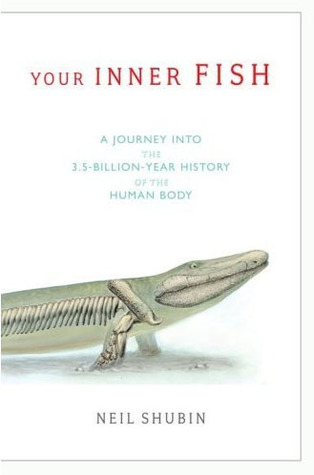
More on this book
Community


Kindle Notes & Highlights

by
Neil Shubin
Read between
February 10 - August 15, 2023

Take the entire 4.5-billion-year history of the earth and scale it down to a single year, with January 1 being the origin of the earth and midnight on December 31 being the present. Until June, the only organisms were single-celled microbes,
fully 3 percent of our entire genome is devoted to genes for detecting different odors.
Carl Sagan once famously said that looking at the stars is like looking back in time. The stars’ light began the journey to our eyes eons ago, long before our world was formed. I like to think that looking at humans is much like peering at the stars. If you know how to look, our body becomes a time capsule that, when opened, tells of critical moments in the history of our planet and of a distant past in ancient oceans, streams, and forests. Changes in the ancient atmosphere are reflected in the molecules that allow our cells to cooperate to make bodies. The environment of ancient streams
...more
The longest uninterrupted hiccups in a person lasted from 1922 to 1990.
Slit the belly of a shark from mouth to tail. The first thing you’ll see is liver, a lot of it. The liver of a shark is gigantic. Some zoologists believe that a large liver contributes to the buoyancy of the shark. Move the liver away and you’ll find the gonads extending up near the heart, in the “chest” area. This arrangement is typical of most fish: the gonads lie toward the front of the body.
