
More on this book
Community


Kindle Notes & Highlights

by
Neil Shubin
Read between
April 14 - May 1, 2021

The paradoxical relationship between planning and chance is best described by Dwight D. Eisenhower’s famous remark about warfare: “In preparing for battle, I have found that planning is essential, but plans are useless.” This captures field paleontology in a nutshell. We make all kinds of plans to get us to promising fossil sites. Once we’re there, the entire field plan may be thrown out the window. Facts on the ground can change our best-laid plans.
Manzoor Elahi liked this
For billions of years, all life lived only in water. Then, as of about 365 million years ago, creatures also inhabited land.
Ideal to preserve fossils are sedimentary rocks: limestones, sandstones, silt-stones, and shales. Compared with volcanic and metamorphic rocks, these are formed by more gentle processes, including the action of rivers, lakes, and seas.
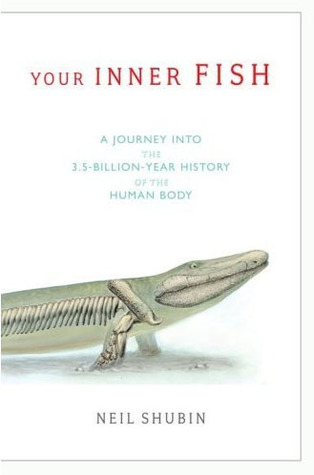
Like a fish, it has scales on its back and fins with fin webbing. But, like early land-living animals, it has a flat head and a neck. And, when we look inside the fin, we see bones that correspond to the upper arm, the forearm, even parts of the wrist. The joints are there, too: this is a fish with shoulder, elbow, and wrist joints. All inside a fin with webbing.
The answer lies in understanding what pieces of DNA (the genes) are actually turned on in every cell. A skin cell is different from a neuron because different genes are active in each cell. When a gene is turned on, it makes a protein that can affect what the cell looks like and how it behaves. Therefore, to understand what makes a cell in the eye different from a cell in the bones of the hand, we need to know about the genetic switches that control the activity of genes in each cell and tissue.
By about 150 million years ago, in rocks from around the world, we find small rodent-size mammals with a new kind of tooth row, one that paved the way for our own existence. What made these creatures special was the complexity of their mouths: the jaw had different kinds of teeth set in it. The mouth developed a kind of division of labor. Incisors in the front became specialized to cut food, canines further back to puncture it, and molars in the extreme back to shear or mash it.
Our particular brand of hardness, with teeth inside our mouths and bones inside our bodies, is an essential part of who we are. We can eat, move about, breathe, even metabolize certain minerals because of our hydroxyapatite-containing tissues. For these capabilities, we can thank the common ancestor we share with all fish. Every fish, amphibian, reptile, bird, and mammal on the planet is like us. All of them have hydroxyapatite-containing structures.
Whether the body belongs to a salmon, a chicken, a frog, or a mouse, all of its organs are formed by endoderm, ectoderm, and mesoderm.
From the early embryologists, people like von Baer, Pander, Mangold, and Spemann, we have learned that all the parts of our adult bodies can be mapped to individual batches of cells in the simple three-layered Frisbee, and the general structure of the body is initiated by the Organizer region discovered by Mangold and Spemann. Cut, slice, and dice, and you’ll find that all mammals, birds, amphibians, and fish have Organizers. You can even sometimes swap one species’ Organizer for another. Take the Organizer region from a chicken and graft it to a salamander embryo: you get a twinned
...more
Genes interact with other genes at all stages of development. One gene may inhibit the activity of another or promote it. Sometimes many genes interact to turn another gene on or off.
Our eyes have a history as organs, but so do eyes’ constituent parts, the cells and tissues, and so do the genes that make those parts. Once we identify these multiple layers of history in our organs, we understand that we are simply a mosaic of bits and pieces found in virtually everything else on the planet.
If I simply showed you an adult human and a shark, you would never guess that this tiny bone deep inside a human’s ear is the same thing as a large rod in the upper jaw of a fish. Yet, developmentally, these bones are the same thing.
The whole system we use to perceive position and acceleration is connected to our eye muscles. The motion of our eyes is controlled by eight small muscles attached to the side walls of the eyeball. The muscles contract to move the eye up, down, left, and right. We can move our eyes voluntarily by contracting these muscles each time we decide to look in a new direction; but some of the most fascinating properties of these muscles relate to their involuntary action. They move our eyes all the time, without our even thinking about it.
When we drink too much, we are putting lots of ethanol into our bloodstream, but the fluid inside our ear tubes initially contains very little. As time passes, however, the alcohol diffuses from our blood into the gel of the inner ear. Alcohol is lighter than the gel, so the result of the diffusion is like the result of pouring alcohol into a glass of olive oil. Just as the oil moves around in the glass as the alcohol enters, so the gel inside our ear swirls. The convection wreaks havoc on the intemperate among us. Our hair cells are stimulated and our brain thinks we are moving. But we are
...more
Massive hangovers involve a slightly different response. The day after the binge, your liver has done a remarkably efficient job of removing the alcohol from your bloodstream. Too efficient, for we still have alcohol in the tubes in our ears. That alcohol then diffuses from the gel back into the bloodstream, and in doing so it once more sets the gel in motion: the spins again.
Organs can come about for one function, only to be repurposed over time for any number of new uses.
The major genes that control our eye and ear correspond to a single gene in more primitive creatures, such as jellyfish. You’re probably thinking, So what? The ancient connection between ear and eye genes helps to make sense of things we see in hospital clinics today: a number of human birth defects affect both the eyes and the inner ear. All this is a reflection of our deep connections to primitive creatures like the stinging box jellyfish.
This biological “law of everything” is that every living thing on the planet had parents.
The extension of this law is where its power comes in. Here it is, in all its beauty: all of us are modified descendants of our parents or parental genetic information. I’m descended from my mother and father, but I’m not identical to them. My parents are modified descendants of their parents. And so on. This pattern of descent with modification defines our family lineage. It does this so well that we can reconstruct your family lineage just by taking blood samples of individuals.
