
More on this book
Community


Kindle Notes & Highlights
by
Neil Shubin
Read between
March 5 - March 17, 2021

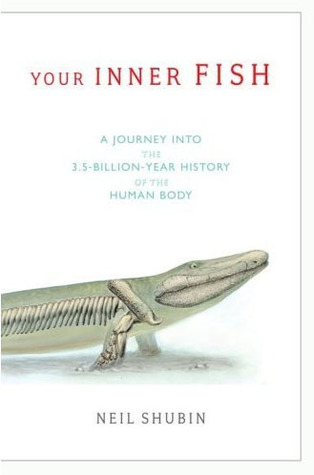
Like a fish, it has scales on its back and fins with fin webbing. But, like early land-living animals, it has a flat head and a neck. And, when we look inside the fin, we see bones that correspond to the upper arm, the forearm, even parts of the wrist. The joints are there, too: this is a fish with shoulder, elbow, and wrist joints. All inside a fin with webbing.

Missing link
The common plan for all limbs: one bone, followed by two bones, then little blobs, then fingers or toes.
The strategies to succeed in this setting were pretty obvious: get big, get armor, or get out of the water. It looks as if our distant ancestors avoided the fight.
At conception, we start as a single cell that contains all the DNA needed to build our body. The plan for that entire body unfolds via the instructions contained in this single microscopic cell. To go from this generalized egg cell to a complete human, with trillions of specialized cells organized in just the right way, whole batteries of genes need to be turned on and off at just the right stages of development. Like a concerto composed of individual notes played by many instruments, our bodies are a composition of individual genes turning on and off inside each cell during our development.
All the genetic switches that make fingers, arm bones, and toes do their thing during the third to eighth week after conception.
A strip of tissue at the extreme end of the limb bud is essential for all limb development. Remove it, and development stops. Remove it early, and we are left with only an upper arm, or a piece of an arm. Remove it slightly later, and we end up with an upper arm and a forearm. Remove it even later, and the arm is almost complete, except that the digits are short and deformed.
The DNA recipe to build upper arms, forearms, wrists, and digits is virtually identical in every creature that has limbs.
Teeth develop by an interaction of two layers of tissue in our developing skin. Basically, two layers approach each other, cells divide, and the layers change shape and make proteins.
We’re all modified sharks—or, worse, there is a lawyer inside each of us.
We may be more complicated than we were at twenty-one days after conception, but we are still a tube within a tube, and all of our organs derive from one of the three layers of tissue that appeared in our second week after conception.
all our cells contain the same DNA; what differs is which bits of DNA are active.
It turns out that these creatures have, unlike more advanced fish and mammals, neither “air” nor “water” genes; rather, their receptors combine both types. The implication is clear: these primitive fish arose before the smelling genes split into two types.
