
More on this book
Community


Kindle Notes & Highlights

by
Neil Shubin
Read between
March 16 - March 27, 2023

Ancient fish bones can be a path to knowledge about who we are and how we got that way. We learn about our own bodies in seemingly bizarre places, ranging from the fossils of worms and fish recovered from rocks from around the world to the DNA in virtually every animal alive on earth today.
For billions of years, all life lived only in water. Then, as of about 365 million years ago, creatures also inhabited land. Life in these two environments is radically different. Breathing in water requires very different organs than breathing in air. The same is true for excretion, feeding, and moving about. A whole new kind of body had to arise. At first glance, the divide between the two environments appears almost unbridgeable. But everything changes when we look at the evidence; what looks impossible actually happened.
The order of fossils in the world’s rocks is powerful evidence of our connections to the rest of life. If, digging in 600-million-year-old rocks, we found the earliest jellyfish lying next to the skeleton of a woodchuck, then we would have to rewrite our texts. That woodchuck would have appeared earlier in the fossil record than the first mammal, reptile, or even fish—before even the first worm. Moreover, our ancient woodchuck would tell us that much of what we think we know about the history of the earth and life on it is wrong. Despite more than 150 years of people looking for fossils—on
...more
Ideal to preserve fossils are sedimentary rocks: limestones, sandstones, silt-stones, and shales. Compared with volcanic and metamorphic rocks, these are formed by more gentle processes, including the action of rivers, lakes, and seas. Not only are animals likely to live in such environments, but the sedimentary processes make these rocks more likely places to preserve fossils. For example, in an ocean or lake, particles constantly settle out of the water and are deposited on the bottom. Over time, as these particles accumulate, they are compressed by new, overriding layers. The gradual
...more
Every rock sitting on the ground has a story to tell: the story of what the world looked like as that particular rock formed. Inside the rock is evidence of past climates and surroundings often vastly different from those of today. Sometimes, the disconnect between present and past could not be sharper. Take the extreme example of Mount Everest, near whose top, at an altitude of over five miles, lie rocks from an ancient sea floor. Go to the North Face almost within sight of the famous Hillary Step, and you can find fossilized seashells. Similarly, where we work in the Arctic, temperatures can
...more
Fossil bones are often harder than the surrounding rock and so erode at a slightly slower rate and present a raised profile on the rock surface.
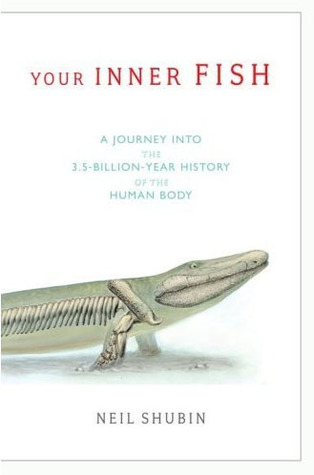
Like a fish, it has scales on its back and fins with fin webbing. But, like early land-living animals, it has a flat head and a neck. And, when we look inside the fin, we see bones that correspond to the upper arm, the forearm, even parts of the wrist. The joints are there, too: this is a fish with shoulder, elbow, and wrist joints. All inside a fin with webbing.
In the midst of the press hubbub, my son’s preschool teacher asked me to bring in the fossil and describe it. I dutifully brought a cast of Tiktaalik into Nathaniel’s class, bracing myself for the chaos that would ensue. The twenty four-and five-year-olds were surprisingly well behaved as I described how we had worked in the Arctic to find the fossil and showed them the animal’s sharp teeth. Then I asked what they thought it was. Hands shot up. The first child said it was a crocodile or an alligator. When queried why, he said that like a crocodile or lizard it has a flat head with eyes on top.
...more
All fish prior to Tiktaalik have a set of bones that attach the skull to the shoulder, so that every time the animal bent its body, it also bent its head. Tiktaalik is different. The head is completely free of the shoulder. This whole arrangement is shared with amphibians, reptiles, birds, and mammals, including us.
In the mid-1800s, anatomists began to learn of mysterious living fish from the southern continents. One of the first was discovered by German anatomists working in South America. It looked like a normal fish, with fins and scales, but behind its throat were large vascular sacs: lungs. Yet the creature had scales and fins. So confused were the discoverers that they named the creature Lepidosiren paradoxa, “paradoxically scaled amphibian.” Other fish with lungs, aptly named lungfish, were soon found in Africa and Australia. African explorers brought one to Owen. Scientists such as Thomas Huxley
...more
When we took the fin of Tiktaalik apart, we found something truly remarkable: all the joint surfaces were extremely well preserved. Tiktaalik has a shoulder, elbow, and wrist composed of the same bones as an upper arm, forearm, and wrist in a human. When we study the structure of these joints to assess how one bone moves against another, we see that Tiktaalik was specialized for a rather extraordinary function: it was capable of doing push-ups.
Fins capable of supporting the body would have been very helpful indeed for a fish that needed to maneuver in all these environments. This interpretation also fits with the geology of the site where we found the fossils of Tiktaalik. The structure of the rock layers and the pattern of the grains in the rocks themselves have the characteristic signature of a deposit that was originally formed by a shallow stream surrounded by large seasonal mudflats. But why live in these environments at all? What possessed fish to get out of the water or live in the margins? Think of this: virtually every fish
...more
This highlight has been truncated due to consecutive passage length restrictions.
The DNA recipe to build upper arms, forearms, wrists, and digits is virtually identical in every creature that has limbs.
Sharks and their relatives are the earliest creatures that have fins with a skeleton inside.
Paleontologists find teeth wonderfully informative. Teeth are the hardest parts of our bodies, because the enamel includes a high proportion of the mineral hydroxyapatite—higher even than is found in bones. Thanks to their hardness, teeth are often the best-preserved animal part we find in the fossil record for many time periods. This is lucky; since teeth are such a great clue to an animal’s diet, the fossil record can give us a good window on how different ways of feeding came about.
There is something else remarkable about the bodies to which conodonts belonged. They have no hard bones. These were soft-bodied animals with hard teeth. For years, paleontologists have argued about why hard skeletons, those containing hydroxyapatite, arose in the first place. For those who believed that skeletons began with jaws, backbones, or body armor, conodonts provide an “inconvenient tooth,” if you will. The first hard hydroxyapatite-containing body parts were teeth. Hard bones arose not to protect animals, but to eat them. With this, the fish-eat-fish world really began in earnest.
...more
Once the process that makes teeth came into being, it was modified to make the diverse kinds of organs that lie within skin. We saw this taken to a very great extreme in the ostracoderms. Birds, reptiles, and humans are just as extreme in many ways. We would never have scales, feathers, or breasts if we didn’t have teeth in the first place. The developmental tools that make teeth have been repurposed to make other important skin structures. In a very real sense organs as different as teeth, feathers, and breasts are inextricably linked by history.
When you see these deep similarities among different organs and bodies, you begin to recognize that the diverse inhabitants of our world are just variations on a theme.
One of the joys of science is that, on occasion, we see a pattern that reveals the order in what initially seems chaotic. A jumble becomes part of a simple plan, and you feel you are seeing right through something to find its essence.
Looking at embryos, it almost seems that the differences among mammals, birds, amphibians, and fish simply pale in comparison with their fundamental similarities.
All animals are the same but different. Like a cake recipe passed down from generation to generation—with enhancements to the cake in each—the recipe that builds our bodies has been passed down, and modified, for eons. We may not look much like sea anemones and jellyfish, but the recipe that builds us is a more intricate version of the one that builds them.
We could speculate on this ad infinitum, but more exciting would be some tangible experimental evidence that shows how predation could bring about bodies. That is essentially what Martin Boraas and his colleagues provided. They took an alga that is normally single-celled and let it live in the lab for over a thousand generations. Then they introduced a predator: a single-celled creature with a flagellum that engulfs other microbes to ingest them. In less than two hundred generations, the alga responded by becoming a clump of hundreds of cells; over time, the number of cells dropped until there
...more
Extracting DNA from bodies is incredibly easy, so easy you can do it in your kitchen. Take a handful of tissue from some plant or animal—peas, or steak, or chicken liver. Add some salt and water and pop everything in a blender to mush up the tissue. Then add some dish soap. Soap breaks up the membranes that surround all the cells in the tissue that were too small for the blender to handle. After that, add some meat tenderizer. The meat tenderizer breaks up some of the proteins that attach to DNA. Now you have a soapy, meat-tenderized soup, with DNA inside. Finally, add some rubbing alcohol to
...more
Our sense of smell allows us to discriminate among five thousand to ten thousand odors. Some people can detect the odor molecules in a green bell pepper at a concentration of less than one part per trillion. That is like picking out one grain of sand from a mile-long beach. How do we do that? What we perceive as a smell is our brain’s response to a cocktail of molecules floating in the air. The molecules that we ultimately register as an odor are tiny, light enough to be suspended in the air. As we breathe or sniff, we suck these odor molecules into our nostrils. From there, the odor molecules
...more
From studying the other primates that have color vision, we can estimate that our kind of color vision arose about 55 million years ago. At this time we find fossil evidence of changes in the composition of ancient forests. Before this time, the forests were rich in figs and palms, which are tasty but all of the same general color. Later forests had more of a diversity of plants, likely with different colors. It seems a good bet that the switch to color vision correlates with a switch from a monochromatic forest to one with a richer palette of colors in food.
When you look into eyes, forget about romance, creation, and the windows into the soul. With their molecules, genes, and tissues derived from microbes, jellyfish, worms, and flies, you see an entire menagerie.
The elegance of our connection to sharks and bony fish is revealed when we look inside our ears. Ears might seem an unlikely place for a human-shark connection, especially since sharks don’t have ears. But the connection is there.
The central issue here is deciphering the family tree of species. Or, in more precise biological terms, their pattern of relatedness. This pattern even gives us the means to interpret a fossil such as Tiktaalik in light of our walk through the zoo. Tiktaalik is a wonderful intermediate between fish and their land-living descendants, but the odds of it being our exact ancestor are very remote. It is more like a cousin of our ancestor. No sane paleontologist would ever claim that he or she had discovered “The Ancestor.” Think about it this way: What is the chance that while walking through any
...more
Carl Sagan once famously said that looking at the stars is like looking back in time. The stars’ light began the journey to our eyes eons ago, long before our world was formed. I like to think that looking at humans is much like peering at the stars. If you know how to look, our body becomes a time capsule that, when opened, tells of critical moments in the history of our planet and of a distant past in ancient oceans, streams, and forests. Changes in the ancient atmosphere are reflected in the molecules that allow our cells to cooperate to make bodies. The environment of ancient streams
...more
The real story is that Apollo 8 is a symbol for the power of science to explain and make our universe knowable. People can quibble over the extent to which the space program was about science or politics, but the central fact remains as clear today as it was in 1968: Apollo 8 was a product of the essential optimism that fuels the best science. It exemplifies how the unknown should not be a source of suspicion, fear, or retreat to superstition, but motivation to continue asking questions and seeking answers.
Just as the space program changed the way we look at the moon, paleontology and genetics are changing the way we view ourselves. As we learn more, what once seemed distant and unattainable comes within our comprehension and our grasp.
What do billions of years of history mean for our lives today? Answers to fundamental questions we face—about the inner workings of our organs and our place in nature—will come from understanding how our bodies and minds have emerged from parts common to other living creatures. I can imagine few things more beautiful or intellectually profound than finding the basis for our humanity, and remedies for many of the ills we suffer, nestled inside some of the most humble creatures that have ever lived on our planet.
