
More on this book
Community


Kindle Notes & Highlights

As she pulled off the covering, Abby kept her eyes on her father for his reaction.
“My late wife, Emily, picked out the name ‘Abigail’ for our daughter. It means ‘father’s joy,’ and nothing could be truer.” Ken had never heard this story before. Did his name mean anything?
Abby beamed and bowed deeply. But as she tried to lift herself, a cramp radiated from her groin. Instinctively, she turned away and as she did, her eyes landed on her painting, where she caught the misplaced shimmers of moonlight streaking this way and that across the canvas. New lines. Ones she hadn’t painted. She felt light-headed. Gold channels zigzagged their way across her work. Then it hit her. This was Jenny’s doing. But Jenny would never intentionally damage her artwork. But then, who? And just as the answer came to her, an agonizing contraction tore through her, and her knees buckled.
Below, a compact shape burst up the stairs and onto the deck. Her half sister. “Step back!” Steph said, taking charge. Who the hell was this woman? Ken wondered. “I’ve got this,” he told her, blocking her with a possessive arm. “Move back,” Steph ordered again, and when he didn’t, she shoved him, causing him to lose his balance and fall on his ass. “I’ve had EMT training.”
“That’s my sister,” he shouted, scrambling to a more dignified position. “Mine, too,” Steph said,
She peeked out through the slit of her eyelids and tried to give a reassuring smile. Ken saw Abby’s glimmer of consciousness. Jenny: “Hang on, Abs.” David: “I love you, Abby.” Wait. Ken felt a familiar prick of betrayal. What? Was David the father? Tessa glared at her father and turned away. Enough, Ken thought, standing up. This was vintage Abby. Her drama would be all anyone would remember of the night. Not his beautiful home. Not the fabulous catering. Not his extraordinary gift. How long would Abby keep up the show? He’d seen her open her eyes and smile even if no one else had. He didn’t
...more
How dare Abby portray his love this way and turn his affection into something degenerate?
From there, Ken squinted and blinked, his gaze traveling from canvas to canvas, taking in the story of their childhood from a different perspective. Abby’s version contradicted his memories.
And what about the painting on the closest easel, where a torso hid under a canoe in their shed, contorting away from a groping arm? It hadn’t been like that. How well is your mask working for you now? George’s voice in his head. Call me anytime. Ken covered his face in his hands. How had he gotten it so wrong? “Siri, call George Kunar.”
Her biological father was oblivious to the chaos he created, and Steph wanted no part of his madness. Even at seventy, Adam was like a kid who threw a lit match over his shoulder and was surprised by the wildfire that followed. Steph thought of her own parents—flawed, yes, but solid, loving, dependable.
Steph pulled over a hospital chair and straddled it. “Are you up for a talk?” “About…?” “All of it, I suppose,” Steph said. “I’ve made some decisions.”

Rude?
“Your family is completely fucked up.”
She’d decided to name the baby Reid, her mother’s maiden name. Reid Gardner.
All the times they’d hid in her closet together,
Ken had created an irrevocable, generation-skipping trust that deeded the property and dwelling to Reid while allowing Abby lifetime use of it. Leave it to her brother to snatch the world out from under her and present it back to her as a gift.
Abby knew that Jenny must have fought to make this happen and decided to focus on gratitude.
Impt
alongside these women and two men-in-the-making—Jonah and Reid.
It was everything.
No one ever got tested for thT genetic disease? Why didnt abby hate ken more? Gretchen sounded like the best charater. Why did she leave specificallt? Fuck adam. He was oblivious to everything? Did ken leave his fAMILY?
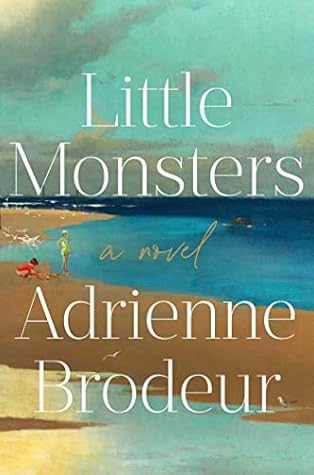
Inspired by the archetypal story of Cain and Abel, Little Monsters is a kaleidoscopic, propulsive, and sophisticated drama exquisite with the tension of characters careening in and out of one another’s orbits, alternately sharing and withholding secrets from one another and themselves—and with Cape Cod’s magnificence and hidden corners elevating every page.
Why do you think Brodeur chose to make mental health—specifically of the male characters—a key element of their respective characterizations?
Having finished the book, how would you characterize what happened between them when they were young?
That said, the tale informed the structure of the book in as much as Cain and Abel made offerings to God, and God favored Abel’s gift. In Little Monsters, the narrative structure builds toward the patriarch’s seventieth birthday where his children present him with gifts of great personal importance and the father favors one child’s offering over the other’s.
also love the subversive idea that the readers know more about what will happen next than the characters.
