
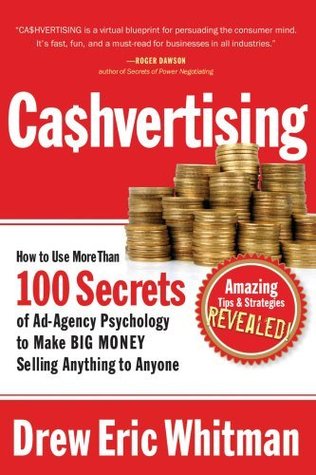
More on this book
Community


Kindle Notes & Highlights


They care about what products will do for them, how they’ll make their lives better, happier, more fulfilled.
According to Haldeman-Julius, the two strongest appeals were sex and self-improvement.
People buy because of emotion and justify with logic. Force an emotional response by touching on a basic want or need.
Not only is it pleasant for us to satisfy our eight primary desires, but it’s also pleasant for us to read about how others have satisfied them.
This vicarious pleasure is where the persuasion begins, because the first use of any product is inside the consumers’ minds. (Stop. Read that last sentence again.) Imagining the use of something that appeals to you increases your desire for it.
And—this is critical—the less imagery you convey, the less your message occupies consumers’ brains, the less likely it is that you’ll influence them.
A 6th grader should be able to read and understand this passage.
Regardless of your prospects’ educational background, short words and short sentences make reading easier for everybody.
A good rule of thumb is that about 70 to 80 percent of your copy should consist of one-syllable words.)
Rule of thumb: Express only one thought in a sentence, no more. Use your next sentence to say the next thing. Why? Because it’s much easier for your readers to process and understand just one thought at a time. And because everything you say is important, you want them to understand each of your sales points, don’t you? Of course. So do as the good Dr. Flesch suggests: (1) Use shorter words—70 to 80 percent of them should consist of just one syllable, and (2) write shorter sentences—aim for about 11 words each. People will read more. The more they read, the greater your chance of persuading
...more
Here’s a great trick used by today’s top copywriters to keep people reading and moving ahead at a quick pace. You simply ask a question or make a quick statement, and then answer the question or continue the thought in the next paragraph in just a few words. Here’s an example.
Not only does this short-paragraph trick move your readers’ eyes down the page, but it also quickens their pace and makes your ad or letter look much more inviting. (As opposed to a big, solid page full of text.)
Get it? The features are the attributes. The benefits are what you get from those attributes. The benefits are what entice people to buy.
There are four important qualities that a good headline may possess. They are:1. Self-interest. 2. News. 3. Curiosity. 4. Quick, easy way. —John Caples
When participants were shown the black-on-white version and were then immediately shown the reversed version, the reversed passage was proven to be 4 percent less legible. When they were only shown the reversed copy, it proved 16 percent less legible...statistically significant in anyone’s book. Verdict? Don’t reverse it.
“We make our bread fresh every day, golden and crusty. Our pasta is made from scratch. We use only fresh herbs in all our recipes. Only pure, cold-pressed 100-percent virgin olive oil is served. Spring water fills your glass, mellow Italian music fills the air, and softly glowing candles light your table.”
Handyman Jack’s is no ordinary hardware store. We’re a Hardware Super Store! We carry 343 kinds of fasteners, 28 types of nails, 86 gauges of wire, 43 grit sizes of sandpaper, 16 different styles of hammers, 28 kinds of screwdrivers, 47 types of keys, a daily inventory of 354,000 bolts and screws, all the top-name power tools for less, and a no-nonsense, money-back
Multiple researchers confirm that serif fonts make words easier to read. (Wordon, 1991; Hartley, 1994). Examples of serif fonts are Times New Roman, Palatino, Schoolbook, Georgia, Courier, Cheltenham, Bookman, and Garamond.
The best way to write any advertising is to start by making a list of all the benefits your product or service offers.
CA$HVERTISING Tip: Start your letter with a question. It’s an extremely effective device for getting people to read deeper.
Remember: The purpose of your first sentence and paragraph is to get people to read your second sentence and paragraph. And so on.
CA$HVERTISING Tip: Put your photo at the top of your ad and make your headline a quote from you. For example, next to my photo in my ad, the headline reads (quote marks included), “Give Me 90 Minutes & I’ll Show You How to Double...Triple...Quadruple Your Ad Response!” You can’t help but notice it. So give the “guillotine” a go!
Remember: The more specific your words—described with PV’s—the clearer the pictures. Even if your product or service is similar to your competitors’, you can still stand out by using this technique.
An ad that only informs and doesn’t move people to buy is like a salesperson who can’t close.
Getting action requires two steps: (1) Make it easy to act, and then (2) ask for action.
Fact: When people can’t distinguish you from your competition, they have no reason to prefer you. And your goal in business is to have people prefer your product, to choose you over everyone else offering the same or a similar thing.
tired of this vague, generic stuff. Ask yourself, “What’s unique about my offer? Am I the only one offering this plan, product, or service? What’s unique about me that I can exploit?” Are you a farmer with a great cash-generating idea to sell to others in your industry? “Idaho Farmer Says, ‘Growing $100 Bills Is as Easy as Growing Potatoes When You Follow My Plan!’”
My Life in Advertising and Scientific Advertising
How to Write a Good Advertisement,
Small-Space Advertising for Large and Small Advertising,
The Robert Collier Letter Book,
Positioning: The Battle for Your Mind,
The Copywriter’s Handbook,
Systematic Approach to Advertising Creativity
How to Design Effective Store Advertising,
Looking Good in Print,
