
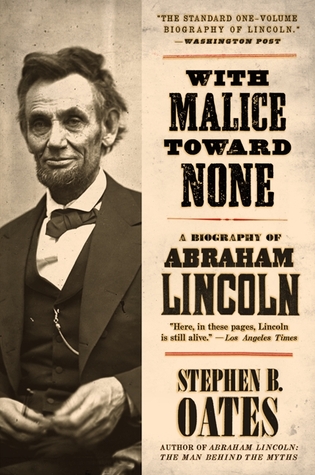
More on this book
Community


Kindle Notes & Highlights
Read between
May 5 - July 24, 2018

Screaming at misguided people, Lincoln believed, was not the way to correct their wrongs. As he put it later, you won people to your side through “persuasion, kind, unassuming persuasion,” making friends with them, appealing to their reason, gently telling them that they were only hurting themselves by their follies.
He who regarded the Declaration as “the sheet anchor” of American liberty understood only too well how human bondage mocked that noble document.
Moreover, he categorically rejected Herndon’s argument that a President could order an invasion of another country to prevent an aggressive act. That, said Lincoln, would allow an American President “to make war at will.”
In truth, in back of popular sovereignty was “a covert real zeal” for the spread of slavery, which Lincoln could not but hate. He hated it because of “the monstrous injustice of slavery itself,” which deprived “our republican example of its just influence in the world.”
Slavery, in sum, was a “total violation” of the sacred right of a man to govern himself, which was guaranteed by the Declaration and was “the sheet anchor of American republicanism.” And that was why Lincoln detested popular sovereignty so—because under the pretext of “MORAL argument” it extended and compounded the evil of slavery and the violation of self-government.

This is important in understanding how immoral slavery is and was in the US
Our progress in degeneracy appears to me to be pretty rapid. As a nation, we began by declaring that ‘all men are created equal.’ We now practically read it ‘all men are created equal, except negroes.’ When the Know-Nothings get control, it will read ‘all men are created equal, except negroes, and foreigners, and catholics.’
Physical rebellions & bloody resistances,” he insisted, would only hurt the free-state cause and the cause of freedom in general. The way to right a wrong was through political action and moral influence: let them mobilize public opinion against Kansas-Nebraska and make the national government stand once again for liberty and justice.
As he’d repeatedly argued, Negro equality was not the issue between him and Douglas. The moral question of slavery in a country with the Declaration of Independence—that was the central question in this contest.
“This is a world of compensations; and he who would be no slave, must consent to have no slave. Those who deny freedom to others, deserve it not for themselves.”
Yes!
At Gettysburg this day, he’d called for a national rededication to the proposition that all men were created equal, a new resolve to fight for that proposition and salvage America’s experiment in democracy for all mankind.
“if slavery is not wrong, nothing is wrong.”
Lincoln said it was the only thing today that had given him pleasure. He wanted Speed to say of him that Lincoln had good judgment, that he always tried to plant a flower when he thought one would grow.
“There is no man in the country whose opinion I value more than yours. I want to know what you think of it.” Douglass said he was impressed: he thought it “a sacred effort.” “I am glad you liked it!” Lincoln said, and he watched as Douglass passed down the line. It was the first inaugural reception in the history of the Republic in which an American President had greeted a free black man and solicited his opinion.
his postwar burdens were among the most difficult he’d ever faced. He had to rebuild and restore the conquered South, maintain the loyalty of white Unionists there, protect Negro freedom, and contend with an increasingly hostile Congress.
The lines swelled with wounded soldiers, who left their hospital beds and marched along now, some hobbling on crutches, torn and bandaged men who followed after their fallen chief. There was a procession of black citizens, walking in lines of forty from curb to curb, four thousand of them in high silk hats and white gloves, holding hands as they moved.
In Chicago, thousands of Lincoln’s fellow Illinoisians—columns of officials, ordinary citizens, Ellsworth Zouaves, immigrants, carpenters, Chicago actors, Jews, Negroes, and ten thousand schoolchildren wearing black armbands—all marched with the coffin in final tribute.
