
More on this book
Community


Kindle Notes & Highlights

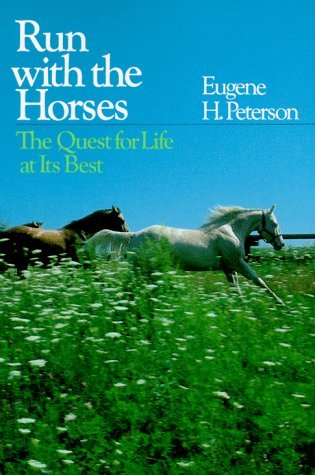
So, Jeremiah, if you’re worn out in this footrace with men, what makes you think you can race against horses? And if you can’t keep your wits during times of calm, what’s going to happen when troubles break loose like the Jordan in flood? JEREMIAH 12:5
individuals who live trivial lives and then engage in evil acts in order to establish significance for themselves.
we continue to have an unquenchable thirst for wholeness, a hunger for righteousness.
One of the first things that strikes us about the men and women in Scripture is that they were disappointingly non- heroic.
significant figures in the life of faith were fashioned from the same clay as the rest of us.
It refuses to feed our lust for hero worship. It will not pander to our adolescent desire to join a fan club.
Fan clubs encourage secondhand living.
We find diversion from our own humdrum existence by riding on the coattails of someone exotic.
each person discovers all the elements of a unique and original adventure.
We are prevented from following in another’s footsteps and are called to an incomparable association with Christ.
The Bible makes it clear that every time that there is a story of faith, it is completely original. God’s creative genius is endless. He never, fatigued and unable to maintain the rigors of creativity, resorts to mass-producing copies. Each life is a fresh canvas on which he uses lines and colo...
This highlight has been truncated due to consecutive passage length restrictions.
We see what is p...
This highlight has been truncated due to consecutive passage length restrictions.
we see how it is possible:
by plunging into a life of faith, participating in what God initiates in each life, exploring what God is doing in each event. The persons we meet on the pages of Scripture are remarkable for the intensity with which they live Godward, the thoroughness in which all the details of their lives are included in God’s word to them, in God’s action in them. It is these persons who are conscious of participating in what God is saying and doing that are most human, most alive. These persons are evidence that none of us is required to live “at this poor dying rate” for another day, another hour.
In Jeremiah it is clear that the excellence comes from a life of faith, from being more interested in God than in self, and has almost nothing to do with comfort or esteem or achievement.
He lived at his best.
His was not a hothouse piety, for he lived through crushing storms of hostility and furies of bitter doubt.
The counsel is that we can arrive at our full humanness by gratifying our desires.
The biblical counsel in these matters is clear: “not my will but thine be done.”
The difficult pastoral art is to encourage people to grow in excellence and to live selflessly, at one and the same time to lose the self and find the self.
By enlisting the devout imagination in meditatively perusing these pages of Scripture, I hope to stir up a dissatisfaction with anything less than our best. I want to provide fresh documentation that the only way that any one of us can live at our best is in a life of radical faith in God. Every one of us needs to be stretched to live at our best, awakened out of dull moral habits, shaken out of petty and trivial busywork.
R. K. Harrison, Jeremiah and Lamentations (InterVarsity Press) for a good, readable introduction into the world and text of Jeremiah; John A. Thompson, The Book of Jeremiah (Eerdmans) for a more advanced, detailed treatment; and John Bright, Jeremiah (Doubleday) for the most complete study of the prophet and the prophecy.
The terrible threat is “that we might die earlier than we really do die, before death has become a natural necessity. The real horror lies in just such a premature death, a death after which we go on living for many years.”[6]
“So, Jeremiah, if you’re worn out in this footrace with men, what makes you think you can race against horses? And if you can’t keep your wits during times of calm, what’s going to happen when troubles break loose like the Jordan in flood?” (Jer 12:5). Biochemist Erwin Chargaff updates the questions: “What do you want to achieve? Greater riches? Cheaper chicken? A happier life, a longer life? Is it power over your neighbors that you are after? Are you only running away from your death? Or are you seeking greater wisdom, deeper piety?”[7]

“Did I point people to Jesus today?”
Life is difficult, Jeremiah. Are you going to quit at the first wave of opposition? Are you going to retreat when you find that there is more to life than finding three meals a day and a dry place to sleep at night? Are you going to run home the minute you find that the mass of men and women are more interested in keeping their feet warm than in living at risk to the glory of God? Are you going to live cautiously or courageously? I called you to live at your best, to pursue righteousness, to sustain a drive toward excellence. It is easier, I know, to be neurotic. It is easier to be parasitic.
...more
The name is that part of speech by which we are recognized as a person:
What we are named is not as significant as that we are named.
Every time that we go along with this movement from the personal to the impersonal, from the immediate to the remote, from the concrete to the abstract, we are diminished, we are less. Resistance is required if we will retain our humanity.
No one can assess my significance by looking at the work that I do. No one can determine my worth by deciding the salary they will pay me. No one can know what is going on in my mind by examining my school transcripts. No one can know me by measuring me or weighing me or analyzing me. Call my name.
It is in relationship—with God.
Naming is not a whim; it is a lever of hope against the future.
And the “hope is not a dream but a way of making dreams become reality” (Cardinal L. J. Suenens).
No child is just a child. Each is a creature in whom God intends to do something glorious and great. No one is only a product of the genes contributed by parents. Who we are and will be is compounded with who God is and what he does. God’s love and providence and salvation are comprised in the real...
This highlight has been truncated due to consecutive passage length restrictions.
A personal name, not an assigned role, is our passbook into reality. It is also our continuing orientation in reality. Anything other than our name—title, job description, number, role—is less than a name. Apart from the name that marks us as uniquely created and personally addressed, we slide into fantasies that are out of touch with the world as it is and so we live ineffectively, irresponsibly. Or we live by the stereotypes in which other people cast us that are out of touch with the uniqueness in which God has created us, and so live diminished into boredom, the brightness leaking away.
The before is the root system of the visible now. Our lives cannot be read as newspaper reports on current events; they are unabridged novels with character and plot development, each paragraph essential for mature appreciation.
Every person we meet must be drawn into that expectation. Every situation in which we find ourselves must be included in the kingdom that we are convinced God is bringing into being. Hope is buying into what we believe. We don’t turn away in despair. We don’t throw up our hands in disgust. We don’t write this person off as incorrigible. We don’t withdraw from a complex world that is too much for us.
