
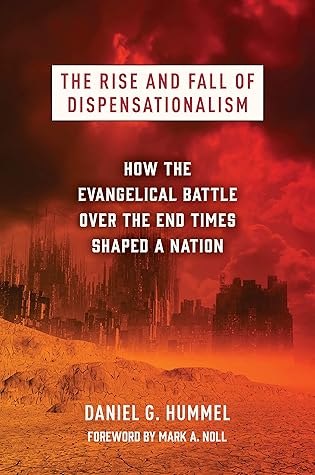
More on this book
Community


Kindle Notes & Highlights
Read between
July 2 - July 11, 2024

By 1928, Philip Mauro had also concluded that something was wrong with fundamentalism. The movement had fractured, and he had identified one of the chief culprits in its own camp: the spread of “dispensationalism.”15 “The time is fully ripe,” he wrote, “for a thorough examination and frank exposure of this new and subtle form of modernism that has been spreading itself among those who have adopted the name ‘Fundamentalists.’” Mauro wanted to prosecute wrong beliefs within the fundamentalist movement and recapture the optimism of a few years earlier. “Evangelical Christianity must purge itself
...more
This highlight has been truncated due to consecutive passage length restrictions.
None of the original faculty held PhDs, and because Chafer subscribed to the same faith principle as many missions agencies (that there should be no direct solicitation of funds), the early years of the school were mired in financial distress, faculty unrest, and institutional reorganization. In this, the early years of Dallas Theological Seminary mirrored fundamentalism writ large.
Chafer described the school as “denominationally unrelated” rather than interdenominational (which might imply a desire to affiliate with denominations) or undenominational (which might imply hostility to denominations).
As a model for effecting immediate change in the contest against modernism, Chafer’s plan proved to be no more effective than Riley’s. A degree from Dallas Seminary carried hardly any cachet outside of the same fundamentalist circles that prized Bible institute graduates. Over the course of the 1920s and 1930s, the seminary gradually became a magnet for separatist and independent churches (and later megachurches), leaving the fight for denominational power to others. But for stitching together a different Christian identity steeped in the theology of dispensational time and new
...more
Independent fundamentalists often taught key features of new premillennial eschatology, such as the rapture and the encroaching reign of the antichrist, but just as often they neglected the teachings of dispensational time, the church-Israel distinction, free grace, and the spirituality of the church. In short, they were uninterested in adopting a theological system but preferred to adopt some features of the emerging system of dispensationalism. While independent fundamentalists suffered from acute infighting, they were often eager to bridge North-South sectional differences, giving
...more
Led by evangelist Billy Graham, the neo-evangelicals (sometimes called “new evangelicals”) claimed to represent a halfway point between fundamentalists and modernists. Their stated objective was to be a big tent and, through the renovated label of “evangelical,” to draw together as many Christians across the spectrum of denominations and creeds that could agree to work together on the basis of a minimal shared doctrinal commitment. In this period the term “evangelical” was basically an endeavor to broker agreement between fundamentalists, Pentecostals, and conservative mainline Protestants to
...more
Neo-evangelicals diagnosed dispensationalists as severed from the evangelical traditions that had guided American Protestant social concern for generations. Some nineteenth-century evangelicals had embraced social reforms such as abolition, temperance, and poverty relief, even as others (or sometimes the very same activists) supported slavery and Jim Crow segregation. Dispensationalism had no comparable record or body of thought, rejecting the very premise that Christians were called to such earthly tasks. A large portion of neo-evangelical writings from the 1940s to the 1970s was focused on
...more
This highlight has been truncated due to consecutive passage length restrictions.
Conspiratorial thinking had always accompanied premillennialists to some extent, dating to Darby’s suspicions of the Church of Ireland and extending to speculations about the reign of Napoleon III and trends of consolidation in the early twentieth century. Riley began to theorize in earnest in the wake of his foiled antievolution activism, though he, too, had a long history of writing about elites (modernists, leftists) he thought possessed too much power. In attacking his political opponents in the 1920s, Riley repeatedly described the conspirators as “Jewish-Bolshevik-Darwinist.”3 His
...more
This highlight has been truncated due to consecutive passage length restrictions.
the overtly antisemitic strain of dispensationalism had more detractors than supporters. J. Frank Norris, the popular preacher Louis Bauman, and most scholastics dissented from this line of thought and were Zionists as well as critics of European antisemitism. They agreed with Riley that Jews were exceptional and occupied “a major place in prophecy,” but they fixed their negative analysis of global events on communists, fascists, progressives, and evolutionists. Rather, the place of Jews in prophecy was linked to Zionism and the “restoration” of national Israel in the Holy Land. Most
...more
For nationalists, on the other hand, prophetic interpretation was all about making sense of the chaotic surface waters of global events.
While Walvoord was a part of a relatively small circle of scholastics based in Dallas and a few other schools working to erect the theological system of dispensationalism, Bauman was one of dozens of nationalists who used prophecy to decode contemporary events in real time. Doing so required no specialized language skills or training. Bauman had none in any case, being ordained into full-time ministry in the German Baptist Brethren church at age eighteen. Rather than exposit dispensational time, Bauman was a popular translator of the signs of the times with columns in the King’s Business and
...more
This highlight has been truncated due to consecutive passage length restrictions.
Upwardly mobile white migrants to the Southwest brought their religion with them, and through the mediums of print and radio blended southern sensibilities with the culture and teachings of northern fundamentalism. The blending of sectional identities was illustrated in the free roam of the same radio waves. Talbot (a Presbyterian from Australia), Fuller (a Baptist native of Los Angeles), and McGee (a Presbyterian from Texas) each had followings across the country. The cultural and media recontextualization of dispensationalism in the Sun Belt extended the reach of dispensational influence and
...more
Unsurprisingly, dispensationalism in its systematized form was unappealing to the Black church, even Black fundamentalists who agreed with other doctrines of the movement. A strand of apocalypticism was present in the teachings of Black fundamentalists, most of whom were entirely excluded from white fundamentalist institutions and conversations.
The term “conservative” had been used inconsistently before 1930 and the systematization of dispensationalism. It rarely described premillennial theology or politics in nineteenth-century usage. Arthur T. Pierson, in 1903, described teachers of Higher Life holiness as possessing “a conservative spirit, a tenacious clinging to the old truths, with a corresponding suspicion of all new and strange doctrines.”12 Still, no identification of political conservatism appeared until “world system” analysis identified progressivism as an agent of global consolidation. By the 1910s, conservatism had
...more
This highlight has been truncated due to consecutive passage length restrictions.
The fundamentalist-modernist controversy had always entailed more than theological difference, but fundamentalists—and especially dispensationalists—had not initially conceived of themselves as propagating a “system.” Yet by the 1940s, they were advancing interlocking commitments that circumscribed the influence of theological ideas outside the system and extrapolated ideas inside the system.
By the 1930s, literal readings of all Scripture, not just prophecy, had become a hallmark of dispensationalism. As David Cooper, a professor at Biola College, described his “Golden Rule of Interpretation” in 1942: “When the plain sense of Scripture makes common sense, seek no other sense; therefore, take every word at its primary, ordinary, usual, literal meaning unless the facts of the immediate context, studied in the light of related passages and axiomatic and fundamental truths, indicate clearly otherwise.”18 Slight variations on this definition were offered time and again—in the
...more
This highlight has been truncated due to consecutive passage length restrictions.
For example, dispensational educator G. Douglas Young, from his American Institute of Holy Land Studies in Jerusalem, spearheaded evangelical Christian Zionism by calling for “Bible-believing Christians” to find a “practical outlet for their pre-millennial faith” informed by literal interpretations of prophecy.20 In little more than two decades, Young and his allies managed to vault evangelical Christians ahead of mainline Protestants as the staunchest Christian supporters of the State of Israel in American politics. Another, and perhaps less obvious, area where the dispensational embrace of
...more
Young-earth creationism extended far beyond dispensational circles—especially in the Wisconsin Evangelical Lutheran Synod and among independent fundamentalist networks. In 2019, 40 percent of Americans agreed with what Gallup defined as “creationism”: dating the human species to not more than 10,000 years old.
In the years after World War II, the theological differences between dispensationalists and other fundamentalists, including the emerging neo-evangelicals, were obscured by an overarching political conservatism rooted in Cold War anticommunism. No figure better reflected the overlap and tensions within fundamentalism than did the evangelist Billy Graham, at once an agent of fundamentalist and later neo-evangelical theology, and also an international celebrity and constant presence in the halls of American power. Though raised in North Carolina, away from the main currents of dispensationalism,
...more
Graham wrote of the rapture in his 1965 best seller, World Aflame. In Graham’s globe-spanning revivals, he, like Dwight Moody fifty years earlier, reiterated time and again that “the Church has been most effective in the world when she has lived in momentary expectancy of the return of Christ.”27 For all his invocations of the rapture, Graham’s understanding of dispensationalism—like Moody’s—remained superficial. Key doctrines, including the church-Israel distinction and the negation of a present kingdom, were hardly taught consistently. At the same 1949 crusade in which he prophesied
...more
Rehearsing standard dispensational teachings, Late Great Planet Earth’s core message was straightforward. Before the rapture and the return of Christ, three prophetic events had to be fulfilled: the return of the Jewish people to their biblical land, their capture of Jerusalem, and the rebuilding of the sacrificial temple destroyed in year 70 by Roman legions. By mid-1967, two of the three steps had improbably reached fulfillment in Lindsey’s estimation. He predicted, based on a typological reading of a parable in Matthew 24, that “within forty years or so of 1948, all these things could take
...more
Late Great Planet Earth did not invoke the term “dispensationalism” once, but when it did appear in coverage of the book or in Lindsey’s teachings, it became synonymous with Lindsey’s apocalyptic timeline. Like the invention of the prophecy chart more than a century before, Lindsey initiated the steady process of popularization by thinning out the theology and making it tantamount to its apocalyptic scenario.
Lindsey offered no mentions of Scofield or Chafer or of his many teachers at Dallas. Late Great Planet Earth was intended as much as an evasion of the scholastic tradition as it was indebted to it. The torrent of pop-dispensational works that followed Lindsey exhibited even fewer references to scholastic thought, further widening the breach in the community. Late Great Planet Earth’s success instead prompted new, less theologically grounded questions for writers: Why did prophecy commentary need any connection to the scholastics or to formal religious thought of any kind? Why did it need to be
...more
This diffusion of the rapture and Armageddon through print, film, and music introduced millions of Americans to the imagery of dispensationalism. But mass exposure through diverse media only hastened the incoherence of dispensational theology. Popularizers failed to ask how the media through which they articulated their faith shaped the meanings they conveyed. Like scholastic dispensationalists, who disregarded critical perspectives on their own hermeneutic assumptions, the producers and consumers of popular dispensationalism were oblivious to Marshall McLuhan’s diagnosis, “the medium is the
...more
The Jesus People movement originated in the Bay Area and was centered in Southern California, in Lindsey’s backyard. This was no accident, growing as it did in the same California soil tilled by premillennialists, dispensationalists, and Pentecostals for more than half a century.
Pop dispensationalism and the Jesus People flourished in Southern California and beyond for much of the 1970s. The movement was soon a national phenomenon, visible in cities and college campuses from Seattle to Washington, DC. Billy Graham grew out his hair a little and capitalized on the youthful energy in his crusades. Explo ’72, a massive eighty-thousand-person rally organized by Campus Crusade for Christ in Dallas, attracted Graham, Johnny Cash, and Larry Norman, among others. The movement inspired most of the first generation of Christian rock musicians and roused some of the first
...more
In one sense this was a story as old as new premillennialism, harkening to the efforts of James Brookes, Joseph Seiss, and Dwight Moody in the nineteenth century. But in another sense, the Jesus People’s embrace of apocalyptic theology helped to undermine the legacy and future of dispensationalism on scholastic terms. The same cultural logic that extended pop dispensationalism’s reach made it vulnerable to the whims of culture and commerce. When cultural trends shifted and consumer tastes changed, pop dispensationalism would be forced to further adapt or die.
In the 1970s, even as pop dispensationalism reached millions of Americans, the project of scholastic dispensationalism began to crumble and the leadership of dispensational theology soon slipped beyond the control of its scholastic stewards. The cultural authority accrued by Dallas Seminary and others slowly drained away to the media empires of pop dispensationalists.
Armageddon, Oil, and the Middle East was only the most successful of a rash of similar outputs by scholastic dispensationalists. In each case, writers presented a more accessible writing style, vocabulary, and fluency with contemporary affairs. The books ignored systematic doctrine, lending credence to the popular image of dispensationalism as little more than an end-times scenario. Other scholarly popularizations included retired Dallas Seminary archaeologist Merrill Unger’s Beyond the Crystal Ball (1973), Western Seminary biblical scholar Stanley A. Ellison’s Biography of a Great Planet
...more
Underlying this self-serving complaint was a nugget of truth: dispensational theology as a whole, if it could still be called a whole, was awash in money but shallow in rigor. For whatever reason, younger evangelicals and fundamentalists lacked the interest to ponder the depths of scholastic dispensationalism. From Couch’s perspective, the most galling failures were unforced errors by dispensational seminaries, Bible schools, and pastors. “[A] de-emphasis on the teaching of the rapture and Bible prophecy in general” among once-strong churches signaled an alarming “paradigm shift,” he warned.
...more
This highlight has been truncated due to consecutive passage length restrictions.
It was not until 1966 that Dallas Seminary accepted its first Black student. A few years later, with still only a handful of Black students on campus, one of them asked John Walvoord, the president, why there was not more concerted effort at recruiting eager Black would-be seminarians. That student was Tony Evans, who would become the seminary’s first Black PhD recipient and a nationally known pastor and author. Writing years later, Evans recalled Walvoord responding, “Tony, I’m not a fighter. I kind of go with the law—the protocol.” Into the 1970s, the institutional leadership of scholastic
...more
A rising movement of Christian political activism and a new strain of nationalism—gathering steam in the 1970s and bursting forth in the New Christian Right at the end of the decade—was, like the commercial popularizers, animated not by strict theological purity but by galvanized interests in society, politics, and culture. Pop dispensationalism’s emphasis on eschatology gave it special cachet in both commercial and political spaces. Meanwhile, the external and internal blows to the scholastic project left dispensationalism-as-a-theological-system in tatters.
The implications of Lindsey’s analysis mirrored a wider pop-dispensational synthesis with Christian nationalism that saw the United States as a decisive actor in the prophetic timeline. The centrality of the United States to God’s purposes was a basic Christian nationalist conceit that was centuries old, but in the 1970s it was newly fused with dispensational eschatology that had up to this point been allergic to making prophecy fulfillment conditional on Republican partisan politics. In many ways pop dispensationalists were indistinguishable from other conservative Christians, but in this
...more
To paraphrase Neil Postman one more time, what happened in the 1980s was not that pop dispensationalism became the dominant content of television, but that television shows became one of the dominant purveyors of a reduced version of dispensationalism.
The leaders of New Calvinism were predominantly megachurch pastors, including John Piper, Tim Keller, and Kevin DeYoung, all members of the Presbyterian Church in America, as well as nondenominational Reformed teachers Charles Joseph (C. J.) Mahaney and Mark Driscoll.

Piper is baptist and Maheney started his own denomination.
Gentry’s conversion story from dispensationalism was shared by other leaders of the movement. North gladly admitted: “I was an ultradispensationalist in the early spring of 1964” while Ray Sutton, pastor of the reconstructionist hot spot of Westminster Presbyterian Church in Tyler, Texas, had trained at Dallas Seminary.4 The shared fundamentalist heritage intensified the rivalry that followed. At the heart of their criticism of fellow fundamentalists, reconstructionists blamed the failure of the church to assert its God-ordained authority over society on dispensationalist teachings that
...more
This is yet another example of people that are basically in a cult like position moving to a new cult like position and not moving towards traditional Christian orthodoxy.
The dispensationalist Thomas Ice wrote around the same time of his undaunted confidence that his was the superior theology, “since the Bible teaches only a single viewpoint on any issue, amillennialism and postmillennialism are nowhere to be found, but premillennialism is found on every page of the Bible, from Genesis to Revelation.”
“Dispensationalism is a popular, and populist, movement,” one of the editors wrote. “Dispensational teaching is so widespread that a lot of people read the Bible this way, even if they are unaware that their position is dispensational. For many of them, it is all they know.”35 Indeed, a general premillennial orientation toward world events and church apostasy could be found across evangelicalism, as could more specific teachings on the rapture and the special eschatological role of the State of Israel. In many cases, pastors trained at dispensational schools continued to teach the theology
...more
This highlight has been truncated due to consecutive passage length restrictions.
The Left Behind series was the most visible sign of this success, and in many other forms of media—nonfiction books, films, music—the American appetite for “rapture culture” seemed insatiable. At the same time, the fate of dispensationalism as a living theological tradition had never been more under threat. The sales success of Left Behind—and the broader success of pop dispensationalism—was a minor consolation. In 2004, dispensationalism was a movement with no vested national leaders, a scholastic tradition with no young scholars, a commercial behemoth with no internal cohesion. Frykholm’s
...more
Whether cognizant of the reality or not, twenty-first-century American evangelicals lived in a religious culture deeply imprinted by the dispensational system, whose ideas did not vanish, as Frykholm perceptively documented, but whose theological integrity was laid low. The parts of dispensationalism had been scattered, no longer organized in the service of a seemingly broken “system” but pulled into powerful currents of popular culture and politics where they continued to shape and form Christians in powerful ways.
Like sports commentators picking winners for the upcoming season, or movie buffs predicting next year’s Oscar awards, the appeal of pop-dispensational prophecy analysis did not hinge on accuracy. Neither did its appeal wane as predictions shifted. As Lindsey’s ceaseless sales proved, what mattered was that the exploration of relevant data was entertaining, that the predictions reinforced existing political and cultural commitments, and that the host was authentic in the conviction of the rightness of his predictions.
The political rather than theological core of these sites indicated what united pop dispensationalists after 2010: a shared loathing of liberalism, progressivism, and modernism.
Evangelicals, and Americans more broadly, have only multiplied doomsday speculation since the collapse of dispensational theology in the 1990s. Its remnants in pop dispensationalism have been thrust into an ocean of raging American apocalypticisms that includes doomsayers of the Anthropocene, Replacement Theory extremists, QAnon trolls, techno pessimists, and neo-Malthusians. For all the problems that theological apocalypticism posed in the twentieth century, it is likely that irreligious apocalypticism in the twenty-first century will prove to be even more disruptive.
