
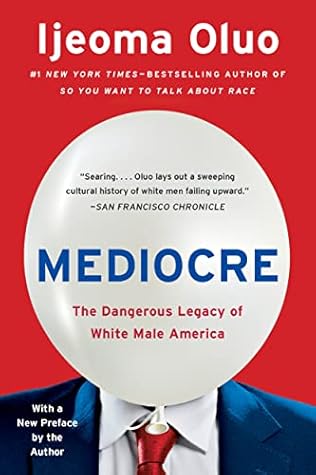
More on this book
Community


Kindle Notes & Highlights

by
Ijeoma Oluo
Read between
March 20 - March 24, 2021

What I’m saying is that white male mediocrity is a baseline, the dominant narrative, and that everything in our society is centered around preserving white male power regardless of white male skill or talent.
By making whiteness and maleness their own reward, we disincentivize white men from working to earn their privileged status. If you are constantly assumed to be great just for being white and male, why would you struggle to make a real contribution? Why take a risk or make a determined effort that might fail when you can be rewarded for keeping your head down? Societal incentives are toward mediocrity. Most
all you need to do to distract white men from how they are actually faring is to task them with the responsibility of ensuring that people of color and women don’t take what little might be theirs.
From these made-up horrors, these fictionalized enemies, he had created a villain worthy of the violent bravado that he imagined he would display if confronted by said villain. This web of racist lies was what he needed to make himself seem like a man.
He invented a story about bad guys who were out to get him, and he repeated it to himself and others until he believed it. Then he made up another story—of himself as hero, defending himself and his family against this violent threat—and he repeated that one until he believed it too.
Perhaps one of the most brutal of white male privileges is the opportunity to live long enough to regret the carnage you have brought upon others.
We were that desperate for a white man to not be trash that we treated mediocrity like it was a masterpiece.
So what happens when a white man decides to take up a cause that will directly threaten his identity as a white man? Well, sometimes he will subconsciously work to maintain his position above those he is trying to “help” by elevating himself even further above them with his selfless deeds, by recentering the goals of the group to maintain his social and political power, or by quietly exploiting or abusing individuals he is claiming to help—or perhaps a combination of the three.
This claim that the focus on identity distracts from “real” politics—while simultaneously centering how “identity politics” affect white men and claiming not to be engaging in identity politics—is a tightrope of hypocrisy that Sanders himself likes to walk. Let’s be clear: centering the needs of progressive, working-class, white men is identity politics. It is just as steeped in individual identity as movements focusing on women and people of color.
This line that Sanders insisted on walking had a special appeal to “progressive” white men who held more left-leaning and socialist views but were deeply afraid of being decentered politically by women and people of color. In Sanders, they had a candidate they could support who would allow them to appear “good”—he spoke of equality, of economic justice, of ending wars, of universal health care—while not having to engage with or challenge their own place in exploitative systems of racial and gender inequality.
A political movement that focuses on class and ignores the specific ways in which race determines financial health and well-being for people of color in this country will be a movement that maintains white supremacy, because it will not be able to identify or address the specific, race-based systems that are the main causes of inequality for people of color.
Not only have things in America not been built for me; they have never been built for me. And although that has been physically, financially, politically, and psychologically disastrous for my community, I have come to see that it is also damaging to be led to believe that everything should be built for you and that anything built with the consideration of others is inherently harmful to you. It is harmful to the individual who believes it, and it is harmful to every system they interact with that is supposed to be built on coalition.
What exactly do people who aren’t white men have that could be more inclusive of white men? We do not have control of our local governments, our national governments, our school boards, our universities, our police forces, our militaries, our workplaces. All we have is our struggle. And yet we are told that our struggle for inclusion and equity—and our celebration of even symbolic steps toward them—is divisive and threatening to those who have far greater access to everything else than we can dream of.
Whereas Chisholm’s candidacy had been ridiculed and dismissed, the white male candidates ended up making history for their embarrassing levels of incompetence and corruption.
What does it look like to respect qualified women of color as thought leaders instead of waiting to turn to them in dire times as saviors? What does it look like to recognize that the ideas we have to help our communities might just benefit all communities? What does it look like to recognize that we are more than warriors, more than survivors—we are innovators and leaders? White men get to be respected in every step of the political process. We look to them for fresh new ideas; we look to them for the wisdom of ages; we look to them to rescue us from disaster. And yet it is women of color who
...more
When you are denied the power, the success, or even the relationships that you think are your right, you either believe that you are broken or you believe that you have been stolen from. White men who think they have been stolen from often take that anger out on others. White men who think they are broken take that anger out on themselves.
White male identity is in a very dark place. White men have been told that they should be fulfilled, happy, successful, and powerful, and they are not. They are missing something vital—an intrinsic sense of self that is not tied to how much power or success they can hold over others—and that hole is eating away at them. I can only imagine how desolately lonely it must feel to only be able to relate to other human beings through conquer and competition. The love, admiration, belonging, and fulfilment they have been promised will never come—it cannot exist for you when your success is tied to
...more
