
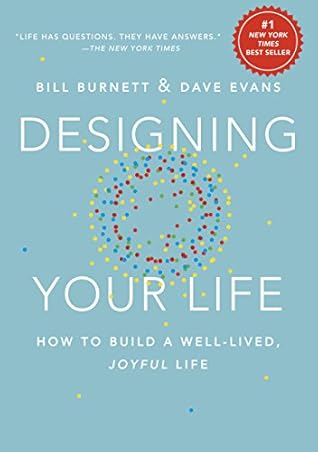
More on this book
Community


Kindle Notes & Highlights

by
Bill Burnett
Read between
May 12, 2019 - April 13, 2020

A well-designed life is a life that is generative—it is constantly creative, productive, changing, evolving, and there is always the possibility of surprise.
The five mind-sets you are going to learn in order to design your life are curiosity, bias to action, reframing, awareness, and radical collaboration.
Life design is a journey; let go of the end goal and focus on the process and see what happens next.
Anti-Passion Is Our Passion
We believe that people actually need to take time to develop a passion. And the research shows that, for most people, passion comes after they try something, discover they like it, and develop mastery—not before. To put it more succinctly: passion is the result of a good life design, not the cause.
Curiosity Bias to action Reframing Awareness Radical collaboration
Let’s face it, you’re not reading this book because you have all the answers, are in your dream job, and have a life imbued with more meaning and purpose than you can imagine. Somewhere, in some area of your life, you are stuck. You have a wicked problem. And that’s a wonderful and exciting place to start.
Problem Finding + Problem Solving = Well-Designed Life
Deciding which problems to work on may be one of the most important decisions you make, because people can lose years (or a lifetime) working on the wrong problem.
These are all gravity problems—meaning they are not real problems. Why? Because in life design, if it’s not actionable, it’s not a problem. Let’s repeat that. If it’s not actionable, it’s not a problem. It’s a situation, a circumstance, a fact of life. It may be a drag (so to speak), but, like gravity, it’s not a problem that can be solved.
We recognize that there are two variations of gravity problems—totally inactionable ones (such as gravity itself) and functionally unactionable ones (such as the average income of a full-time poet). Some of you are trying to decide if the thing you’re stuck on is a gravity problem that isn’t actionable, or just a really, really hard problem that will require effort and sacrifice and runs a high risk of failure but is worth trying.
The only response to a gravity problem is acceptance. And this is where all good designers begin. This is the “You Are Here” or “Accept” phase of design thinking. Acceptance. That’s why you start where you are. Not where you wish you were. Not where you hope you are. Not where you think you should be. But right where you are.
Dysfunctional Belief: To be happy, I have to make the right choice. Reframe: There is no right choice—only good choosing.
The fourth step in the process is to let go of our unnecessary options and move on, embracing our choice fully so that we can get the most from it.
The key is to reframe your idea of options by realizing that if you have too many options, you actually have none at all. If you get frozen in front of your daunting list of possibilities, then, in fact, you have no options. Remember that options only actually create value in your life when they are chosen and realized. We often teach our students that when an option grows up it becomes a choice. So, when you’ve got twenty-four jam options, you actually have zero options. Once you understand that, in choice making, twenty-four equals zero (and, boy, is it hard to believe when you love your
...more
In the Internet-powered, globalized world, there are always a gazillion options, so we are now more capable of being unhappy with our choices than any generation in history has been.
That’s the problem with letting go—it’s more of an inaction than an action, and your brain just hates that, the same way nature abhors a vacuum.
