
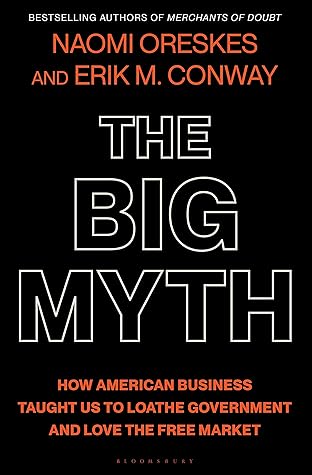
More on this book
Community


Kindle Notes & Highlights
Read between
June 11 - October 30, 2023

Markets are good for many things, but they are not magic. Just look around. Income inequality, the opioid crisis, the lack of affordable housing, retirees who can’t afford to retire, the climate crisis: markets created problems that our market-based system has failed to solve. The only proven remedy is governance.
“Ill fares the land, to hastening ills a prey / Where wealth accumulates, and men decay,” wrote Oliver Goldsmith in 1770, just six years before Adam Smith published The Wealth of Nations.
We need a more realistic vision of what markets are and are not good at, of where they succeed and where they fail. We also need a historically informed conception of the role of governance in creating and managing markets, protecting markets from predatory practices, providing public goods, and addressing social costs of business.
We think what’s at issue is not capitalism per se. Contemporary conservatives, libertarians, and market fundamentalists are not really defending capitalism, even if they think they are. They are defending a certain idea of
capitalism, a vision of growth and innovation by unfettered markets where government just gets out of the way.
Laws exist to prevent people from doing things that hurt other people. We do not see laws against murder and theft as infringing our freedom, because we take it for granted that there is no right to engage in such immoral activities.
As historian Michael Bernstein has shown, the economics profession in America is notable for its lack of diversity in intellectual orientation, both in contrast to other social sciences and in contrast to European economics departments.
In American economics programs, market fundamentalism for a long time was the dominant order of the day, and in many quarters it still is.
Perhaps most importantly, NELA pioneered a strategy of insisting that these claims were true, regardless of the facts.
This privileging of economic rights coupled with the slippery-slope argument—the idea that once property rights were compromised, other rights would ultimately be lost entirely—soon became a cornerstone of twentieth-century American conservative thought.
On another level, however, the league was extremely successful: It effectively articulated a set of arguments that would circulate and influence conservative thinking into the twenty-first century.
La Follette’s Senate committee documented corporate espionage, intimidation of union members and organizers, and management violence.84 Manufacturers and mine owners hired strikebreakers to attack workers and picket lines, sometimes with the assistance of local police, and weaponized their facilities with tear gas, machine guns, and armored cars.
Employers also hired third-party allies specializing in industrial espionage, including the notorious Pinkerton National Detective Agency, infamous for its role in violent strikebreaking.
NAM and NIIC spent $12,719,444.52 on activities intended to influence American public opinion, a figure that would be approximately $140 million today.
By promoting a false dichotomy between laissez-faire capitalism and communist regimentation, market fundamentalists would make it difficult for Americans to have conversations about crucial issues, such as appropriate levels of taxation or the balance between federal and state authority, or even how to appraise the size of the federal government objectively.
They used private espionage and strikebreaking to prevent workers from exercising their freedom to organize, and they used their power and influence to suppress academic freedom by purging textbooks they disliked and replacing them with commissioned texts.
Building on NELA before it, NAM refined the playbook to ensure propaganda would be taken as truth, that its prerogatives
were defended as freedoms while others’ prerogatives were denied as socialistic.
the American economic order was built upon such interventions.
The key was machining: using machines to make parts for other machines. It took nearly fifty years—what would have been an inconceivable period of research and development for
a private corporation in the nineteenth century (or today, for that matter)—but once it was achieved, it revolutionized manufacturing.
The U.S. government’s role in the promotion of railroads, for example—through land grants and the dispossession of Native Americans—has been well documented and well critiqued.
Slavery’s defenders typically invoked property rights to justify it—yet here, in the slave code, was a bald-faced restriction on what slaveowners could do with their (alleged) property.
The key point here is that a market for enslaved people didn’t emerge simply because individual plantation owners insisted on their right to buy and sell other human beings. States claimed their prerogative to decide whether such a market would exist within their borders, and if so, what that market would look like.
NAM was created in the late nineteenth century to advocate for federal imposition of protective tariffs, and to encourage the U.S. government to build the Panama Canal—both policies benefiting American manufacturers.
Tariff Act of 1789,
NAM’s myth about the origins of American prosperity whitewashed the long history of protectionism from which manufacturers benefited, as well as the long history of government participation—on the local, state, and federal level—in markets.
Despite his insistence that economics was a science, he came from a tradition that collected little or no data, and many claims he made were difficult if not impossible to test.

Yellow in this chapter constitutes criticisms of Moses.
In a rare moment of candor, NAM Secretary Noel Sargent had admitted that the opposite of socialism wasn’t, in fact, capitalism.
Sargent identified a key conceptual error in the indivisibility thesis: the failure to acknowledge that capitalism was an economic program, which could be linked with various forms of social and political organization. “[W]hen we compare socialism with capitalism we are discussing two economic programs, and are not discussing such questions as the relation of socialism to art, religion or forms of government. Capitalism may prevail under a democracy or under a dictatorship; socialism … in theory might exist full-fledged under a democracy.”
a second flaw in Mises’s work: it succumbed to the fallacy of the excluded middle. It rested on the false dichotomy of tyrannical totalitarianism on the one hand and unalloyed laissez-faire on the other.
The heart of Keynesianism—and of a good deal of mid-century economic thinking—was to sort out the appropriate role of government in addressing business cycles, monopolies, and market failure.
They assembled a network of funders among business executives, including Harold Luhnow, the director of the Kansas City–based William Volker Fund; Henry Ford II; GM executive Charles Kettering; media mogul William Scripps; and NAM leader and Sun Oil president J. Howard Pew.60 They would christen it the Foundation for Economic Education (FEE), incorporated in 1946 with Goodrich as chairman, Read as president, and Hazlitt as vice president.
One might argue the Austrians were implicitly adopting a utilitarian framework: privileging the greatest good for the greatest number of people and accepting current suffering so long as net harm was reduced. But any position grounded in a utilitarian calculus could hardly claim to be value-neutral. Mises and Hayek insisted on the imperative of value-neutrality, but their positions were anything but. The values they advocated—prosperity, freedom, and above all the right of individuals to decide for themselves what is best and right for themselves—may have been defensible, but they were values,
...more
But in 1935, Hayek took up the argument that Mises began in Socialism and moved it in an explicitly political and normative direction.86
The thesis of The Road to Serfdom is that capitalism and freedom are linked, and so if we wish to preserve political freedom, we must preserve economic freedom.
Like Mises, Hayek collapses the distinctions between social reform, social democracy, socialism, and even National Socialism (i.e., Nazism).
He conflates all forms of antiliberalism with socialism and collapses socialism into fully fledged Soviet-style central economic planning.
markets solve the information problem that dooms socialist planning, and markets are composed of individuals expressing their preferences, so individualism is the best social strategy.
As we have seen, a close reading of his work bears this out: Hayek is not a heartless absolutist.
The right-wing totalitarianism against which Americans were still fighting in the spring of 1945 is equated with left-wing socialism, which is in turn equated with central planning.
Yet Hayek, like Mises, reduced this spectrum of choice to two (and only two) “irreconcilable types of social organization.”
As historian Kevin Kruse explains, restricting the reading to just the preamble allowed them to present the Declaration as a “libertarian manifesto, dedicated to the removal of an oppressive government.” The full Declaration includes a “long list of grievances about the absence of government and rule of law in the colonies”; it critiques the British government for failing to do the job the colonists wanted—indeed, needed—done.
The “right to work” was Orwellian rhetoric, developed by and for management to safeguard their ability to hire and fire at will.
Hayek had given intellectual respectability to a self-serving ideology, but Christianity Today went further, attempting to give not just moral respectability—but a Christian moral imperative—to what liberal theologians had long seen as patently immoral.
“Rand appeals to a lot of rudderless young adults who turn to her for guidance as religion continues its long decline in cultural influence.”
Harvard law professor Yochai Benkler has demonstrated how disinformation and propaganda on the internet are asymmetric, with far more right-wing than left-wing claims.
Smith—the hero of libertarians, the father of free-market economics, the patron saint of self-interest—spent a significant section of his most famous work discussing banks and banking precisely because it illustrated an essential and nonnegligible point: that regulations do infringe liberty, but they are necessary when the “natural liberty of a few individuals … endanger[s] the security of the whole society.”
“The modern advocate of laissez-faire who objects to government participation in business on the grounds that it is an encroachment upon a field reserved by nature for private enterprise cannot find support for this argument in the Wealth of Nations.”57
Yet Smith absolutely affirms that workers are entitled to a minimum standard of decency: “No society can surely be flourishing or happy, of which the far greater part of the members are poor and miserable. It is but equity, besides, that they who feed, cloath and lodge the whole body of the people, should have such a share of the produce of their own labour as to be themselves
