
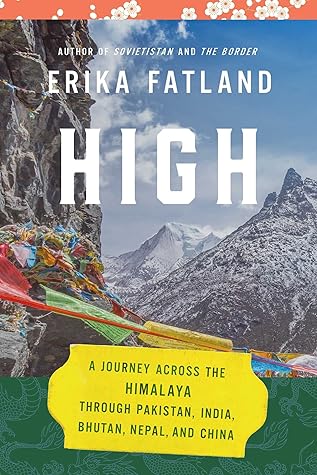
More on this book


Kindle Notes & Highlights
Read between
October 1 - December 5, 2025

But even more impressive than the lengths of their journeys was the fact that they had managed to collect all the papers, stamps and signatures necessary to cross the many invisible district boundaries and get through all the checks in order to be here, now, this very morning, as the delicate snowflakes danced in the air.
“If there is a paradise on earth, it is this, it is this, it is this.” Ascribed to the poet Hazrat Amir Khusrau
In Kyrgyzstan, the Pamir Mountains meet Tian Shan, the Celestial Mountains, which to the north become the Altai Mountains and to the east seamlessly become a mountain range called Sayan that ends at the Sea of Okhotsk in the east.
Such are the prosaic problems of the modern traveller. The transport part takes no time at all these days; it is the bureaucracy that is interminable. We are constantly being told that we live in a world without borders, in a globalised age, but only if you have the right passport and the right papers. What do adventurous globetrotters talk about when they meet? They talk about bureaucracy, about consulates, about visa extensions and application procedures.
China has cracked the code: in the age of hyper capitalism, when anything can be sold and free competition is god, empire building takes on a different form. Why occupy when you can buy? Why subjugate a country with force when you can be the cheapest supplier to their markets?
The Uighurs are a Turkic people with roots in Mongolia and the area south of Lake Baikal in Russia. When they were driven out of Mongolia by the Yensei Kyrgyz in the ninth century, they settled in the area that now includes Xinjiang. Here they established the kingdom of Qocho, also known as Uighuristan.
Until relatively recently, an island, a sea or a continent was not properly discovered until a European man had written about it and left his mark there.
The Karakoram Highway, an important part of the New Silk Road, undulates like a black asphalt snake along the mountainside all the way from Kashgar to Gilgit in Pakistan.
“I don’t understand that,” Umair said. “Why move abroad if you only want to be with Pakistanis?”
Khunjerab means “blood valley” in Wakhi, the Persian language spoken by the Wakhi people who live in Upper Hunza, in Tashkurgan and on the Tajik and Afghan sides of the border. Political borders seldom follow linguistic borders in these mountains. The name was apparently inspired by the frequent bloody ambushes on passing caravans
in 1976, after all the principal-ities were dissolved by the then prime minister Ali Bhutto, the name was changed to Karimabad in honour of His Highness Karim Aga Khan, the religious leader of the Ismaili community. The majority of people in Hunza are Ismaili Muslims, a branch of Shia Islam that places great importance on education and science. The Ismailis only pray three times a day, many do not fast during Ramadan, and only a small number of women cover their heads.
“The Aga Khan says that if you have two children, a son and a daughter, and you can only afford to give one of them schooling, then you should prioritise the girl,” Akhtar said.
There are two things I still regret from my travels in the Himalayas. And one is that I did not stay longer in Hunza.
The days when caravans could freely cross mountain passes and national borders are long gone. While it is constantly said that the world is getting smaller and there are fewer and fewer boundaries, never before have borders been more rigid than they are now.
We sat and talked about Barth and his travels for a long time, and the fact that his best-known theory – that identity and awareness of one’s own culture is created only in meeting another, unknown group, in other words, in crossing boundaries – was inspired by his fieldwork in Swat.
The notoriously bad-tempered American writer, Paul Theroux, describes Peshawar with surprising warmth in his travel classic The Great Railway Bazaar. “I could happily have moved here,” he writes, “settled down on a veranda and got old watching the sunsets over the Khyber Pass.” Powerful words indeed, coming from Theroux.
But I’m not afraid. We will continue to fight, even though I am no longer an optimist but more of a realist as a result. I no longer believe we’ll achieve justice, but we must try all the same. We have to do everything in our power, absolutely all that we can.”
Have you been to the community kitchen?” I nodded. “Good,” the young man said. “That’s the first place you should go when you visit the temple. We are not able to concentrate on spiritual matters unless our bellies are full. We all eat together in the canteen, high and low, there is no difference between us.”
The Khalistan movement, which campaigned for an independent Sikh state in Punjab, was responsible for a number of killings and attacks that had cost hundreds of lives. In the summer of 1984, the prime minister, Indira Gandhi, abandoned any attempt to negotiate with the rebels and ordered that the temple be stormed. The military operation, which involved more than ten thousand soldiers and lasted for a week, was called Blue Star. The temple was at the time full of pilgrims who had come to celebrate the anniversary of the death of Guru Arjan, its founder. According to official records, 493
...more
When you travel with someone else, even if it is only one other person, you are immediately in a bubble, a private micro-world. When you travel alone, you are at the mercy of what is around you, you are vulnerable, naked.
India is not simply a country, it is a subcontinent, and it comprises not one reality, but myriad parallel worlds.
An elderly, white-haired gentleman was selling kahwah, a Kashmiri speciality. It is a drink made from green tea flavoured with saffron and cinnamon, sweetened with honey and garnished with chopped almonds. I bought a cup for myself and the boatman; the sweet, warm drink tasted as golden as the sunrise I had just seen.

Ah, I feel I am back to Kashmir...
Srinagar is known for its extravagant Persian gardens, and Shalimar Bagh, the one made by Jahangir, is perhaps the most beautiful of all. Shalimar means “abode of love”, and bagh is Persian for “garden”.
He had a quotation carved into the uppermost pavilion, lines that are generally ascribed to the poet Hazrat Amir Khusrau: “If there is a paradise on earth, it is this, it is this, it is this.” It is said that when he was on his deathbed, Jahangir was asked what he desired most in the world. “Kashmir, the rest is worthless,” was his reply.
True that
In the 1970s, none of the women here wore veils, but now nearly all of them do. I don’t think it’s due to radicalisation, they’re just trying to hide themselves from the soldiers.”
“My sister is married to a man who refuses to divorce her, even though he’s married three other women! I’ve tried talking to muftis and imams, but no-one wants to help me, they all say that Islam allows a man to have four wives, so my sister’s husband is living in accordance with Islam. In my opinion, Islam is full of intellectual nonsense! I’m probably one of those who is hardest hit by the conflict,” he said, gloomily. “I can’t criticise Islam, because then the mullahs will threaten to kill me.
“Six thousand families in Kashmir are blacklisted and can’t get a passport. The head of our organisation was refused a passport for eleven years, as was his deputy. We all have major issues because of our work. I lost a leg in 2004. I was with six others on our way to Lolab Valley to be election observers when a roadside bomb exploded. My best friend and the driver were killed. Everything points to the authorities, that they were behind it, but we don’t have conclusive evidence, so can’t prove it. I had to have my leg amputated, just below the knee, and spent three and a half months in
...more
“If Europe could become a peaceful place after a hundred years of war, and if Germany could rid itself of the Nazis, then there’s hope for Kashmir as well,” he said. “I believe Kashmir will be free, sooner or later. I sincerely hope and wish that for my children. To lose hope is a crime. It’s not all bleak, not at all. Two hundred million Indians are malnourished, but here in Kashmir no-one is starving, despite all the other problems.”
I don’t earn any money from my work with human rights; it’s my wife and mother who pay for the family. But as I love my children, I have to carry on with my work. I work so that my children may one day live in a free and peaceful Kashmir.”
Even at the top, four thousand metres above sea level, the landscape was lush and the green-clad mountains stretched out in all directions, as far as the eye could see, with no regard to troubled borders, military road checks or control lines.
I still regret that I did not stay longer in Kashmir, and at several points on my onward journey, I was tempted to order a flight back to Srinagar, if nothing else to experience one more day on a houseboat on Nigeen Lake.
Tons of overripe apples were left to rot on the ground as seasonal workers from other parts of India could no longer get there to pick them.
Reminded me of John Steinbeck's 'Grapes of Wrath', in case of Kashmir 'Apples of...'
Many of the apple farmers were able to save some of the 2019 harvest and put the apples into cold stores in the hope of better times. They may have to wait a long time.
The borders in the Himalayas are not only still dotted lines and debated, they are also soaked in blood.
Haji Hassan had lived in the house all his life while rulers and borders came and went, and one war took over from another. From here, on the flat ground in front of his house, he had watched the geopolitical drama unfold from the best seat in the house.
“Are you worried that there might be another war?” I asked, before leaving. “Yes,” Haji Hassan said. “I’m worried for my grandchildren. Because there will be another war, you can be certain of that!”
“I am angry with the border authorities,” he said in a quiet voice. “Because of a couple of lines in the map, I couldn’t meet my father. It’s only forty-five kilometres from here to Skardu – that’s half an hour in a car – but it’s not possible to cross the border. My whole life has been marred by this dividing line they put in place in 1971. If Father had been here, he would have been able to give me advice as I grew up and became an adult myself. But there was no-one who could give me advice. My life has been difficult.”
For a good part of the twentieth century, explorers continued to risk their lives in their attempts to get into Lhasa, dressed as monks or merchants, crossing the plateau by foot, exposed to the elements. Almost none of them succeeded, but the few that did were guaranteed an income for the rest of their lives from book sales and lecture tours.
Buddhism is not a religion; it is a discipline. Buddhism is about your life, the truth of your life, it’s about the essential nature of existence and the universe. We have to know how the world works in order to live. The Buddha’s teaching is integral to liberation.”
It is perhaps not so strange that Buddhism became so deeply rooted, and still has such a strong hold, in these remote mountain valleys where practically nothing grows. Life here has always been hard, in winter in particular, when the snow renders the isolated villages even more isolated. In surroundings like this it is surely easier to think about emptiness and the insignificance of human life. And the land itself has contributed to Buddhism’s popularity here: people are poor and arable ground for the eldest son to inherit is a scarcity. The monasteries are part of the social fabric of these
...more
The story is the same throughout the Himalayas: the borders are closing as nation states pull back to protect themselves and plug any holes with military posts.
The other people in the queue appeared to have embraced the new day with fully charged batteries and the atmosphere was buoyant; complete strangers chatted away, united by a shared spiritual yearning.
A woman in her sixties, with long, grey hair, dressed in white cotton clothes, strode down the steps and chanted and spoke about harmony, peace and holy rituals in a nasal American English. She spoke for a long time, but repeated the same words and points again and again. Holy rituals, harmony, peace. Peace, holy rituals, harmony.
LOL
Shiva uses his locks to divide the river in three – Bhagirathi, Alaknanda and Mandakini – which he then allows to stream down to earth.
These three rivers, or locks of hair, which are all holy to the Hindus, all spring from glaciers in the Indian part of the Himalayas. Alaknanda and Mandakini merge after some seventy kilometres, and further down the Alaknanda and Bhagirathi meet to become the Ganges.
Cartographers and etymologists would probably say that the mighty Ganges starts in the small town of Devprayag, about two hours’ drive north-west from Rishikesh, where the Bhagirathi and Alaknanda rivers meet and change their names to the Ganges. Hydrologists and geographers might argue that the Ganges starts at the Satopanth Glacier, where the Alaknanda has its source.
But most Hindus believe that the Ganges starts at the source of the Bhagirathi River, at the foot of the Gangotri Glacier.
The Indians call the Milky Way Aksaganga: Heavenly Ganges.
Indians are, not surprisingly, big tea drinkers. However, if one looks at the population as a whole, annual consumption is not so great, at around three-quarters of a kilo per person. The British drink twice as much, and the Irish almost three times as much. But no-one beats the Turks, who hold the record with more than three kilos, equivalent to thirteen hundred cups of tea per person per year.
It was originally called Dorje Ling, the Land of Thunder, after a Buddhist monastery that was there. With the exception of a few small villages, the area was uninhabited. The chogyal, or king of Sikkim, was at first not willing to lease the territory to the British, but when the British once again stopped the Gorkhas from taking over Sikkim in the 1830s, an agreement was soon drawn up.
