
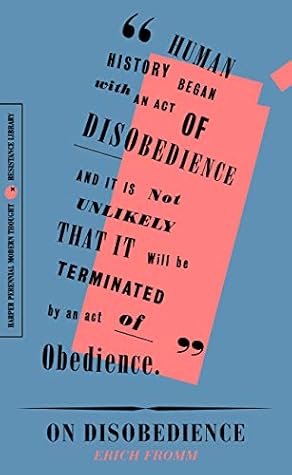
More on this book


Kindle Notes & Highlights

There is the possibility, or even the probability, that the human race will destroy civilization and even all life upon earth within the next five to ten years.
Obedience to the “authoritarian conscience,” like all obedience to outside thoughts and power, tends to debilitate “humanistic conscience,” the ability to be and to judge oneself.
rational authority is rational because the authority, whether it is held by a teacher or a captain of a ship giving orders in an emergency, acts in the name of reason which, being universal, I can accept without submitting. Irrational authority has to use force or suggestion, because no one would let himself be exploited if he were free to prevent it.
In order to disobey, one must have the courage to be alone, to err and to sin. But courage is not enough. The capacity for courage depends on a person’s state of development. Only if a person has emerged from mother’s lap and father’s commands, only if he has emerged as a fully developed individual and thus has acquired the capacity to think and feel for himself, only then can he have the courage to say “no” to power, to disobey.
Indeed, freedom and the capacity for disobedience are inseparable; hence any social, political, and religious system which proclaims freedom, yet stamps out disobedience, cannot speak the truth.
The fight against authority was inseparable from the intellectual mood which characterized the philosophers of the enlightenment and the scientists. This “critical mood” was one of faith in reason, and at the same time of doubt in everything which is said or thought, inasmuch as it is based on tradition, superstition, custom, power.
The organization man has lost the capacity to disobey, he is not even aware of the fact that he obeys. At this point in history the capacity to doubt, to criticize and to disobey may be all that stands between a future for mankind and the end of civilization.
But ideas do have an effect on man if the idea is lived by the one who teaches it; if it is personified by the teacher, if the idea appears in the flesh.
The prophet Amos expressed this idea very succinctly: “The lion has roared, who will not be afraid. God has spoken, who will not be a prophet.”
It is the historical situation which makes prophets, not the wish of some men to be prophets.
There are priests not only in religion. There are priests in philosophy and priests in politics.
Then there are the political priests; we have seen enough of them in the last 150 years. They have administered the idea of freedom, to protect the economic interests of their social class. In the twentieth century the priests have taken over the administration of the ideas of socialism. While this idea aimed at the liberation and independence of man, the priests declared in one way or another that man was not capable of being free, or at least that he would not be for a long time.
Yet, while a child could see that they live precisely the opposite of what they teach, the great mass of the people are brainwashed effectively, and eventually they come to believe that if the priests live in splendor they do so as a sacrifice, because they have to represent the great idea; or if they kill ruthlessly they only do so out of revolutionary faith.
Among the few in whom the idea has become manifest in the flesh, and whom the historical situation of mankind has transformed from teachers into prophets, is Bertrand Russell.
He, together with Einstein and Schweitzer, represents the answer of Western humanity to the threat to its existence, because all three of them have spoken up, have warned, and have pointed out the alternatives.
Bertrand Russell tries to prove that there are the ten who can save the city. That is why he has organized people, has marched with them, and has sat down with them and been carried off with them in police vans.
in our culture when most people feel “guilty,” they are actually feeling afraid because they have been disobedient. They are not really troubled by a moral issue, as they think they are, but by the fact of having disobeyed a command.
This century is the century of the hierarchically organized bureaucracies in government, business, and labor unions.
Disobedience, then, in the sense in which we use it here, is an act of the affirmation of reason and will. It is not primarily an attitude directed against something, but for something: for man’s capacity to see, to say what he sees, and to refuse to say what he does not see. To do so he does not need to be aggressive or rebellious; he needs to have his eyes open, to be fully awake, and willing to take the responsibility to open the eyes of those who are in danger of perishing because they are half asleep.
Most philosophers were not disobedient to the authorities of their time. Socrates obeyed by dying, Spinoza declined the position of a professor rather than to find himself in conflict with authority, Kant was a loyal citizen, Hegel exchanged his youthful revolutionary sympathies for the glorification of the State in his later years.
The philosopher is disobedient to clichés and to public opinion because he is obedient to reason and to mankind. It is precisely because reason is universal and transcends all national borders, that the philosopher who follows reason is a citizen of the world; man is his object—not this or that person, this or that nation. The world is his country, not the place where he was born.
Principles of Social Reconstruction (1916),
Bertrand Russell’s capacity to disobey is rooted, not in some abstract principle, but in the most real experience there is—in the love of life. This love of life shines through his writings as well as through the person. It is a rare quality today, and especially rare in the very countries where men live in the midst of plenty. Many confuse thrill with joy, excitement with interest, consuming with being.
For the very same reason he has no use for those voices which love to harp on the evilness of man, in fact thus saying more about themselves and their own gloomy moods than about men.
They are more interested in the results of their thoughts than in the process of enlightenment which occurs in the inquiring person.

On scholars
In bureaucratized, centralized industrialism, regardless of political ideology, there is an increasing number of people who are fed up with life and willing to die in order to get over their boredom. They are the ones who say “better dead than red,” but deep down their motto is “better dead than alive.”
However, the attraction to death which Unamuno called necrophilia is not a product of fascist thought alone. It is a phenomenon deeply rooted in a culture which is increasingly dominated by the bureaucratic organizations of the big corporations, governments, and armies, and by the central role of man-made things, gadgets, and machines. This bureaucratic industrialism tends to transform human beings into things. It tends to replace nature by technical devices, the organic by the inorganic.
Goethe once said that the most profound distinction between various historical periods is that between belief and disbelief, and added that all epochs in which belief dominates are brilliant, uplifting, and fruitful, while those in which disbelief dominates vanish because nobody cares to devote himself to the unfruitful. The “belief” Goethe spoke of is deeply rooted in the love of life. Cultures which create the conditions for loving life are also cultures of belief; those which cannot create this love also cannot create belief.
Are they right? Are they not both in the process of converging into a new industrial neo-feudalism, into industrial societies, led and manipulated by big, powerful bureaucracies—societies in which the individual becomes a well-fed and well-entertained automaton who loses his individuality, his independence and his humanity?
On capitalism and communism
Is there no other alternative than that between capitalist and communist managerial industrialism? Can we not build an industrial society in which the individual retains his role as an active, responsible member who controls circumstances, rather than being controlled by them? Are economic wealth and human fulfillment really incompatible?
Can we close the gap between our great intellectual achievement and our emotional and moral backwardness?
We have affluence, but we do not have amenity. We are wealthier, but we have less freedom. We consume more, but we are emptier. We have more atomic weapons, but we are more defenseless. We have more education, but we have less critical judgment and convictions. We have more religion, but we become more materialistic. We speak of the American tradition which, in fact, is the spiritual tradition of radical humanism, and we call “un-American” those who want to apply the tradition to present-day society.
In the large enterprises, legal ownership of the means of production has become separated from the management and has lost importance. The big enterprises are run by bureaucratic management, which does not own the enterprise legally, but socially.
These managers do not have the qualities of the old owner—individual initiative, daring, risk-taking—but the qualities of the bureaucrat—lack of individuality, impersonality, caution, lack of imagination.
With the development of ever greater enterprises, unions have also developed into big bureaucratic machines in which the individual member has very little to say.
When man is transformed into a thing and managed like a thing, his managers themselves become things; and things have no will, no vision, no plan.
Especially in the political sphere, elections become more and more reduced to plebiscites in which the individual can express preference for one of two slates of professional politicians, and the best that can be said is that he is governed with his consent. But the means to bring about this consent are those of suggestion and manipulation and, with all that, the most fundamental decisions—those of foreign policy which involve peace and war—are made by small groups which the average citizen hardly even knows.
It has deteriorated into a flat concept of “progress,” into a vision of the production of more and better things, rather than standing for the birth of the fully alive and productive man
On man and society
Whether it is the consumption of food, clothing, liquor, cigarettes, movies, or television programs, a powerful suggestion apparatus is employed with two purposes: first, to constantly increase the individual’s appetite for new commodities, and second, to direct these appetites into the channels most profitable for industry.
While our economic system has enriched man materially, it has impoverished him humanly.
During his working hours, the individual is managed as part of a production team. During his hours of leisure time, he is managed and manipulated to be the perfect consumer who likes what he is told to like and yet has the illusion that he follows his own tastes. All the time he is hammered at by slogans, by suggestions, by voices of unreality which deprive him of the last bit of realism he may still have.
There is little critical thought, there is little real feeling, and hence only conformity with the rest can save the individual from an unbearable feeling of loneliness and lostness.
His own act becomes to him an alien power, standing over and against him instead of being ruled by him.
His products, his machines, and the State have become the idols of modern man, and these idols represent his own life forces in alienated form.
We are poor in spite of all our wealth because we have much, but we are little.”
He could not stand the joylessness and meaninglessness of life were it not for the fact that the system offers him innumerable avenues of escape, ranging from television to tranquilizers, which permit him to forget that he is losing more and more of all that is valuable in life.
We talk of freedom and democracy, yet an increasing number of people are afraid of the responsibility of freedom, and prefer the slavery of the well-fed robot; they have no faith in democracy and are happy to leave it to the political experts to make the decisions.
We have created a widespread system of communication by means of radio, television and newspapers. Yet people are misinformed and indoctrinated rather than informed about political and social reality.
Yet, while people get more education, they have less reason, judgment, and conviction. At best their intelligence is improved, but their reason—that is, their capacity to penetrate through the surface and to understand the underlying forces in individual and social life—is impoverished more and more.
Man, instead of being the master of the machines he has built, has become their servant.
