
More on this book


Kindle Notes & Highlights

by
Erich Fromm
Read between
January 30 - February 6, 2024

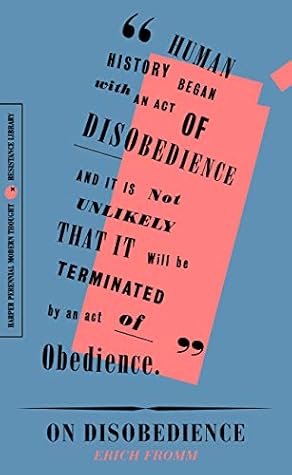
human history began with an act of disobedience, and it is not unlikely that it will be terminated by an act of obedience.
But I do not mean to say that all disobedience is a virtue and all obedience a vice. Such a view would ignore the dialectical relationship between obedience and disobedience.
Obedience to a person, institution or power (heteronomous obedience) is submission; it implies the abdication of my autonomy and the acceptance of a foreign will or judgment in place of my own. Obedience to my own reason or conviction (autonomous obedience) is not an act of submission but one of affirmation.
My obedience makes me part of the power I worship, and hence I feel strong. I can make no error, since it decides for me; I cannot be alone, because it watches over me; I cannot commit a sin, because it does not let me do so, and even if I do sin, the punishment is only the way of returning to the almighty power.
Those who announce ideas—and not necessarily new ones—and at the same time live them we may call prophets.
This kind of rebellious disobedience is as blind and impotent as its opposite, the conformist obedience which is incapable of saying “no.”
They are struck by the irrational contradictions which beset our system. While there are millions in our own midst, and hundreds of millions abroad, who do not have enough to eat, we restrict agricultural production and, in addition, spend hundreds of millions each year in storing our surplus. We have affluence, but we do not have amenity. We are wealthier, but we have less freedom. We consume more, but we are emptier. We have more atomic weapons, but we are more defenseless. We have more education, but we have less critical judgment and convictions. We have more religion, but we become more
...more
The individual is managed and manipulated not only in the sphere of production, but also in the sphere of consumption, which allegedly is the one in which the individual expresses his free choice. Whether it is the consumption of food, clothing, liquor, cigarettes, movies, or television programs, a powerful suggestion apparatus is employed with two purposes: first, to constantly increase the individual’s appetite for new commodities, and second, to direct these appetites into the channels most profitable for industry. The very size of the capital investment in the consumer-goods industry and
...more
That which was the greatest criticism of socialism fifty years ago—that it would lead to uniformity, bureaucratization, centralization, and a soulless materialism—is a reality of today’s capitalism.
Yet, while people get more education, they have less reason, judgment, and conviction. At best their intelligence is improved, but their reason—that is, their capacity to penetrate through the surface and to understand the underlying forces in individual and social life—is impoverished more and more.
Capitalism puts things (capital) higher than life (labor). Power follows from possession, not from activity.
Thus socialism became the vehicle for the workers to attain their place within the capitalistic structure rather than transcending it; instead of changing capitalism, socialism was absorbed by its spirit.
