
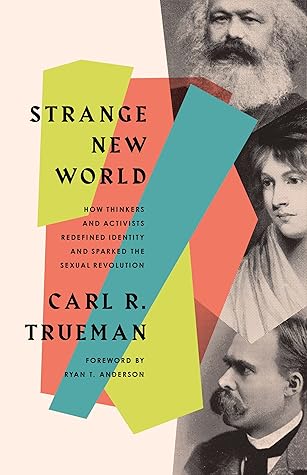
More on this book
Community


Kindle Notes & Highlights

Read between
February 5 - April 16, 2023

Arguments based on the authority of God’s law or the idea that human beings are made in the image of God no longer carry any significant weight in a world devoid of the sacred.
Roger Scruton, pornography is about bodies, not faces.
For our culture is one marked by plastic people who believe they can make and remake themselves at will; and by a liquid world in which, to borrow a phrase from Karl Marx, all that is solid seems continually to melt into air. The coincidence of these two things—plastic people and a liquid world—is central to the issues we now face in our culture, from identity politics and LGBTQ+ rights to the growing impatience in some quarters with traditional freedoms such as those of speech and religion.
The teenager who wants to express her freedom does so by wearing the uniform of the group to which she wishes to belong. She may well be rebelling against the norms set by her parents, but she is conforming to a framework established by those with whom she wishes to identify. The same is true of society as a whole. We may be intuitively free and intentional in our actions, but we also wish to belong to a group or groups that make us feel valued.
In short, a unified community assumed limited information that allowed for a single dominant narrative to give coherence to the whole. This is not to argue for the need for censorship of information such as we now see in China.
National narratives are not the means for social unity but have instead become battle zones, and it is very hard to be part of an imagined community when the nature of what is to be imagined is itself a primary source of division.
In the past, civil society was possible because, whatever the differences that existed between citizens, there was a deeper narrative, a deeper sense of identity and community, that all shared and that served to relativize such. Therefore, when an election was won by one party, adherents of the other party respected the results because something deeper than party politics—the nation itself—was strong enough to provide a sense of underlying unity. As the elections of Donald Trump in 2016 and Joseph Biden in 2020 have demonstrated, this is no longer the case. Modern American society is
...more
allows for them to be sharply separated either. In the words of Raymond,
This should alert us to the logic of the argument upon which trans ideology depends: because it assumes that the body is not of primary relevance to gender identity, it consequently excludes bodily considerations from the definition of what it means to be a man or a woman. But notice: This is a circular argument. Its conclusion is already contained in its premise.
The transsexual is identified as such solely on his/her own script, which can be as learned as any sex-typed behavior and as editorialized as autobiographies usually are.
What this principle assumes is the power of technology to overcome the natural limitations of human procreation and thereby turn the family into another institution that can be redefined to meet the therapeutic needs of the moment.
What this means is that trans ideology now has a grip on the law in such a way that it is going to be impossible to avoid.
Carried through consistently, women’s sports will soon be a thing of the past, given the typical disparity of strength between male and female athletes.
ethics of life and death in a world of expressive individualism tend to default to a form of utilitarianism. Utilitarianism is the philosophy of life where the morally defensible position is that which gives most happiness to most of the persons involved.
Indeed, the challenge to religious freedom is simply the specific instance of a much broader challenge to traditional freedom of speech.
the church needs to be the strongest community to which we each belong.
It might sound trite, but a large part of the church’s witness to the world is simply being the church in worship.
This means that the chaotic nature of our times is no excuse for abandoning the church’s task of teaching her people the whole counsel of God. If anything, she should see such a moment as a time to examine whether that is what she is doing and make any necessary changes in her pedagogical strategy. She needs to make sure that Christians are being intentionally grounded in the truth.
Time is a great solvent of irrelevance.
The various psalmists speak with honesty, often brutal and painful, about their feelings toward friends, enemies, and even God himself. But this is never for the purpose of self-validation or, worse still, a wallowing in self-indulgent self-pity. Rather, it is for the purpose of setting the experiences and the feelings recounted within the context of God’s great truths.
We need to reform our corporate church lives in a way that forms our inner lives appropriately. And that means choosing worship songs that do not indulge in emotion for the sake of emotion or press upon me that my needs and my desires are the reason God exists. No, we need songs that allow us to understand and express our feelings honestly, but in a way that always leads outward to God and to his truth.
Thus, for example, the dependency of a newborn child upon her mother is natural, as is the obligation of the mother to protect and nurture the child to the best of her ability. It would, therefore, be immoral for the mother to abandon the child in the woods, to be eaten by wild animals.
when things in this world go awry, or when I am faced with changes that bring suffering to me or to my loved ones or to society at large, I must not despair, I must work to the best of my ability to right such wrongs, and I must also remember that the real meaning of my life and that of others is not found in the here and now but in the hereafter. Suffering here and now may at times be terrible, even unbearable, but it is never meaningless. No, it finds its meaning in the life, death, resurrection, ascension, and return of the Lord Jesus Christ.
