
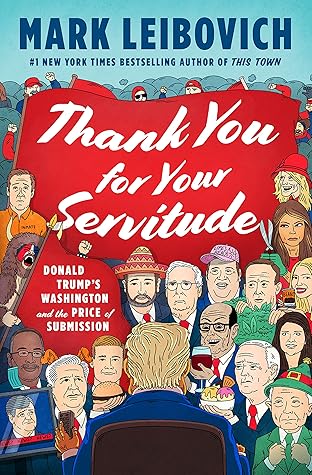
More on this book
Community


Kindle Notes & Highlights

Read between
July 27 - August 3, 2022

Trump’s usual collection of pet rocks had stopped showing up at the hotel weeks before. There was no sign of any Rudys, Bannons, or Lewandowskis; no Secretary of the Treasury Steven Mnuchin or his wife, Louise Linton, or the tiny dog she kept in her tiny purse (an actual, breathing lapdog); no trace of the Trump leg-humpers from the House; and no hint of the Sean Spicers, Kellyanne Conways, or any of the other Washington C-listers who were bumped temporarily up to B-list status by their proximity to Donald J. Trump.
“What is the downside for humoring him for this little bit of time?” a senior Republican official was quoted as saying in The Washington Post. The blind quote, oft repeated, became an instant classic in the genre of “takes that did not age well.” It was held up as a dark marker of where things stood for a party that stood idly by while Trump solicited foreign campaign help and mocked war heroes and disabled reporters and entire ethnic minorities and it only got worse. “Humoring him” had essentially become the GOP platform.
Caroline liked this
“I know how to deal with bullies,” Chris Christie used to boast back when he was still a self-respecting New Jersey governor and presidential candidate. “You can either sidle up to the bully, or you can punch them in the face. I like to punch them in the face.” No one pushed around a tough-guy governor from Jersey—except, apparently, a whining, spray-tanned drama queen with dyed orange hair from Queens.
“The essence of obedience consists in the fact that a person comes to view himself as the instrument for carrying out another person’s wishes,” Milgram concluded. “He therefore no longer regards himself as responsible for his actions.”
“The cliché says that power always corrupts,” wrote the biographer/historian Robert Caro. “What is seldom said,” Caro continued, “is that power always reveals.” Power reveals the most about those who enable its abuse. Republicans became the party that made Trump possible and that refused to stop him even after the U.S. Capitol fell under the control of some madman in a Viking hat.
It was always rationalization followed by capitulation and then full surrender. The routine was always numbingly the same, and so was the sad truth at the heart of it: they all knew better.
This book is about the view from the Trump Hotel. If not always physically, it is set against the unholy backdrop and sensibility that the owner fostered during his Washington residency. It is about the dirt that Trump tracked in, the people he broke, and the swamp he did not drain.
Christie had a seemingly limitless appetite for, among other things, being humiliated by Trump. This was true of a lot of people, but Christie was special in this regard. Trump mocked him for his weight (“No more Oreos”), ordered him around, and basically treated the former Garden State governor like Mr. French, the portly and exasperated butler from the old show Family Affair.
Christie’s support “gave a stamp of credibility to a thoroughly uncredible candidate,” wrote Tim Miller, Bush’s former communications director. “Like every other pathetic, podgy, scared, insecure bully who has ever disgraced a schoolyard, Chris Christie talks a big game.”
Cruz called Trump “utterly amoral” and a “pathological liar” (basically true) after Trump described him as a sleazy asshole whom everyone in the Senate hated (also true). For good measure, Trump suggested Cruz’s wife was ugly and his father was somehow caught up in the John F. Kennedy assassination.
Rubio now held the astonishing position of saying he would vote for someone he previously declared unfit to hold the American nuclear codes. I envisioned him under a mushroom cloud, telling his kids that at least Dad didn’t vote for the ghastly Hillary.
Coming to terms with Donald Trump as the Republican nominee is like being told you have Stage 1 or Stage 2 cancer. You know you’ll probably survive, but one way or the other, there’s going to be a lot of throwing up. —Christopher Buckley, The Spectator
Whenever Trump offered a scouting report about someone, it was based almost entirely on whether that person had been “nice” to him, or “liked” him. His vocabulary could be so basic and childlike.
“If you say nice things about Trump, he will like you,” Graham said, in his capacity of Trump explainer, one of the many ways Lindsey tried to be “helpful.” In other words, Graham would explain, Trump was not a racist, just so long as people of different races were nice to him. “You could be dark as charcoal and lily white, it doesn’t matter,” Graham said.
The conservative radio host Hugh Hewitt warned that Republicans’ accepting Trump as their nominee was “like ignoring Stage IV cancer.” Hewitt would of course go on to become one of Trump’s most devout supporters—just as Perry would go on to become secretary of energy despite previously calling Trump “a cancer on conservatism.” It was inspiring how many principled conservatives were learning to live so bravely with cancer.
Trump’s survival instinct went far beyond Clinton’s, to a pathological point. What he possessed would easily transcend her admirable human qualities like toughness and resilience. Unlike Clinton, Trump was a desperately untamed figure with no regard for rules, traditions, or ethics. His non-capacity for humiliation or embarrassment created an asymmetric contest. He was willing to say or do or lie about anything. While Hillary had drawn her own suspicions and distrust over the years, she respected certain lines. With Trump, there were no lines.
(Henry would himself have a “perception problem” in subsequent years; google “Ed Henry” and you’ll get the gist.)
“Not a fan,” Martha said. Of Hillary or Washington. She had been a Democrat, but liked Trump and had really come to hate politics. “It’s all such bullshit,” she said. Trump was an antidote. She knew he had issues, but Trump was refreshing in that it felt as if he were telling them the truth. I heard this time and again: that Trump was a truth teller, despite his lying.
Over the previous few months, Trump had managed—in that gross and sexist way of his—to make his opponent’s health, fitness, and stamina an issue. He did this despite being roughly fifty pounds overweight himself. He was barely able to climb a dozen stairs without gasping for breath (or descend without clutching a banister for dear life). Trump was “just asking questions,” he said, just as he was about Obama’s birth certificate. He tried to make us smarter every day.
If you could get beyond the bluster and menace of Trump (and, okay, the cruelty, bigotry, lunacy, criminality, incompetence, and so on), his message did contain kernels of cogent defiance against Washington’s permanent syndicates. You could make an argument that he did offer a version of the “they’re screwing you” critique that the likes of Bernie Sanders and Elizabeth Warren had been tossing out. Both Sanders and Warren used the term “rigged system” long before Trump ever did.
That was another underappreciated aspect of what Trump represented, Murray said. They did not so much love Donald Trump or care to defend his character. His main appeal, simply, was as a tool of revenge. “He’s our murder weapon,” Murray said, channeling Trump supporters. “And I think that is a pretty short, accurate way of saying what function Trump served.”
Trump then pointed a few places down the cabaret line and started gushing over Sessions, the first senator to endorse him during the primary season. Trump hailed Sessions as being “highly respected in Washington” and “as smart as it gets.” Neither was sincere or true. Sessions was in fact a not terribly well-respected backbencher in the Senate, and his endorsement would not be coveted by anyone outside Alabama. Nor did Trump think Sessions was “as smart as it gets.” (He would refer to him later as “mentally retarded” and a “dumb Southerner.”)
The crowd size episode was idiotic, but contained its own autocratic foreboding. “The point was to demonstrate the party’s power to proclaim and promulgate a falsehood,” wrote Anne Applebaum in a cover story in The Atlantic, “History Will Judge the Complicit.” Applebaum, who has reported extensively on European tyrants, described the crowd fiasco as a kind of authoritarian’s flex. Trump perpetrated this bizarre claim because he could. “Sometimes the point isn’t to make people believe a lie,” Applebaum said. “It’s to make people fear the liar.”
Spicer had other issues. He suffered nonstop abuse and incredulity from much of the press corps. In a job where every little slipup was accentuated, Spicer slipped up regularly. At one point, he claimed that Hitler “didn’t even sink to using chemical weapons” (fact check: extremely wrong). His job appraisals were across-the-board brutal. “There’s something about Sean Spicer that inspires pity,” the Washington Post media columnist Margaret Sullivan wrote, and then proceeded to eviscerate him without pity.
Stephen Miller, the president’s top deportation enthusiast, was accosted at a Mexican restaurant by a customer yelling “fascist” at him. Nielsen, the top enforcer of the administration’s hardline immigration and child separation policies, met a similar fate at another south-of-the-border bistro. You could understand why their choice of cuisine could be triggering.
All of these episodes made the Trump Hotel even more of a sanctuary for the temporary ruling class of the West Wing. We were almost a year into the incursion when I started to come in semi-regularly. Republicans controlled all three chambers of government, but the hotel had become their main chamber. It was like Cheers for the MAGA set—except instead of Norm and Sam yukking it up over Norm’s tab, you had Corey Lewandowski mugging for photos with some leather-faced groupie from the Villages whose grandson might harbor Proud Boy aspirations.
The hotel was a perfect place for Nielsen to relax and unwind after a grueling day spent separating Central American kids from their mothers and getting abused herself by Trump, who seemed to take special delight in separating Nielsen from her sanity and self-respect.
The counter-counterfactual was this: Were Republican leaders so unwilling to condemn Trump because their voters supported him so vigorously, or did these voters support Trump so vigorously because so few Republican leaders ever dared condemn his actions? Chicken, egg; egg, chicken.
“Trumpism is not the philosophy of free-market and limited-government conservatives like me,” National Review’s Kevin Williamson wrote in The Washington Post. “It is something more like group therapy for conservatives and others who feel alienated from, and hostile toward, the progressive social consensus . . . Trumpism is, at heart, not a philosophy but an enemies list.”
Anecdotally, the single biggest reason these members gave for walking away was they had no interest in debasing themselves in the service of Trump any longer than they had to. “You have a situation where the leader of our party models the worst behavior imaginable,” another outgoing Republican member of Congress told me. “And if you’re a Republican in Washington, the idea is basically to make yourself as much of a dickhead as possible in order to get attention and impress the biggest dickhead of all, the guy sitting in the White House.”
No offense to Stormy, but I consider it a minor feat that I’ve gotten this far in the book without mentioning her now–household name. But as we’ve come to learn, Trump has a way of wearing you down. He invades your habitat, like the opossum that gets into the attic, dies, stinks, and attracts derivative nuisances. Okay, it’s not a perfect analogy (for one, Trump remained very much alive). It’s probably disrespectful, too, to compare the president of the United States to a dead opossum—respect for the office, you know. I used to be mindful of these things. Color me worn down.
Gohmert was one of several House members who were there to watch the proceedings, even though he was not on the Intelligence Committee—or possessed of much intelligence. “There’s not a functional brain in there,” was former Speaker Boehner’s succinct assessment of Gohmert. Gohmert would pigeonhole reporters and call for Democrats to apologize to my president for the ordeal they had put him through. No apology appeared to be forthcoming.
Huge numbers of Americans were simply done with this guy. They were sick of his face on their screens and the space he occupied in their heads. Trump had become a burning irritant across every realm, like a national canker sore.
Another Trump supporter in Franklin saw my New York Times badge and had questions. Why, he wanted to know, were “all of you in the mainstream media” ignoring antifa, “Fascist Fauci,” Biden’s senility, and whatnot? The man, about seventy, wore a blue blazer over a dress shirt. He listed a bunch of other reckless and fantastical things related to Biden that he said the press was suppressing. (He attributed his claims of Biden atrocities to “common sense.”) He also asked me if I was a socialist and a “card-carrying member of antifa.”
Several thousand of his supporters waited in the chill, and every major Republican pol in the state who didn’t have COVID dropped everything to be there. And why shouldn’t they? The day before, the White House had put out a sheet of its “science and technology accomplishments,” beginning with the top one: “ENDING THE COVID-19 PANDEMIC.” As FiveThirtyEight’s Clare Malone noted, “That day alone, 983 Americans died.”
Trump’s supporting cast onstage included Loeffler, her fellow Republican senator David Perdue, and Marjorie Taylor Greene, the loony-tunes local congressional candidate and QAnon enthusiast whose long history of racist, anti-Semitic, and generally harassing conduct made her an incendiary character long before she ever arrived in Washington. And yes, you knew she would arrive in Washington soon enough, as surely as her campaign would run up a tab of $717.30 for meals at the Trump Hotel a few days after her election.
Is there anybody in charge at the White House who was doing anything but kissing his fat butt? —Nancy Pelosi to General Mark Milley, chairman of the Joint Chiefs of Staff
Four years earlier, after Trump lost to Cruz in the Iowa caucuses, the future president trotted out his usual playbook of insisting he had won and accusing the actual winner (Cruz) of election fraud. This was, even then, entirely predictable for Trump, who was never a huge adherent of that old Republican ethic of “personal responsibility.” He had previously complained that he’d “gotten screwed” out of, among other things, an Emmy Award and would later insist he’d have won the popular vote against Hillary, except for the ever-present “voter fraud” and the (nonexistent) “busloads of people from
...more
Trump’s more sober advisers had become progressively alarmed by Giuliani’s outsized role in this excuse for a legal challenge. Barr described him as “a fucking idiot” who was “drinking too much and was desperate for money.” Other than that, he was happy to vouch for him.
Apparently, the Clintons, the Venezuelans, and those ever-present deep state agents had executed a massive scheme to steal victory away from Trump (while still allowing other, victorious Republicans to keep their jobs). It was a stunningly far-reaching and complicated plot that only counselor MyPillow seemed to have the bandwidth to grasp.
none became more exercised than Lou Dobbs, the Fox Business host whose infatuation with Trump and general ardor for the man might actually rival Trump’s own.
After November 3, the Trump GOP’s messaging apparatus moved almost immediately from screeching about Hunter Biden to a singular focus on getting the president’s stolen tricycle back.
“If I lost, I’d be a very gracious loser,” the president reassured everyone at the rally, held exactly one month after he was decisively defeated and one month prior to the deadly insurrection he incited.
“We take this for granted, or we used to, that when you’re in a position of public prominence, you want to avoid maybe saying something that will activate that nut out there,” Mitt Romney said. “The challenge is that we had a president who was not particularly sensitive to that.” Romney always had a knack for understatement.
This was a pure case of governing by intimidation, which is the essence of authoritarianism. It occurred during what had always been a pro forma yet sacred rite of democracy. The members’ votes were being influenced not by argument or political position, but in response to the threat of physical harm. It’s worth spelling this out from time to time, as obvious as it is. Because with few exceptions, Republicans keep ignoring the obvious, in favor of cowering and humoring.
They did their best to keep Trump away from the TV and the still-circling outside “advisers” trying to fill his head with last-ditch insanity. Toddler-in-chief terminology was never in greater evidence: Graham, Ivanka, and company would do anything to keep Special Boy’s attention—feed him the whole bag of Cheese Puffs, whatever got you to bedtime. Whatever landed the plane.
Anti-Trump Republicans spewed hot rage, with distinct notes of schadenfreude. As an admirer of good screeds, I found many of them quite artful. The Atlantic’s Caitlin Flanagan described the rioters as “deadbeat dads, YouPorn enthusiasts, slow students, and MMA fans” who had “heard the rebel yell, packed up their Confederate flags and Trump banners, and GPS-ed their way to Washington. . . . They had pulled into the swamp with bellies full of beer and Sausage McMuffins, maybe a little high on Adderall, ready to get it done.” Flanagan didn’t bother visiting any Rust Belt coffee shops to better
...more
Trump’s always-low approval ratings—now down in the 30s—were the well-earned product of a toxic personality and now fully disastrous final scorecard: he would leave office as the first president in history to be impeached twice, the first since Hoover to preside over his party’s loss of the House, Senate, and White House in a single term, the first president in history to leave office with fewer jobs than he entered with, the indirect cause of (conservatively) thousands of coronavirus deaths, countless international embarrassments, and a nation that felt far more divided and deranged than at
...more
Other than that, the forty-fifth president was a perfect hybrid of Lincoln and FDR.
A man never stands taller than when he is down on all fours kissing somebody’s ass. —Rahm Emanuel
